
The AS and the rules it lives under
Almost every Norwegian startup an angel meets is a private limited company (aksjeselskap, AS), and the Companies Act (aksjeloven) sets almost everything about it: the organs, the general meeting (generalforsamling) and the board (styret), and how the share capital changes.
Ownership is recorded in the company’s share register (aksjeeierbok). Every AS must keep one, the board is responsible for it (aksjeloven § 4-5), and anyone may read it (§ 4-6). Since 1 February 2025 the company must as a rule send an electronic copy by email, free of charge, within three business days of a request.
The company cannot refuse access; the regulation‘s objective-grounds test (saklig grunn) only concerns delivery by other channels. So read the register before you invest. It shows who owns what today, which the cap-table slide may not.
After you invest, your entry in the register is what makes you a shareholder the company must recognise; the cap-table slide and the investment agreement do not.
The company must enter you without delay once you notify and prove the acquisition (§ 4-7). Your rights run from that entry, or from the notified and proven acquisition (§ 4-2), so ask for a copy after closing and check your own line.
The ownership-threshold ladder
Every threshold is a fraction of the votes cast and of the capital represented at the meeting, so when shareholders stay away a stake counts for more than its share of the issued capital. “33.4 per cent” and “50.1 per cent” are shorthands for those fractions.
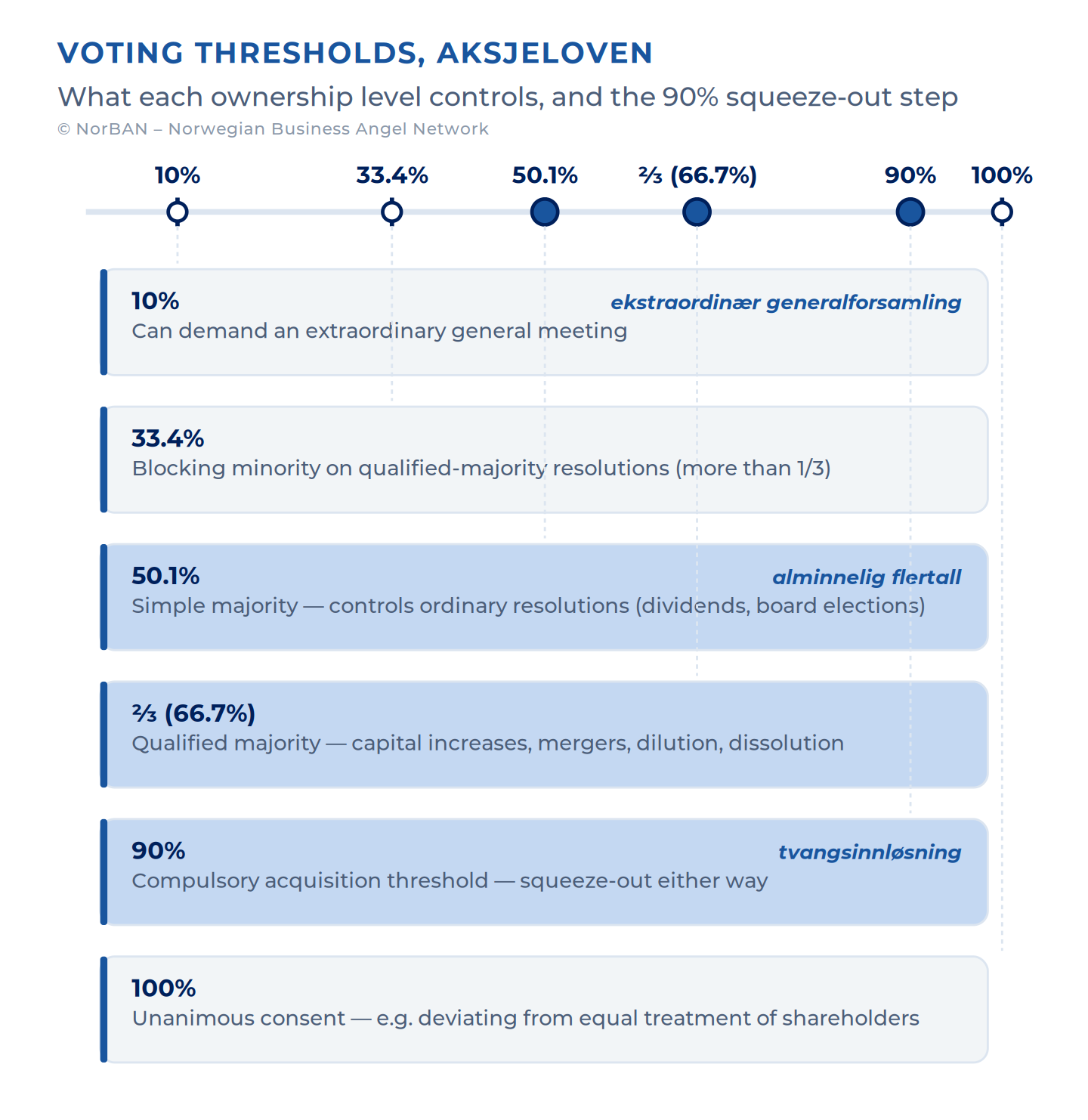
Use the ladder to see which decisions your stake, or your syndicate’s combined stake, can force or block.
| Holding | What it enables or blocks | Section |
|---|---|---|
| One tenth | Demand an extraordinary general meeting on a stated matter; carry a proposal for an investigation (gransking) to the district court; petition the court to set a higher dividend where the resolved one is unreasonably low | § 5-6, § 5-25, § 8-4 |
| More than one third | Blocks amendments to the articles of association, new share issues, mergers, demergers and voluntary liquidation | § 5-18 |
| More than half of the votes cast | Carries ordinary decisions, including election of the board and approval of a dividend the board has proposed | § 5-17, § 8-2 |
| Two thirds of votes cast and capital represented | Amends the articles of association, resolves a capital increase, sets aside existing shareholders’ pre-emptive rights, and resolves mergers and liquidation | § 5-18, § 10-5 |
| More than nine tenths, held by a parent company | Compulsory acquisition of the minority, with a mirror right for each minority shareholder to be bought out | § 4-26 |
An angel-sized stake sits below every rung except the first. A single angel rarely reaches a tenth; a syndicate acting together often does, and a syndicate with more than a third of the votes can block the decisions that matter most.
Compulsory acquisition (§ 4-26) is a parent company’s right, at more than nine tenths of both shares and votes. An individual holding the same directly has no such right; an angel’s holding company can qualify as a parent.
What the law does not give a minority shareholder
Each of these has to be written into the shareholders’ agreement (aksjonæravtale) if you want it, so treat the list as the first draft of your term negotiation.
- No tag-along (medsalgsrett) and no drag-along (medsalgsplikt). The Companies Act contains no provisions on either. If the majority sells, nothing in the statute takes you along.
- No board seat. The general meeting elects the board by ordinary majority (§ 5-17), so the majority appoints it.
- No dividend entitlement. The general meeting resolves a dividend on the board’s proposal and cannot go above it (§ 8-2). A tenth of the capital can petition the court under § 8-4, but the rule is rarely invoked and gives no right to be paid.
- Thin information rights. At the general meeting you can require the board and the managing director to answer on the annual accounts, on matters put to the meeting and on the company’s financial position, unless the answer would cause the company disproportionate harm. A researched answer comes in writing within two weeks (§ 5-15).
- A slow escalation route. Beyond that, the remedy is an investigation (§ 5-25), backed by the rule that neither the general meeting (§ 5-21) nor the board and those who represent the company (§ 6-28) may give some shareholders an unreasonable advantage at the expense of others or of the company.
What to ask for depends on where you sit on the cap table. The higher the rung, the more the statute already gives you.
- An angel-sized first cheque: tag-along, and reporting at a fixed frequency, so your information does not wait for the annual general meeting.
- A syndicate that reaches a tenth: the rights to call a meeting and to propose an investigation are already yours. Add a board or observer seat by agreement; the majority still elects the board.
- A holding above one third: you block every two-thirds decision, including the next share issue, and the rest of the cap table will want the terms of that veto written down.
How a share issue (emisjon) works
A round of financing is a capital increase. The Act fixes the sequence, which tells you when your money is at risk and when you own shares.
- The board proposes the increase with its supporting documents.
- The general meeting resolves it (aksjeloven § 10-1) by two thirds of the votes cast and of the capital represented, because the capital figure in the articles changes. The resolution states the amount, the nominal value and subscription price, who may subscribe, the deadlines for subscription and payment, and the rights attaching to the new shares.
- Existing shareholders have a pre-emptive right to subscribe pro rata in a cash issue (§ 10-4). Bringing in an outside investor means setting that right aside for the issue, by the same two-thirds majority (§ 10-5). Check that the resolution does so.
- Subscription is made in the minutes or in a separate subscription document reproducing the resolution.
- Payment is made and confirmed by an auditor, a financial institution, a lawyer or an authorised accountant.
- The increase is notified to the Register of Business Enterprises within three months of the subscription deadline. Miss it and the resolution lapses and subscribers are repaid (§ 10-9).
- The new shares confer shareholder rights on registration, unless the resolution provides otherwise, and ordinary shareholder rights arise no later than registration (§ 10-11).
Until step 7 the shares you have paid for do not exist. Put the three-month deadline in your own calendar, and confirm the registration at Brønnøysundregistrene yourself.
Transferring shares
The Act’s defaults on selling existing shares are stricter than newcomers expect, and the articles of association can change them in either direction, so read the articles first.
By default, acquiring a share requires the company’s consent. The board decides, and consent is deemed given if the acquirer has not been notified of a refusal within two months of the company being notified (§§ 4-15, 4-16).
Also by default, the other shareholders have a pre-emption right (forkjøpsrett) over shares that have changed owner (§ 4-19), exercisable within two months of the company receiving notice, at actual value where no price is agreed (§ 4-23).
The statutory right applies only after a sale has been concluded. It is a right to take over someone else’s deal; nobody is entitled to be offered the shares first. For anyone buying your shares it means up to two months of uncertainty after signing.
Transfer clauses in shareholders’ agreements and articles convert that after-the-fact right into an offer-first obligation, add the lock-ups and the tag- and drag-along rights the statute does not provide, and define what counts as a transfer.
The board and its duties
The board manages the company. It must see that the business is soundly organised, draw up plans and budgets, keep itself informed of the financial position, and ensure that activities, accounts and asset management are adequately controlled (§ 6-12), and it supervises day-to-day management (§ 6-13).
Those duties are personal, and a board seat in a Norwegian AS carries personal liability exposure, which an angel who takes the seat takes alongside the information it provides.
An observer arrangement gives a first-time angel most of the information and none of the duties. An experienced angel with relevant sector background may be worth more to the company on the board, and takes the duties above with the seat.