
What the shareholders’ agreement governs, and what the articles do
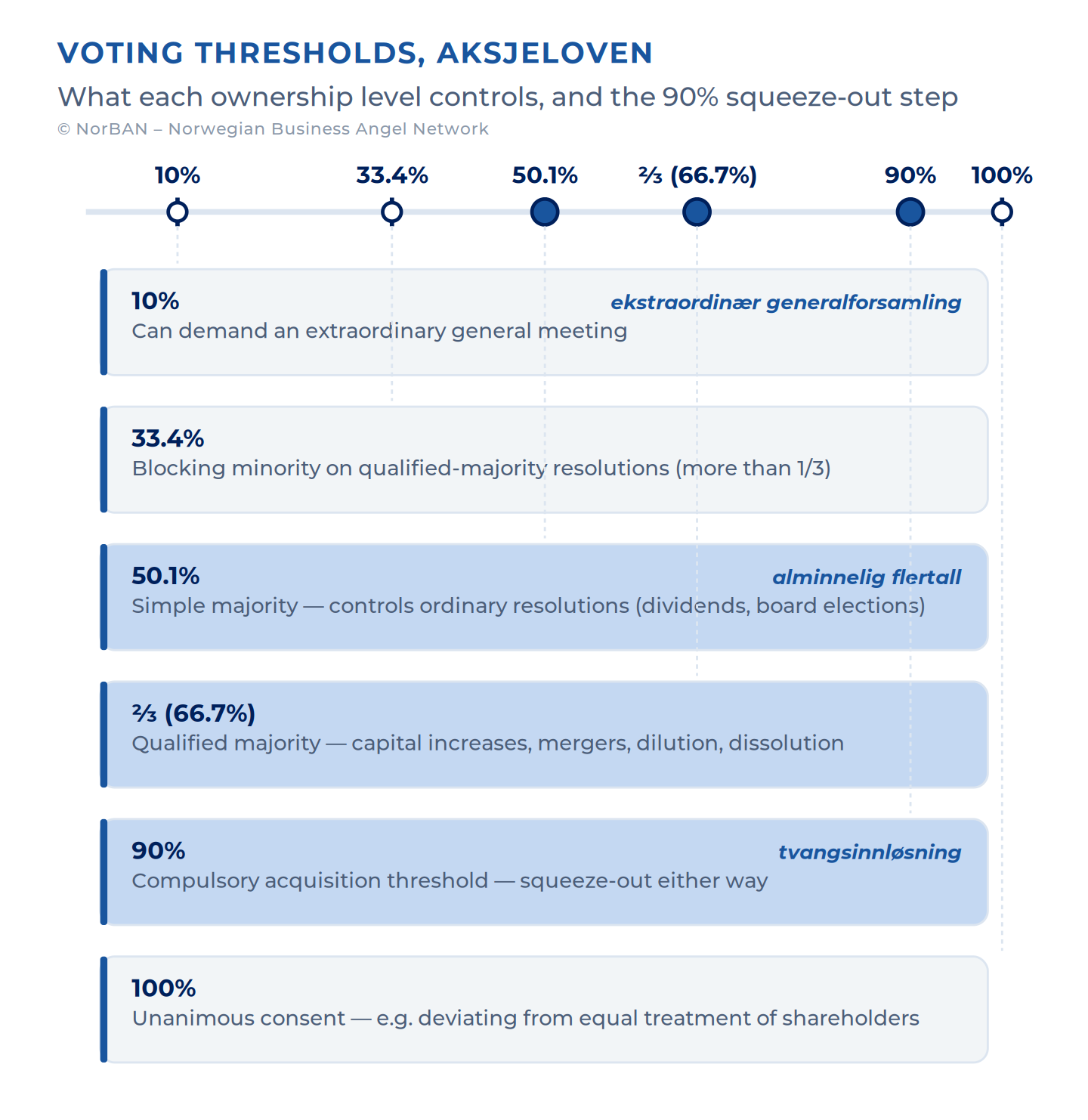
Read the draft against the statute. Every clause either replaces a default in the Companies Act (aksjeloven) or adds something the statute never provided, and the statute by itself decides very little. These are the thresholds the investors are contracting around.
- More than half of the votes cast carries ordinary decisions at the general meeting, including electing the board (§ 5-17).
- Two thirds of the votes cast and of the capital represented carries an amendment to the articles of association (vedtekter) (§ 5-18), a capital increase, and the setting aside of existing shareholders’ pre-emptive rights in a new issue (§ 10-5). Anyone holding more than a third of what is represented at the meeting can block your next round.
- A tenth of the share capital can force an extraordinary general meeting (§ 5-6).
- A corporate parent above nine tenths can force the minority out, and the minority can demand to be bought out (§ 4-26).
The statute gives no tag-along (medsalgsrett), no drag-along (medsalgsplikt), no board seat for a minority, no vesting, no dividend entitlement and no reporting beyond the annual accounts. All of it is contract. Without the agreement an investor in your company has almost no protection, and neither do you against a co-founder who leaves in month seven.
Where a clause sits decides what it can do. Check that before you argue about wording.
- The shareholders’ agreement (aksjonæravtale) is an ordinary contract. It binds the people who sign it, and a new shareholder only when they accede, in practice through an accession declaration (tiltredelseserklæring) required with every transfer and every subscription.
- A board or general-meeting decision taken in breach of the agreement is still valid for the company. The remedy is contractual: damages, an agreed penalty or a buyout trigger. Anything that must bind the company’s organs and every future owner automatically goes in the articles of association as well.
- The company itself is bound only where it is made a party, and even then it cannot contract away mandatory company law.
Standard and fair: sign without a fight
These clauses appear in almost every Norwegian shareholders’ agreement. Arguing against them costs you credibility and, in most cases, protection you will want yourself.
| Clause | What it does, and why you sign it |
|---|---|
| Board consent to transfers | The Companies Act already makes an acquisition conditional on the company’s consent unless the articles say otherwise. The board decides, and consent is deemed given if no refusal is notified within two months (§ 4-15, § 4-16). The agreement names the grounds and tightens the process, so you decide who joins the cap table. Watch the two-month silence rule: an unanswered request is a yes. |
| Pre-emption right (forkjøpsrett) | The statutory right lets the other shareholders take over shares that have already changed owner (§ 4-19), which arrives too late to be useful. Agreements convert it into an offer-first right: the seller must offer the shares internally before agreeing terms with an outsider. It keeps the shareholder group closed without needing anyone’s goodwill, and protects you as much as the investor. |
| Transfer restrictions and lock-up | A period in which nobody sells, and a definition of transfer that catches an indirect sale through a holding company. Investors buy the team, and a lock-up on the founders is the price of that. It should bind the investors too. |
| Accession requirement | Every new shareholder signs the agreement before receiving shares. Without it the agreement thins out with every round until it binds nobody who matters. |
| Information and reporting rights | Monthly or quarterly reporting, an annual budget, access to the accounts. Specify format, deadline and owner, because vague reporting promises become monthly friction. |
| Confidentiality | Both directions, with the usual carve-outs. It protects the company’s information in the hands of shareholders you did not choose. |
| Intellectual property assignment | Founders assign pre-incorporation work; employees assign under their contracts. Norwegian law does not transfer most employee-created intellectual property to the company by default. The Employee Inventions Act (arbeidstakeroppfinnelsesloven) covers inventions made in the course of employment, the Copyright Act (åndsverkloven) § 71 covers computer programs, and the rest needs a written assignment. Missing assignments are a standing diligence finding, and they will block a sale. |
Negotiable: where pushback is expected
Nobody on the other side is surprised when these are argued. Come with a position on each, and know which two or three you will trade for the rest.
| Clause | What is at stake | What to ask for |
|---|---|---|
| Board composition | Who controls the company between general meetings. | A board that reflects ownership and stays workable: an investor seat where the holding justifies it, an observer seat where it does not, and a size that can meet at short notice. |
| Reserved matters | The list of decisions requiring investor consent. A long list stalls the company; a short one leaves the investor exposed at the moments they care about. | New issues, debt above a limit, related-party transactions, a sale of the company and changes to the business. Push operational items (hiring, salaries, ordinary purchasing) back to the board. |
| Decision thresholds | Whether consent means the lead investor, or a percentage of the investor group. | Percentages rather than named people, so the clause survives the investors selling to each other. A deemed-consent deadline, so silence cannot block a decision. |
| Drag-along | The threshold at which you can be forced into a sale. | A threshold that requires the founders’ bloc or a large majority, an equal-terms requirement, and a floor price or a board recommendation on early triggers. |
| Non-compete | Whether you can work at all if you leave. | The narrowest defensible field, and a duration measured in months. See the employment-law limits below. |
| Dividend policy | Whether profits are reinvested or paid out. | Nothing while the company reinvests, with a stated approach once it is cash generative. |
| Anti-dilution | What happens to your shareholding if a later round is priced below this one. | Broad-based weighted average at most, time-limited or limited to the next round. It is the market-standard formula where formula-based protection is given at all. Full ratchet is the aggressive outlier. |
| Liquidation preference (likvidasjonspreferanse) | Who is paid first, and how much, when the company is sold. | One times the investment, non-participating. Read it together with the drag-along: a drag that delivers a price inside the preference stack pays the founders nothing. |
Accepting harsher anti-dilution terms to keep the headline price is tempting, because the price is the number people see. A complicated shareholders’ agreement stays with you for years, as Norwegian practitioners writing for founders keep pointing out. Where the disagreement is about the valuation, negotiate the valuation.
How you run the negotiation depends on where you are in the raise. The clauses are the same; who you argue them with is not.
- First raise, no lead. Several angels each send comments and the draft drifts. Put your own draft on the table first, mark the positions from this table on it, and ask the group to name one person you negotiate with. Everyone else accedes to what that person agrees.
- First raise, with a lead. The lead’s counsel drafts. Negotiate the table above with the lead only, and settle the clauses about your own shares before the smaller investors see the document.
- Second raise. Read your existing agreement first, for the majority needed to amend it and for any right you hold that is tied to a threshold. The new investors will want the agreement amended, and what you negotiated last time only survives if the amendment clause lets it.
Read twice: the clauses about your own shares
These clauses concern you personally, and they are the ones founders sign without having modelled them. Model each one at the value you expect the company to have in three years.
Work obligation. A commitment to work full time for a defined period, with consequences spelled out for leaving early. It is legitimate, because the round was priced on the assumption that the team stays. Check what counts as leaving, who decides, and whether illness or a board dismissal without cause lands you in the wrong category.
Vesting and leaver terms. Norwegian law has no vesting mechanism. Vesting is a contractual buyback or call right over unvested shares, priced differently for a good leaver and a bad leaver. The execution route matters as much as the schedule: shares are repurchased by the company only within the limits on own shares (§ 9-2 and following), redeemed through a capital reduction, or transferred to the remaining founders, and each route runs through the transfer clauses above.
Leaver pricing. In Norwegian practice a good leaver (illness, retirement, an agreed departure) is usually bought out at market value. A bad leaver, meaning dismissal for cause or walking out to a competitor, is often obliged to sell at cost price or another pre-agreed low formula.
Model what that means for you. A founder holding 20 per cent bought at par for NOK 30,000, who leaves as a bad leaver when the company is worth NOK 20 million, surrenders shares worth NOK 4 million for NOK 30,000.
Where the statute prices an exit, on a refused consent and under the statutory pre-emption right (§ 4-23 read with § 4-17), it uses actual value (virkelig verdi). A pre-agreed formula in the agreement displaces that between the parties.
Such clauses are valid as contract. Only a grossly unreasonable one can be set aside or revised under avtaleloven § 36, and that route runs through the courts.
Fix these while you can. None of them can be reopened once you are the one leaving.
- The leaver definitions themselves, and who decides which one applies.
- An objective method for market value, where market value is the good-leaver price.
- A cliff and schedule that credit the time you have already put in.
Non-compete, where you are also an employee. The Working Environment Act (arbeidsmiljøloven) limits post-termination non-competes between employer and employee: written form, a maximum of one year from termination, a genuine need for protection (§ 14 A-1), and compensation payable by the employer for the restricted period.
The compensation is 100 per cent of pay up to 8 G (eight times the National Insurance base amount) and at least 70 per cent of pay above 8 G, calculated on the pay earned in the twelve months before termination.
The employer may cap the total at 12 G, and may deduct up to half of it against what the employee earns elsewhere during the restricted period (§ 14 A-3).
Whether those limits reach a non-compete placed in a shareholders’ agreement between the same people is a recognised grey zone. Chapter 14 A governs the employment relationship, and the rules cannot be evaded simply by moving the clause into another document between the same parties.
A restriction genuinely tied to the sale value of ownership rather than to the employment may fall outside them. Where the line runs for a founder who is both shareholder and employee has not been settled, and no source states the current position with authority.
Size any founder non-compete as if the employment-law limits applied, and have your own counsel look at it.
The clauses that should worry you
If any of these appear, stop and take advice before signing anything else. Each of them reaches past this round into your personal position.
| Clause | What it obliges | The problem |
|---|---|---|
| Personal guarantee | You, personally, stand behind a company obligation. | It converts a limited-liability shareholding into unlimited personal exposure, and it survives your leaving the company. |
| Duty to finance future rounds | Shareholders must participate in, or must not block, later capital raises. It appears in some Norwegian agreements; investors routinely negotiate an express statement that they carry no such obligation themselves. | An open-ended commitment to fund a company whose next crisis you cannot foresee, usually asymmetric: the duty lands on the people without the capital. |
| Full-ratchet anti-dilution | Earlier investors are repriced to the lowest price ever paid, without weighting for the size of the new round. | A small down round can transfer a large part of the founders’ shareholding. Broad-based weighted average is the market position. |
| Consent rights without limit | Every meaningful decision requires investor approval, with no deadline for answering. | A board that cannot act is worse than a board that acts imperfectly, and silence becomes a veto. |
| Redemption at par or nominal value, without limit | The company or the other shareholders can call your shares at a nominal price in circumstances that are not narrowly defined. | Combined with a broad bad-leaver definition, this is an option on your entire holding, held by people who can also trigger it. |
| Pre-agreed price with no method | An exit price fixed by a formula nobody can apply, or by the other party’s valuation. | Every future disagreement is decided by whoever chose the method. |
The mirror rights to insist on
An experienced investor expects drag-along and makes sure they also get tag-along. The same discipline works from your chair. For every right the agreement gives, ask whether it points in one direction only, and ask for the mirror where it does.
- Tag-along against drag-along. If you can be forced to sell, you must also be able to join a sale. A drag without a matching tag lets a majority sell and leave you holding shares in a company with a new owner you did not choose.
- Equal terms when dragged. The same price per share, the same form of consideration, and the same warranty exposure. A dragged seller should not be asked to give warranties the majority does not.
- Symmetry in information and confidentiality. If investors receive monthly reporting, the reporting obligations, the confidentiality duty and the use restrictions bind them as well.
- Transfer restrictions that bind the investors. Pre-emption, consent and the indirect-transfer definition should apply to their shares as well as yours, so you are not one holding-company sale away from a co-owner you have never met.
- A right to follow your money. A right, not a duty, to take your pro rata share of the next issue is the cheapest protection you have against dilution.
How the agreement behaves later
Read every clause against two future moments, the next round and the exit. That is when it is applied, and by then the wording is fixed.
At the next round. New investors accede to the agreement, and they will want it amended. The reserved-matters list grows, the board changes, and preferences from the new round sit on top of the old ones. What survives depends on the majority required to amend the agreement, and on whether a right you negotiated is tied to a holding threshold. A board seat that depends on holding a fifth of the company is a board seat you lose in the round after next.
At the exit. The drag-along works exactly as written, and by then nobody is renegotiating. The preference stack decides who receives what, the leaver clauses decide whether a founder who left three years ago still holds shares, and the transfer restrictions decide whether the buyer can get 100 per cent.
Duration is the clause people forget. The standard pattern binds each party for as long as they hold shares, and terminates for everyone on a trade sale or a listing. A right for any party to terminate on notice undoes the rest of the document. Take the draft to your own lawyer with your positions marked.