
Pre-money, post-money and what the percentage costs
The pre-money valuation (verdsettelse) is what the parties agree the company is worth before the new money arrives. Add the new capital and you have post-money, and your share is the new capital divided by post-money.
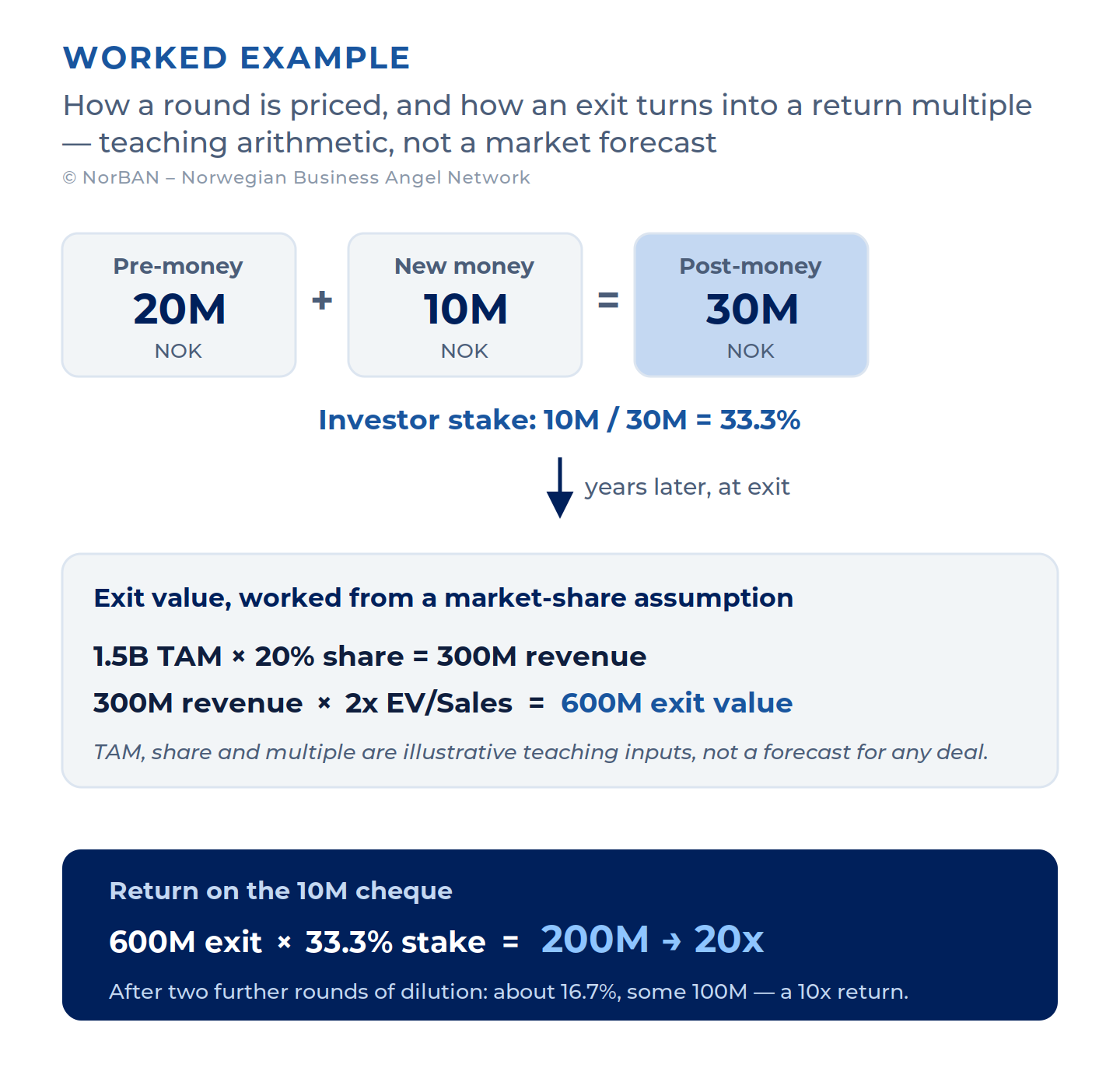
A round of NOK 10 million at NOK 20 million pre-money gives a post-money of NOK 30 million, and the incoming investors hold 10 of 30, or 33.3 per cent. The founders’ dilution (utvanning) is the mirror image: they held all of it and now hold two thirds.
The price per share, the subscription price (emisjonskurs, called tegningskurs in the statute), is the pre-money figure divided by the shares already issued. The general meeting resolution must state it when the capital increase is resolved (aksjeloven § 10-1).
Ask for the share count and check the percentage yourself. That percentage is what a high price costs you, now and in the rounds that follow.
The method families, and where each one breaks
Knowing the five families tells you where a founder’s number came from and how much weight it can bear. All five need a past, a forecast or a peer group, and a pre-revenue company has none in usable form.
| Family | Named methods | What it anchors on, and why it strains at pre-revenue |
|---|---|---|
| Cost | Replacement cost, book value | What has been spent, or what it would cost to rebuild the assets. Value sits in the option on the future rather than in the spend; a startup that is worth its costs is not worth investing in. |
| Income | Discounted cash flow, scenario-weighted and First Chicago variants, the venture capital method | Discounted future cash flows. The forecast is the thing in dispute, and small changes in growth or discount rate swing the answer by multiples. |
| Market | Revenue and earnings multiples, comparable transactions | Prices paid for comparable companies. There is no revenue to multiply, and Norwegian early-stage prices stay between the parties, so the comparison rests on what the people in the room have seen. |
| Factor | Berkus, Risk Factor Summation, Payne scorecard | Scored qualitative factors, benchmarked against a regional average pre-money — an American reference point, so the scores compare companies rather than fix a Norwegian price. |
| Stage | Stage bands | Where the company sits on a maturity path. Order of magnitude only; it gives the bracket, never the number. |
The factor methods are worth running anyway, because they are checklists in disguise. Run one across two companies at the same stage and it shows what differs between them.
- Berkus scores five elements (sound idea, management team, working prototype, quality board, product rollout) with a ceiling on each.
- Risk Factor Summation, from Ohio TechAngels, scores twelve risks from management and stage through funding, competition and technology.
- The Payne scorecard weights team, market size, product, competition and the need for further financing.
The stage ladder in practice
Most angel rounds are priced by stage and comparison. The ladder dates from 2018 and has not moved: an idea with a team and no product at roughly USD 250,000–500,000 pre-money, a company with revenue growth and a visible path to profitability at USD 5 million and above, and the intermediate stages spread between.
A 2018 dollar heuristic places a price in a bracket and no finer, and the brackets are American: read them as an order of magnitude for a Norwegian round, not as a price.
Round size is firmer ground. EBAN’s Statistics Compendium reports what angels put in, which tells you whether the amount being raised is normal even where the price itself has no benchmark.
- The average European angel investment per company was EUR 204,900 in 2024, down from EUR 221,400 the year before.
- The average ticket per angel was EUR 25,600.
- Norway’s visible market, the part flowing through networks, was EUR 25.23 million across 90 rounds, roughly EUR 280,000 each.
Working backwards from the exit
The venture arithmetic is the test that survives any method. Start from the exit the business would have to reach, and see whether today’s price still leaves the return that pays for the risk.
Take the round above: NOK 10 million at NOK 20 million pre-money, NOK 30 million post-money, 33.3 per cent to the investors. Now build the exit case.
Suppose the addressable market is NOK 1.5 billion and the company can plausibly take a fifth of it, NOK 300 million of revenue. At an enterprise value of twice sales, that is an exit at NOK 600 million, and the round is priced at 20 times post-money.
Two further rounds at the ordinary rate of dilution, around 20 per cent a round and rarely more than 25, roughly halve an early stake, from 33.3 per cent to about 16.7. At exit that stake is worth some NOK 100 million on NOK 10 million invested: 10 times, over however many years the exit takes.
Run the same chain at NOK 40 million pre-money and the return halves again. Market, share and multiple are all arguable, and a price that only works if all three land at their optimistic end is a hope.
To test a proposed pre-money before agreeing to it, run the chain yourself on one page. Keep the sheet; it is what you compare the next case against.
- Take the share count and the round size and work out your percentage after the round.
- Write down the exit the business has to reach: the market, a plausible share of it, and a sales multiple you would defend to another investor.
- Halve your stake for the two rounds that follow, and see what multiple is left.
- Run it again with each of the three at its cautious end. If the return survives only the optimistic case, the price is too high for the risk.
With a sector background, spend the time on market share and multiple, where your judgment is worth most. In a syndicate, have one person run the chain and circulate it before the price is discussed, so the group argues about the same numbers.
What actually moves the number
Five things move an early-stage price more than any model. Weigh them before you answer a founder’s figure.
- Competition for the deal. A round with three interested investors prices differently from a round with one, so find out early who else is looking. It is the largest single factor and the least discussed.
- The team. Whether these people can carry the company to the point where the next investor takes over.
- The quality of traction. Paying customers outrank pilots, pilots outrank letters of intent, and a signed enterprise agreement with no revenue attached is a sales document.
- Capital efficiency. How far the company got on what it has spent tells you what it will do with what you give it.
- What the next round has to look like. The constraint most angels underweight, and the one that decides whether your position is ever worth anything.
A price the next financing cannot clear forces a down round, and down rounds destroy value beyond the arithmetic. They trigger price protection, reset the founders’ incentives and signal distress.
Some examples: Klarna’s valuation fell from USD 45.6 billion in June 2021 to USD 6.7 billion in its July 2022 raise, a fall of 85 per cent. Oda raised USD 151 million in December 2022 at about USD 353 million, down from roughly USD 900 million in April 2021, or 61 per cent.
Neither company was failing at the moment of the reset; both had been priced for a future that did not arrive on schedule.
When the price cannot be agreed
Sometimes the gap does not close, and the honest response is to stop pricing. A convertible loan (konvertibelt lån) lends the money now and converts it into shares at the next priced round, usually at a discount and under a valuation cap.
Norwegian law provides for it directly. A company can take up loans carrying a right to demand shares issued, and the general meeting resolves it (aksjeloven § 11-1).
What you give up is control of the price. It is set later, in a negotiation you may not be part of, and the cap and discount are the only boundaries on it.
For you the cap is the price, so negotiate it with the same care. A cap set too high leaves your early money carrying the early risk at a late-money price, and a discount with no cap gives no protection at all if the next round is priced aggressively.