
Have the company documents ready
Buying shares means investing in the existing corporate structure. Be ready to explain the articles, ownership and agreements as well as the business and price.
Prepare the company records investors will ask for:
- Formation documents and articles of association.
- Share capital, options, convertibles and pledges.
- Agreements with owners.
- Holdings in other companies.
- Contracts that end if control of the company changes.
Unclear rights can be harder to resolve than a price disagreement. An unexplained share class or a key asset held elsewhere may need clarification before investment. Some changes need a general meeting, registry filing or creditor notice.
Review early arrangements in particular: a share class created to resolve a disagreement, equity given for a one-off service, or a consultancy agreement entered into by the founder’s own AS. Check whether the solution still fits.
Consider starting the review six to eighteen months before a planned raise. This allows time to assess alternatives and make changes before they become investment conditions.
One share class or several: aksjeklasser in a Norwegian AS
All shares carry equal rights in the company unless the articles of association (vedtekter) provide otherwise (aksjeloven § 4-1). Where share classes (aksjeklasser) exist, the articles must state what distinguishes them and what each class amounts to in nominal value.
One class of ordinary shares simplifies valuation. Every share carries the same rights, so a new issue can be calculated without explaining differences between classes.
Where classes exist they are public. The articles are filed with and open from Foretaksregisteret, and the annual shareholder-register extract from Skatteetaten states the class of each holding, so a second class is visible to an investor before you mention it.
A second class is worth having when an incoming investor requires a right the ordinary shares do not carry. A liquidation preference is the usual one, and it is a class right, so it has to be written into the articles to bind the company at all.
A preference for distributions on winding-up should be stated in the articles as a share-class right. On a sale of shares, the consideration normally goes from buyer to sellers. Agree the allocation of those proceeds, commonly in the shareholders’ agreement and sale documents, and align it with relevant articles provisions.
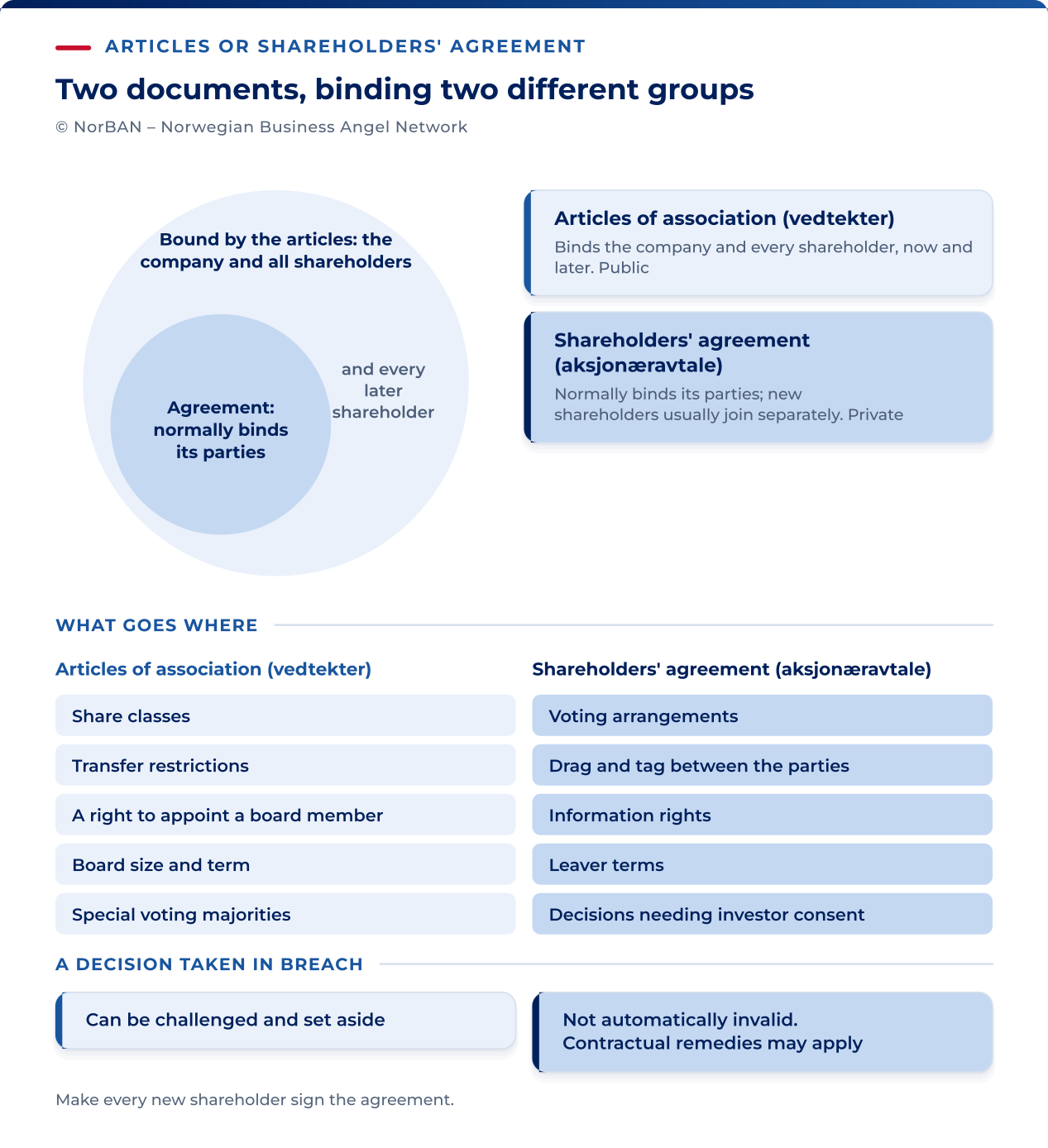
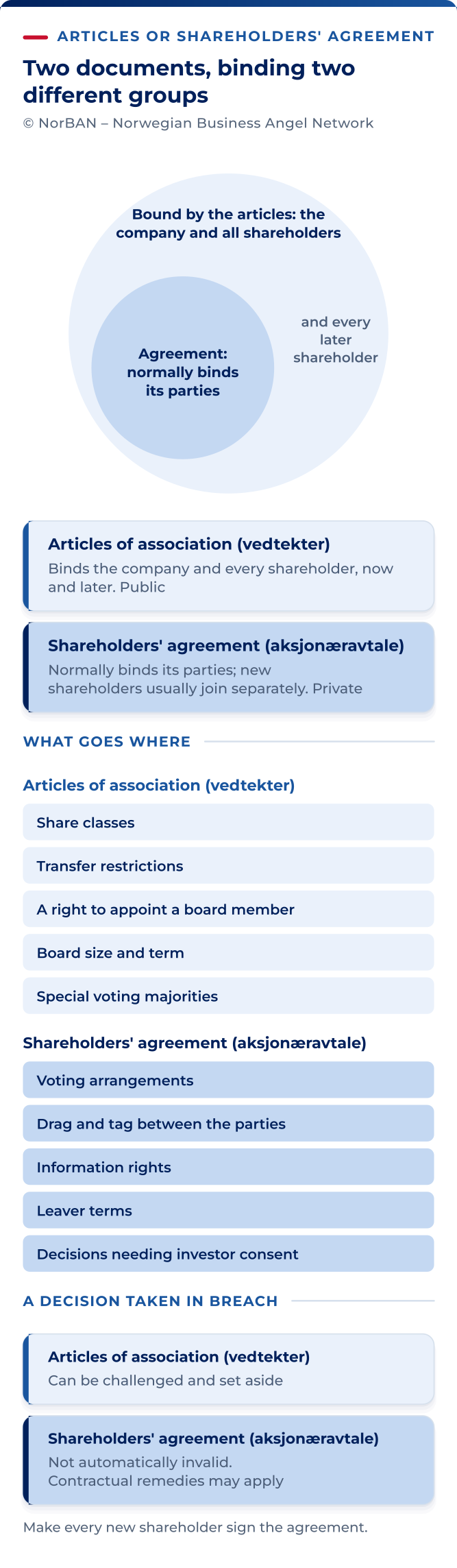
Use the articles for corporate rules that must apply to the company’s organs and shareholders, within the law. The shareholders’ agreement regulates contractual obligations among its parties. A company can also be a party, but signing an agreement does not dispense with statutory corporate procedures. New owners need to accede where contractual obligations are intended to bind them.
A class also has a cost that lasts. Every later issue has to decide which class is being issued and what that does to the balance between them.
Changing class rights can require several approvals. § 5-18(2) adds class approval when an entire class is disadvantaged. Reducing existing shares’ rights to dividends or assets can require more than 90% of represented capital as well as the ordinary articles majority under § 5-19. Changes listed in § 5-20, including unequal treatment of previously equal shares, require unanimous consent, or consent from all affected holders plus the articles majority where only some are affected.
Examine classes created to give a co-founder economic rights without votes, restrict a former founder’s dividends, or link adviser shares to future work. Make the purpose and effects clear.
Vesting, leaver terms and voting commitments can often be handled in the shareholders’ agreement or separate agreements. A share class may still have a legitimate purpose. Choose the mechanism that fits the intended rights and assess how difficult it will be to change later.
The vedtekter investors read first
Read your articles before approaching investors, especially if they still use the standard wording from incorporation. Check the four mandatory items and any optional provisions against how the company now operates.
| Provision | What to check | If the articles say nothing |
|---|---|---|
| Company name | Registered name, required by § 2-2. | Cannot be omitted. |
| Business | Required by § 2-2. Check whether the description still covers the business. | Cannot be omitted. |
| Share capital | Registered capital amount; changes require an articles update. Minimum capital is set by § 3-1. | Cannot be omitted. |
| Nominal value | Amount of share capital represented by each share, distinct from its issue price. A suitable denomination makes allocations easier; a high nominal value does not itself fix the market price. | Cannot be omitted. |
| Share classes | Differences in rights and aggregate nominal value per class under § 4-1. | Shares have equal corporate rights. |
| Consent and pre-emption | Align any changes with the Act. The default is company consent and statutory pre-emption, with exceptions. | The board normally decides consent and needs objective grounds to refuse. Consent is deemed given if refusal is not notified within two months after the company receives notice of acquisition (§ 4-16). Pre-emption is governed by § 4-19 onwards. |
| Board composition | Check numbers, terms and any permitted appointment rights. Transferring election rights is subject to the limits in § 6-3. | General meeting election is the starting point, subject to employee representation or a corporate assembly where applicable. An AS has at least one director. |
| Redemption | Articles can provide redemption through capital reduction under § 12-7. Adding compulsory redemption to issued shares engages the consent rules in § 5-20. | No articles-based right; statutory redemption and squeeze-out rights may still apply. |
| Meeting procedures | Check longer notice, attendance requirements and lawful majority rules. | Ordinary notice is at least one week under § 5-10. Simplified treatment and unanimous waiver have separate rules; do not assume all situations need a new one-week wait. |
An AS no longer has to state its registered municipality in the articles. It may retain such a provision voluntarily. An ASA still has a statutory requirement to state the municipality.
Transfer rules, share classes and appointment rights need no bespoke articles provision if the statutory default fits. To establish a different corporate arrangement, follow the procedure required by law. A shareholders’ agreement does not amend the articles.
The initial articles form part of the incorporation documents. Later amendments normally require a general-meeting resolution and registration. The Act permits specific exceptions, including board action under a valid capital-increase mandate.
Founder holding companies
A holding company (holdingselskap) is an AS that exists to own shares in other companies. Altinn gives the two reasons the structure exists: separating the risk of different businesses, and the fact that gains on a sale and dividends received are close to tax-free at company level under the participation exemption (fritaksmetoden).
The holding company can reinvest gains exempt under the participation exemption. Qualifying dividends normally have a small taxable portion, with exceptions. A dividend paid to you personally is taxed under the shareholder model. Repayment of documented paid-in capital or genuine loan principal is different. The exemption does not cover every investment or other company income; check Skatteetaten’s guidance.
An ordinary sale or contribution of personally held shares to your holding company normally constitutes realisation under § 9-2. Retaining indirect ownership does not make it tax-free. Specific reorganisation rules require a separate assessment. The historical transition rule is not a general exemption for a transfer today.
A taxable transfer before substantial value has accumulated may create little taxable gain, but establishing and running the holding company still costs money. A later transfer can realise a larger gain even if the consideration is shares or a receivable rather than cash.
Investors may own shares personally or through companies, including holding companies. A sole proprietorship is not a separate legal person: its owner remains the person holding the shares. Do not treat an ENK as a third corporate ownership form.
Identify the actual legal owner in the ownership records. For your own holding structure, check which obligations bind you, which bind the holding company, and whether changes in indirect ownership are covered.
A founder’s personal obligations do not automatically disappear when shares move into a holding company. However, a clause that only restricts transfers of the operating-company shares may not catch a sale of the holding company. Check the wording and the parties.
Have the holding company accede to the shareholders’ agreement. At the same time, agree how a change of control in it will be treated and which obligations remain personal to the founder. Do this when establishing the structure.
The ownership record
The board is responsible for the share register (§ 4-5). After a buyer reports and substantiates the acquisition, the company must enter the new owner without delay unless consent or pre-emption rules prevent this (§ 4-7). Access to the register is public under the applicable rules. The register should reflect documented ownership; an entry is not a substitute for a valid acquisition.
Check that the share register agrees with three other records:
- Foretaksregisteret, for the share capital, board and articles.
- The shareholder-register statement filed annually with Skatteetaten.
- The cap table you show investors.
Registration in Foretaksregisteret makes the registered facts effective against third parties (foretaksregisterloven § 7-1), and the register is open to everyone (foretaksregisterloven § 9-1), so a mismatch is visible before you are asked about it.
Check beneficial ownership separately from the shareholder list. It concerns the people who ultimately own or control the company, including through voting rights, appointment rights or other control. More than 25% ownership is one criterion, not the whole test. Register changes without delay and within fourteen days after identifying a new beneficial owner or becoming aware that the registered information has changed. Company housekeeping covers the records in detail.
Secure the rights the business needs
List the assets and rights the business needs. Record who owns them and which agreements secure the company’s use.
- The code, the designs, the brand and anything filed or registrable. Work done by founders before incorporation, and by contractors at any time, does not arrive in the company on its own.
- Domains, accounts and repositories registered in a founder’s personal name.
- The customer and supplier contracts, the licences the business needs, and any permit held personally.
- The employment contracts, including the founders’ own.
Section 3-8 can require board approval of related-party agreements where the company’s performance exceeds 2.5% of the balance-sheet total in its latest approved annual accounts. A qualifying interim balance sheet can be used; without either, the base is issued nominal capital plus share premium. The procedure also includes a statement, auditor confirmation and a board declaration. Lack of approval makes the agreement non-binding only if the company establishes that the counterparty knew or should have known approval was missing.
Exceptions include agreements in the ordinary course of business on ordinary commercial terms and agreements where the company’s performance is worth less than NOK 100,000. § 3-8 lists further exceptions. Check each founder consultancy agreement against the actual scope and exceptions rather than assuming it always required approval.
Control can arise through an agreement or ownership. A majority of votes or a right to appoint or dismiss a board majority always establishes controlling influence under § 1-3. A parent must assess the consolidated-accounts rules and available exemptions. Audit exemption must also be checked for the group as a whole.
If the investment goes into the operating company, explain the companies above and below it in the ownership structure and the agreements between them.
If an essential asset is held elsewhere, agree how the operating company will secure it. An assignment or a sufficiently robust licence may be appropriate, depending on the investment and business. An asset contribution in a capital increase requires the board’s statement and auditor confirmation, with valuation no earlier than four weeks before the general-meeting resolution (§ 10-2). Assess related-party and tax rules as well.
The structural faults that cost a round
Check for these structural problems before approaching investors. Each can delay a round while the investor asks for an explanation or a repair.
| Potential issue | What to clarify |
|---|---|
| Hundreds of shareholders | Keep contact information, notices, voting and accession processes manageable. A valid board mandate may allow an issue without a new general meeting. Do not infer voting power from the number of holders alone. |
| An earlier equity-crowdfunding round | Assess ownership administration and any nominee or platform arrangements. Later investors may have preferences, but shortening the owner list is not a universal requirement. |
| A large stake held by a departed founder | Check actual voting power, consent rights and leaver agreements. A large stake does not automatically veto every important decision. |
| A share class with an unclear purpose | Document its rights, purpose and the approvals needed to change it. |
| An essential asset held elsewhere | Check ownership, licences, duration and termination rights. Outside ownership is not necessarily a defect if use is properly secured. |
| Transfers missing from the share register | Reconcile agreements, consent, pre-emption and the register. Missing registration does not by itself prove the transfer never took place. |
| Option promises without a delivery plan | Document obligations, conditions, possible dilution and the corporate steps still needed. A promise does not itself issue shares. |
| Assets and contracts spread across group companies | Explain which company the investor funds and how that company secures the resources and income it needs. |
The first two rows principally concern administration and decision-making. Many owners require sound processes, but there is no single maximum number every company should observe.
A wide offer also raises the prospectus question, which the share-capital filing asks about directly. Verdipapirhandelloven § 7-1 incorporates the EU Prospectus Regulation; § 7-3 and § 7-5 set the bands, with a lighter national prospectus registered in Foretaksregisteret before publication, and § 7-6 carries the exemptions. Check the Norwegian rules in force when the offer is made: as checked on 10 October 2026, Finanstilsynet states that the EU Listing Act has not yet been implemented in Norway. EU commencement dates therefore do not by themselves change the Norwegian thresholds.
The bands are euro amounts over a rolling twelve months, and Finanstilsynet publishes the current values. Brønnøysundregistrene’s own registration form still points at an older section number for this, so read the section in the act itself.
Fixing it before you raise
Allow for the statutory waiting and filing periods when planning repairs. Work backwards from the intended closing date so each required step can be completed in time.
| Action | Procedure | Required approvals | Timing |
|---|---|---|---|
| Amend articles | Resolve the change and file the minutes and complete articles. Most changes are free to register; name changes and capital reductions incur fees. | Normally two-thirds of votes cast and represented capital. Also check class approval under § 5-18, more-than-90% requirements under § 5-19, and consent under § 5-20. | Allow for lawful notice and current registry processing times. |
| Remove a share class | Convert its shares through an articles amendment. | Apply the rules above to the actual rights being changed; two-thirds alone may be insufficient. | Allow time to obtain every required approval. |
| Correct the share register | Document acquisitions, resolve consent and pre-emption issues, then enter the owner. | Consent is normally a board matter unless the articles say otherwise; not every transfer needs consent. | Potentially days, but unresolved rights or deadlines can take longer. |
| Buy a departed founder’s shares | An ordinary company buyback requires fully paid shares, dividend capacity, the minimum-capital test and a registered mandate stating maximum aggregate nominal value, price range and methods. The mandate lasts at most two years (§§ 9-2–9-4). A purchase by other owners has different funding and transfer rules. | Articles majority for the company’s mandate; agree the sale or establish an enforceable right to buy. | Register the mandate before buying under it. |
| Redeem through capital reduction | File the decision within two months. Where creditor notice is required, wait six weeks and file completion within one year of the decision. | Articles majority plus any additional affected-holder consent. | Plan months rather than days. Under § 12-5, specified loss coverage or a simultaneous new issue maintaining at least the previous restricted equity can avoid notice; loss coverage has later distribution restrictions. § 12-7 has a further redemption exception. |
| Transfer an asset into the company | Purchase or make a contribution in kind. The latter requires a board statement, auditor confirmation and valuation within four weeks before the decision. Check tax and related-party rules. | Articles majority for a general-meeting capital increase, or action within a valid mandate. | Depends on valuation, auditor and approvals; budget time for preparation. |
| Arrange option delivery | Choose new shares, lawful treasury shares or shareholder-supplied shares and document the applicable route. | Depends on the route; register a mandate before use where required. | Track resolutions, registration and expiry against the exercise period. |
Keep three filing deadlines separate. A capital increase under aksjeloven § 10-9 must be notified within three months after the subscription deadline. If it is not, registration cannot take place and subscriptions cease to bind. A capital-reduction decision must be notified within two months after the decision, or the reduction lapses (§ 12-4). For a reduction following the creditor-notice procedure, the implementation notification must be sent no later than one year after the reduction was decided, or it lapses (§ 12-6). These are notification deadlines, not promises that registration will be completed by those dates.
The ordinary deadline for challenging a general-meeting resolution is three months after the decision; for decisions outside a meeting, time runs from sending the minutes. § 5-23 has important exceptions: decisions that even unanimous holders could not adopt, missing required consent, and absent or seriously defective notice. A further exception permits proceedings within two years after the ordinary deadline where its specific conditions are met. Do not assume that an old defect has disappeared merely because three months have passed.
Where documentation is missing, first establish what was actually agreed and resolved. New papers or a confirmatory resolution do not automatically cure the original defect. Assess a lawful remedy and do not imply that newly prepared documents were created earlier.
Disclose unresolved issues in writing. The parties can then agree how to handle them, for example through completion conditions or warranties. Whether disclosure limits a later claim depends on the agreement and the clarity of the disclosure.