
Plan the raise backwards from runway
An angel investment round typically takes two to four months to close, on NorBAN’s published figures. It is much shorter for a well-prepared company with strong investor interest, and considerably longer when the round is difficult to fill or core documentation is missing.
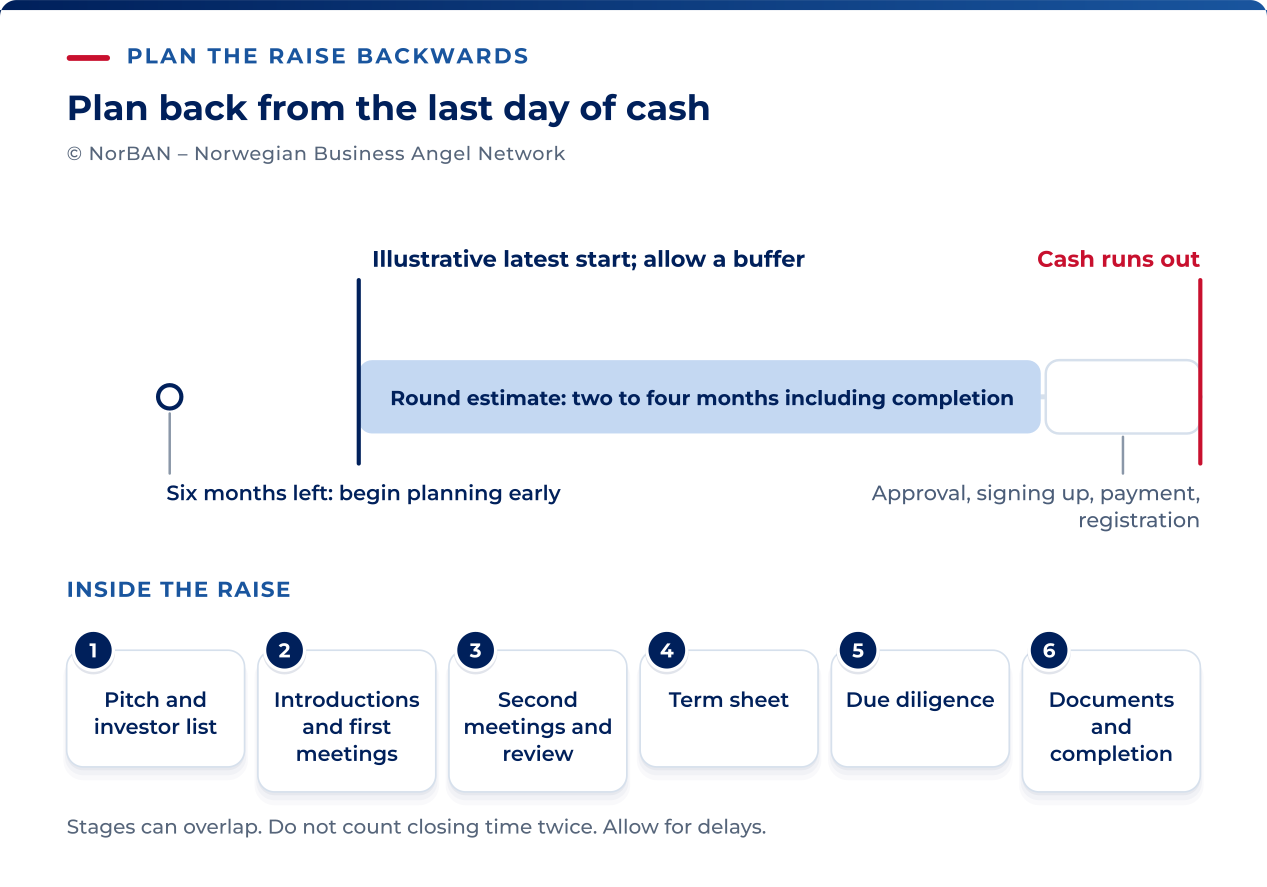
The page describes its figures as rough estimates from experience. The sequence it gives is preparing the investment case and identifying suitable angels, then introductions, meetings, due diligence (selskapsgjennomgang) and negotiation of terms.
Allow time after the investment decision for the round to complete. Once an investor has decided, the legal documentation and completion can be quick, and some investors transfer the money within days, though the page calls that rare.
A share issue in a Norwegian AS requires the appropriate resolution, subscription, payment confirmation and registration. Other financing instruments have different steps. Map the chosen route using Closing a round in Norway.
Start with when funds must be available. Estimate preparation, meetings, diligence, negotiation and completion, allowing for overlap. Compare the total with NorBAN’s broad estimate and add a suitable buffer. This gives a planning date, not a guaranteed final day to begin outreach.
Six months of cash does not guarantee enough time. A difficult round can take longer than four months, and unexpected spending can shorten runway. Update the forecast and alternatives as discussions progress.
| Phase | What should become clear | Your task |
|---|---|---|
| Materials and list | Credible case and relevant contacts | Prepare documents, assumptions and priorities. |
| First meetings | Investor fit and next steps | Coordinate outreach and meetings. |
| Further meetings | Questions, possible amounts and decision process | Keep answers consistent and record conditions. |
| Term sheet | Proposed terms and binding process obligations | Compare offers and clarify actual commitments. |
| Due diligence | Findings, remaining work and conditions | Maintain documents and question log; observe confidentiality and exclusivity. |
| Completion | Signed documents, valid corporate steps, payment and registration | Coordinate investors, advisers, bank and registries. |
Stages can overlap. A term sheet does not necessarily create a binding investment commitment.
Set a target date for each phase. The US-focused NFX fundraising manual recommends deadlines to keep the process moving. Review missed targets weekly and establish the reason before revising the plan.
Parallel conversations, held at the same stage
Paul Graham’s 2013 essay recommends parallel discussions, prioritising promising investors. It is US fundraising advice, not a requirement or evidence that all Norwegian investors behave alike.
Sequential conversations can take longer and leave fewer alternatives. Plan parallel discussions where your capacity allows and describe other investors’ interest accurately.
Batch the first meetings into a window of two or three weeks, so the second meetings fall in the same fortnight and the term sheets, when they come, arrive close enough together to be read side by side.
Compare price with board rights, consent and pre-emption provisions, warranties and exit terms. Several live offers can strengthen your position. A single offer can still be assessed and negotiated against your needs and alternatives.
If one conversation is months ahead, ask for a clear timetable and enough time to assess the offer. An early investor may have a stronger position but does not automatically dictate the terms.
NFX recommends a credible first term sheet to help other discussions progress. Consider whether the investor and terms fit, and check confidentiality before sharing the offer or investor’s name.
Deadlines investors believe
Guy Kawasaki’s 2006 list uses satire to warn against inventing competition between investors. His reference to only a hundred founders is rhetoric, not a measured count. Describe genuine interest accurately.
Explain the reason for the date and what happens if it is missed. A cash shortage is a real constraint, but does not itself establish that investors will commit.
- An investor commitment. State the agreed amount, timing and conditions accurately. An expression of interest alone is not a binding commitment.
- Planned corporate decisions. Explain the proposed general-meeting date and distinguish it from the subscription deadline set in a valid resolution.
- Cash need. Give a dated forecast of when funds are needed and the alternatives if the round is delayed.
Graham considered three working days acceptable in his 2013 context. That is not a legal minimum or a universal test of investor quality. Ask for enough time to review the documents, obtain advice and make the necessary decisions.
When one investor digs in
PwC’s 2021 report found an exclusivity period in 147 of 187 final VC term sheets issued in 2020, or 79%. This historical UK-market sample covered several funding stages. It is not a current estimate for Norwegian angel rounds. Be prepared to discuss the scope, duration and ending conditions of an actual request.
WilmerHale’s 2017 US guidance suggests a few weeks to a month for a straightforward early-stage financing. Negotiate a proportionate period, clear milestones and objective ending rights. Investor silence does not automatically end exclusivity unless the agreement says so.
Specify which clauses are binding. Exclusivity and confidentiality often are; costs, governing law and dispute provisions can be as well. Read the wording rather than relying on the document title or a general non-binding label.
Due diligence may take weeks depending on scope and unresolved issues. It includes meetings, document work and specialist checks. Coordinate your side and clarify which contact with other investors remains permitted.
- Share updates with other investors only where confidentiality and exclusivity permit it. Agree necessary exceptions beforehand.
- Keep dated answers and current documents. Give access according to need and the agreed restrictions, rather than sharing everything automatically.
- Review remaining work, responsibilities and dates weekly. Identify delays together; do not assume one question explains every standstill.
Reading a stalled raise, and restarting it
Review progress weekly. Follow up missing answers and missed dates, then prioritise the actions most likely to move the process forward.
| Signal | Next step |
|---|---|
| Further meetings without amounts | Ask whether the obstacle is the case, price, timing, fit or an internal decision. |
| Repeated questions | Check whether the material is unclear or the underlying issue unresolved. Prepare a clear answer. |
| No status changes | Ask active investors for next steps and dates. Update the plan and develop alternatives. |
| “Too early” | Ask what would change the answer and whether a smaller raise could credibly reach that milestone. |
| One investor far ahead | Clarify commitment, conditions and the next document. Share progress with others only where permitted. |
A smaller round may fund a useful milestone, but allow for delays and the cost and uncertainty of raising again. A better price later is possible, not guaranteed.
Staged completion may allow some investors to complete before others. Check the subscription terms, payment and registration deadlines, and the relevant corporate resolution or board authority. Do not assume that a single resolution permits any later investment. See the article on closing a round.
Repeated price objections justify reassessing the valuation alongside the evidence and investor fit. Compare a lower-priced round with realistic alternatives and the cash forecast; a few objections are not a precise market valuation.
New contacts take time and response speed varies. Add suitable names while there is time to develop the conversation, rather than relying on fixed three-week and six-week meeting dates.
Do not assume silence means you are next in a queue. Investors may be considering other companies or dealing with their own constraints. Ask whether the case is active and what is needed for a decision.
Use dates to make follow-up concrete. If an investor will not clarify the next step, spend less time on that conversation and develop alternatives.
Running the company while raising
With several founders, assign fundraising coordination to one and operational responsibilities to the others. Graham recommends concentrating the effort because it absorbs attention. A solo founder must plan explicitly for both fundraising and essential operations.
Investors may ask for updated sales figures, bank statements and forecasts during diligence. If trading weakens during the raise, explain the change and its effect on funding needs and assumptions.
The other founders need to keep improving the numbers between meetings and maintaining the cash position investors will examine during diligence.
Assign responsibility explicitly. One founder can coordinate investor contacts, the data room and the question log while colleagues contribute answers in their areas and manage delivery and sales. Agree a regular written update, for example fortnightly, and check what may be shared.
Keeping investors you will not take
Some interested investors may not join because the round is full or the terms do not fit. Give a timely, respectful answer and leave room for later contact where relevant.
Explain the actual reason promptly and in writing: for example, the round is full or another investor offered expertise you needed. Thank them for their time and ask whether they would like updates.
Agree when future contact would be useful and record it. NorBAN roughly estimates that a third of angels have capacity for follow-on investments, meaning further investment in companies they already hold. This does not establish whether an investor who declined this round will join the next one.
Angels in Norway know each other, sit on each other’s boards and hear about each other’s rounds. An investor you decline respectfully can tell others that you were straightforward to deal with, helping your next introduction.