
The same questions, every time
Foreign investors and advisers may be used to different ownership records and closing procedures. Explain the Norwegian process and show the actual documents. Differences do not by themselves mean something is missing or that one side has stronger protection.
Give precise answers with sources and identify anything that needs transaction-specific advice. See international fundraising for the wider preparation and closing a round for the sequence.
Where the cap table actually lives
For an AS whose shares are not registered in a securities depository, the board keeps a shareholder book under section 4-5. Public access follows section 4-6 and regulations. A fully diluted cap table is a separate working overview that also includes options and convertible rights. Reconcile the two.
For existing shares, entry or a notified and documented acquisition generally permits exercise of rights against the company, provided no transfer restriction blocks it (§ 4-2). Dividends, other distributions and new-issue pre-emption are exceptions to that condition. The register does not establish priority against competing claims. New shares follow § 10-11.
Priority turns on something else. Between two good-faith buyers of the same share, the one the company heard of first wins, and against the seller’s creditors the buyer’s right holds only once the company has had notice from either side (§ 4-13).
Notice has no prescribed form. It takes effect when it reaches the company, which can be a different date from the entry in the register.
Under section 4-7, enter the acquirer without delay once the acquisition is notified and substantiated, unless a transfer restriction prevents entry. Record the entry date and notify the owner as required. Correct late entries accurately before due diligence; do not backdate them.
Anyone may request access without establishing a legal interest. The normal route is a free electronic copy within three working days under the access regulation. A qualifying searchable access service may be used instead under section 1-2, with safeguards where the requester cannot access it.
The copy leaves out the shareholder’s digital address, national identity number, bank account and the historical ownership trail. A requester therefore sees the register as it stands, and not how it got there.
Separately, Skatteetaten’s shareholder register is open to anyone and is built from the company’s annual filing, due 31 January and opened for inspection in May of the following year. It carries shareholder names, year of birth, postcode, share class and holdings at the year end.
The public shareholder data an outsider can pull is a 31 December snapshot released the following May, so it can be well over a year old. Say so before a foreign investor treats it as your cap table.
Ordinary share transfers are not entered as ownership changes in the Register of Business Enterprises, so the company certificate is not the current ownership record. Related changes, such as board appointments, may still require filing. Provide the shareholder book, transaction evidence and relevant tax reporting for ownership checks.
The same register answers the nominee question. An ordinary AS has no nominee line: every shareholder is entered by name.
An AS can use securities-depository registration if its articles provide for it under section 4-4. Nominee registration then follows Public Limited Liability Companies Act section 4-10, including approval requirements and the statutory definition of a foreign shareholder. For individuals that definition combines foreign citizenship with residence outside Norway; citizenship alone is insufficient.
The nominee can receive distributions but cannot exercise voting rights in that capacity. Investing through a company instead makes that company the shareholder; it does not remove beneficial-ownership or customer-identification obligations.
The register of beneficial owners is the one register a foreign investor cannot simply search. Norway grants access to defined categories rather than to the public: obliged entities doing customer due diligence, public authorities, the media, civil-society organisations and higher-education institutions (lov om register over reelle rettighetshavere § 11).
Norway settled on that access model after the Court of Justice’s ruling in joined cases C-37/20 and C-601/20. The ruling struck down general public access to beneficial-ownership registers as disproportionate.
Consent and pre-emption on a transfer
Consent and transfer pre-emption serve different purposes and must be checked separately. Their deadlines can run alongside each other; there is no universal rule that one must finish before the other begins.
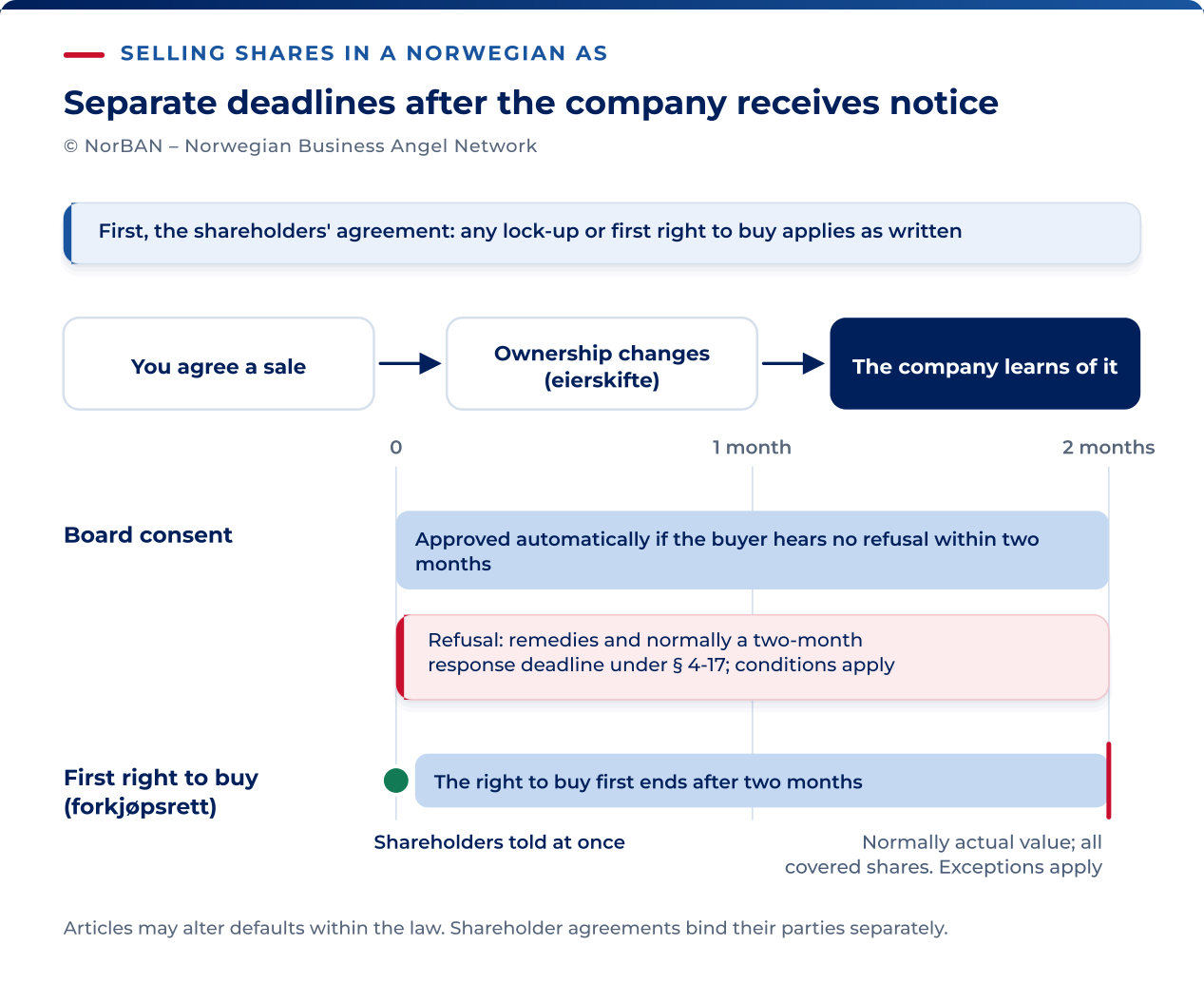
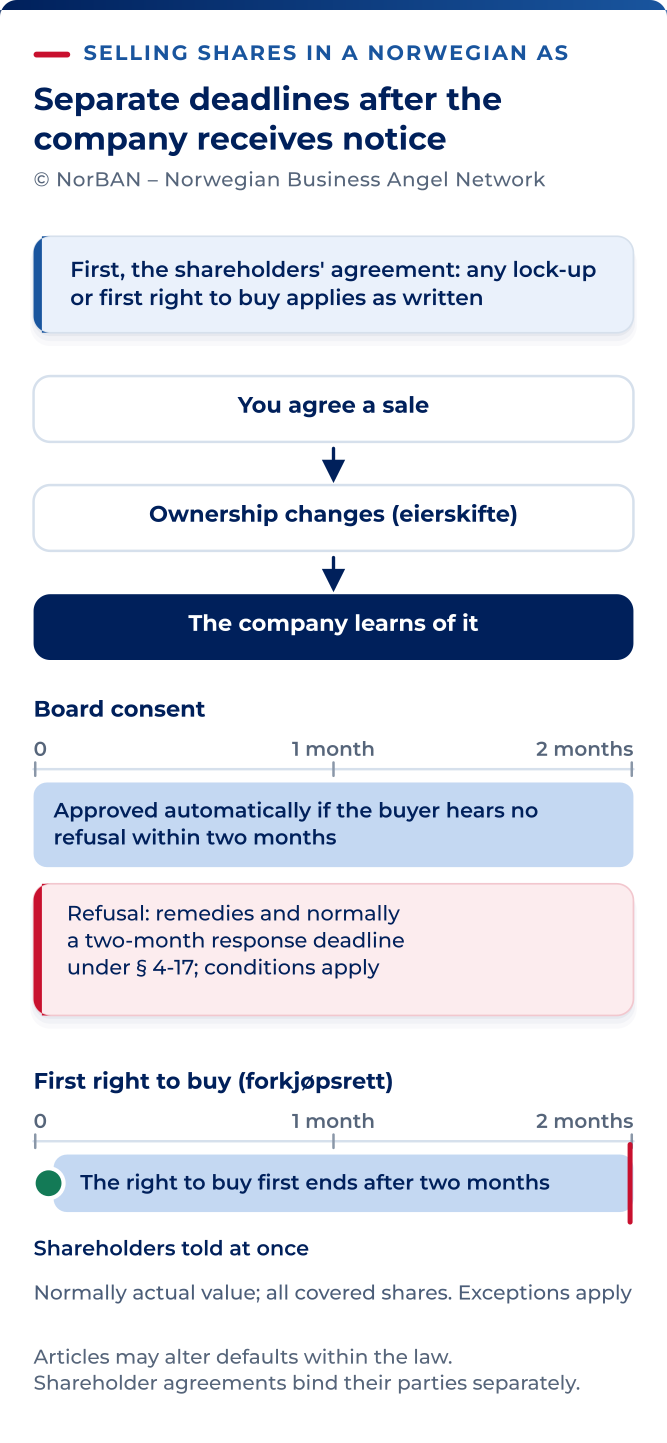
By default an acquisition requires company consent, decided by the board unless the articles provide otherwise. Refusal requires a legitimate reason and must be communicated with reasons. If refusal does not reach the acquirer within two months after the company receives notice, consent is deemed given (sections 4-15–4-16). Special family-transfer protections also apply.
After refusal, section 4-17 provides routes to unwind or resell, challenge the refusal or seek redemption, each subject to its conditions and deadlines. Redemption is not unconditional: a substitute purchaser or substantial harm or unfairness to the company can prevent it. The valuation is actual value at the claim date; Flesberg (Rt-2007-1392) addresses the expected sale-value measure in this context.
The default statutory transfer-pre-emption right concerns a share that has changed owner under section 4-19. Signing an agreement is not necessarily the same event as ownership passing. The articles can provide an earlier trigger for shares that are to be transferred.
Where the right applies, notice exercising it must reach the company within two months after notice of the ownership change. Section 4-23 also sets valuation-procedure and payment deadlines. Section 4-21 has exceptions for certain close relatives and rules on taking the full relevant block; do not treat every transfer as identical.
The articles can alter the consent and pre-emption defaults within statutory limits. A shareholders’ agreement separately creates contractual rights and obligations among its parties. It does not itself amend the articles, but breaching it can still have contractual consequences; corporate validity must be assessed separately.
Tag-along and drag-along are not general statutory rights under the Companies Act; include them in the relevant agreement if wanted. Keep them distinct from statutory compulsory acquisition under section 4-26, which has its own conditions.
The general meeting behind every share issue
A signature on a subscription document is not a closing. The company’s share capital and the nominal value of the shares sit in the articles, so every capital increase is also an amendment to them.
The ordinary general-meeting threshold for an articles amendment is at least two thirds of votes cast and represented capital under section 5-18. Stricter articles, class approvals or individual-consent rules can apply. A properly authorised board can decide a capital increase within its registered authority.
The capital-increase resolution must state the following (§ 10-1):
- Increase amount, or upper and lower limits.
- Nominal value and subscription price per share.
- Who may subscribe and the subscription deadline.
- Time and place for settlement.
- Start of dividend rights and the share class where relevant.
- Estimated issue expenses, including any underwriting commission and the guarantee’s content.
- Special terms for non-cash contributions, set-off or other arrangements covered by section 10-2, with the required board report and auditor confirmation.
Explain both deadlines when planning the closing with a foreign investor. The subscription deadline may be set at no more than three months from the date of the resolution.
The increase must then be notified to the Register of Business Enterprises within three months of that subscription deadline (§ 10-9). Miss it and registration cannot happen, the resolution lapses, and the subscriptions cease to bind.
Under-subscription has its own bar. The resolution may set a minimum amount or a band, and registration cannot occur where the amount bindingly subscribed and allotted falls below the fixed increase or the stated minimum (§ 10-10). A round that does not reach its own floor cannot be registered at all.
A board authority must be registered before the board uses it. Check registration, scope, amount and expiry before making the issue decision, including where shares will satisfy options or convertible rights.
Allow for notice: normally at least one week for an AS, longer if the articles require it. Depository-registered shares have a two-week rule under section 4-4. Simplified proceedings under section 5-7 can omit ordinary meeting formalities if no shareholder objects and the participation and other safeguards are met. Written consent from everyone is not the statutory wording, though documenting the process is important.
Two payment details catch cross-border rounds specifically.
- A cash contribution may be confirmed by an auditor, a financial institution in Norway or another EEA state, a lawyer or an authorised accountant. For non-cash contributions or set-off, an auditor must confirm settlement. A board report signed by the whole board and confirmed by an auditor is also required. The valuation may be no earlier than four weeks before the resolution.
- If a financial institution in another EEA state confirms payment, Brønnøysundregistrene’s guidance requires the whole notification to be sent on paper. Clarify this before payment and allow time for processing.
Do not confuse the bank’s location with the contribution’s currency. An NOK cash contribution to a qualifying foreign bank is not non-cash merely because the account is abroad. A contribution actually made in foreign currency is treated as non-cash and requires the corresponding report and auditor confirmation. The legislative explanation preserves this currency distinction. Agree the route before payment.
No notary, and where an apostille genuinely belongs
There is no general statutory notarisation step for an ordinary Norwegian share issue or transfer. Contribution confirmation and registration apply to the issue under their own rules; an ordinary transfer does not involve registering new share capital. Supporting documents may nevertheless require certification for identification or foreign use.
Norway does have a notarius publicus, sitting at the district courts, and it exists for documents used abroad. It certifies a signature, a signature together with a company’s signing authority, a state-authorised translator’s signature, and copies against an original. The courts publish what each certification requires and what it costs.
An apostille authenticates the relevant public signature or seal, not the document’s substantive content. Statsforvalteren issues apostilles for qualifying Norwegian documents. Some public originals can receive one directly; private documents often need notarial certification first. Other destinations may require legalisation through the relevant authorities instead.
If an adviser asks for notarised or apostilled documents, ask which document, recipient and requirement the request concerns. The absence of a mandatory notarial closing step does not make every supporting-document request unnecessary.
A bank or counterparty may require certified foreign corporate or identity documents. Norwegian documents for use abroad may have corresponding requirements. Confirm the exact form with the recipient before paying for certification or translation.
For the outbound case, the Register of Business Enterprises sells an English-language certificate of registration and a notarised version of it, listed with its other products. The objects clause from the articles is not normally included in the English products, so ask for it if the foreign registry wants it.
The public register helps verify the company and registered authority. Under section 7-1, registered facts can be treated as known where knowledge matters legally. There is a specific exception for transactions before the sixteenth day after publication where the third party proves knowledge was impossible. Public access follows section 9-1. A certificate is useful evidence, not proof of all ownership or contractual rights.
What a two-thirds majority decides
Foreign counsel expect protective provisions to be negotiated, so they look for them in the shareholders’ agreement and ask why the list is short. Part of the answer is that Norwegian law supplies them.
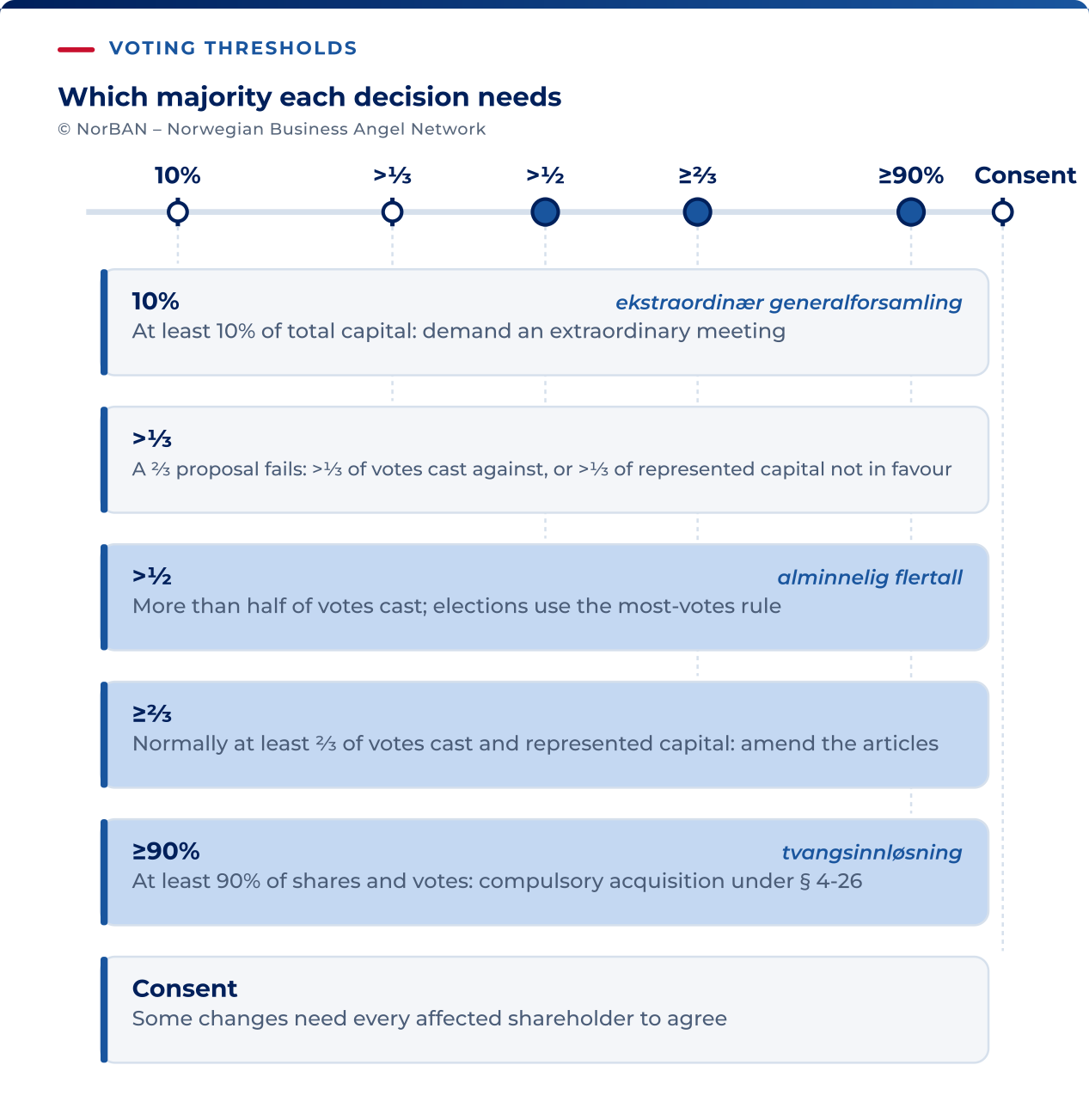
Ordinary resolutions normally require more than half of votes cast, with tie and election rules under section 5-17. Articles amendments normally need two thirds of both votes cast and represented capital. Check stricter requirements and special consent or class rules.
The two-thirds threshold is relevant to ordinary capital-increase decisions and waiver of subscription pre-emption under section 10-5. Changes to class or shareholder rights can require additional approval. A valid board authority means the general meeting need not vote on each individual issue within it.
A proposal requiring two thirds fails if more than one third of votes cast oppose it, or more than one third of represented capital does not support it. The denominator is meeting participation, not necessarily all issued shares. This statutory protection does not replace every contractual veto the parties may need.
The regulators counsel asks about next
Two questions usually close the legal conversation, and both have short answers for an ordinary startup.
Prospectus. Check whether the proposed offer or admission to trading triggers a prospectus requirement and whether an exemption applies. Under the Norwegian rules checked on 9 October 2026, public offers below EUR 8 million over 12 months are exempt from the EEA offer-prospectus requirement under section 7-3. National prospectus rules generally cover offers from EUR 1 million to below EUR 8 million, subject to exemptions. Admission to a regulated market has separate triggers.
Use Finanstilsynet’s guidance and the current Norwegian legislation. The EU’s Listing Act changes are not automatically Norwegian law; Finanstilsynet states they have not yet been implemented here. Recheck commencement before applying changed EU thresholds to a Norwegian offer.
A relevant exemption can be an offer to fewer than 150 non-qualified persons per EEA state, subject to the applicable conditions. Count the people addressed, not only those who eventually invest. Round size or the label “angel round” does not itself establish an exemption.
Ownership control. There is no general approval requirement for foreign ownership of a Norwegian AS. Sector rules and the government’s exceptional intervention power under sikkerhetsloven § 2-5 can still matter, even without designation under the Act. Ownership control is tied to undertakings brought within the National Security Act, where an acquirer of a qualified holding must notify (sikkerhetsloven § 10-1). Nasjonal sikkerhetsmyndighet publishes who the duty reaches and how notification works.
The list to hand your investor’s counsel
Send a short source-linked note before the legal discussion. It gives advisers a common starting point and helps separate standard Norwegian rules from questions about this particular transaction.
| Question | Where to start |
|---|---|
| Where is the cap table? | Supply the working cap table and reconcile it to the legal shareholder record. The public-access rules concern the latter, not every option or convertible right (sections 4-5–4-6). |
| Does the record prove title? | Exercise of rights follows section 4-2; competing acquisitions and creditor protection involve notification under section 4-13. Check underlying evidence too. |
| Can a nominee hold for us? | Only within the depository and approved-nominee framework; check the definition of foreign shareholder and voting limits (section 4-4). |
| Who consents? | Normally the board. The two-month deemed-consent period runs from notice of acquisition reaching the company (section 4-16). |
| When does transfer pre-emption arise? | Normally when ownership changes, subject to articles and exceptions. Exercise and payment deadlines follow section 4-23. |
| Where are drag and tag rights? | In the relevant agreement if included. Statutory compulsory acquisition is a different mechanism. |
| When is the issue complete? | Distinguish contractual closing from corporate registration. Follow the valid resolution or board authority, subscription, full settlement, confirmation and filing; capital is increased on registration under section 10-10. |
| What if subscriptions are too low? | Binding subscriptions and allotments must reach the fixed increase or stated minimum (section 10-10). |
| Is a notary needed? | Not as a general issue or transfer step; supporting documents may need certification. |
| What protects a minority? | Normal two-thirds thresholds, enhanced consent requirements and abuse-of-authority rules; check articles and contracts as well (section 5-18). |
| Is a prospectus needed? | Check offer type, amount, recipients and exemptions against current Norwegian rules and Finanstilsynet. |
| Is ownership approval needed? | Usually not for an ordinary AS; check sector and security rules, including sections 2-5 and 10-1. |
Update the note when the articles, transaction structure or applicable rules change. Give participants the current version and keep a record of what was shared.