
Size the round to a milestone, not a wish
Start by deciding what the company needs to prove with the money. A raise carries the company to a milestone (milepæl) that raises its value in the eyes of the next investor, and it has to last through the next raise as well. What feels achievable, and what dilution feels tolerable, come after that.
Ketil Wig’s financing-strategy paper for Remis works the chain through on a model company raising three rounds against ordinary investor return requirements. Each krone of new equity has to produce about 2.8 kroner of valuation growth before the next round, and the growth has to be visible to the investor pricing that round.
The figures come from the paper’s 2018 model, but its approach remains useful. A milestone has to be measurable and verifiable by an outsider. A claimed breakthrough needs evidence; three paying customers on annual contracts give an investor something they can check. Wig sorts value into five families, and a round should move at least one:
- Technical and product.
- Intellectual property, know-how protection and brand.
- Commercial and market.
- Organisation and team.
- Regulatory.
The runway arithmetic
Multiply the monthly burn after your planned hires by the months needed to reach the milestone. Then add a buffer for the next raise, since the company must keep operating while you secure it.
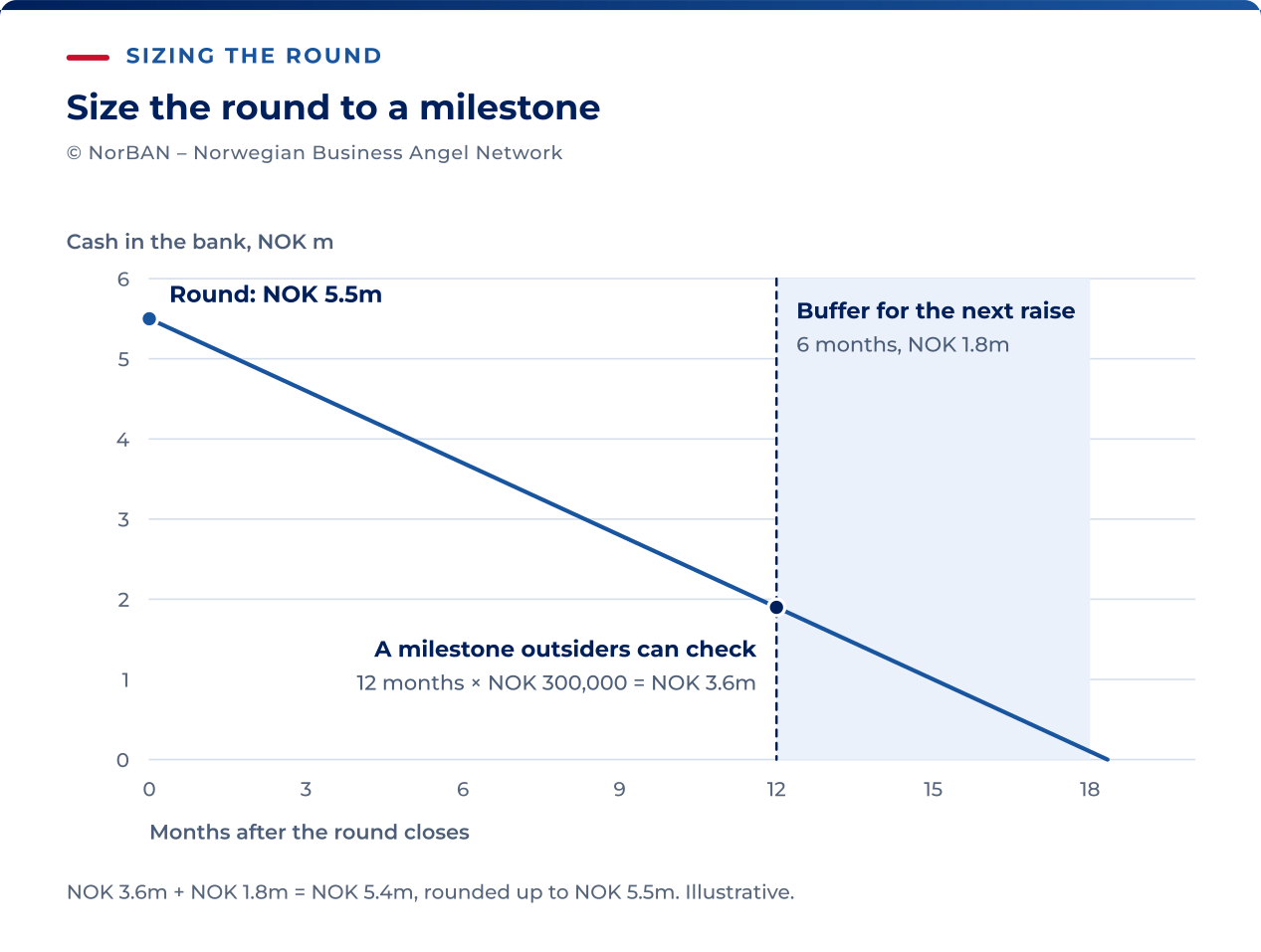
| Step | Example |
|---|---|
| Monthly burn once the plan’s hires are made | NOK 300,000 |
| Months to a milestone an outsider can verify | 12 |
| Cash to reach the milestone | NOK 3.6 million |
| Buffer for the next raise, which takes months and slips | 6 months, NOK 1.8 million |
| Round to ask for | NOK 5.4 million, rounded to NOK 5.5 million |
The convention you will hear from investors is twelve to eighteen months of runway after a round, sometimes twenty-four. It comes from this sum, so a company whose milestone is nine months away and whose raise takes four has no reason to copy a number built for someone else’s plan.
Check the answer against the people who will fund it. NorBAN’s published figures put most angel tickets between half a million and two million kroner, a normal first or second round at four to six angels, and the angels able to anchor a round at roughly one in six.
For example, a NOK 5.5 million round could combine an anchor investor with four or five others. The number depends on how much each invests. Before settling the amount, identify potential anchors you already know and put their names in the plan.
Then run Paul Graham’s test, written for American founders in 2015 and true anywhere. It asks whether the company reaches profitability on the money it has left, with expenses constant and revenue growing as it has lately. If not, write down precisely what you would do to survive without another round, before you need to.
What raising too little costs
CB Insights’ March 2026 post-mortems of 431 American venture-backed shutdowns since 2023 put running out of capital at 70 per cent, and call it the symptom. Poor product-market fit, bad timing and unsustainable unit economics are why the capital ran out. Too small a round removes the months in which you could have found that out and fixed it.
If the milestone is missed, you may need bridge financing from existing investors. A convertible loan or a SLIP can be used, but they are not the only routes. Conversion, any discount and any valuation cap depend on the terms. Norwegian guidance often illustrates a 20% discount; that is a negotiated term, not a legal rule.
With no alternative, you have little room to negotiate, and investors know it. New investors will see the loan and its conversion discount as evidence of the missed milestone. A bridge planned from the start is easier to explain as staged financing.
What raising too much costs
If the company’s valuation rises as planned, money raised in the first round costs more ownership than the same amount raised later. Extra cash now therefore has a dilution cost. Balance that cost against the risk that later funding is delayed, unavailable or priced lower.
If you raise the extra money by increasing the valuation, you also increase what the company must achieve before the next round. In Wig’s model, more than doubling the starting valuation raises the value each krone of cash must generate from 2.8 to 4.4 times, and the next round has to clear it.
A large round also changes behaviour. Burn grows to meet the cash, hires arrive before the evidence that justifies them, and the plan is now judged against a bigger number.
When to start, and how long a raise takes
NorBAN’s published figures put an angel round at typically two to four months to close. The sequence is preparing the investment case and identifying suitable angels, followed by introductions, meetings, due diligence and negotiation of terms.
It is much shorter for a well-prepared company with strong investor interest, and considerably longer when the round is difficult to fill or core documentation is missing.
Once an investor has decided, the legal documentation and completion can be quick, and a transfer within days of agreement happens, though rarely. Plan for several months from the first investor conversations to the full investment secured.
Start while your remaining runway still covers a slow raise and a buffer afterwards. Once it no longer does, investors can see when you will run out of cash, which weakens your position on terms.
NFX’s fundraising manual, written for American founders, adds the habit that keeps a raise honest. Set an objective date for each phase and hold yourself to it, because the process takes longer than you think.
Staging money across rounds
The Norwegian pattern interleaves public money with share issues (emisjon). Each round is sized to a milestone, a grant lands between rounds where it extends the runway without repricing the company, and the R&D tax deduction, SkatteFUNN, refunds part of last year’s development cost with the following year’s tax settlement.
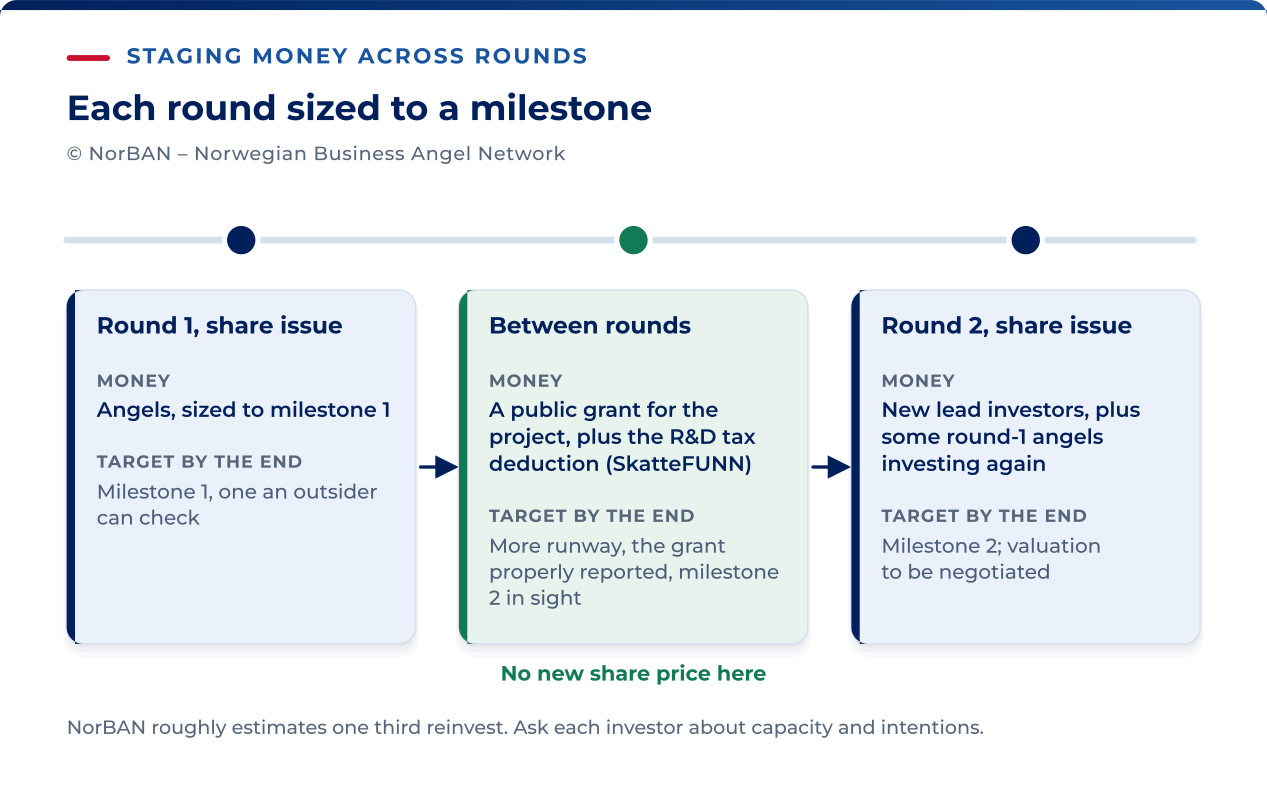
| Stage | Money | What must be true by the end of it |
|---|---|---|
| Round 1, share issue | Angels, sized to milestone 1 as above | Milestone 1, verifiable by an outsider |
| Between rounds | A public grant against the project plan, plus the R&D tax deduction on last year’s costs | Runway extended, the grant reported cleanly, milestone 2 in sight |
| Round 2, share issue | New core investors, plus follow-on from some of round 1 | Milestone 2, at a price round 1’s investors are glad to see |
Plan the next round on the assumption that most of your current angels will not be in it. NorBAN’s figures put those with capacity to follow on at about a third, so expect to find new core investors for each round.
Before this round closes, identify who could fund the next round and what they would need to see by then. Record both in the plan; investors in the current round will ask about them.