What soft funding buys, and what it costs
Non-dilutive public funding takes founder time to apply for and report on. Its conditions can continue for years after payment.
Read the own-financing rules for the specific scheme. Oppstartstilskudd 2 covers at most 50% of approved project costs, up to NOK 1 million. The rest must be available before the first payment. Retained or saved funds and private capital, including qualifying subordinated loans or SLIP capital, can count. The funds cannot be other public support or committed elsewhere; contributed capital cannot be serviced or repaid during the project. An auditor or authorised accountant must confirm availability.
Oppstartslån also requires own financing at least equal to the amount disbursed, subject to its conditions. Oppstartstilskudd 1 can cover up to 100% of eligible external invoiced costs, capped at NOK 150,000. Its payment schedule is 50% at acceptance and 50% at completion: plan liquidity for the unpaid portion and all excluded costs.
Blended finance combines a grant with an investment, such as shares or a convertible loan. The investment can dilute shareholders and must be accounted for according to its actual terms, separately from the grant.
How the instruments differ
For a team of three, the time an application takes and the obligations it creates can matter more than the award amount. Check these distinctions before applying.
- Entitlement or competition. SkatteFUNN is available when its conditions are met. Other schemes assess applications against call criteria and available funds, with fixed deadlines or rolling submissions.
- Financing form. Distinguish grants, loans, guarantees, tax credits and equity investment. They affect ownership, debt and cash differently.
- National or European. Norway participates in Horizon Europe as an associated country. Check each call’s eligibility, consortium and control requirements; not every EU programme is identical.
- After rejection. Innovation Norway is generally outside the Public Administration Act, under section 6 of its own act. Some decisions have specific complaint routes, including loans and guarantees. Check its complaints guidance and the decision letter.
Choosing what to apply for
Start with the funding suited to your current stage, giving priority to applications your team has time to complete.
- Testing demand. Consider Oppstartstilskudd 1 if the company and project qualify. It covers eligible purchased services, not founder time. Allow for costs paid before the final grant payment. An incubator may provide useful support on separate participation terms.
- An approved R&D project. Keep project accounts and time records current, and arrange the auditor’s confirmation for the tax claim. Identify which costs any additional support will cover.
- During fundraising. Check the permitted project start date before work begins. Some schemes require an application before starting; for awards covered by FOR-2018-05-23-747, starting before award is a recovery ground. Show investors which grants are awarded and which are merely applied for.
- A European project. Match the call to your project and capacity. Horizon Europe collaboration projects involve a consortium; EIC Accelerator generally targets a single company. Investigate PES support for preparing the EU application, including its payment threshold.
A grant can extend runway without pricing the company again. Compare the amount, timing, eligible use, own-financing requirement and administrative work. An earlier payment may be more useful for liquidity than a larger later award, but timing alone does not determine value.
Apply in time and protect capacity for sales and delivery. An award letter sets the conditions for payment; some schemes allow advances before costs are incurred. Build grants and any equity round into one financing plan (payment and reporting).
The schemes
Identify instruments suited to the proposed work, then check their costs and conditions before committing time to an application.
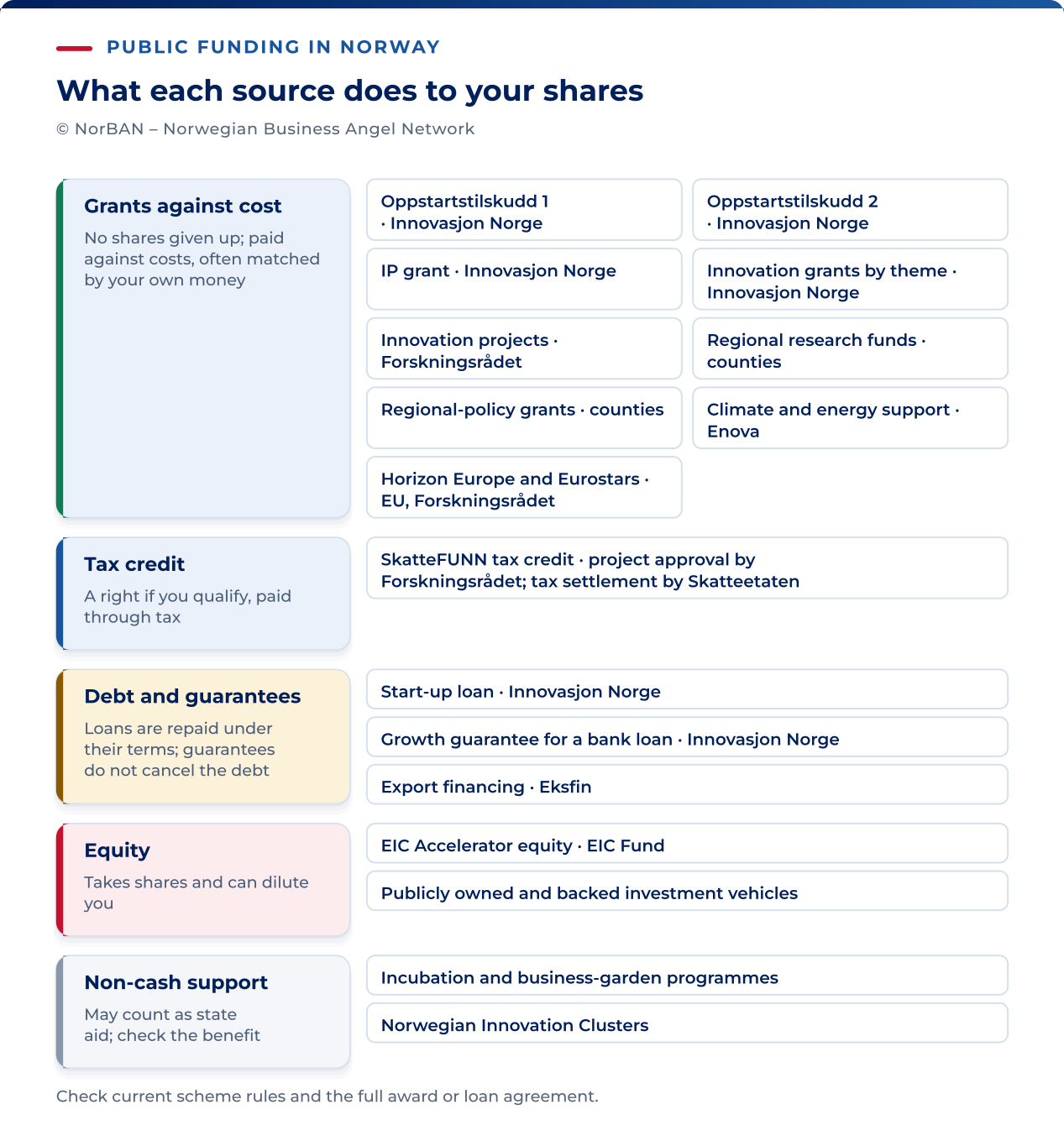
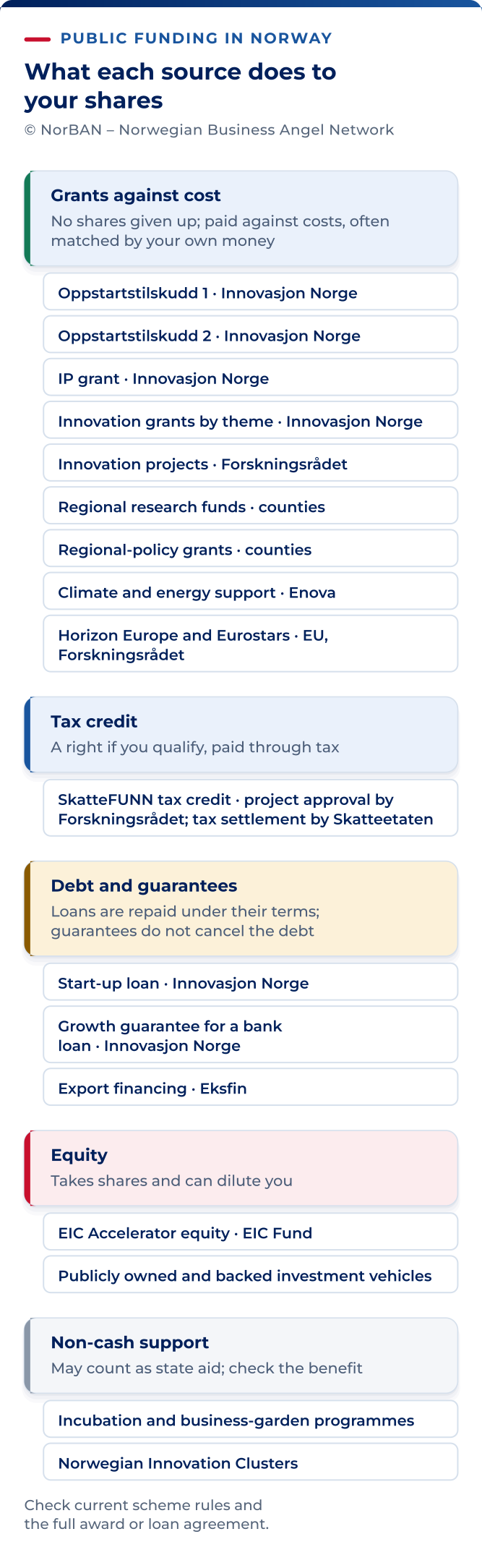
Market-clarification grant (oppstartstilskudd 1), Innovasjon Norge
What it funds. Purchased external services for testing whether a market exists; not own labour
Assessment. Rolling assessment of the published company and project criteria, including evidence of customer needs and a plan for testing demand.
Company requirements. Document eligible external invoices and submit the final report and payment request. The grant can cover all eligible invoiced costs within the NOK 150,000 cap; own time, related-party costs and VAT are excluded. Half is paid at acceptance and half at completion.
Effect on the round. No dilution from the grant. Budget for the portion paid at completion and costs outside the award.
Where the current terms are published. innovasjonnorge.no
Start-up grant (oppstartstilskudd 2), Innovasjon Norge
What it funds. Demanding technology development in a young AS
How it is decided. Adviser-assessed on effects, degree of innovation and technical risk, and implementation capability
Company requirements. Available own financing for at least half the approved costs, subject to the rules above. This need not be newly issued equity. Document the funds, project costs and final delivery as required by the award.
Effect on the round. No dilution from the grant itself. Include the required own financing in the overall funding plan; it need not all come from the round.
Where the current terms are published. innovasjonnorge.no
IP clarification grant, Innovasjon Norge
What it funds. Purchased external work on patentability, freedom to operate, IP mapping and IP strategy
How it is decided. Case by case, with the grant required to be necessary to trigger the work
Company requirements. Active dialogue with Innovation Norway’s IP advisers, eligibility for de minimis aid, and documentation of work and invoices. Disclose other public support for the same costs; it can reduce or eliminate the grant.
What it does to a round. Small and non-dilutive
Where the current terms are published. innovasjonnorge.no
Innovation grants by theme, Innovasjon Norge
What it funds. Development projects with significant technical risk, run as separate schemes by theme, for example with a committed pilot customer or in environmental technology
How it is decided. Assessed against each scheme’s published criteria
What it costs the company. State-aid rules cap the public share, and financing for the rest is documented before the first payment. Project accounts checked by an auditor or authorised accountant
Effect on the round. Include the uncovered project costs in the financing plan, using the funding sources the scheme permits.
Where the current terms are published. innovasjonnorge.no
Start-up loan, Innovasjon Norge
What it funds. Working capital in a young AS or NUF
How it is decided. Adviser-assessed credit decision
Company requirements. Available own financing matching each disbursement, from permitted sources rather than other public aid. An external board member with relevant experience. Agreed security in company assets, including transferable IP where applicable. Contributed financing cannot be serviced or repaid before the start-up loan is repaid.
Effect on the round. Adds debt and security ahead of equity. Check the actual start-up loan terms before changes of ownership or borrower; the general guidance for other Innovation Norway loans expressly excludes this product.
Where the current terms are published. innovasjonnorge.no
Growth guarantee (Vekstgaranti), Innovasjon Norge through participating banks
What it funds. Bank lending to an SME with repayment capacity and insufficient collateral
How it is decided. The bank assesses credit and applies; Innovasjon Norge checks scheme compliance
Company requirements. Meet the bank’s loan terms and the guarantee conditions, including applicable information, audit and control obligations. The guarantee does not release the borrower from its debt.
Effect on the round. The bank lends to the company. The guarantee is not a grant, and the company remains liable for the loan.
Current terms. Growth Guarantee scheme and borrower documentation.
R&D tax credit (SkatteFUNN), project approval by Forskningsrådet and tax settlement through Skatteetaten
What it funds. Approved R&D cost: own personnel time, purchased R&D services in the EEA or a treaty state, and other direct project cost
How it is decided. Rights-based under skatteloven § 16-40; every applicant meeting the conditions qualifies
Company requirements. Current project accounts and daily time records, signed by the employee and project manager at least quarterly. An auditor confirms the cost basis claimed in the tax return, even if the company otherwise opts out of audit. Submit annual status and final reports to the Research Council separately.
What it does to a round. Cash arrives through a later tax settlement. Model the payment date separately from accounting recognition, which the accountant must confirm
Where the current terms are published. skatteetaten.no
Innovation projects, demonstration projects and industrial PhD, Forskningsrådet
What it funds. Company-led research and development
Assessment. The current call sets competition, submission deadlines or rolling assessment, expert review and funding criteria. These differ between programme types.
What it costs the company. The Council’s general terms form part of the contract: project accounting, reporting, archiving, audit rights, and approval before a change
What it does to a round. Contractual obligations a buyer and a new investor will read
Where the current terms are published. forskningsradet.no
Regional research funds, administered by the relevant county authority
What it funds. Regional research and innovation projects
Assessment. The regional call sets the criteria and whether applications have a fixed deadline or are assessed on a rolling basis. Available schemes differ between counties; the regional portal also lists FORREGION calls.
What it costs the company. Published per fund and per call
What it does to a round. As project funding
Where the current terms are published. regionaleforskningsfond.no
County and municipal regional-policy grants, the county authorities
What it funds. Regional-policy measures, published per post and per county
How it is decided. Decided by the county authority under ministry regulations
What it costs the company. Reporting under the award decision. FOR-2018-05-23-747 § 8 allows reduction, a stop in payment or repayment on five conduct-based grounds
What it does to a round. Non-dilutive. Beginning the work before the award is itself a clawback ground
Where the current terms are published. lovdata.no and the county’s own pages
Climate and energy support, Enova SF
What it funds. Industry, maritime and land transport, buildings and energy systems
How it is decided. Per programme, with substantial professional autonomy in the body
What it costs the company. Published per programme
What it does to a round. Non-dilutive
Where the current terms are published. enova.no
Export financing, Eksfin
What it funds. Working capital, investment and buyer financing tied to export activity
How it is decided. Application, often alongside a bank
What it costs the company. Loan and guarantee documentation, and the security it carries
What it does to a round. Debt, and a security package a later investor will read
Where the current terms are published. eksfin.no
Horizon Europe collaborative projects, the European Commission with Forskningsrådet as national contact point
What it funds. Consortium research and development
How it is decided. Competitive central evaluation per call
Obligations for the company. The grant agreement covers record-keeping and retention (Article 20), checks and audits (Article 25), and rights to results (Article 16 and Annex 5). The final reporting must include a Results Ownership List identifying who owns the results.
What it does to a round. Non-dilutive, with obligations running years past the project
Where the current terms are published. ec.europa.eu
EIC Accelerator, the European Innovation Council with the EIC Fund holding the investment limb
What it funds. Innovation activities, with a separate investment limb in equity or quasi-equity
Assessment. Short application, full application and jury interview. Successful applicants then arrange the grant agreement, while an investment component undergoes the fund’s separate due diligence and decision.
What it costs the company. Grant-agreement obligations on the grant limb. Shareholder obligations on the investment limb
What it does to a round. Dilutive where the investment limb is taken
Where the current terms are published. eic.ec.europa.eu
Eurostars, Eureka with the European Commission; Forskningsrådet funds the Norwegian participants
What it funds. International SME consortium projects
How it is decided. Competitive central evaluation, then national funding of the qualified national participants
What it costs the company. An innovative SME from a Eurostars country leads the consortium; the lead need not be Norwegian. Norwegian participants must meet the Research Council’s national funding conditions, including financial requirements and subcontracting limits. Check the current call and the terms for the Norwegian part.
What it does to a round. The consortium budget decides the company’s own share
Where the current terms are published. forskningsradet.no
Project-establishment support, Forskningsrådet
What it funds. The work of preparing an EU application
How it is decided. Application-based against a published quality threshold
What it costs the company. Companies apply per individual EU application
What it does to a round. Non-dilutive. Pays for the application, not the project
Where the current terms are published. forskningsradet.no
Incubation and business-garden programmes, administered by Innovation Norway and delivered by local operators
What it funds. Concept development, facilities and tools, mentors, investor network, links to research environments
How it is decided. Staged intake from first contact to scaling
Company requirements. Meet the operator’s admission criteria and agree services, development goals, own payment and reporting. The support basis and enterprise-size requirements depend on the service and programme.
Effect on the round. Usually subsidised services rather than a cash grant. Record any aid value notified by the operator and include it when assessing relevant public-support limits.
Current terms. Innovation Norway’s programme information and the relevant incubator or business garden.
Norwegian Innovation Clusters, Innovasjon Norge with Siva and Forskningsrådet
What it funds. Competence, network, access to capital and joint innovation projects
How it is decided. Cluster-level admission on published criteria; a company joins through a member cluster
Company requirements. Join through a participating cluster on its terms. The programme’s maximum support period concerns the cluster, not a universal time limit on each company’s membership.
What it does to a round. Non-cash
Where the current terms are published. nic.innovasjonnorge.no
Enterprise Europe Network, with Innovasjon Norge as the Norwegian node
What it funds. Business advisory and international partner search
How it is decided. Advisory intake
Company requirements. Agree the scope with the adviser and provide the information needed for the service. Check any service-specific conditions.
What it does to a round. Non-cash
Where the current terms are published. enterpriseeuropenetwork.no
Blended finance and dilution
EIC Accelerator offers blended finance, grant-only and investment-only routes, subject to their respective eligibility rules. Small mid-caps can apply for investment only. Where a blended-finance company is not yet investment-ready after due diligence, the investment can be reconsidered at defined milestones while the grant activities start.
The investment component is decided separately by the EIC Fund following its own due diligence. Its rights depend on the chosen instrument and agreements. A convertible loan initially makes the fund a creditor; a share investment makes it a shareholder.
Before signing, work out what instrument the Fund takes, what it converts into and on what trigger, who must consent to what afterwards, and how a lead at the next round will read a public shareholder on the register.
Limits on combining public support
When aid covers the same eligible costs, combine it under the applicable cumulation rules and limits. Under GBER Article 8, centrally managed EU funding outside national control is treated separately from state aid for the aid-intensity test, but their combined public funding still has a ceiling. Different cost categories, aid bases and award conditions may change the calculation.
Before applying, check how a new award would affect support for your existing projects. A reduction in an earlier award can outweigh the new funding.
| Combination | What to check | Source |
|---|---|---|
| National aid and other aid for the same costs | Aid basis, eligible costs and maximum intensity or amount | GBER Article 8 |
| Centrally managed EU funding and state aid | The separate rule for EU funding outside national control and the ceiling on total public funding | GBER Article 8(2) |
| Additional support for costs already funded by Innovation Norway | Disclose it. The award can be reduced or cancelled under its terms; different costs may be supported separately | Oppstartstilskudd 2 |
| SkatteFUNN with other public project support | Calculate limits across the project period and reduce the deduction when necessary. Follow the tax guidance on adjustments | FSFIN section 16-40-6 and Skatte-ABC |
| Aid reporting | Check who must report, the applicable register or form, and the current threshold. Reporting does not itself authorise excess aid | RF-1354 |
For SkatteFUNN, assess financial difficulty at approval both for the applicant and the relevant economic group. The state-aid group is based on actual control and is not always identical to the accounting group. Insolvency is assessed at company level.
The starting point is the latest accounts prepared before approval. A suitable interim balance sheet dated between those accounts and approval may document a correction. Accounts prepared only after approval do not replace the basis retrospectively. See Skatte-ABC F-29-2.2 for the detailed tests and small-business exceptions.
The obligations that survive the payment
Check your own award against this list before a round and again before a sale, because a buyer’s adviser will work through it in an afternoon.
- SkatteFUNN: keep project accounts current and time records daily; the employee and project manager sign at least quarterly. The auditor confirms the tax-claim cost basis even without an ordinary audit requirement. Research Council status and final reports are separate and do not require that auditor confirmation.
- Innovation Norway: follow the award’s account-control requirements. Its 7 April 2026 change allows eligible interim payments on accounts not yet externally checked; final settlement still requires the specified control. Oppstartstilskudd 1 has its own invoice-documentation process.
- Research Council 2025 terms: retain the final report and project data for at least ten years after the contract period. Within the stated limits, evaluation assistance can be required for up to ten years after the final report. Contract assignment or pledging requires prior written consent. Check project-owner changes separately.
- Foreign control and project results: notify non-EEA control of the project owner or a partner immediately in writing. Transfer of result ownership or exclusive rights to a non-partner outside the EEA requires written approval; no reply within four weeks of written notification may be treated as approval under the terms. These provisions apply during the project and for three years afterwards.
- Use of results: secure the necessary rights and pursue exploitation within a reasonable time. The terms allow creators to request rights where results are unused, subject to agreements and exceptions for ongoing exploitation efforts or commercially justified non-use.
- EU grants: follow the agreement’s record-retention, reporting, audit and result-rights provisions, including the periods selected in its Data Sheet.
Read your own award documentation before signing, again before a round and again before a sale. The position differs by instrument, and only your own papers say which one you are in.
Treat each financing agreement separately. Research Council grants can have foreign-control obligations. SkatteFUNN approval cannot transfer to another organisation number. Innovation Norway loan and EIF guarantee terms may require consents or ownership information; identify the actual product and agreement before applying those rules.
For grants, use the award letter and the exact terms it incorporates. A general provider webpage is useful guidance, but does not establish all the conditions of your award.
Repayment or loss of a grant depends on the scheme and award terms. Check requirements on ownership, project purpose, eligible costs, reporting and record retention. Grounds for recovery can include incorrect information, use outside the purpose, excess payments or breaches of state-aid rules; there is no single three-year documentation deadline for all schemes.
For awards covered by FOR-2018-05-23-747 section 8, recovery grounds include starting before award, incorrect application information, unauthorised departures from the rules or award, lower costs, and missing required reports. The provision does not make ownership changes universally harmless: check the award conditions.
For SkatteFUNN, financial difficulty is assessed at the date the Research Council approves the application. Later financial difficulty or bankruptcy does not itself invalidate that assessment. This does not excuse other eligibility failures or incorrect information at approval (Skatte-ABC F-29-2.2.5).
Check the enterprise-size calculation after an ownership change. Under FSFIN section 16-40-5, partner enterprises normally count proportionately, while linked enterprises count in full. Use the prescribed staff and financial data and aggregation rules; the recipient’s own headcount alone is not sufficient.
Enterprise size affects the maximum combined public support and eligibility for first-time patenting costs. Small and medium-sized enterprises can include qualifying first-time patenting costs under FSFIN section 16-40-6. Check the category and the effect of all other public support for the relevant costs.
Separate a change of ownership from a change of organisation number. With the same recipient, check changed project facts, enterprise size, state-aid limits and applicable notification requirements; do not presume that every ownership change cancels approval. Approval cannot transfer to a new organisation number. The Research Council requires a final report from the old recipient and a new application for the remaining project, submitted by 15 December in the year of the change. It processes the new application after receiving the old project’s final report (project changes). Ask for a specific clarification only where the actual transaction leaves a requirement unresolved.
For an EU grant, the agreement sets out the relevant procedures. Accession of new beneficiaries sits at article 40, transfer of the agreement at article 41, amendments at article 39, and intellectual property at article 16 and Annex 5, with the Results Ownership List completed in the final periodic report.
An incomplete Results Ownership List blocks the final report, and the final report is what releases the final payment, so the list belongs in the project plan from the start.
Results can change hands, but not quietly. A beneficiary may transfer ownership of its results provided that does not affect compliance with the agreement, and it must pass its obligations under the agreement on to the new owner, who must pass them on again in any later transfer.
Under the Horizon Europe terms, beneficiaries with access rights normally receive at least 45 days’ notice of a transfer and can object within 30 days if it would harm those rights. Shorter periods may be agreed in writing, and the terms allow certain other written waivers and legal exceptions. If a valid objection is raised, wait for agreement before transferring.
An exclusive licence is a stricter case. It is available only where every other beneficiary concerned has waived its access rights (Annotated Grant Agreement, article 16 and Annex 5).
Separately, and only where the call conditions provide for it, the granting authority may object to a transfer or an exclusive licence for a period after the action ends.
That right is narrow. It reaches results funded under the grant, where the recipient is established outside the EU in a country not associated with Horizon Europe, and where the authority considers the transfer contrary to EU interests.
That route has its own procedure. The beneficiary notifies the authority formally before transferring, identifying the results, describing the new owner or licensee and the intended exploitation, and assessing the likely effect on EU interests.
Where this objection right applies, the authority must notify an objection within 60 days of the notification or requested additional information. Wait during that period, do not proceed over an objection, and satisfy any conditions attached to an approval. The agreement also permits a request to waive the objection right for an identified recipient with safeguards.
A share sale does not itself transfer the company’s project results. It can nevertheless affect other grant conditions: Article 32.3 allows termination where an ownership change is likely to substantially affect project implementation or calls the award decision into question. Separately, a later transfer or exclusive licence of results may engage the applicable objection rules. Check the call, signed agreement and selected period; do not assume a universal four-year maximum.
When the money actually arrives
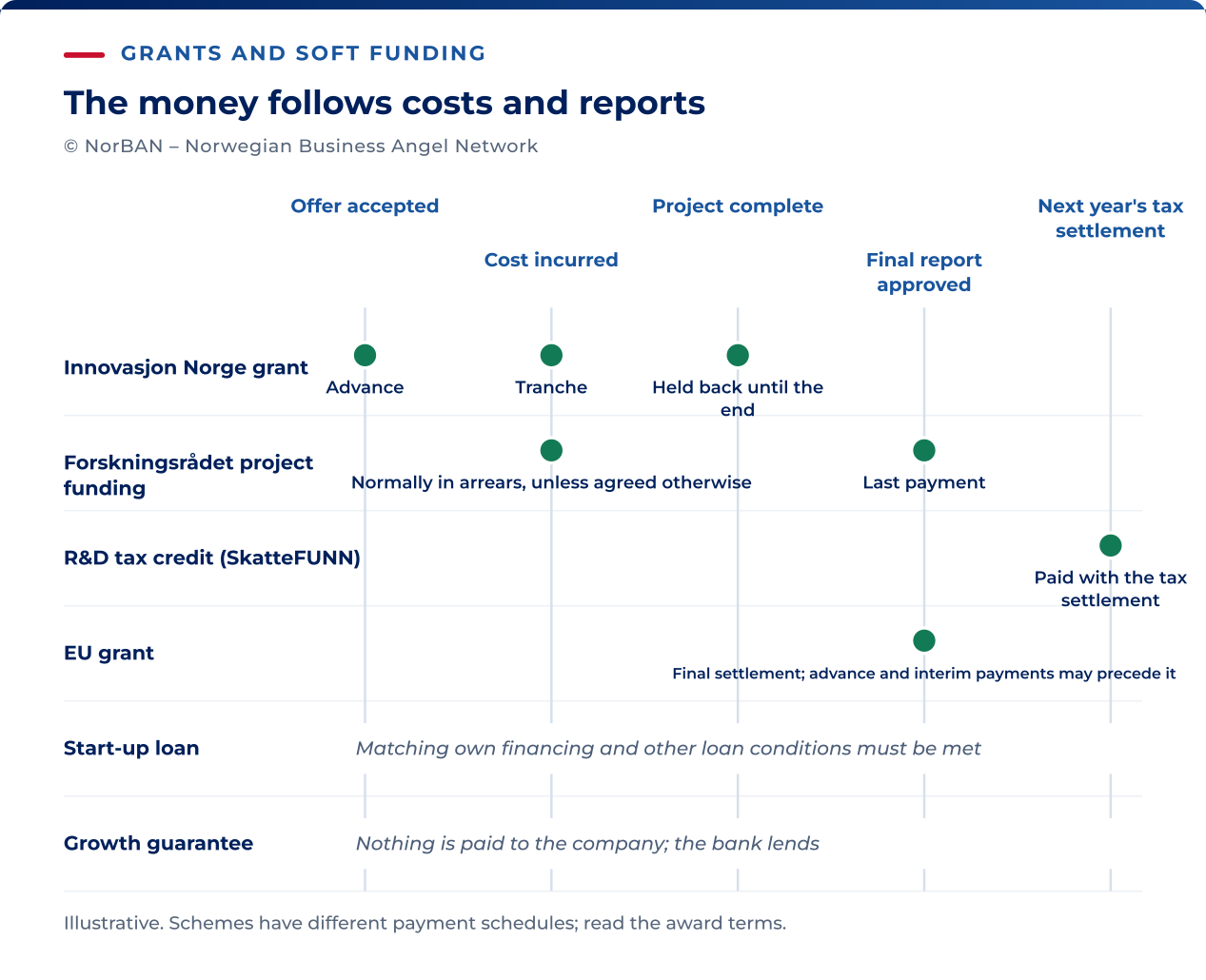
Put payment dates in the runway model, not decision dates, and check the tranche pattern of each instrument against the month the cost actually falls.
| Scheme | Cash timing |
|---|---|
| Innovation Norway grants | Follow the award. Oppstartstilskudd 1: 50% at acceptance, 50% at completion. Oppstartstilskudd 2: up to 50% initially, 30% when half the costs have been incurred, at least 20% retained for completion. Innovation-project grants generally use 30%/50%/at least 20%. Request payment by the award deadline, normally three months after project end |
| Research Council project funding | Under the 2025 terms, normally in arrears against an EHF invoice documenting costs, unless otherwise agreed in writing. Final payment requires the specified final report and/or accounts to be approved |
| SkatteFUNN | Reduces tax for the income year. Excess credit is paid at the tax settlement, normally the following year |
| Oppstartslån | Up to two equal instalments, subject to security and other conditions. Own financing must at least match each disbursement |
| Growth guarantee | The bank disburses the loan. The guarantee is not cash support paid to the company |
| EU grant | Follow the agreement’s pre-financing, interim and final payment schedule. Final reporting includes the required results ownership list |
A grant budgeted as cash on the award date leaves a hole in the month the cost falls. How much to raise and when sizes the round, and the payment dates decide whether the round also has to cover that gap.
What an investor will ask about the grants you hold
An investor reads a grant as three separate things. It is money that does not dilute anyone, which lengthens the runway and changes what the round has to pay for.
It is an assessment by a public body against published criteria, which is evidence about the technical and developmental case and no evidence that a customer will pay. And it is a set of obligations that show up in diligence as things that can go wrong before the money is finally settled.
Expect to be asked whether the conditions are met, whether anything is repayable, whether the award restricts a change of control or claims rights in the results, and what happens to the project on a sale.
Gather these records from the company’s files before investors ask. You can then answer in one email rather than spend a fortnight exchanging documents:
- The award letter and the general terms it incorporates, for every instrument.
- The application as submitted, because the conditions attach to what was applied for.
- The project accounts and the timesheet basis behind them.
- The auditor’s or authorised accountant’s statement on the project accounts.
- Every status and final report filed, and the administering body’s replies.
- A schedule of amounts received, amounts still to be drawn, and the milestone each remaining tranche depends on.
- Your own written statement of what is repayable and on what trigger.
- Confirmation of what other public support the same project costs have already received.
A company whose income is mostly public money will be asked what happens when the grants stop. Expect that question as a request for a customer list and paid pilots, and answer it with those.
Show investors the public body’s evaluation documents rather than describing the award in general terms. The European Commission advises Seal of Excellence holders to make the certificate, the full proposal and the evaluation summary report available to the funders they approach, and the same move works for any award you hold.