
The question due diligence asks first
Before an investor reads your model, they want to know whether the company owns the thing it is selling. In the investment agreement you will be asked to warrant, usually personally, that the company owns its intellectual property (immaterielle rettigheter) and that no third party has a claim on it.
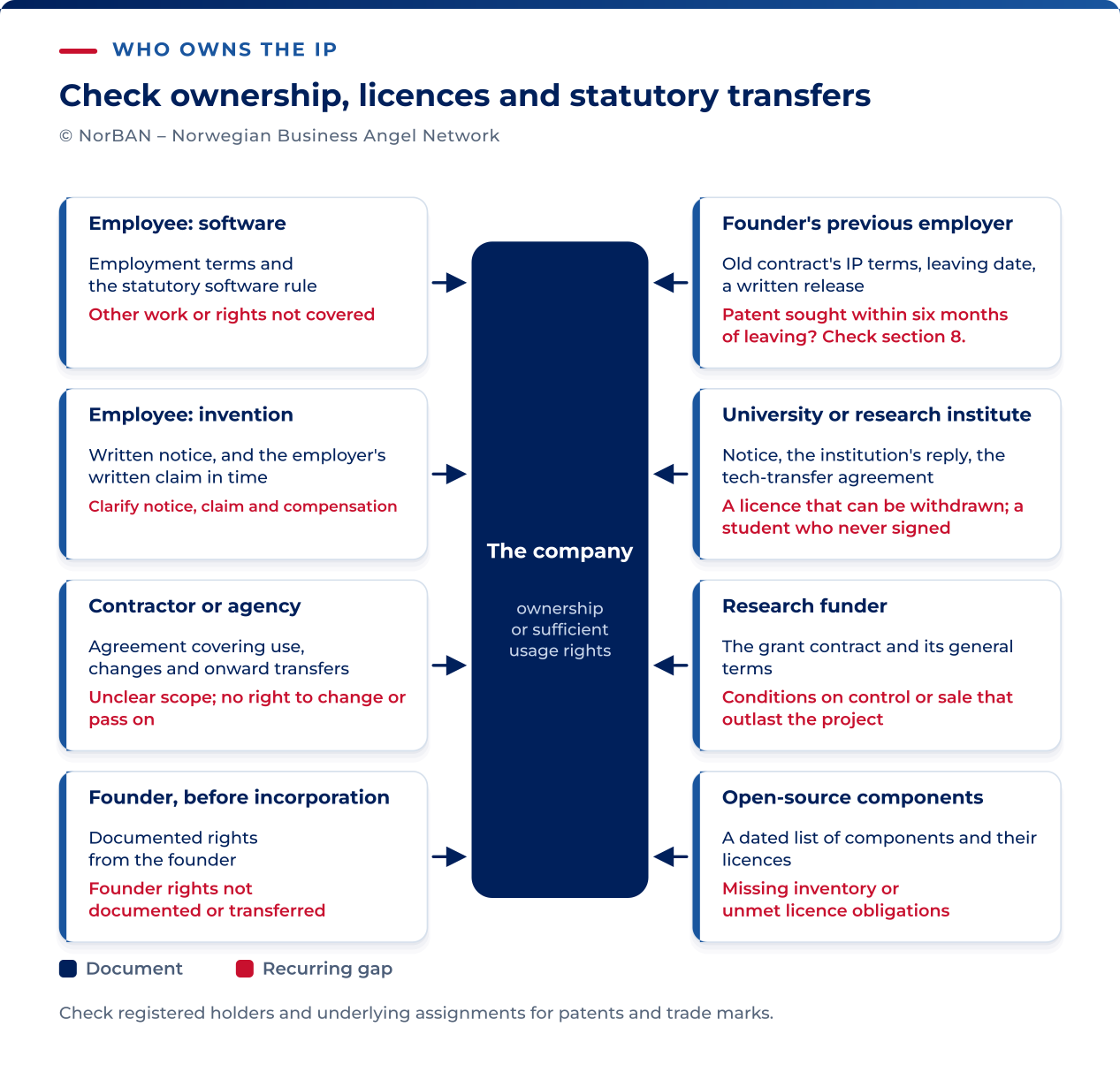
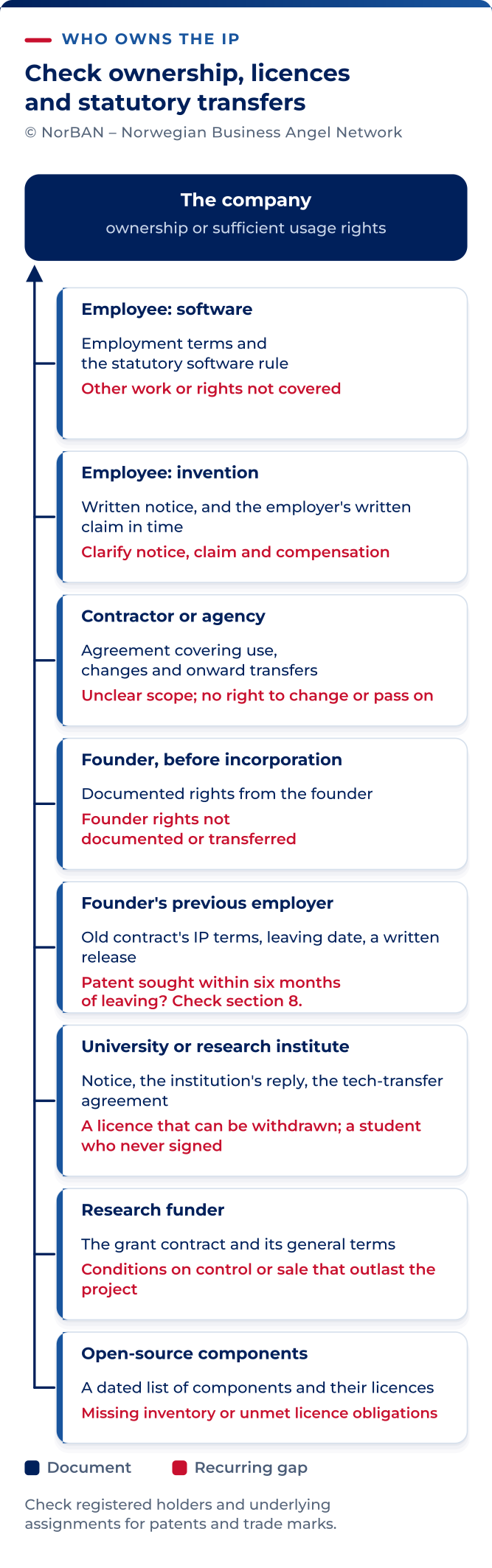
For each contributor, establish the company’s legal basis for using their code, designs or data: statute, employment terms, assignment or licence. Check the rights needed for the business, not only ownership. Unclear rights can delay completion, affect price or lead to negotiated warranties.
Norwegian law has no general rule that paying for commissioned work gives the customer every IP right. Employee software has a specific statutory rule; inventions, other employee works and commissioned work need separate assessments. List everyone who has contributed to the product, including before incorporation.
Employees: what the company gets by default, and what it does not
Inventions: a right to claim, on a clock
The Employee Inventions Act concerns inventions patentable in Norway, whether or not a patent application is filed. Software, designs, text and data do not fall under it merely because they were created at work; a technical invention involving software may require a separate patentability assessment. The employee starts with the inventor’s rights (§ 3), subject to the employer’s rights under the Act and any applicable agreement.
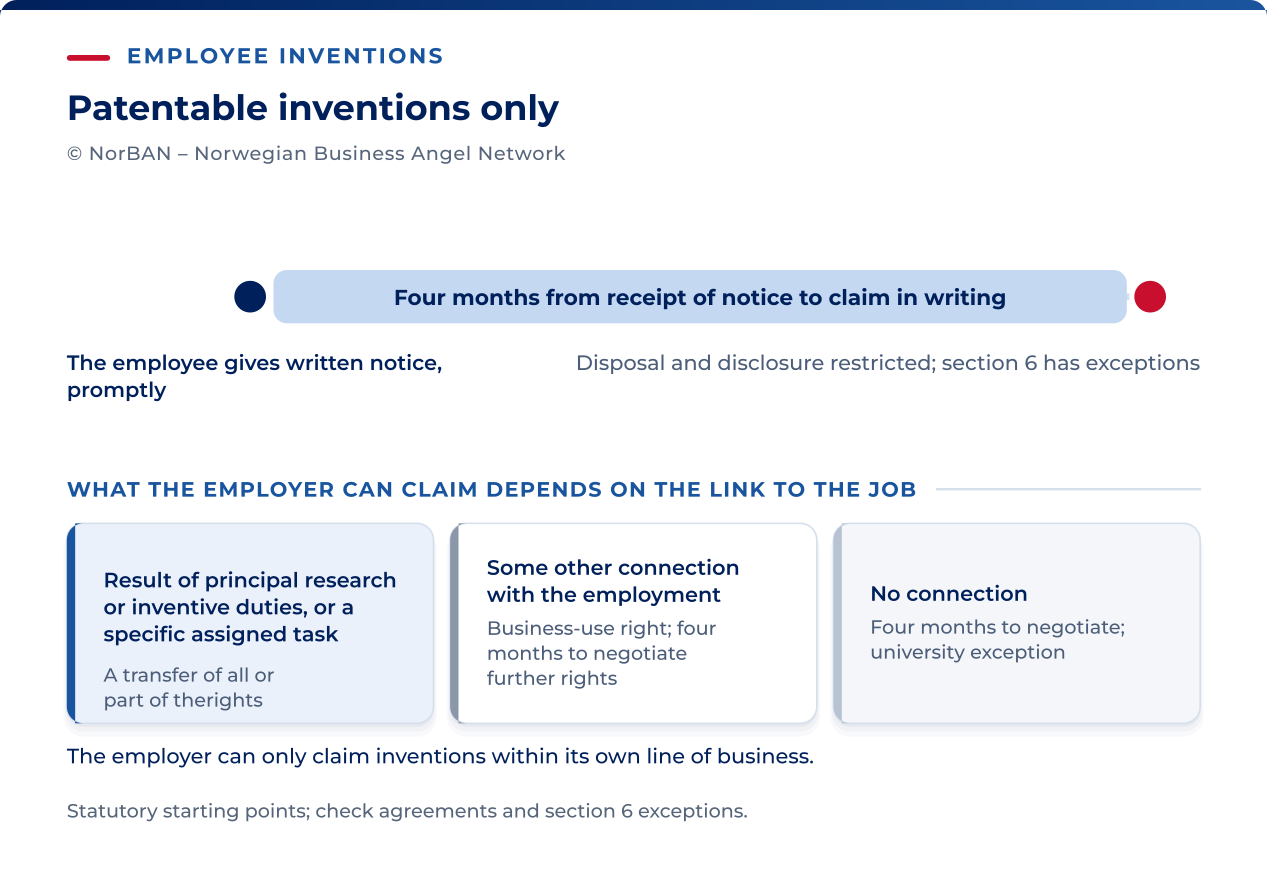
The extent of the employer’s claim depends on the invention’s connection to the job, and a claim is available only where exploiting it falls within the company’s field of activity (§ 4).
- Research or inventive duties, or an assigned task: the employer may demand a transfer of all or part of the rights.
- Some other connection with the employment: the employer may demand only a right to exploit the invention, which is a licence, with four months to negotiate anything more.
- No connection: the employer has only that four-month priority to negotiate.
The deadline runs from the employee’s notice, which they must give the employer in writing without undue delay (§ 5).
To exercise the rights specified in § 4 first paragraph or the first sentence of its second paragraph, the employer must notify the employee in writing within four months of receiving the invention notice (§ 6). During that four-month period, the employee may not dispose of a covered invention or undermine patenting or enable another’s use without written consent. The Act permits a Norwegian patent application before transfer, with advance written notice to the employer, and has a separate university publication exception.
An employee who never notifies never starts the clock, so what diligence usually finds is a set of inventions with no notice and no claim.
The contract cannot remove the statutory right to compensation. An employee whose invention is taken over is entitled to reasonable compensation (rimelig godtgjøring), even where an agreement made before the invention says otherwise (§ 7). The one exception is where the value taken does not exceed what the employee could reasonably be expected to deliver for their salary.
The amount is set case by case on the invention’s value, the extent of the rights taken, the terms of employment and how much the job contributed. It can be revised if circumstances change materially (§ 10).
Either party may bring a dispute under the Act to the Employee Inventions Mediation Board (§§ 12–14). Mediation is free, and the board may act as an arbitration tribunal if both parties agree. Referral is an available route, not an automatic mandatory stage in every dispute.
A patent application within six months after employment ends can trigger a presumption that the invention was made during employment (§ 8). The presumption applies where the statutory connection to the former employer’s business and the inventor’s principal duties, or to a specifically assigned task, is met. The employee can rebut it by showing another account is probable. Check dates and duties; an application within six months does not by itself establish the employer’s ownership.
Software and everything else
The Copyright Act (åndsverkloven) § 71 is a specific statutory transfer rule. Copyright in a computer program created by an employee in the course of the employment, or on the employer’s instructions, passes to the employer, with the right to modify it and to transfer it onward.
Moral rights under § 5 stay with the developer, and the rule yields to any agreement that says otherwise. Employee-written code is the strongest link in a Norwegian company’s chain of title, and the section covers computer programs and nothing else.
For the material around the code, the Storting declined in 2018 to enact a general rule (Innst. 258 L (2017–2018)). What applies is an unwritten one: copyright in works created in employment passes to the employer to the extent the employment presupposes that such works are created and the transfer is necessary and reasonable for its purpose.
- Technical documentation, design material and recorded know-how need an assessment of what the job and agreement require; not every right necessarily transfers.
- Databases can involve copyright in the structure, separate database protection and rights in their contents. Establish who holds each relevant right.
- For model weights and training data, identify the rights and restrictions that actually apply, including third-party licences and confidentiality. An employee assignment cannot give the company rights the employee never held.
The employment contract can define the rights transferred more clearly than the default “to the extent necessary” rule. An employee IP assignment clause names the categories it covers (software, documentation, designs, data, models, content), assigns the rights to modify and to transfer onward, and adds a duty to inform the company of results.
It also deals with anything the employee brought with them, and waives moral rights only for a defined use, which is as far as § 5 allows.
Contractors and consultants own their work
For a contractor, agency, freelancer or dev shop there is no default transfer at all. § 71 is limited to employment, and the proposal to extend it to commissioned work was the specific part the Storting withdrew. Rights sit where the contract puts them, and where the contract is silent they stay with the person who did the work.
Paying the invoice changes nothing. Transfer of a copy does not transfer the copyright, even when the copy handed over is the original (§ 67 third paragraph).
A company may have an express or implied licence to commissioned code without owning its copyright. The agreement’s scope and § 41 matter: lawful users have certain rights to make changes needed for the intended use, including error correction. Broader development, sublicensing and transfer rights still need checking. Do not infer the full licence from payment alone.
Two rules decide what a written assignment is worth.
- Scope of transfer. Section 67 says the author does not transfer more than the agreement clearly expresses. Define the works and uses. A clause’s length or the words “all rights” do not by themselves determine its legal effect.
- Changes and onward transfer. Section 68 normally requires agreement for changes and consent for onward transfer, with an exception for transfer with the business or business division. Software also has the user rights in § 41. Set out the intended rights expressly rather than relying on assumptions.
A software business needs rights that support continued development and its planned sale or licensing model. Describe those uses expressly in the contractor agreement and check any background or third-party material separately.
- The results, in defined terms.
- The right to modify, adapt and make derivative works.
- The right to transfer onward and to sub-license.
- The contractor’s background material, as a licence or an assignment, but named either way.
- A moral-rights waiver limited to a defined use.
- Delivery of source code and build materials, since handing over a copy transfers nothing by itself.
The assignment must also address payment. An author who transfers rights in a business setting is entitled to reasonable remuneration, and the rule cannot be contracted away (§ 69). It is assessed on the rights transferred, what is customary, the parties’ bargaining strength and the probable value of the use.
Price the assignment as part of the fee, and say so in the contract.
Founders’ work before the company existed
Do not assume that work created before incorporation belongs to the new company. A founder may hold the rights, but a former employer, co-author or another party may also have a claim. Check the prototype, code, brand and domain arrangements, and document the company’s ownership or sufficient licence.
Document the transfer or licence. Ordinary copyright transfers generally need neither notarisation nor a prescribed form, but asset-specific rules and registration can affect third-party protection. A later agreement transfers available rights, not past facts. Address this in the founders’ agreement before outside investment.
Because §§ 67 and 68 apply to founders too, the assignment names the works and the period, assigns the rights to modify and to transfer onward, and records what the founder receives. Every founder signs it, including the one who thinks it is a formality.
Registered rights add a second step. An application filed in a founder’s own name stays in that name in the public register until the change of ownership is notified to Patentstyret, with a copy of the assignment as documentation.
Between the parties the assignment moves the right on its own. Registration under patentloven § 44 makes it provable and, under § 44 a, secures priority against later good-faith acquirers. Until then, an investor searching the register by your name finds your name, and one searching Norid finds who holds the domains. Both searches are free and take minutes.
Universities and research institutions
Until 1 January 2003, academic staff at universities and university colleges kept the first right to exploit their own inventions commercially. That teacher exemption (lærerunntaket) was repealed with effect from that date (Ot.prp. nr. 67 (2001–2002)). An institution now claims an employed researcher’s patentable invention through the same § 4 machinery as any other employer, with two modifications.
- Universities and university colleges do not have the statutory negotiation priority for inventions unrelated to the employment.
- Teachers and scientific staff at those institutions have a publication exception under § 6. It requires a publication reservation in the invention notice and no conflicting third-party right. If the conditions hold, the employer cannot acquire the invention under § 4. If the inventor takes no steps towards publication within one year, the employer may acquire it nonetheless.
A researcher who has reserved publication may not file a patent without the employer’s written consent. The right can be waived by contract, and it is blocked where third-party rights stand in the way, most often an external funder or an industry partner.
To establish a spin-out’s title, check whether the institution claimed the invention, the researcher reserved publication and prevented a claim, or the year elapsed and allowed a claim after all. External funding terms may have prevented the researcher from reserving publication, even if nobody raised this at the time.
Technology-transfer offices manage the result on one of two models: a licence to the spin-out, or a sale of the rights for cash or for shares. NTNU is one institution that publishes its terms, in its IPR guidelines.
- NTNU’s employee notification procedure covers results with commercial potential. TTO should reply within one month; that reply can request further investigation rather than make a final acquisition decision. Student and contractor rights also require their applicable agreements.
- For a startup, licensing is the usual model; a rights sale is exceptional and uses market terms. The minimum 10% equity compensation applies where the technology is not directly patentable, licensing is unsuitable and commercialisation depends on the inventor becoming a founder.
- Agreements must allow withdrawal if the ethical or sufficiently broad-use requirements are not met. Check the actual clause.
- NTNU’s rules distinguish commissioned research from grant-funded collaboration. In specified externally funded student projects, a prior student rights agreement is required. These are NTNU’s arrangements; check other institutions separately.
Supervision alone does not give the supervisor rights in a student’s work. For a spinout based on a student project, identify the student’s contribution and any co-authors or prior agreements. Document the rights the company or institution has obtained through assignment or a sufficient licence.
An investor will want the institution’s signed licence or assignment, with the field of use, the claw-back conditions and the money terms on its face, and the funder and partner agreements behind the project. Assemble those first; the institution’s office does not work to your timetable.
Open source in the stack
Investors ask for a licence inventory, and a company without one reconstructs it during diligence. Build it now: every third-party component, its licence, and whether the product is shipped to customers or run as a service. The last question decides which obligations apply.
| Family/licence | Requirements | Trigger |
|---|---|---|
| Permissive: MIT, Apache-2.0 | MIT: copyright/permission notices in copies or substantial portions. Apache: licence, change notices, attribution and applicable NOTICE content. | Copying/distribution under the licence |
| Weak copyleft: MPL-2.0, LGPL-3.0 | MPL generally requires covered files and their source under MPL when distributed. LGPL requires library/combined-work compliance, including suitable relinking or shared-library mechanisms. Other application terms are possible if conditions are met. | Distribution; scope depends on combination |
| Strong copyleft: GPL-2.0, GPL-3.0 | Covered/combined works can require GPL and corresponding source; mere aggregation differs. | Distribution |
| Network copyleft: AGPL-3.0 | Offer corresponding source to all network users of your modified program. | Modified software offered as a service |
| Source-available: SSPL, BUSL-1.1, Elastic 2.0 | SSPL: extensive service-source disclosure. BUSL: production limits, subject to additional-use grants or later licence change. Elastic: restrictions on substantially featured hosted/managed services, key circumvention and notice removal. Not open source under the Open Source Definition. | Service provision or production use |
Check the specific licence version as well as the licence family. GPL-2.0 terminates your rights on breach with no cure provision, so a component distributed in breach is one the company may no longer hold a licence to at all.
GPL-3.0, AGPL-3.0 and MPL-2.0 offer reinstatement after breach: stopping can restore rights provisionally, becoming permanent without rightsholder notice within 60 days. A first notice may allow 30 days to cure. Check the licence, rightsholder and notice history.
Whether a piece of your code is a derivative work at all is the contested question in the field, and one for your own counsel on your own codebase.
The source-code questions on a Norwegian request list go beyond licences: the development history of the software, who holds rights in each part, where the repository sits and who has had access, any third party using the code, domains with proof of ownership, and each employee’s written assignment confirmation.
Closing the gaps before anyone looks
Start with the contributor list. For each person, record their relationship to the company, the legal basis for the company’s rights and the evidence. That basis may be statute, employment terms, assignment or licence. Identify what needs clarification rather than treating every missing assignment as proof of missing rights.
A written agreement can document existing rights or transfer rights the contributor still controls. Check third-party interests and any earlier use separately. For a copyright assignment, address §§ 67–69 and specify:
- Identify the works and the period covered.
- Transfer the rights to modify the works, transfer them onward and sub-license them.
- Limit moral rights for a defined use.
- State the payment or other consideration.
- Provide for delivery of the source and build materials.
Whether a former contributor can be compelled to sign depends on general contract law. If the original engagement included an obligation to assign, specific performance is in principle available.
Where it was silent, there is no free-standing duty to sign, and the remedy is a negotiation with someone who now knows what the signature is worth.
While documenting ownership, keep inventions secret until an application is filed, because any disclosure anywhere, including a conference talk, a poster or a demo, counts as prior art under patentloven § 2 and can block the patent.
And treat unfiled technical knowledge as a trade secret (forretningshemmelighet). The Trade Secrets Act protects information only where it is secret, has commercial value because it is secret, and the holder has taken reasonable steps to keep it so. Confidentiality clauses and access controls are those steps.
Protection depends on the information remaining a trade secret and on the use being unlawful; an employee’s general experience and skills are excluded. For an injunction or corrective measures under §§ 5–6, legal steps must normally be taken within three years after the holder knew or should have acquired the necessary knowledge of the infringement and infringer. Damages claims have their own limitation assessment.
| Check | Done when |
|---|---|
| Contributor inventory | All contributors, including before incorporation, are listed with the legal basis and evidence for the company’s rights |
| Employment contracts | The required rights, uses, information duties and any lawful limited moral-rights waiver are clear |
| Invention notices | Covered inventions have the required notices and any timely company claim; the scope, exceptions and compensation are assessed |
| Contractor agreements | The assignment or licence covers the required results, changes, transfer, sublicensing and source delivery; background material and payment are documented |
| Founder rights | The company’s rights in relevant pre-incorporation work, domains, brand and data are documented |
| Registered rights | Register entries and domain-holder details match the documented ownership or other lawful arrangement; required changes have been notified |
| Previous employers | Previous employment and any application within six months have been assessed; the presumption and any competing rights are resolved with evidence |
| University history | The institution’s licence or assignment, funder agreements and publication correspondence are on file |
| Licence inventory | Each third-party component and version is listed, with obligations checked against the actual distribution or service model |
The documents this produces go into the intellectual-property folder of the data room, where the data-room checklist shows how investors read them. Completing the ownership records before diligence lets investors assess the IP without first waiting for missing assignments.