
The numbers investors recompute
An angel checks a startup’s accounts by recalculating key figures from the source documents, then comparing the results with the deck.
- Cash, from last month’s bank statement, and the balance today if asked.
- Burn, from the ledger: what left the account each month over the last three to six, net of what came in.
- Runway, which is the first divided by the second, in months.
- Revenue, from the customer contracts: signed, invoiced and paid, with recurring separated from one-off.
- What the founders have taken out, from payroll, from any loan account, and from any agreement between the company and a founder or a founder’s holding company.
You can explain a weak number, but a mismatch with the deck makes investors question your other figures. If the pitch claims fourteen months of runway and the bank statement and ledger show nine, you will have to rebuild their confidence.
Most early-stage companies are unaudited, and that is the normal state below the audit thresholds. It means the filed accounts carry no third-party assurance, so the weight moves to the documents an investor can test: the bank statement, the ledger, the VAT returns and the tax certificate. Those are what must agree with each other before the data room opens.
The statutory baseline: bookkeeping and the annual accounts
Every private limited company is bookkeeping-obliged under the Bookkeeping Act (bokføringsloven), both because it files a tax return and because it has an accounting duty. The detailed rules on vouchers, invoices and the accounting system sit in the Act and its regulation; Altinn’s summary is the practical starting point.
Under bokføringsloven § 7, bookkeeping must suit the business’s nature and scale and be updated by mandatory reporting deadlines, normally at least every four months. Ordinary VAT returns cover two-month periods, but their filing deadlines follow the period end. There are exceptions for very few transactions; confirm the applicable timetable with the accountant.
A quarterly service agreement does not itself establish compliance with the company’s reporting deadlines. For fundraising, arrange a reconciled monthly close and management pack. Investors may need more current information than the statutory timetable provides; record that reporting commitment separately.
Records have two retention periods (§ 13). Both run from the end of the financial year.
The vouchers, the bank and payroll records, the balance-sheet documentation and the annual accounts are kept for five years. Agreements concerning the business, other than those of minor importance, are kept for three and a half years, or for five where an agreement documents a booked entry.
Where an invoice says only “per agreement”, the agreement itself becomes primary documentation, so you need to retain it with the accounting records as well as in the contract folder.
Under the Accounting Act (regnskapsloven) every AS prepares annual accounts. Companies qualifying as small enterprises may use simplified rules; others have additional requirements. Confirm the applicable category and statements. Every board member signs them, and the general manager too where there is one.
Check both the adoption and filing deadlines. The general meeting must adopt the accounts within six months of the year end (aksjeloven § 5-5), and the complete accounts must reach the Register of Company Accounts within one month of adoption (regnskapsloven § 8-2).
For a company whose financial year is the calendar year, the 31 July date that Brønnøysundregistrene publishes is the backstop for avoiding a fee, and it cannot be extended. A company that adopts its accounts in March has an April deadline.
Late filing carries a penalty based on the court fee (§ 8-3), which escalates week by week for up to 26 weeks. The company is liable first; if it has not paid within three weeks of the register’s demand, board members are jointly and severally liable in person.
Six months after the deadline the register starts the compulsory dissolution sequence. The names of defaulting companies are published on the way, so the default is visible to anyone who looks.
The filed accounts are public, together with their filing date. An investor can see late filing as a sign of weak administration before asking you any questions. The housekeeping article covers the registers this sits alongside.
Audit is a separate question. Under aksjeloven § 7-6, opting out requires operating revenue and total assets below the prescribed limits and no more than ten average full-time equivalents. For a parent, assess the group as a whole. Other legislation can still require audit. Brønnøysundregistrene explains current amounts, first-year rules and registration.
An eligible general meeting can opt out with the majority required for an articles amendment. The decision takes effect only when registered. Founders can also omit an auditor in the incorporation document if the conditions are met. Check both the registered status and current eligibility. Opting out never removes the annual-accounts filing duty.
Tax, VAT and payroll: the accounts that must show zero surprises
The company can order RF-1507, tax and duty information, from Skatteetaten. It shows registered information, including overdue unpaid taxes and duties. Treat it as a dated snapshot, not proof that every liability is known or that the company can pay its debts.
When ordering RF-1507, you can request delivery of a copy directly to another business. For a private investor, the company can forward the certificate after receiving it. Investigate any arrears and how they will be paid. Some tax claims have preferential status in insolvency, but the type and timing of each claim matter.
Payroll reporting uses the monthly a-meldingen to report pay, employment, withholding and employer contributions to Skatteetaten, NAV and Statistics Norway. Missing reports can lead to enforcement fines after notice and a new deadline. Reconcile this reporting with the payroll records.
Withheld tax is deducted at each salary payment and paid directly to Skatteetaten on the first working day after the salary date. The earlier duty to hold it on a separate tax deduction account (skattetrekkskonto) was abolished from 1 January 2026, so the money now goes straight out.
Removing the tax-deduction account did not remove the employer’s duties to deduct and pay tax. Skattebetalingsloven § 16-20 provides liability for amounts not deducted or paid as required. For a failure to deduct, the Act has an exception where the employer proves that neither it nor its staff was negligent or lacked due care.
Intentional or grossly negligent failure is a criminal matter for the individuals responsible. Employer’s contributions are the company’s own tax, visible on the same certificate.
These arrears can end an investor conversation. Using withheld tax as working capital raises serious concerns about how the company handles cash pressure.
The reconciliations to run before anyone looks
Set aside time with the accountant to work through these checks with the ledger open. Keep each reconciliation so you can provide it when investors ask.
| Reconcile | Against | What a difference may reveal |
|---|---|---|
| Month-end bank balance | Cash ledger | Missing entries, timing differences or an unreconciled ledger |
| Nominal share capital | Registered capital, issued shares and completed capital changes | An unregistered issue or an accounting error; reconcile share premium separately |
| Convertible instruments | Signed terms and the required decision or mandate; identify any later capital increase needed | Missing authority, documentation or an incomplete conversion route |
| Founder loans and related-party balances | Written terms, price and required approvals, including § 3-8 where applicable | Undocumented movements between company and owners |
| Recognised revenue | Agreements, delivery, invoicing and the applicable accounting rules | Revenue recorded before it was earned, or missing revenue |
| Customer advances and deferred revenue | Outstanding delivery and refund obligations | Cash accompanied by future costs or repayment risk; model those obligations rather than automatically treating the whole balance as unavailable |
| Accrued holiday pay and employer contributions | Payroll, a-meldingen and actual due dates | Obligations omitted from the cash forecast; holiday pay is not universally due in June |
| VAT payable or receivable | Submitted VAT returns | Missing returns, wrong entries or insufficient cash for the payment |
| Grants and SkatteFUNN receivable | Awards, project eligibility and recognition rules | Support recorded without a sufficient basis or incorrectly presented as customer sales; cash timing is separate |
| Tax certificate | Ledger and current tax account | Recorded arrears requiring investigation and a payment plan |
Founder loans deserve their own line. Since 7 October 2015 a loan from the company to a personal shareholder, their spouse or a close relative the provision names (a cohabitant is not among them) is taxed as a dividend in the shareholder’s hands under skatteloven § 10-11, whatever it is called in the books. The regulation has exceptions, including credit below NOK 100,000 repaid within 60 days and ordinary customer receivables repaid within 30 days. Separate financial-institution and employee small-shareholding exceptions have their own conditions; cohabitants can matter in the latter ownership calculation.
Company law applies separately. The main rule in aksjeloven § 8-7 limits shareholder credit and security to distributable funds and requires adequate security. Exceptions include ordinary trade credit and specified group arrangements. Unlawful credit can be invalid and repayable under § 8-11, with potential responsibility for those involved. Check the actual transaction rather than assuming that its tax treatment makes it lawful.
A loan to a founder can therefore create both tax and repayment issues. Establish whether an exception applies, what is owed and when it must be paid. Give investors the facts and the plan to resolve any breach.
What the accounts and the cap table must agree on
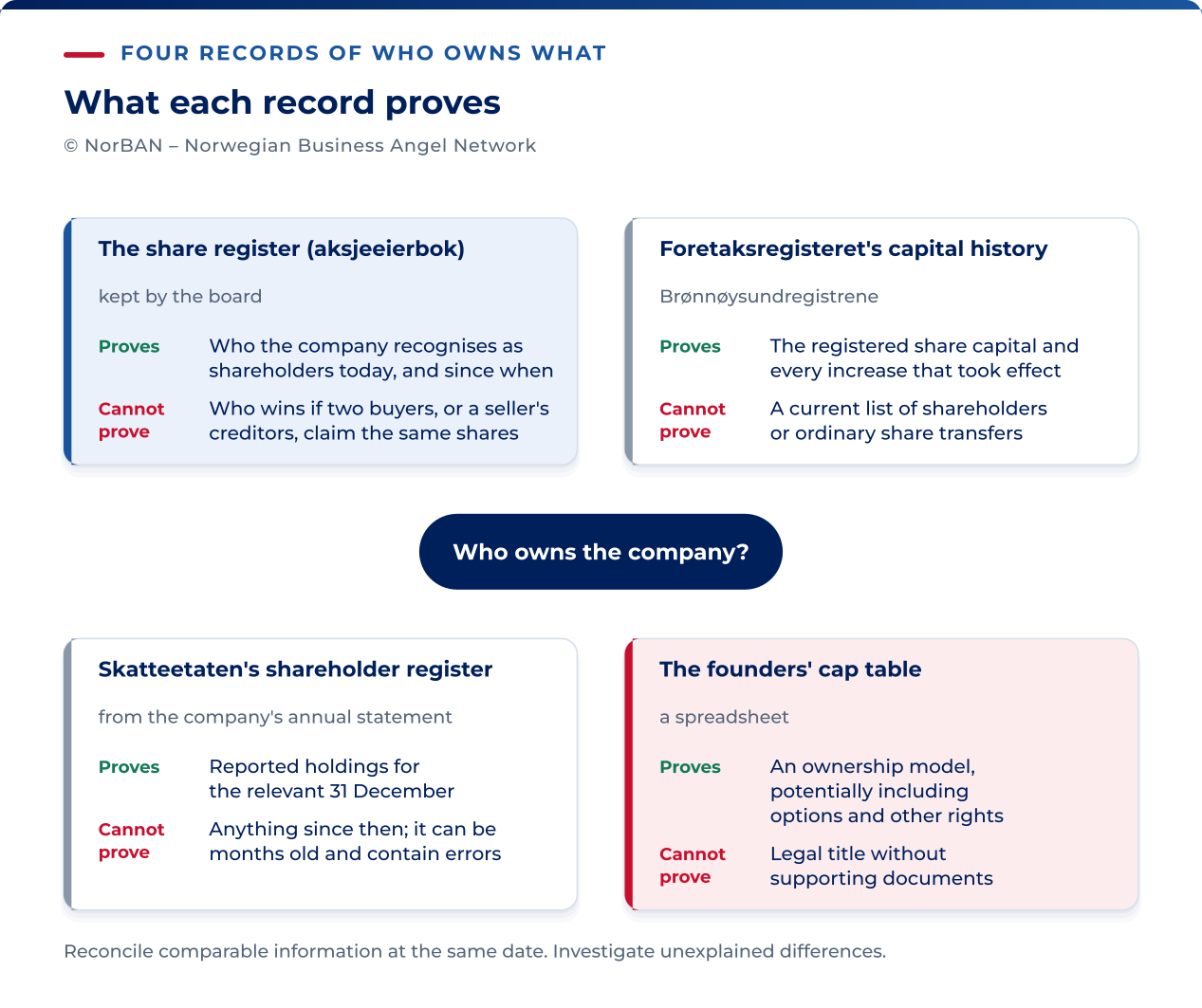
The cap table on your slide, the share register the board keeps, the share capital in the balance sheet and the entry in Foretaksregisteret describe the same shares. Differences are hard to explain when all four records come from the company itself.
- Issued capital. Shares in issue multiplied by nominal value equals the share capital in the balance sheet and in Foretaksregisteret. If it does not, an increase was not registered or was registered wrongly.
- Premium. Everything paid above nominal value sits as share premium in equity. A round booked as a loan, or as revenue, is a finding.
- Options. An option is a promise of a share. It does not appear in the share register and should not appear in the issued capital; it belongs on a fully diluted cap table with its terms.
- Convertible loans. Document the loan and conversion terms and the company-law authority. A chapter 11 instrument can use a registered general-meeting decision or board mandate; an ordinary loan can instead be converted through a later capital increase. Have the accountant check the applicable accounting classification.
Skatteetaten’s shareholder register holds what the company reported in its shareholder register statement (aksjonærregisteroppgave), filed by 31 January for the position at the previous 31 December. It is a snapshot built from your own filing, and Skatteetaten says itself that it may contain errors.
The share register is the live record, and the two must agree on every issue and transfer. Reconcile them year by year, because an investor’s counsel will.
If the statement was not approved, nothing is pre-filled in any shareholder’s tax return and each of them has to compute their own figures. Your existing investors notice when their own tax return arrives without the figures, and remember it.
The monthly pack investors expect during and after the raise
A Norwegian request list asks for last month’s bank statement, the burn rate and the cash position, which the last filed year cannot supply. Build a short pack, dated, and refresh it monthly for as long as the raise runs.
| Item | Recommended management pack or statutory filing |
|---|---|
| Profit and loss against budget | Current month, from the ledger |
| Bank balance and cash position | Current month, from the statement |
| Burn and runway | Current month, computed from the two above |
| Receivables and payables, aged | Current month |
| Headcount and payroll cost | Current month, matching the a-melding |
| The few metrics the model runs on | Current month, defined the same way as in the model |
| Annual accounts | As filed; public in the Register of Company Accounts |
| Tax return and business specification | As filed; not public, so supplied in the data room |
| Tax certificate | Fresh; ordered for the raise |
The model in the financial model article has to tie to this pack: its historical months are the ledger, and its opening cash is the bank statement. A model whose last actual month is four months old tells the investor the company is not run from its numbers.
Keep the pack going after the round. What you agree to report in the shareholders’ agreement is negotiated, but the habit of producing a monthly pack is what makes the reporting clause cheap to honour.
Red flags, and the afternoon fixes
Start with the fixes your accountant can make quickly, then allow time for those requiring board action, a general meeting or a shareholder’s signature.
| Finding | What an investor concludes | The repair |
|---|---|---|
| Ledger not current; the last booked month is months old | The company is not run from its numbers | Meet the statutory reporting deadlines and agree a monthly close for management and investor reporting |
| Bank and ledger disagree | Nobody reconciles | Reconcile every month end and file the reconciliation |
| Deck runway and bank-statement runway disagree | One of them was chosen and typed in | Recompute from the statement and the ledger, and change the slide |
| Tax certificate not on file | Arrears are possible and unchecked | Order RF-1507 today; if it shows arrears, pay them and explain the history |
| Letters of intent or pilots recorded as revenue | Recognition may be unsupported; paid pilots can generate valid revenue | Check delivery and recognition criteria. Distinguish pipeline, contracted, earned and paid amounts |
| Customer advances are omitted from delivery and refund planning | Future obligations may be missing from the cash forecast | Account for deferred revenue correctly and forecast delivery costs and any refunds; do not automatically subtract the entire advance from cash |
| Grants or SkatteFUNN lack recognition support or are presented as sales | Reported income or receivables may be wrong; this does not itself change the bank balance | Check recognition with the accountant and forecast payment separately |
| Accrued holiday pay is missing | Future payroll obligations are understated | Accrue correctly and enter payments at their actual expected due dates |
| Monthly a-meldingen reports are missing | Payroll reporting is incomplete; enforcement fines may follow notice | File the missing reports and reconcile them with the ledger |
| Founder or related-party balance with no agreement | Money moves between the company and its owners informally | Document it, price it, have the board approve it, and check § 8-7 and the tax consequence with your adviser |
| Annual accounts filed late | Administration is weak, and the board is personally exposed to the fee | File now, pay the fee, and never let the one-month rule after adoption slip again |
| Share capital differs between accounts, register and Foretaksregisteret | An issue was never completed | Trace the increase; if the registration lapsed, the shares do not exist and the issue is run again |
| Convertible loan lacks the necessary authority | Share delivery may not be secured under the promised route | Check whether chapter 11 authority, a board mandate or a later chapter 10 issue is needed; document and complete the correct steps |
| Shareholder register statement not approved, or differing from the share register | The company’s own filings contradict each other | Correct and refile the statement, and reconcile it to the register for every year |
Completing the reconciliations before diligence lets the first discussion focus on the business instead of discrepancies in its records.