
Records to keep as the company develops
A second-round investor wants the same information as the first, plus a record of what happened since that round. Keep the operating history, board and shareholder decisions, use of the last round’s money, and obligations arising from employees, options and customers.
Minutes. Board minutes normally require all participating directors’ signatures, subject to the statutory exception for boards of at least five. General-meeting minutes normally require the meeting chair and at least one other person chosen by the meeting; a sole shareholder may sign alone. Simplified proceedings have separate rules. Record decisions promptly with accurate meeting and signing dates; do not backdate a later reconstruction.
Ownership history. The board is responsible for the shareholder register. Under section 4-7, enter a new owner without delay once the acquisition is notified and substantiated, unless transfer restrictions prevent it, and record the entry date. Preserve the underlying transaction dates separately. A later correction must reflect what happened rather than fabricate earlier entries.
Metric history. Keep definitions, source data and calculation methods. Historical data can sometimes be recalculated reliably, but distinguish a later reconstruction from a report actually prepared at the time. Explain gaps and changes rather than presenting unlike figures as comparable.
Employment and intellectual property. Establish the rights the company needs through law, assignment or an adequate licence. A later assignment may cure a gap, but its validity and effect depend on the rights and parties involved. Record the true agreement date and any earlier use. Document option grants, approvals and terms when agreed. These points will matter in due diligence.
The record that has to be contemporaneous
At the first closing, assign responsibility for each record and agree a recurring review day. Build the work into existing administration. A small company may keep the routine simple, but no fixed number of hours covers every company’s obligations.
| Record | Responsibility | Timing | Why it matters |
|---|---|---|---|
| Board minutes under section 6-29 | Board, with administrative help as agreed | Every board proceeding; arrange correct signatures promptly | Documents decisions, participation and dissent |
| General-meeting minutes under section 5-16, or the applicable simplified-procedure rule | Meeting chair or responsible board chair under the relevant procedure | Each proceeding; ordinary meeting within six months of year-end under section 5-5 | Documents corporate approvals |
| Shareholder register under sections 4-5 and 4-7 | Board | Update when required; public access follows section 4-6 and regulations | Legal ownership record to reconcile with the cap table |
| Bookkeeping material under section 13 | Company, supported by its bookkeeper | Book and retain according to applicable rules; monthly review is a useful routine | Traceability from reports to transactions |
| Annual accounts under Accounting Act section 8-2 | Company and its governing bodies | File within one month after adoption; also observe the annual late-fee deadline | Public accounts and filing history under section 8-1 |
| Shareholder register statement | Company | Normally 31 January; from June 2026, submit through an end-user system | Tax reporting and shareholder pre-filled data |
| A-melding | Employer | Normally by the fifth of the following month; next working day if a weekend or public holiday | Employment, pay and withholding records |
| Beneficial-owner registration under section 9 | Company | Initial registration within 14 days; changes without delay and within the applicable 14-day limit after awareness | Identifies natural persons with ownership or control |
| Option grants, exercises and lapses | Company/employer | Record when events occur; tax reporting depends on the scheme | Fully diluted ownership and tax compliance |
| Publicly funded project accounts and timesheets | Project lead and finance function | Follow the particular scheme and award terms; SkatteFUNN requires daily time allocation and regular signatures | Supports the eligible-cost claim |
Under Bookkeeping Act section 13, the main material in items 1–4 must be retained for five years after year-end: accounts and mandatory reporting, specifications, transaction and audit-trail documentation, and the auditor’s specified written communications. Special rules can require longer periods. Norway is the default storage location, with permitted exceptions for electronic storage abroad.
Items 5–8 cover specified business agreements, material supplementary correspondence, delivery documentation and required price lists, generally for three years six months after year-end. Classification depends on use: an agreement that documents a booked transaction can fall under the longer period. Section 13b concerns electronically available booked data, not every electronic file. Its current exemption for turnover below NOK 5 million is removed from 1 January 2027 by the September 2026 regulation. Tax authorities can order extended retention for a control.
Your retention policy needs to distinguish these periods and the circumstances requiring longer retention.
The 2026 bookkeeping reform introduces electronic invoice issuance from 1 January 2027, subject to exceptions and, during transition, the recipient’s ability to receive it. The general duty to receive e-invoices and keep books in an electronic accounting system starts on 1 January 2030. The 30 September 2026 guidance explains the transition. The five-year and three-year-six-month main retention periods are unchanged.
Read the law together with the transition and implementing regulations. The September 2026 amendments specify formats and exceptions. An emailed PDF is not a structured electronic invoice. Do not assume the low-turnover exception applies to an AS: the new provision excludes enterprises with statutory annual-account obligations.
Late annual accounts can trigger escalating late-filing fees, subject to a maximum period. Missing or rejected tax reporting can lead to a coercive fine after the applicable notice and decision, subject to limits and exceptions. Check the authority’s current rates and the actual notice; these are different procedures.
An unapproved statement also creates work for your shareholders. Where the shareholder-register statement is not approved, your shareholders lose their pre-filled amounts and their filing exemption. Company housekeeping before you raise carries the registers and the filings in full.
The monthly and quarterly routine
Record the file location, responsible person and due date. A routine known only to one person can be missed when they are away, leaving a gap that goes unnoticed until diligence.
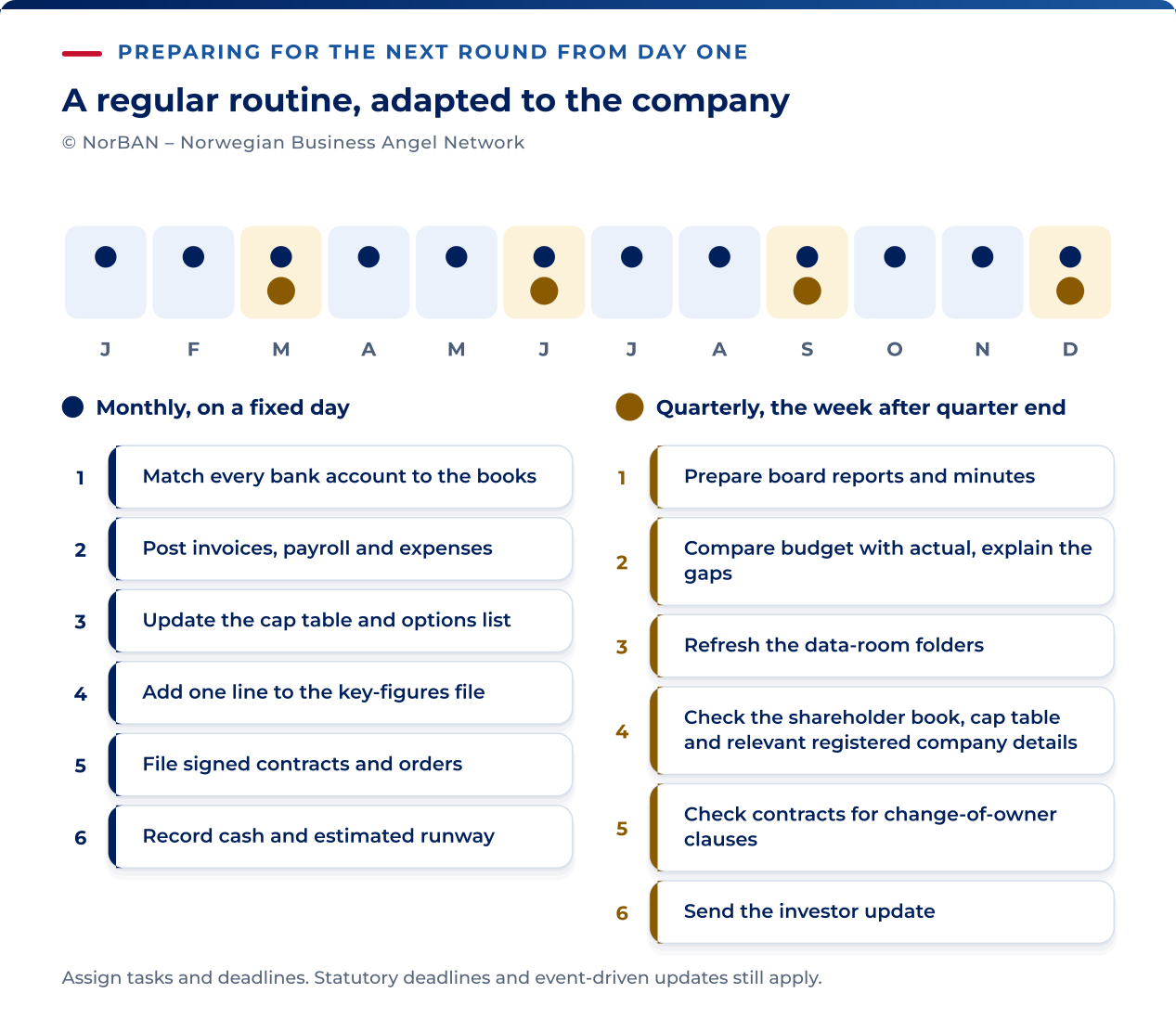
The monthly close
Choose a regular working day for the monthly review and allow time for the workload. Reporting deadlines may fall earlier, so the review date cannot replace them.
- Book outstanding invoices, payroll, expenses and other transactions.
- Reconcile each bank account to the ledger and investigate differences.
- Reconcile the cap table and option register with grants, exercises, lapses, transfers and convertible instruments already recorded when required.
- Add the period’s metrics with definitions and source references.
- File signed contracts and orders, preserving earlier versions and dates.
- Record available cash and update the cash forecast. Runway is a forecast, not a figure obtained from the bank balance alone.
The quarterly pack
Book a recurring half-day meeting in the week after each quarter closes.
- Arrange board consideration as needed, with proper minutes and signatures; a quarterly routine is not a legal maximum or minimum.
- Compare budget with actual results and explain material differences.
- Update the data room against the contents checklist, retaining historical versions.
- Reconcile the shareholder register, cap table and registered capital, explaining timing differences. The Register of Business Enterprises is not a complete shareholder or option register.
- Review new contracts for control-change, exclusivity and termination provisions; assess them before signing as well.
- Send investor reports on their agreed schedule, using the updated material.
When the company gains employees
Employees bring payroll, employment reporting and, when the statutory conditions are met, occupational-pension duties. Check the company’s rights to work created by employees and contractors. Employee-created software can transfer by law under Copyright Act section 71; other rights and assignments depend on their own rules and agreements. Keep employment, IP and option records together with appropriate access controls.
When the board includes an investor
Shareholders have statutory information and minority rights, as well as any rights agreed by contract. The filed annual accounts are public, and anyone may inspect the share register. Shareholders also receive meeting documents and specified transaction disclosures, subject to the applicable statutory rules.
At a general meeting, a shareholder may ask for information relevant to the accounts, the agenda or the company’s financial position, unless disclosure would cause disproportionate harm. Where information must be obtained, a written answer follows within two weeks (aksjeloven § 5-15).
Holders of at least one tenth of total share capital may demand an extraordinary general meeting. Any shareholder may propose an investigation (granskning). Support from at least one tenth of the capital represented permits any shareholder to petition the court within one month; the court then assesses whether there are proper grounds (§§ 5-25 and 5-26).
Agree regular reports, budgets and material-event notices expressly. Identify who owes each obligation and who may enforce it. If the company is to undertake a contractual reporting duty, make it a party or otherwise establish a valid legal basis; shareholders’ promises alone do not automatically bind it.
When the company takes public funding
Public support often requires separate project records, but the detailed rules depend on the scheme. For SkatteFUNN, keep project accounts throughout the year and timesheets showing each person’s hours and sub-goals by day. The employee and project lead sign continuously and at least quarterly. Other grants may use different requirements.
A SkatteFUNN claim is made through the tax return and requires auditor attestation of costs and public support, even if the company has opted out of ordinary audit. The Research Council’s progress and final reports do not require the same auditor attestation of figures. Keep these submissions separate and use the current filing process.
For Innovation Norway support, follow the award letter and scheme-specific payment and reporting terms. Advance payments, final reports and accountant or auditor confirmation differ between schemes. Unsupported costs or breached conditions can reduce the award or require repayment. Record the applicable retention and reporting periods, including obligations continuing after the project.
Metrics you can only have a history of if you start now
Choose a small set of relevant metrics and record their definitions. For retention, specify the starting customer group, period and calculation basis. This makes the result reproducible and lets an investor assess what it actually shows.
Retention by customer group and changes in sales conversion need dated observations. Payback may be estimated from assumptions or measured from realised contribution; label which method you use. Start collecting source data early rather than waiting until the next raise.
When definitions change, keep the old calculation and explain the new one. Where feasible, calculate both over an overlap period or restate the history from reliable source data. Record the date, reason and effects. Two quarters of overlap can be useful, but is not always necessary or possible.
The ownership record between rounds
Record grants, exercises, transfers, convertible instruments and outstanding subscriptions when they occur. Reconcile the records according to what each one covers: issued shares, possible future shares, registered capital and annual tax events are different things. Explain timing differences instead of forcing the totals to match on every date.
A late reconciliation may uncover a grant without the required approval or a mismatch between the legal documents and the spreadsheet. Check the actual authority and terms, rather than assuming every grant requires the same board decision.
For qualifying employee options under the start-up and growth-company scheme, report grants and exercises separately to Skatteetaten, normally by 1 February after the income year. If the conditions are met, grant and share exercise are not salary events in the a-melding. Report resulting shares in the shareholder register statement, normally due 31 January. Outside the scheme, reporting follows the applicable taxable event; cash settlement of an employment option is normally salary. Check conditions and dates for the actual grant.
Use Brønnøysundregistrene’s AS guidance to identify beneficial owners. The direct tests include more than a quarter of shares or votes, the right to appoint or remove over half the board, and control by other means. The register’s criteria differ from anti-money-laundering customer checks; apply its rules through each intermediate company.
A fifteen per cent holder with the right to appoint a board majority meets the board-control test. One seat on a five-person board does not meet that test alone. Assess vetoes by the control they confer, including their interaction with other rights; do not automatically equate every minority protection with control.
Reassess beneficial ownership whenever relevant facts change. Register new or changed information without delay and within the statutory fourteen-day limit; include the assessment and any required update in the closing checklist. Access to the register is restricted, so an investor may need ownership documentation directly from the company.
What the next round’s investors check that this round’s did not
Later investors can compare what the company delivered with earlier plans, alongside the future opportunity. The first round may also have required substantial evidence. Keep the dated records so changes, achievements and setbacks are visible.
| What this round asked | What the next one asks | The record that answers it |
|---|---|---|
| What the plan is | What was delivered against the dates promised | Board minutes and the quarterly pack, milestone by milestone |
| What the budget is | Budget against actual, quarter by quarter | The budget-to-actual written at the time, with variance notes |
| Who the customers will be | Churn, and how much revenue sits with the largest customers | The cohort record and a customer list by revenue share |
| What the cap table looks like | The fully diluted number, the size of the option pool and who holds what | The option ledger, the grants and the resolutions behind them |
| What this round is priced at | How the price compares with the last round, and who from it is in this one | The last round’s documents and a register of who still holds |
| What the money is for | What the last round’s money actually bought | Spend against the stated use of proceeds, quarter by quarter |
| That there is a board | How the board works | Minutes showing what was decided, when and by whom |
| What is outstanding | Every convertible instrument, warrant and subscription right still live | The instruments and their authorising resolutions |
Questions about the previous round’s terms, participants and use of proceeds require records from that round. The other checks can be relevant even for a company raising external capital for the first time.
The evidence that has to exist before you start raising
Work backwards from the month the raise has to start. NorBAN’s published figures put an angel investment round at two to four months to close, from preparing the case and identifying suitable angels through introductions, meetings, due diligence and the negotiation of terms.
It runs considerably longer where the round is hard to fill or core documentation is missing. The figures are rough estimates compiled from experience across the network over the past decade, and the page says so.
If the next process starts in month eighteen, assess what evidence will then exist and what can be reconstructed reliably. Keep contemporaneous metric reports, customer records and budget comparisons alongside any later corrections.
For example, an option agreed in month sixteen but first documented in month nineteen may need explanation in a process opened in month eighteen. The consequences depend on the actual grant, approvals and scheme; it does not follow that every documentation gap causes a fixed fundraising delay.
The quarterly hour that reproduces the next diligence
Set aside an hour each quarter to check whether the files alone answer a later investor’s questions.
- Open the data room as a stranger would, from the folder index, and read it in that order.
- Pick five claims from the last investor update, including one number, one milestone and one customer.
- Prove each of the five from the file alone, without asking a colleague.
- Write down every claim you could not prove and name the document that is missing.
- Put each missing document on the next monthly close with an owner against it.
The first check may reveal a long list of gaps. Repeating it each quarter keeps the list manageable and builds the record before the next raise.