
What a term sheet is, and which parts bind
A Norwegian round runs on three documents. The term sheet summarises the commercial deal in a few pages; the investment agreement and the shareholders’ agreement turn it into binding terms; the general meeting enacts the share issue. Most of what you will live with for years is settled here, in outline.
A term sheet has no special binding status merely because of its name. Norwegian agreements generally do not require a particular form, subject to statutory exceptions. Whether the parties intended to be bound depends on the wording and circumstances, including the rules on offer and acceptance in the Contracts Act.
Term sheets often state that commercial terms are non-binding while exclusivity, confidentiality, costs and dispute provisions bind. Read the actual wording and agree the status explicitly. If it is unclear, resolve that before signing rather than assuming the price is or is not agreed.
Withdrawing in bad faith after signature can ground a claim for the other side’s negotiation costs under Norwegian case law, with no contract concluded. Withdraw for a reason and say what it is.
Signing a term sheet does not issue shares. Due diligence, exclusivity and drafting start when agreed. The issue normally requires a general-meeting resolution under § 10-1, or a board decision under a valid registered mandate. Assess cash subscription rights under § 10-4 and any exclusion under § 10-5.
For a decision requiring the § 5-18 majority, more than one third of votes cast against, or more than one third of represented capital withholding support, can block it. Check attendance, voting rights, class rights and any stricter requirements; a percentage of all issued shares alone is not the complete test.
The economics: price, instrument and the pool
The valuation (verdsettelse) attracts most attention, but the headline figure tells you little without the ownership calculation. Pre-money plus new money is the post-money, and new money divided by post-money is the percentage you sell. Write the percentage next to the valuation before you react to either.
The instrument is usually settled before the term sheet. A priced share issue fixes the number now; a SLIP or a convertible loan defers it and prices the deferral through a discount and a cap. The term sheet writes that choice down.
Check where the calculation includes shares reserved for future employees. The placement of the option pool determines who bears its dilution. In US and UK practice the pool is created before the round, inside the pre-money, so the existing shareholders carry all of it.
Norwegian drafts go both ways, and the pool’s size is on the agenda in almost every negotiation. Read where the draft puts it.
| Pool created inside the pre-money | Pool created after the round | |
|---|---|---|
| Pre-money | NOK 12 million | NOK 12 million |
| Investor cash | NOK 3 million | NOK 3 million |
| Founders after the round | 70.0 per cent | 72.0 per cent |
| Investor after the round | 20.0 per cent | 18.0 per cent |
| Pool after the round | 10.0 per cent | 10.0 per cent |
The figures are round and illustrative. A pool of a tenth placed in the pre-money costs the founders two percentage points on this round and leaves the investor’s percentage untouched. The stated NOK 12 million pre-money then values the founders’ own holding at NOK 10.5 million; the other NOK 1.5 million is the pool.
Restate every headline valuation with the pool where the draft puts it, and compare offers only after that. Size the pool from a hiring plan, and ask the investor for the plan behind the number they propose.
Liquidation preference and anti-dilution, in founder terms
A liquidation preference (likvidasjonspreferanse) sets who is paid first when the company is sold or wound up. Preference shares are the standard in Norwegian venture rounds with an institutional lead, and the standard preference is one times non-participating: the investor takes back the money invested or converts to a proportional share, whichever pays more.
Angel rounds are often plain ordinary shares with no preference at all. If the draft in front of you has one, ask which of those two rounds you are in.
Different class rights against the company must be set out in the articles under § 4-1. A preference may concern distributions or liquidation proceeds, depending on its wording. A shareholders’ agreement alone does not create a statutory share class, although it can regulate contractual obligations between its parties.
In a share sale, the buyer pays the sellers. If a preference is to affect that price allocation, give it a workable contractual basis in the shareholders’ agreement and sale documents, with the necessary parties bound. Do not assume that a liquidation clause in the articles automatically reallocates a third-party buyer’s payments.
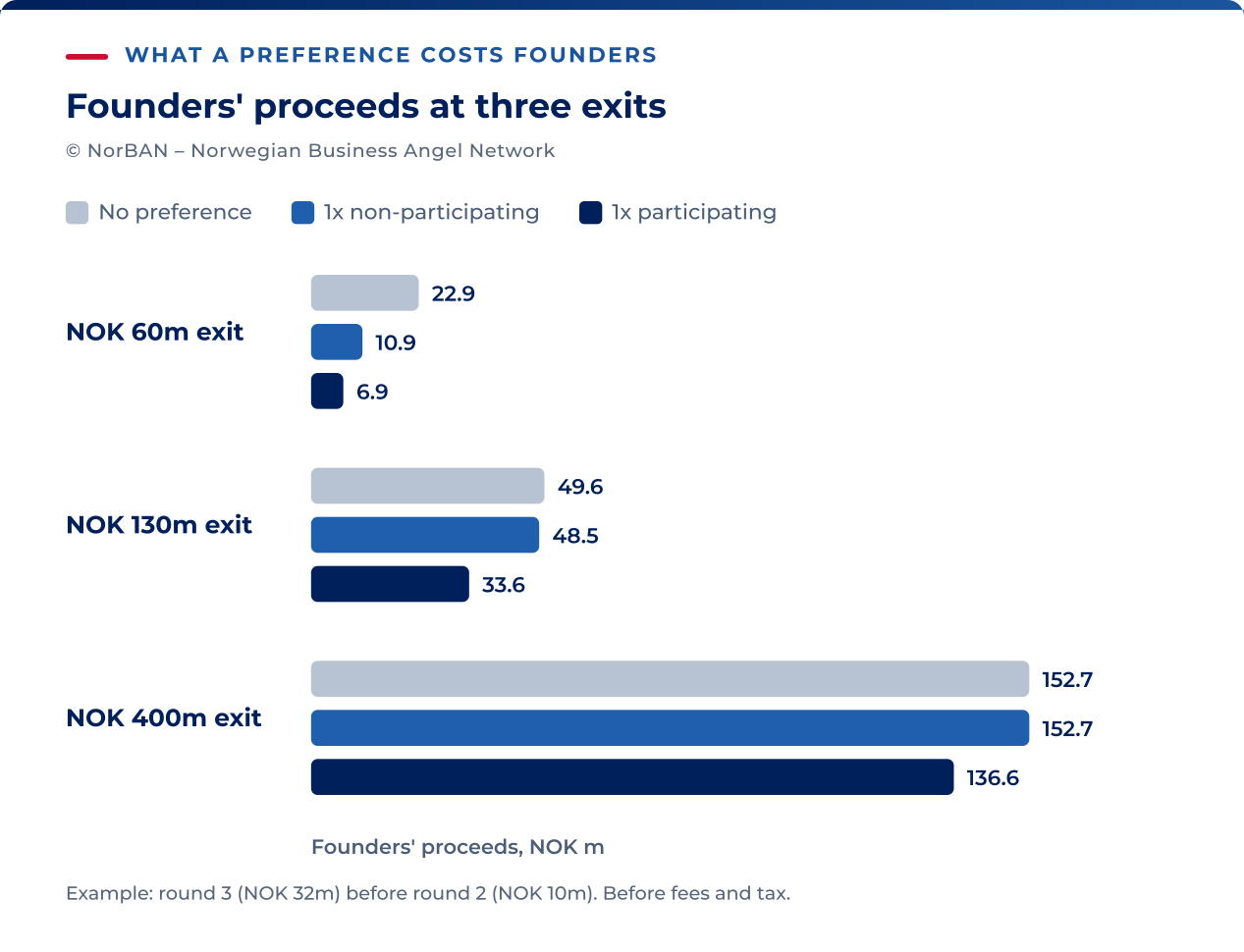
Use the same Nordvind model as the dilution article: 1,834,259.259 theoretical fully diluted units after three rounds, including 700,000 founder shares. Round 3’s NOK 32 million preference ranks ahead of round 2’s NOK 10 million. Options participate at zero exercise price. The table compares distributable equity proceeds before fees and tax; both preferred classes have the stated treatment.
| Equity exit (NOK m) | Founders, no preference (NOK m) | Founders, both non-participating (NOK m) | Founders, both participating (NOK m) |
|---|---|---|---|
| 60 | 22.898 | 10.933 | 6.869 |
| 130 | 49.611 | 48.481 | 33.583 |
| 400 | 152.650 | 152.650 | 136.622 |
At the NOK 400 million exit, both non-participating holders convert, leaving the founders the same proceeds as without preferences. At NOK 60 million, both take their preferences and the founders receive less than half their unpreferred proceeds. These scenarios show the effect of the terms; they are not exit forecasts.
A participating preference takes from you at every exit; multiples above one times are the same problem scaled up. Where the disagreement is really about price, negotiate the price.
Anti-dilution protects this round’s investor if a later round is priced lower. Broad-based weighted average is the most common formula in Norwegian venture practice and stays open to negotiation; full ratchet reprices the investor to the new lower price in full. The clause is common in rounds with an institutional lead and variable at angel stage.
For the down-round comparison, use the same pre-money pool convention as the dilution model: the protected round was priced at NOK 38.095238, followed by a round at NOK 26.666667, 30% lower. The protected investment is NOK 10 million, and the new round raises NOK 28 million. The pre-money count, including its pool top-up, is 1,415,000 units; founders still hold 700,000.
| Holder | No protection | Broad-based weighted average | Full ratchet |
|---|---|---|---|
| Founders | 28.40% | 27.96% | 27.16% |
| Protected investor | 10.65% | 12.02% | 14.55% |
All holders without protection, including earlier angels, share the dilution from the adjustment. Because the cost is spread among them, it matters less to each holder than the protection is worth to the protected investor, making the clause harder to negotiate away. Full ratchet moves nearly three times as many shares as weighted average on the same fall in price.
Angel rounds in ordinary shares have no conversion price to reset, so the same economics arrive as extra shares issued at nominal value, or as subscription rights granted at the round. One documented Norwegian pattern issues the earlier investors extra shares at par if a placement inside a short window after completion prices more than a stated percentage lower.
That is full-ratchet arithmetic inside a time limit and a trigger, harsher per event than weighted average and quick to expire. Read which mechanism the draft contains, how long it runs and what triggers it, and refuse open-ended protection stacked on a high price.
Accepting harsher protection to preserve the headline valuation postpones its cost until the next round, when you need new investors.
Control: board, reserved matters, information rights
Shareholders have statutory rights even with small holdings; additional rights can be negotiated. The § 5-18 majority requires both two thirds of votes cast and two thirds of represented capital, so failure of either test blocks the resolution. Holders of at least one tenth of share capital can require an extraordinary general meeting under § 5-6. Check which rights the investor seeks beyond the law.
What counts as proportionate is network practice: an observer seat for a small investment, a board seat where the money is large enough to carry the work that comes with it. In Norwegian venture rounds the lead investor typically appoints one or two directors.
A board seat for a small ticket carries duties and liability for the holder and gives you a larger, slower board. An observer seat with the papers in advance is the better offer to make.
Reserved matters are the decisions needing investor consent regardless of shareholding. In Norwegian venture practice the list runs to articles amendments, changes to the capital structure, debt, sales and reorganisations, major contracts and investments, dividends and key hires, typically by consent of two thirds of the preferred shares.
Accept the items about issuing and transferring shares and selling the company. Push hiring, salaries and ordinary purchasing back to the board, and insist on a deemed-consent deadline so that silence cannot stop the company.
Information rights are standard in Norwegian shareholders’ agreements, covering operations, financials and performance. Name the documents and the deadlines; a vague reporting promise becomes friction every month, and a specific one is cheap to keep.
Question whether control rights are proportionate when a small investment comes with a board-seat request, when vetoes extend to ordinary trading, or when consent rights have no response deadline. Say so, and offer the observer seat, the short list and the deadline instead.
Founder terms: vesting, lock-in and leaver clauses
Investors expect the founders’ shares to be earned over time, because the round is priced on the assumption that the team stays. Norwegian practice does this by time-based vesting with good- and bad-leaver pricing. The same clause protects you from a co-founder who leaves in month seven with a full stake, so sign it and negotiate the wording.
Vesting in a Norwegian AS is contractual. Founders already own their shares, so the agreement writes a buyback or call right over the unvested portion, exercised through the routes the statute allows: acquisition of own shares within distributable equity, redemption by capital reduction, or transfer to the remaining founders.
Check the rules for the chosen route. A transfer may engage consent and pre-emption under §§ 4-15 onwards, subject to articles and statutory exceptions. A company buyback also needs chapter 9 compliance; redemption by capital reduction follows chapter 12. These routes do not all use the same procedure.
The contract defines good and bad leavers and the pricing consequences. Illness, agreed departure, resignation and dismissal can be treated differently. Do not assume that resigning automatically makes a founder a bad leaver or that any particular price formula always applies.
For illustration, a founder’s 20% holding in a company valued at NOK 20 million has a headline value of NOK 4 million. If the agreed leaver clause requires sale of that entire holding at its original cost, the difference may be substantial. Actual value and the portion affected depend on rights, vesting and the contract. Check the following before signing.
- A bad-leaver definition wide enough to catch ordinary resignation. The UK model documents removed resignation from that definition in their February 2025 update, which makes pushing back a normal position.
- Who decides which label applies, and whether a dismissal without cause lands you in the wrong one.
- An objective method for market value where market value is the good-leaver price, because an open “fair value” invites dispute.
- A cliff and schedule that credit the time you have already put in.
A punitive price can be revised by a court under avtaleloven § 36, and the exposure rises with how harsh the clause is and how little the leaver did to deserve it. That is a remedy of last resort, so get the definitions right instead.
A lock-in keeps the founders committed for a defined period and is expected at angel stage. Check that it binds the investors too, and that the transfer definition catches a sale of a holding company, since Norwegian shareholders commonly hold through one.
Exclusivity, confidentiality and costs
Check which of these clauses bind from signing, how long they last and how they end. Their effect depends on the wording, not simply their heading.
Expect exclusivity: PwC found a period specified in 79 per cent of the 187 UK term sheets it surveyed. Your leverage is on duration and termination. Weeks is the right order of magnitude for an early-stage financing; the 45 to 60 days seen in acquisitions belongs to acquisitions.
Agree a due-diligence timetable and a clear end to exclusivity, including what happens if progress stalls. Check whether the clause prohibits contact, discussions, solicitation or agreements with other investors before maintaining those conversations. Each exclusive week uses part of the company’s remaining runway.
Make confidentiality mutual if both sides disclose protected information. Ensure your company’s information is covered, with suitable exceptions, duration and permitted recipients. A one-way obligation protecting only the company can be appropriate where only the company discloses information.
Agree who pays each adviser before the work begins. If the company will contribute to an investor’s costs, record the cap, covered work and payment conditions in the term sheet, including what happens if the round does not close.
Governing law should be Norwegian, with a named venue or arbitration. Foreign law for a Norwegian company with Norwegian shareholders is a cost with no benefit to you.
Standard, negotiable, walk away
Sort the draft with this table before the call with your lawyer, so the paid hours go on points marked “Stop and take advice”.
| Clause | Expect and sign | Negotiate | Stop and take advice |
|---|---|---|---|
| Price and percentage | NOK pre-money, resulting percentage and share count. | Price based on evidenced stage and intended percentage sold. | Percentage without share count, or confused pre-/post-money. |
| Option pool | A pool sized to a hiring plan. | Its placement, pre- or post-money, and its size. | A pool with no plan behind it, placed in the pre-money on top of a high preference. |
| Liquidation preference | Ordinary shares, or one times non-participating where the round has an institutional lead. | Whether a preference is needed. | Multiples above one times, or participating. |
| Anti-dilution | Broad-based weighted average, or a short-window true-up, where protection is given at all. | Duration, trigger and whether it is limited to the next round. | Full ratchet without a time limit. |
| Board | Observer for small investments; board seat for a suitably committed lead. | Board size and any ownership threshold for the seat. | A seat for every investor. |
| Reserved matters | Issues, transfers, sale of the company, related-party dealings, debt above a limit. | Operational items back to the board; a deemed-consent deadline. | Vetoes over ordinary trading without response deadlines. |
| Information rights | Named documents on named dates. | Format and cadence. | Unspecified reporting, or reporting with no mirror confidentiality duty. |
| Founder vesting | Time-based vesting with good- and bad-leaver pricing. | Definitions, who decides, the market-value method, credit for time served. | Resignation as bad leaver; a pre-agreed price with no method. |
| Exclusivity | A period in weeks, with a diligence deadline. | Length and automatic termination. | Months, or no end date. |
| Confidentiality | Mutual, from signature. | Carve-outs. | One-way. |
| Costs | Each side’s payment obligations stated. | Any contribution, cap and payment conditions. | Uncapped investor legal costs. |
| Warranties | Named in outline; the catalogue comes later. | Who warrants, the cap and the claim period. | Personal, unlimited and open-ended. |
Warranties: the clause the term sheet only previews
The term sheet names warranties in outline. The catalogue arrives in the investment agreement. In Norwegian practice it covers corporate status, ownership and validity of the shares, the accounts, assets, intellectual property, data protection, material contracts, related-party dealings, employees, tax and litigation, and it is generally shorter than in US practice.
Founders may be asked to give personal warranties. Breach remedies can include damages or an agreed share-based adjustment, depending on the contract. Extra shares do not arise automatically: a valid issue or other lawful mechanism must be in place. Identify who owes the obligation and who bears the dilution.
Company payments to investors require their own legal assessment. A genuine contractual liability is not automatically an unlawful distribution, but company obligations must be checked against capital protection, corporate authority and, where applicable, § 8-10. The law does not mean that every warranty remedy must instead be funded personally by founders.
Negotiate the cap on your exposure and the period during which claims can be brought; both are settled on the facts of the round. Disclosure lets the parties account for a known issue in the terms; leaving it undisclosed exposes you under the warranties.
Using your lawyer well
An angel round does not justify a lawyer on every line. The document set is three documents plus the corporate resolutions, and the process from a lead engaging to closing runs three to six weeks in Norwegian practice. Decide in advance where the paid hours go, and spend them on the clauses that set money or survive the round.
- The economics as a set: the pool’s placement, the preference and the anti-dilution mechanism, read against a restated price.
- The leaver terms, which concern you personally and cannot be reopened later.
- Anything that will live on in the shareholders’ agreement: the drag threshold, the transfer definition, the reserved-matters list.
- The binding tail: exclusivity length, confidentiality symmetry, costs.
Sign the standard clauses yourself and say that you are doing so. Investors notice a founder who argues every line as much as one who reads nothing, and neither is someone they want across the table for the years the investment will last.
Mark your positions on the draft and negotiate the terms together in writing. Consider trade-offs across clauses and support your position with the assumptions behind it. A lower price on clean terms is a trade many experienced investors will offer you themselves, because it is better for them in every exit but the largest.
Where an investor will not move on a clause marked “Stop and take advice”, bring counsel in and, if the answer stays the same, walk.