Why round one is priced three rounds out
Your seed investor considers what their holding will look like after Series A. Later investors will inherit the arrangements you agree now, including the pool, convertibles taken between rounds and any anti-dilution clause conceded to preserve the headline price.
A round selling 20 per cent does not leave that investor with 20 per cent indefinitely. Model the later rounds before signing, as investors will.
The cap-table questions on a Norwegian investor’s checklist ask how much the founders and key people own, whether an option plan exists and how large it is as a share of the capital, whether any options or warrants are outstanding, and what the fully diluted share count is.
Fully diluted is a scenario including issued shares and the shares that options, warrants and convertibles would create on the stated assumptions. State whether an unallocated option reserve is included. Issued ownership and voting rights also matter and should be shown separately. The examples below use an expressly defined fully diluted model.
A cap table that cannot be reconciled is among the things that stop a round outright. The findings that do it are the same few.
- Consent or pre-emption requirements in an existing shareholders’ agreement.
- An earlier round done at a lower price.
- Convertible claims agreed by e-mail and never documented.
- Third-party rights triggered by the new investment.
These issues can leave the share count uncertain. Resolve them before building the model so an investor can price a defined holding.
The dilution arithmetic of a priced round
Take Nordvind AS. The founders hold 700,000 shares and nothing else exists. The company raises NOK 3 million at a pre-money valuation of NOK 12 million. The figures are round and illustrative, and every later step in this article builds on them.
Dilution (utvanning) in a share issue (emisjon) follows from three numbers. Post-money is pre-money plus new money, NOK 15 million. The percentage sold is new money divided by post-money, 20 per cent.
The price per share is pre-money divided by the shares in issue before the round, NOK 12 million over 700,000, or NOK 17.14. That is the subscription price the general meeting resolution must state when it resolves the increase (aksjeloven § 10-1).
The investor receives NOK 3 million at that price, 175,000 new shares. The founders keep their 700,000, which is now 80 per cent of 875,000.
| Before the round | After the round | |
|---|---|---|
| Founders | 700,000 shares, 100 per cent | 700,000 shares, 80.0 per cent |
| Investor | none | 175,000 shares, 20.0 per cent |
| Fully diluted shares | 700,000 | 875,000 |
| Price per share | NOK 17.14 |
Nobody’s share count fell. Dilution is the same shares becoming a smaller fraction of a larger total, and the founders’ holding is worth NOK 12 million at the round price, which is what the pre-money said it was worth. Other instruments make this calculation more complicated.
What else dilutes you
Include the pool, convertibles and any subscription rights alongside the priced shares. Model each as the shares it would become to see its effect on ownership.
The option pool, and where it is created
Suppose the investor asks for a 10 per cent option pool as part of the same round. Where the pool is created decides who pays for it. Created inside the pre-money, the pool joins the share base the NOK 12 million is divided over, so the founders carry all of it. Created after the round, it dilutes the investor too.
| Pool inside the pre-money | Pool created after the round | |
|---|---|---|
| Founders | 700,000 shares, 70.0 per cent | 72.0 per cent |
| Investor | 200,000 shares, 20.0 per cent | 18.0 per cent |
| Pool | 100,000 shares, 10.0 per cent | 10.0 per cent |
| Price per share | NOK 15.00 | NOK 17.14 |
With the pool inside the pre-money the price falls from NOK 17.14 to NOK 15.00, the investor’s NOK 3 million buys 200,000 shares, up from 175,000, and the founders hold 70 per cent, down from 80. The stated NOK 12 million pre-money values the founders’ own shares at NOK 10.5 million; the pool is the other NOK 1.5 million.
In US and UK practice the pool is created before the round, inside the pre-money. Norwegian drafts go both ways, and the size of the pool is on the agenda in almost every negotiation, so read its placement as a term and argue it as one.
The rest of this article follows the pre-money case, because it is the one that costs you more: founders 700,000, angels 200,000, pool 100,000, one million shares in all.
Convertibles converting at a discount or a cap
Between rounds, Nordvind borrows NOK 1.5 million with a 20% discount and NOK 30 million pre-money cap. Interest is excluded from this example. In a real agreement, check whether interest accrues, is paid in cash or converts; conversion of interest would add shares.
At the next round the loan converts at the lower of the discounted round price and the cap price. Include the 50,000-unit pool top-up in both denominators before comparing them, giving a pricing count of 1,050,000.
| Round pre-money | Round price (NOK) | Discount price | Cap price | Applied price | Lender units | Value above principal |
|---|---|---|---|---|---|---|
| NOK 40 million | 38.095238 | 30.476190 | 28.571429 | 28.571429 | 52,500.000 | NOK 500,000 |
| NOK 30 million | 28.571429 | 22.857143 | 28.571429 | 22.857143 | 65,625.000 | NOK 375,000 |
| NOK 20 million | 19.047619 | 15.238095 | 28.571429 | 15.238095 | 98,437.500 | NOK 375,000 |
Compare the two prices. With the same denominator and a 20% discount, the NOK 30 million cap becomes the lower price above NOK 37.5 million pre-money; at that point they are equal. Once the cap binds, fixed principal converts into a fixed number of shares for that denominator. A higher round price increases their value, not their number.
Two instruments at the same cap take two slices at the same low price. Before signing, model each instrument at the cap and add up their combined dilution.
Subscription rights and warrants
A subscription right (tegningsrett) or warrant is a promise of shares at a set price, and it dilutes on the day it is exercised. They arrive as price protection in an angel round, or attached to a loan or an adviser agreement, and each belongs in the fully diluted count from the day it is granted.
The pool top-up
A pool is sized for the hires the current money funds. The next investor will want it refilled for the hires their money funds, and the refill is negotiated on the same terms as the pool was, placement included. In the model it lands inside the pre-money, as the pool did, carried by the existing holders.
Three rounds forward: the full model
Each 50,000-unit pool top-up enters the pre-money pricing count before the new investment. In round 2, the cap uses that same count of 1,050,000. Conversion shares themselves are excluded from the price denominator, so conversion dilutes the incoming investor too.
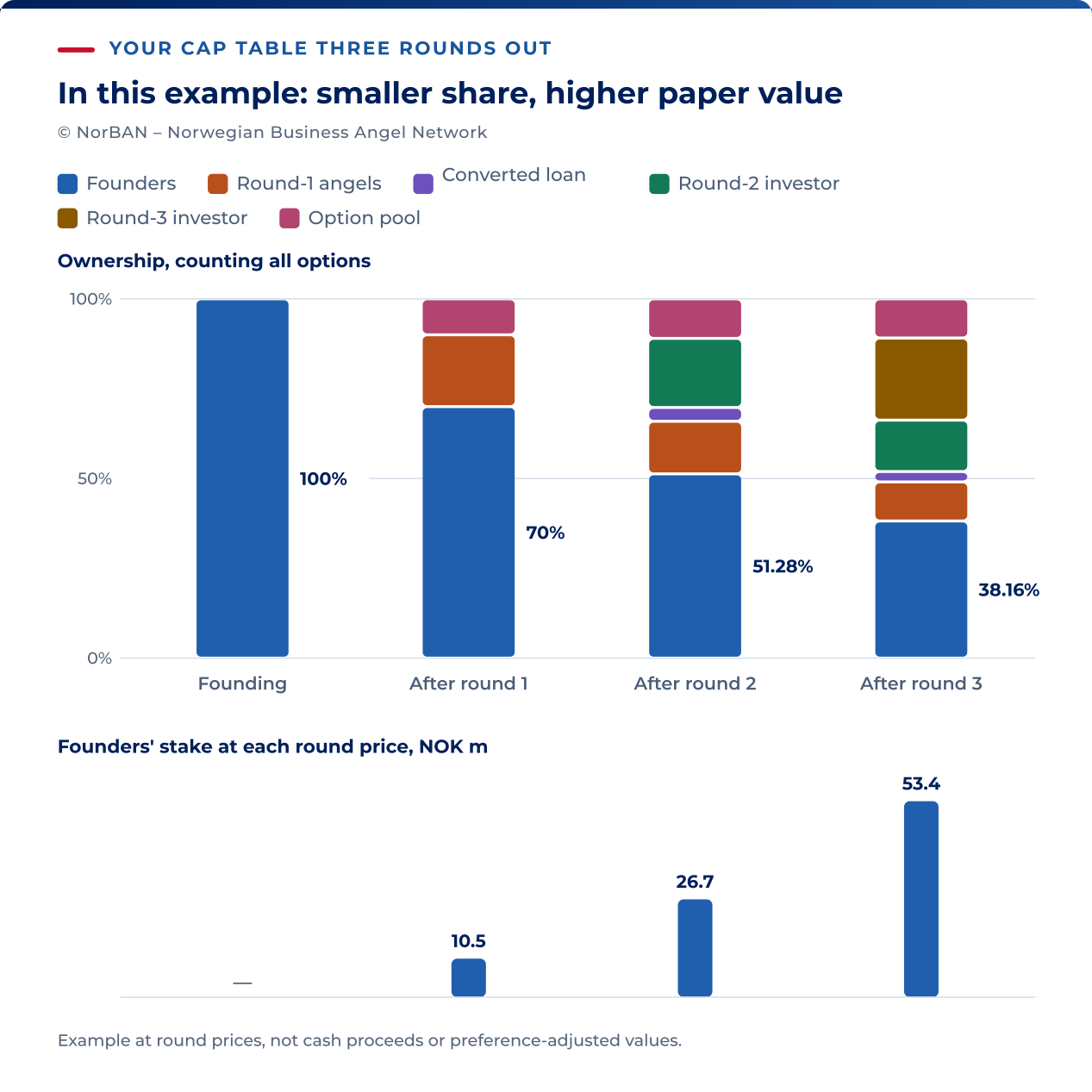
Keep those definitions explicit in the documents. These figures ignore interest and exercise proceeds; prices and theoretical fully diluted units are rounded for display, while percentages use exact values. An actual transaction needs a whole-unit implementation.
Round 2
The NOK 40 million pre-money divided by 1,050,000 gives NOK 38.095238 per share. The cap price produces 52,500 conversion shares; NOK 10 million of new money buys 262,500 shares.
| Holder | Fully diluted units | Ownership |
|---|---|---|
| Founders | 700,000 | 51.28% |
| Round-1 angels | 200,000 | 14.65% |
| Convertible holder | 52,500 | 3.85% |
| Round-2 investor | 262,500 | 19.23% |
| Option pool | 150,000 | 10.99% |
| Total | 1,365,000 | 100.00% |
New money divided by pre-money plus new money gives a headline 20%. After conversion, the incoming investor holds 19.23%. The founders’ fall from 70% to 51.28% is 18.72 percentage points, or 26.74% of their previous stake. Keep those measures separate.
At the round price, total value is NOK 52 million: NOK 40 million of pre-money capitalisation including the pool top-up, NOK 10 million of new investment, and NOK 2 million assigned to conversion shares. The last amount includes NOK 1.5 million of principal and NOK 0.5 million of uplift; it is not cash paid by the founders.
Round 3
The next 50,000-unit top-up takes the price denominator to 1,415,000. NOK 108 million pre-money gives NOK 76.325088 per share; NOK 32 million buys 419,259.259 theoretical units.
| Holder | Fully diluted units | Ownership | Value at round price (NOK m) |
|---|---|---|---|
| Founders | 700,000.000 | 38.16% | 53.428 |
| Round-1 angels | 200,000.000 | 10.90% | 15.265 |
| Convertible holder | 52,500.000 | 2.86% | 4.007 |
| Round-2 investor | 262,500.000 | 14.31% | 20.035 |
| Option pool | 200,000.000 | 10.90% | 15.265 |
| Round-3 investor | 419,259.259 | 22.86% | 32.000 |
| Total | 1,834,259.259 | 100.00% | 140.000 |
The pool is increased before each round; it is not kept at exactly 10%. Rounded percentages may not sum to 100%, and round-price values are not cash received or guaranteed exit proceeds.
| Founding | After round 1 | After round 2 | After round 3 | |
|---|---|---|---|---|
| Founder ownership | 100.00% | 70.00% | 51.28% | 38.16% |
| Founders’ stake at round price (NOK m) | — | 10.500 | 26.667 | 53.428 |
| Fully diluted units | 700,000 | 1,000,000 | 1,365,000.000 | 1,834,259.259 |
| Price per share (NOK) | — | 15.000000 | 38.095238 | 76.325088 |
The same 700,000 founder shares represent 38.16% after three rounds. Their value at the round price has increased from NOK 10.5 million to NOK 53.428 million. Compare that outcome with a down round before agreeing to the terms.
The down round: anti-dilution arrives
Keep NOK 28 million of new money and the original 30% fall from the round-2 price. The new price is NOK 26.666667 and the investor receives 1,050,000 units. Include the same 50,000-unit pre-money pool top-up used in the higher-valuation case.
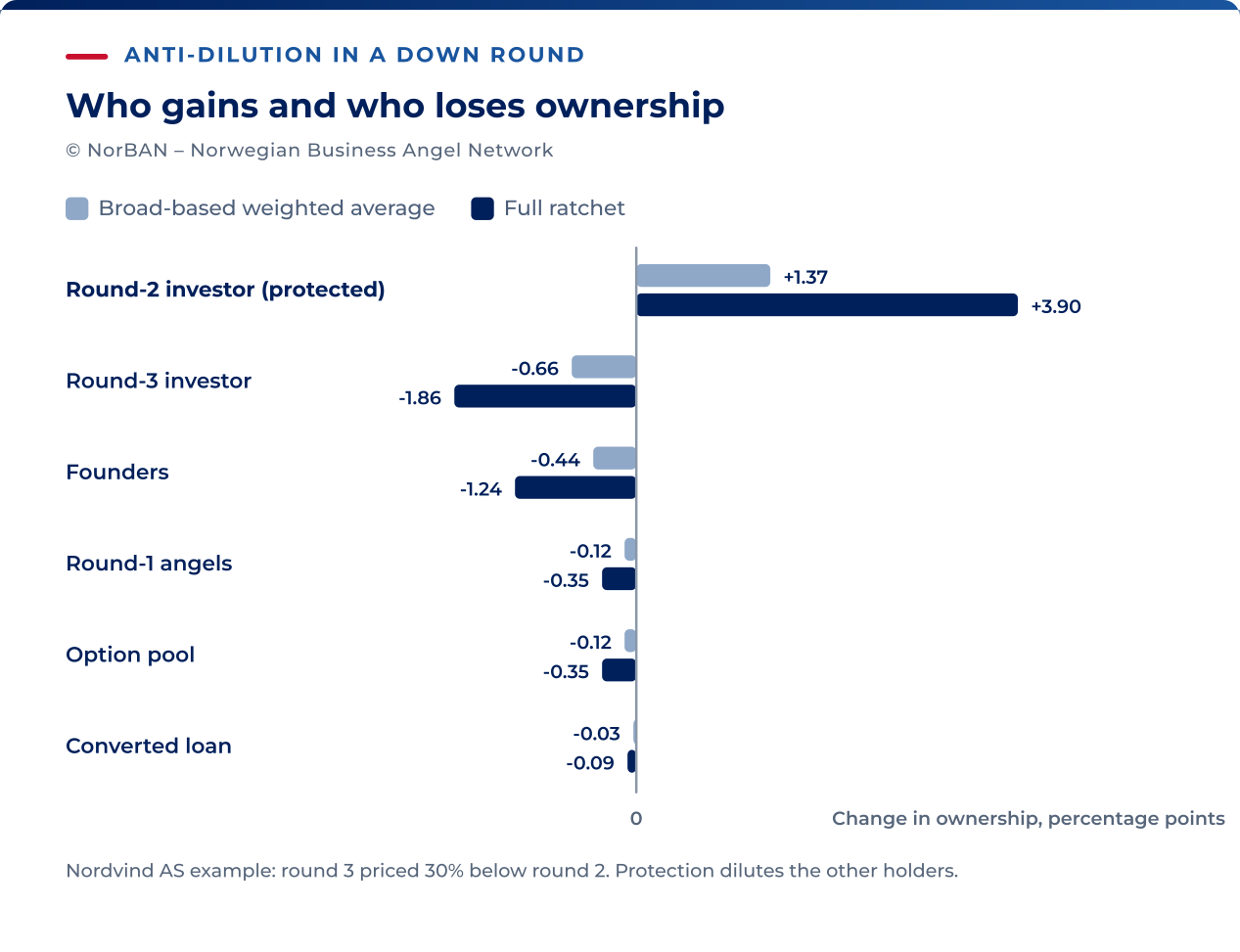
For the broad-based weighted-average illustration, A is 1,415,000 units before the new money; B is NOK 28 million divided by the old price, or 735,000; and C is the 1,050,000 units issued. The adjustment is old price × (A + B) ÷ (A + C), giving NOK 33.227084.
The protected NOK 10 million position becomes 300,959.302 units, an increase of 38,459.302 over 262,500. Full ratchet gives 375,000 units at the new round price, an increase of 112,500. These are economic equivalents; the agreed clause and corporate steps determine how any adjustment is delivered.
| Holder | No protection | Weighted average | Full ratchet |
|---|---|---|---|
| Founders | 28.40% | 27.96% | 27.16% |
| Round-1 angels | 8.11% | 7.99% | 7.76% |
| Convertible holder | 2.13% | 2.10% | 2.04% |
| Round-2 investor | 10.65% | 12.02% | 14.55% |
| Round-3 investor | 42.60% | 41.94% | 40.74% |
| Option pool | 8.11% | 7.99% | 7.76% |
| Total units | 2,465,000.000 | 2,503,459.302 | 2,577,500.000 |
| Total ownership | 100.00% | 100.00% | 100.00% |
Founders lose about 0.44 percentage points under weighted average and 1.24 under full ratchet compared with the same down round without protection. The other unprotected positions also fall; the full denominator includes the conversion shares and pool.
The dilution is spread among unprotected holders, so each bears less cost than the benefit the protected investor receives. This helps explain why founders concede the clause and later struggle to remove it.
Norwegian angel rounds in ordinary shares deliver the same economics differently: extra shares at nominal value, or subscription rights granted at the round. One documented pattern runs only inside a short window after completion and only above a stated fall in price.
Whichever mechanism your draft contains, model a down round before signing. Protection that has no cost in the base case can materially change ownership when the price falls.
How much should founders still own?
There is no rule about the share founders should still hold after a given round. There is an investor’s reason for caring, and two benchmarks.
The reason is that the founders’ stake is what the investor is buying. A team diluted to a stake that no longer motivates them, two rounds before the exit, is a problem for every investor on the table, because every other position depends on that team staying and working.
Experienced angels check the trajectory before they sign, for the same reason you should.
The two benchmarks are labelled by origin, and neither is a target. Carta’s Founder Ownership Report 2026, platform data with no geography attached, puts the median founding team at 56 per cent of fully diluted equity after the seed round and 36 per cent at Series A, so the median team is below half after two rounds.
The nearest Norwegian published statement, from Lise Fulland of StartupLab in Shifter, puts per-round dilution at around 20 per cent, almost never more than 25, and founders at around 50 per cent after Series A.
Nordvind’s founders sit at 38.16 per cent after three rounds, between the two. Where you sit depends on the pool, the convertibles and the price of each round, and the last of those is where founders most often make the trade that looks like ownership protection and is not.
Ketil Wig’s financing-strategy paper for Remis works the arithmetic. A company that starts at a 15 million pre-money and raises three issues on the return requirements investors carry ends with the founders at 46 per cent, and each unit of new equity has to generate 2.8 times its value in valuation growth between rounds.
Start the same company at 35 million, with the same capital and the same return requirements, and the founders end at 66 per cent, but each unit of cash must now generate 4.4 times.
Twenty percentage points of ownership were bought with a value-creation obligation more than half as large again, due at the next round. If the company does not clear it, the next round is the down round modelled above, and the anti-dilution clause returns the ownership with interest. Price the round at a level the next round can clear.
Modelling before you sign
Keep one spreadsheet for all proposals and follow the same checks at every round.
- Show issued and fully diluted ownership. Reconcile issued shares to the share register. List classes, granted options, unallocated reserve, warrants and each convertible with its terms. Clearly distinguish potential shares from issued ones.
- One scenario per offer. Place the pool as agreed and calculate the applicable conversion price, comparing discount and cap where required. Include price-protection triggers and duration. Compare resulting ownership, not just the headline valuation.
- Project later rounds. State expected financing and pool increases, then test a lower-priced round. These are scenarios, not predictions.
- Test clauses. Examine effects in both the base case and adverse cases. Even a small percentage change can have material value; use judgment rather than a fixed one-percentage-point cut-off.
The trades that protect ownership do not require a fight with the investor, because each of them is also in the investor’s interest.
- Raise the amount the next milestone needs and no more. Every krone above it is sold at today’s price, which is the lowest price you hope to sell at.
- Put grants and other non-dilutive money alongside the equity. A smaller round at the same valuation sells fewer shares.
- Argue the placement of the pool and the size of the top-up from a hiring plan. A pool sized to a plan is easier to defend than a percentage.
Where the disagreement is about the valuation, negotiate the valuation, and hold the terms clean. A lower price on clean terms, carried three rounds forward, can leave the founders with more of the company than a higher price carrying a pre-money pool, a low cap and a ratchet. The model shows you which.