
How big a pool, and what it is for
An option pool reserves equity for employee grants. Its size should follow the hiring plan, while its placement before or after the financing determines who bears the dilution (utvanning).
List the roles needed before the next round and a defensible equity allocation for each. The total gives you a pool to negotiate against actual hiring needs.
An oversized pre-money reserve reduces existing holders’ percentage in the fully diluted calculation before all options are granted. The reserve itself does not issue shares. An undersized reserve may require shareholder approval before further awards can be made.
Review recruitment plans before promising options. An investor will ask whether a plan exists, how large it is, what is outstanding and what the fully diluted count is. Have those answers before the term sheet, with the hiring plan behind them.
Who is actually diluted
If the option reserve is included in the pre-money valuation and sized to the agreed post-round percentage, existing holders bear its dilution while the new investor retains the agreed percentage. A reserve created after the investment dilutes the new investor as well. The calculation depends on the agreed definition and timing.
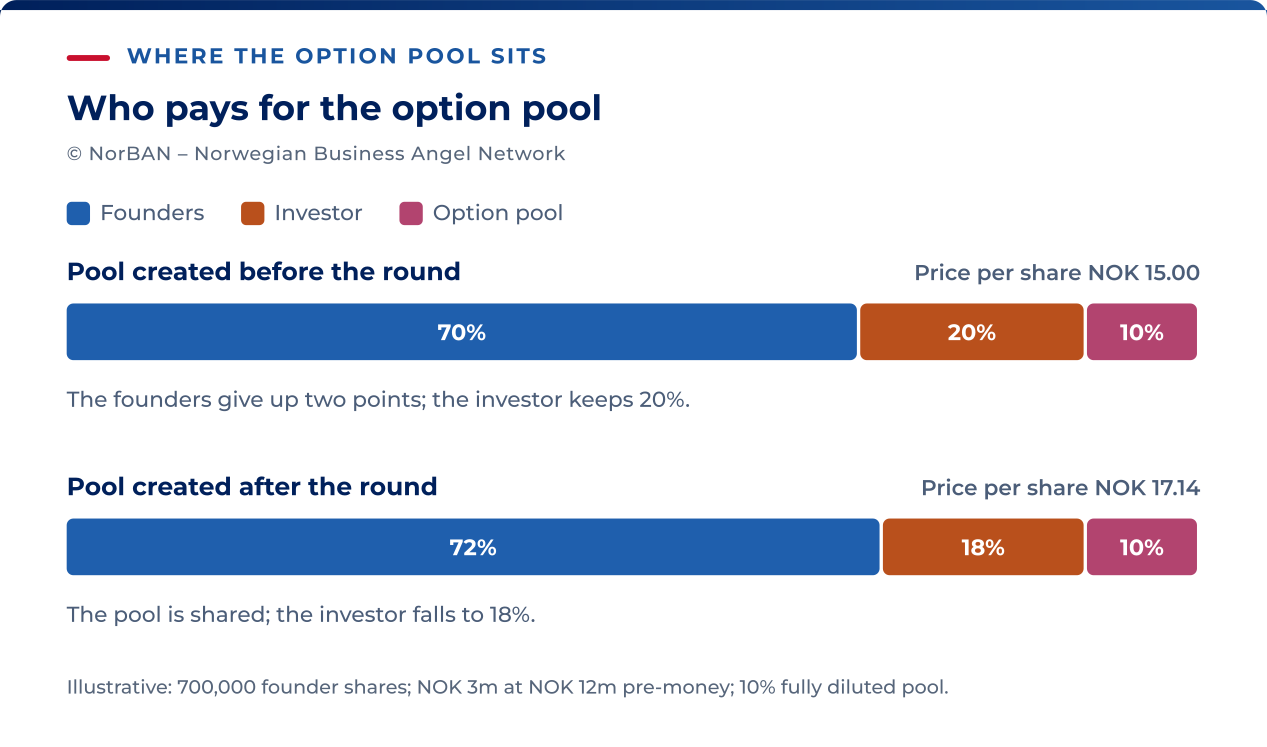
The example uses the same company as the cap-table model. Founders hold 700,000 shares and the investor contributes NOK 3 million at a NOK 12 million pre-money valuation. The pool is 10% after the round in both alternatives. Figures are rounded and illustrative.
| Pool created inside the pre-money | Pool created after the round | |
|---|---|---|
| Price per share | NOK 15.00 | NOK 17.14 |
| Founders after the round | 70.0 per cent | 72.0 per cent |
| Investor after the round | 20.0 per cent | 18.0 per cent |
| Pool after the round | 10.0 per cent | 10.0 per cent |
With the pool inside the pre-money value, NOK 12 million is divided over a larger share count. The price is lower and the investor’s NOK 3 million buys more shares. Compared with the post-money-pool alternative, the founders have two percentage points less and the investor two points more. The pool is 10% in both cases.
The stated NOK 12 million values the founders’ own shares at NOK 10.5 million and the pool at NOK 1.5 million. Restate the valuation without the pool before you compare offers.
A pre-money pool is a familiar negotiating structure, but do not assume it from the jurisdiction or a headline valuation. Check the actual term sheet. If the quoted pre-money value includes an unallocated pool, less of that value is attributable to the existing shares.
Granting options in a Norwegian AS
An option gives a right to acquire shares later at an agreed price. Delivery can use newly issued shares, company-held shares or existing shares supplied by a shareholder. Each route needs the appropriate agreements and corporate steps.
- New shares. Use a general-meeting increase (§ 10-1) or board mandate (§§ 10-14–10-19). Mandates last at most two years, cover at most half the capital registered at mandate registration, and require registration before use. Standalone warrants (§ 11-12) have at most five years to exercise from the meeting decision.
- Treasury shares. Deliver lawfully held shares. Ordinary paid buybacks need a registered general-meeting mandate, at most two years, specifying maximum nominal value, price range and acquisition/disposal methods. Shares must be fully paid; payment must fit dividend capacity and the minimum-capital test (§§ 9-2–9-4). Section 9-6 provides exceptions, including gifts.
Register a capital-increase mandate before the board uses it, and a treasury-share acquisition mandate before buying under it. Track expiry dates. The tax scheme’s three-to-ten-year exercise window can outlast a corporate mandate or warrant. Plan a lawful delivery route throughout; do not assume that replacing a right leaves its tax grant date unchanged.
Document the plan rules and each individual grant separately. The plan rules set the pool, who may receive grants, how the strike price is set, the vesting schedule and cliff, the exercise window, and what happens when a holder leaves. The option agreement (opsjonsavtale) makes one grant to one person on those rules, and is the document the employee signs.
Vesting and leaver terms are contractual. For the tax scheme, actual exercise must occur between three and ten years after grant. Vesting can begin earlier, provided all the other conditions are met (Tax Administration).
Employee options differ from founder reverse vesting. The founder already owns shares, subject to agreed repurchase rights. The option holder has a contractual right, but does not own the underlying shares before exercise and delivery.
The start-up option tax scheme (opsjonsskatteordningen)
Under the general rule in skatteloven § 5-14, the benefit at exercise is salary income: share market value less the strike price, any option premium and deductible option transaction costs.
The start-up option tax scheme (opsjonsskatteordningen), in the second paragraph of the same section with the conditions in FSFIN § 5-14-12, replaces that with a deferral: no tax at grant, no tax at exercise, and tax on the sale of the shares as capital income under the shareholder model.
The scheme applies to options granted from 2022 onwards, in unlisted companies. It has three sets of conditions. The size ceilings among them are amounts the regulation fixes and can be amended, and Skatteetaten publishes the current values in the Skatte-ABC entry on options in employment, which is where each condition is checked.
Company: form and listing
A Norwegian-resident AS, or an equivalent foreign company resident in the EEA or a country with a tax information-exchange treaty with Norway, can qualify. The foreign company must also be taxable in Norway under § 2-3(1)(b). The scheme is for the AS form or its foreign equivalent, not a listed ASA (FSFIN).
Company: size
For grants under the current limits, the preceding income year must show no more than 150 average full-time equivalents, NOK 80 million operating revenue and NOK 200 million total assets. All three limits apply. Assess a group together, with all group companies in the required company form (FSFIN).
Company: age
The company must be no more than twelve years old in the grant year, counting the founding year. A tax-neutral conversion carries forward the original entity’s age; demergers also use the original age, and mergers use the oldest participating company. For a group, check the oldest company (FSFIN).
Company: ownership and activity
Public bodies, including state and municipal companies, may not control 25 per cent or more of the capital or votes at the grant date.
The company cannot conduct coal or steel activities and must mainly conduct activities other than passive capital management. No more than 30% of total payroll costs may relate to financial services, dealing in property or commodities, long-term letting of residential or commercial premises, legal advice, auditing or accounting, as specified in FSFIN.
Company: state aid and difficulty
The company may not owe repayment of unlawful state aid and may not be in financial difficulty on the EEA definition at the grant date; in a group, no group company may be (FSFIN § 5-14-12).
Employee: employment
The employee must have started work at grant and still be employed at exercise. An actual grant before starting falls outside the scheme. An earlier agreement expressly conditional on starting can instead have its grant date when employment begins; see Skatte-ABC.
Employee: working time
The employee must work an average of at least 25 hours per week, calculated annually, from grant through exercise. Absence for illness, parental leave and involuntary temporary layoff can count as working time; do not extend this to all forms of leave (FSFIN; Tax Administration).
Employee: ownership
The holder, alone or with related parties, may not directly or indirectly own or control more than 5 per cent of the shares or votes, including the group where applicable, tested in the grant year and the two preceding years (FSFIN § 5-14-12).
Option: form
A personal, non-transferable right to acquire shares in the employer company. It cannot be sold, inherited or moved into the holder’s own company (FSFIN § 5-14-12).
Option: strike price
Not below the market value of the shares at grant (FSFIN § 5-14-12).
Option: exercise window
Exercised no earlier than three years and no later than ten years after grant; outside the window the general rules apply. The date of actual exercise decides, whatever the vesting schedule says (FSFIN § 5-14-12).
Ceilings
The aggregate grant-date market value of underlying shares is limited to NOK 3 million per employee and NOK 60 million per company. Count earlier grants under the scheme, not merely currently outstanding options. A group shares the company limit (FSFIN).
The employer reports each grant and each exercise to Skatteetaten, with the strike price and the market value at grant, by 1 February after the income year. Late reporting can attract a fine and does not by itself take the option out of the scheme. Shares issued on exercise are also an event in the annual shareholder register statement.
Document the grant-date market value because the exercise price cannot be lower. A recent arm’s-length transaction in comparable shares can provide strong evidence. Check whether the traded shares have different preferences or other rights before using that price for employee shares.
Older or thinner transactions are assessed for arm’s length, how long ago they were and whether the volume was large enough to price the shares at all, then adjusted for time. Document the transaction, its date and the adjustment.
If there is no usable transaction, you must make a valuation you can support without advance confirmation from Skatteetaten. Skatteetaten names no approved method and no standard discount for an unlisted company, and can change an assessment it finds wrong under skatteforvaltningsloven § 12-1.
A binding advance ruling cannot approve the valuation: Tax Administration Regulation § 6-1-4 excludes valuation and other discretionary assessments. A ruling can address concrete legal questions about a planned arrangement on the stated facts. It does not certify every factual condition or the price.
Keep the valuation, assumptions and calculation with the grant documents for later diligence or tax review.
What the employee actually receives
Take one grant carried to a sale: options struck at NOK 15, exercised when shares are worth NOK 80, sold at NOK 150. Assume no option premium or transaction costs; the exercise benefit outside the scheme is 80 − 15 = NOK 65.
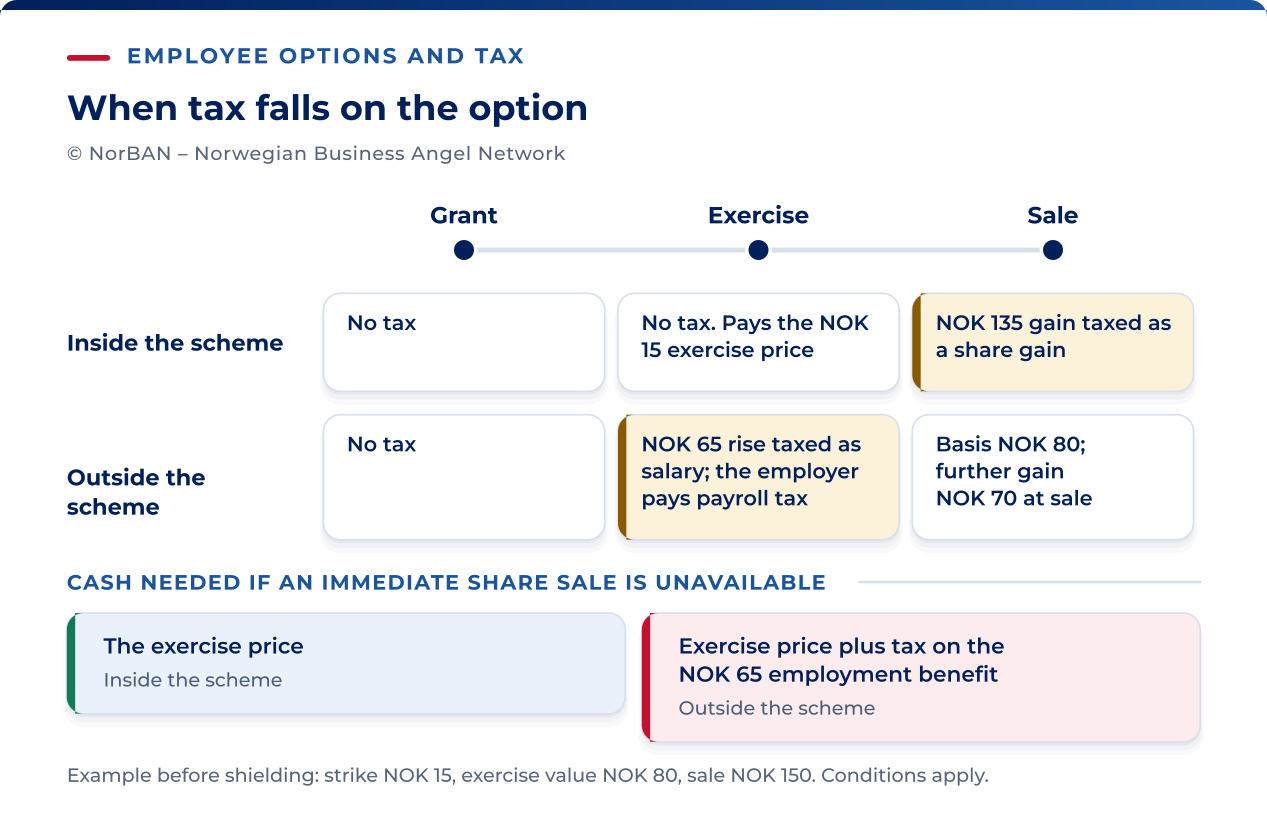
| Within scheme | Outside scheme | |
|---|---|---|
| Grant | No income tax. | No income tax. |
| Exercise | No income tax; pay NOK 15 per share. | NOK 65 employment income per share: withholding, employer contributions and a-melding reporting. |
| Sale at NOK 150 | NOK 135 gain before shielding, taxed under the shareholder model. | Basis NOK 80 after employment taxation; further NOK 70 gain before shielding, under the shareholder model. |
| Cash if immediate sale unavailable | Exercise price. | Exercise price plus tax on NOK 65 benefit. |
| Employer contributions | None on qualifying option benefit. | On NOK 65 at applicable rate. |
The example excludes option premiums, transaction and administrative costs; grants are not costless for company or owners.
The rates at each step are set annually and published by Skatteetaten: the factor and rate for share gains, and the employer’s contribution rate by zone.
Explain the possible cash requirement when hiring. Outside the scheme, exercise can trigger employment tax for the employee and employer contributions for the company. If the shares cannot be sold at the same time, neither party receives sale proceeds to fund those amounts.
The scheme defers ordinary income tax until share disposal; moving abroad needs a separate exit-tax assessment. In SKNS1 38/2025, a divided board found the taxpayer did not own the specific conditional options at departure in 2016: continued employment was required and exercise unavailable. This does not exempt all employment-conditioned options. Check actual rights and departure-date rules.
Outgrowing the scheme, and the round that breaks it
The scheme’s conditions have different test dates. Company size is measured in the income year before grant, age in the grant year, and public ownership and financial difficulty at grant. The regulation gives no express test date for some activity restrictions; do not assume every company condition is either continuing or tested only once.
The employee’s working-time condition continues from grant to exercise. The ownership test covers the grant year and the two preceding years. Strike price and value caps are measured at grant; the exercise window is three to ten years afterwards. The option must concern shares in the employer company and remain non-transferable.
Check each condition against FSFIN § 5-14-12 for the particular grant. Older grants may fall under earlier limits.
Assess a later change against the condition and its test date. Growth after a size-measurement date differs from changing the employer or the shares underlying the option. Do not assume that all existing grants survive any restructuring merely because they qualified when granted.
If continued eligibility is unclear for the proposed change, seek advice or a binding advance ruling (bindende forhåndsuttalelse) before acting. The ruling can address the legal treatment of the structure, but cannot confirm the valuation.
A financing round can close the scheme to future grants, and a term sheet rarely mentions any of the ways it does.
- Public ownership. A state or municipal investment vehicle, alone or with other public bodies, reaching 25 per cent of capital or votes.
- A group. A round that makes the company a subsidiary means every company condition is tested for the group as a whole; the age limit runs on the oldest group company and the company ceiling is shared.
- Size. A round that lifts the balance sheet above its ceiling, or growth that takes revenue or headcount above theirs, closes the scheme to grants made in the following year.
- Age. The limit runs regardless of the round.
A round can also close it to one person. A founder-employee whose stake crosses 5 per cent is outside the scheme, and the test looks at the grant year and the two preceding years.
Check the applicable limits and measurement dates before signing the term sheet. Plan justified awards in time, but do not treat a pre-round grant as automatically qualifying: employment must have begun, the valuation must be current and every condition must be met at its relevant time.
When options are the wrong instrument
Where the scheme does not fit, the choice is between diluting now, diluting later and paying cash — and each alternative is taxed differently in the holder’s hands.
| Instrument | Ownership and tax |
|---|---|
| Ordinary options | New shares dilute; existing-share delivery changes ownership only. Employment benefits trigger tax, withholding, reporting and employer contributions (§ 5-14). |
| Market-value shares | New shares dilute; transfers do not. Genuine market investments normally create no acquisition employment benefit; employment discounts are taxable. Assess actual risk, vesting and leaver terms. |
| Subscription rights/warrants | New shares dilute. Employment-linked rights, including loan-linked rights, can fall under § 5-14; not every investor warrant does. |
| Cash-settled synthetic options | No shares; outside § 5-14, but employment-linked gains can be salary. Market-value purchase does not guarantee capital treatment (BFU 3/2024). The company funds payment. Assess synthetic shares with different risk separately. |
Exit bonuses in cash
A cash bonus payable only on a sale does not dilute shareholdings. It is income from work, taxed under skatteloven § 5-1 and § 5-10. The latter covers remuneration from work both inside and outside an employment relationship and explicitly includes bonuses.
The bonus is personal income under § 12-2 and carries employer’s contributions under folketrygdloven § 23-2. Tax is withheld and the payment reported through the a-melding like other pay.
These obligations also apply when someone other than the employer pays the bonus. Under skatteforvaltningsloven § 7-2 second paragraph, the employer must still report the payment.
If sellers pay a bonus from their own proceeds, the company must report it and pay the employer’s contributions. Tell the employer what each employee receives and allocate the cost in the sale agreement. Otherwise, the cost remains in the company for the buyer to discover.
Deductibility depends on the payer. Paid by the company it is a salary cost under skatteloven § 6-1 where it serves the company’s own income, so the board’s reasons for paying it belong in the minutes at the time.
A corporate seller inside the participation exemption gets no deduction for realisation costs, skatteloven § 6-24 second paragraph.
Qualifying personal sale costs reduce taxable gain or increase deductible loss (Skatte-ABC A-5-1.3). Exit bonuses do not automatically qualify: establish payer, obligation and connection to that seller’s taxable sale. A 2024 Tax Appeals Board decision denied a corporate deduction on allocation and income-connection grounds, without establishing a general rule for bonuses or personal sellers. Obtain classification before agreeing payment.
A qualifying option can let the employee fix the exercise price now and defer ordinary income tax until disposal of the shares. Any option premium, the exercise payment, eligibility conditions and possible exit tax still matter.
Before you promise anyone anything
An oral promise of options can create contractual obligations or disputes even if the company has not arranged share delivery. It is not itself a valid share issue. Record promises and any conditions clearly, and review the checklist before making a binding commitment.
- Document share delivery, required decisions/agreements, registration before mandate use, and expiry dates.
- Write plan terms and individual award agreements, including outstanding conditions.
- Evidence grant-date market value: comparable transactions, dates, volumes, rights and adjustments.
- Check company conditions, group status, public ownership and grant limits.
- Check employment has begun, working time and ownership conditions.
- Assign reporting: normally 1 February for options and 31 January for the shareholder register statement, after the income year. Check the filing calendar.
- Record option count, exercise price, vesting, exercise window and leaver terms.
Also record promises made outside this process. Investors may ask the company or founders to warrant that all rights to shares have been disclosed. Check who gives each warranty and its scope before signing.