
Why the round negotiates the pool
An option pool is a block of shares reserved for future employees, and every share in it dilutes everyone else when it is granted and exercised. Agreeing the pool in the round means agreeing that dilution (utvanning) now, before the people it is for have been hired.
Size the pool from the hiring plan through to the next round. Each planned hire carries a grant, each grant is a number of shares, and the pool is the sum. A pool sized from a percentage quoted at another company is either dilution nobody needed or a shortfall that becomes a top-up at the next round, priced then.
An oversized pool at a low valuation has a real cost. If the round creates it inside the pre-money, the founders’ own holding is worth less than the headline pre-money says, and the difference is the pool.
Simonsen Vogt Wiig note that the size of the pool is almost always on the agenda in Norwegian venture negotiations, and that arithmetic is the reason.
Pre-money or post-money pool
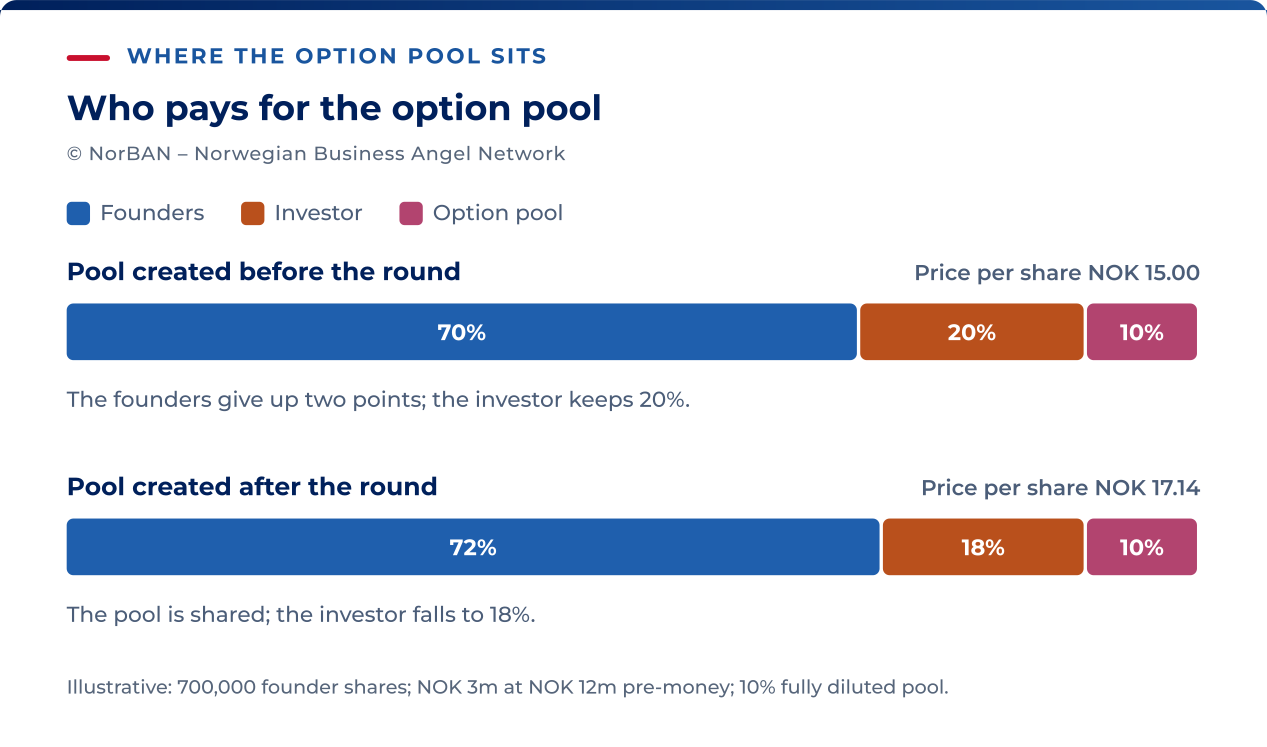
The same round, run both ways at the same pre-money and the same investor cash, gives different prices and different stakes. The company below has two founders holding 700 000 shares and raises NOK 3 million at NOK 12 million pre-money with a pool of 10 per cent of the post-round table.
| Pool created in the pre-money | Pool created after the round | |
|---|---|---|
| Pre-money | NOK 12 000 000 | NOK 12 000 000 |
| Investor cash | NOK 3 000 000 | NOK 3 000 000 |
| Price per share | NOK 15.00 | NOK 17.142857 |
| Founders | 700 000 shares, 70.0 % | 700 000 shares, 72.0 % |
| Investor | 200 000 shares, 20.0 % | 175 000 shares, 18.0 % |
| Pool | 100 000 shares, 10.0 % | approximately 97 222 units, 10.0 % |
| Fully diluted | 1 000 000 | approximately 972 222 |
For display, the post-round pool count is rounded and its percentages use the exact count; an actual issue needs an agreed whole-unit structure before the transaction can proceed.
The figures are a NorBAN illustration in round numbers and no market benchmark. In the pre-money the founders pay the whole pool, two percentage points here, and your 20 per cent is untouched. After the round the pool is shared, your stake falls to 18 per cent, and the price per share is higher.
The pool’s treatment is negotiated in every round. Before discussing the valuation, establish whether the headline figure includes the pool. The founder-side reading and the forward model that produces these tables are in the cap-table article.
Sizing the pool
Translate the hiring plan into a number of shares. For the hypothetical company above, the plan through to its next round might look like this.
| Planned hire before the next round | Grant, as a share of the post-round table | Shares at 1 000 000 fully diluted |
|---|---|---|
| Head of sales | 2.0 % | 20 000 |
| Two senior engineers | 1.5 % each | 30 000 |
| Three further hires | 0.5 % each | 15 000 |
| Reserve for a hire not yet planned | 1.0 % | 10 000 |
| Pool needed | 7.5 % | 75 000 |
A plan that sums to 7.5 per cent does not need a 15 per cent pool, and a pool that is not granted by the next round is dilution the founders and you carried for nothing.
A plan that sums to more than the pool on offer means the next round will create a top-up, and the investor in that round will want it in the pre-money.
One historical European benchmark gives context. Index Ventures’ Rewarding Talent handbook put the traditional pool at 10 per cent and the range at seed at 10 to 20 per cent, from cap-table analysis of European portfolio companies in 2017 and 2018. Read it as the order of magnitude of a pool, and size yours from the plan.
Each refresh needs its own calculation. In the linked three-round model, the pool gains 50 000 shares before the second round and another 50 000 before the third. Those pre-money top-ups dilute the holders already in place; the incoming investor is priced against the enlarged pre-money count. The new cash issue then causes further dilution.
The start-up option scheme (opsjonsskatteordningen)
The tax treatment of the options affects whether they help retain employees. The start-up option tax scheme (opsjonsskatteordningen) in skatteloven § 5-14, second paragraph, with its conditions in FSFIN § 5-14-12, applies to options granted from 1 January 2022 on.
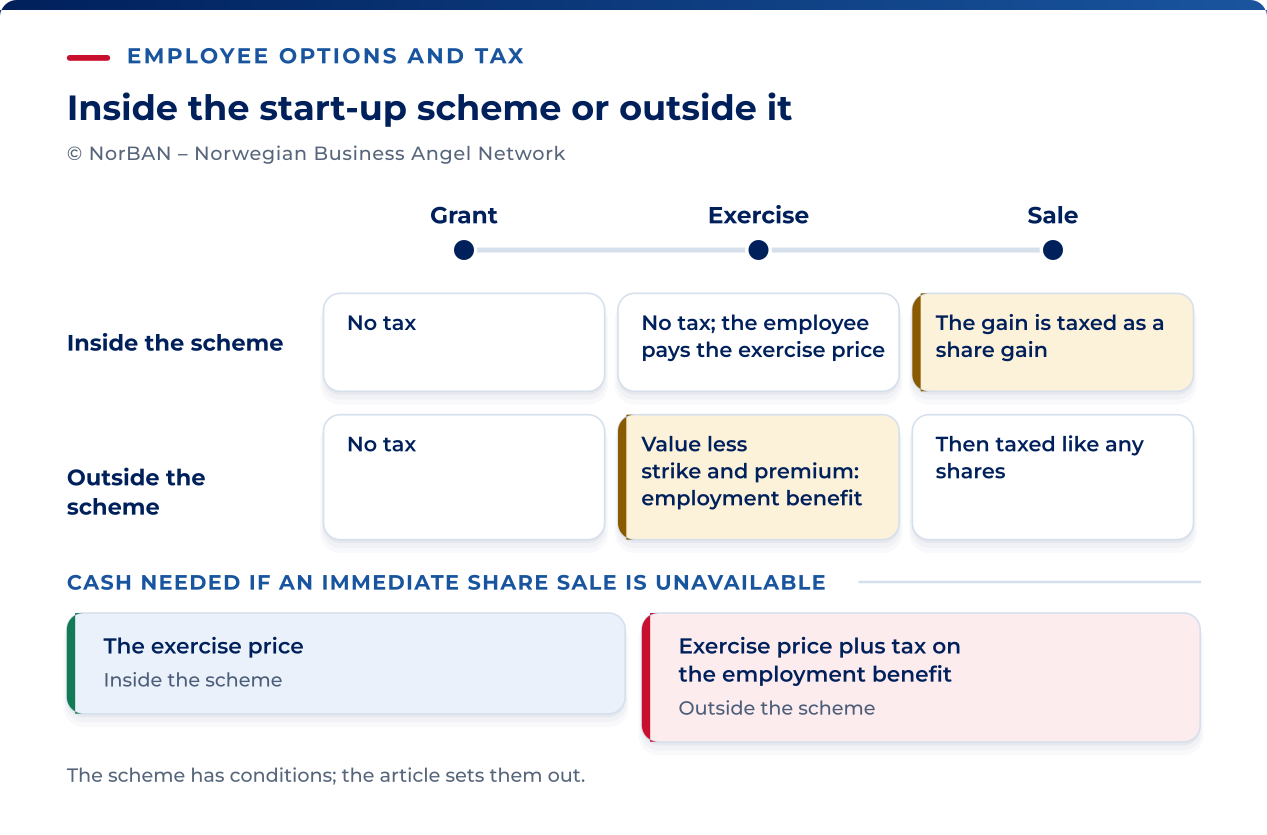
Inside the scheme, neither granting nor exercising the option triggers tax. The gain is taxed under the shareholder model when the employee sells the shares.
The shares’ input value is what the employee paid for the option plus what they paid for the share plus acquisition costs. A later taxable realisation need not be a sale, and emigration can also trigger tax.
That deferral is central to the options’ value as a retention tool. The employee still needs cash for the strike price and costs at exercise, even if no buyer is available.
The conditions come in three groups, and the moment each is tested is the part that matters to an investor. The numeric parameters are set in the regulation and have been raised since the scheme opened; the current values are in Skatte-ABC and on Skatteetaten’s scheme page.
| Condition group | What is tested, and when |
|---|---|
| The company (FSFIN § 5-14-12, first paragraph) | An unlisted AS resident in Norway, or a corresponding foreign company resident in the EEA or a country with a treaty information-exchange provision, and taxable in Norway under § 2-3(1)(b). Operating revenue, balance sheet total and average full-time equivalents at or below the regulation’s ceilings, measured in the income year before the grant. Company age within the limit at grant. Public bodies below the ownership threshold at grant, counting ownership through state and municipal companies. No coal or steel activity; financial, property, letting and professional-services activity below the salary-cost share the regulation sets; mainly active business, with passive capital management within its limit. Not in financial difficulty and owing no unlawful state aid at grant. In a group, every test runs for the group as a whole, the age limit on the oldest company. |
| The employee (second paragraph) | In post at grant and still employed at exercise. A weekly working-hours floor for the company, averaged over the year, from grant to exercise, with illness, parental leave and lay-off counting as working time. Ownership, directly or indirectly and alone or with related parties, not above the regulation’s cap in the grant year and the two preceding years. An option granted before the person starts work is outside the scheme. |
| The option (third paragraph) | A personal, non-transferable right to acquire shares in the employer. A strike price at or above the market value of the shares at grant. Exercise inside a window that opens a set number of years after grant and closes a set number of years later; what counts is the actual exercise date, so gradual vesting inside the window does no harm. |
| The two ceilings (fourth paragraph) | A cap on the market value at grant of all shares under option per employee, and a cap per company, both counting earlier grants whatever became of them. In a group the company cap runs across the group. |
The scheme’s conditions have different test dates. Company size is measured in the income year before grant, age in the grant year, and public ownership and financial difficulty at grant. The regulation gives no express test date for some activity restrictions; do not assume every company condition is either continuing or tested only once.
The employee’s working-time condition continues from grant to exercise. The ownership test covers the grant year and the two preceding years. Strike price and value caps are measured at grant; the exercise window is three to ten years afterwards. The option must concern shares in the employer company and remain non-transferable.
A later change needs to be assessed against the test date for the condition concerned. Outgrowing a size ceiling matters differently from changing the employer or replacing options with rights over a new parent. Check the specific change before assuming an existing grant remains within the scheme.
Where a change leaves continued eligibility uncertain, take advice before implementing it. A binding advance ruling (bindende forhåndsuttalelse) can address the legal treatment of the planned arrangement; it cannot approve the valuation.
Options outside the scheme
An option that fails a condition, or is exercised outside the window, falls back to the general rule in skatteloven § 5-14, first paragraph, and most of the pool’s retention value turns on the difference between the two.
| Inside the scheme | Under the general rule | |
|---|---|---|
| At grant | No tax. | No tax. |
| At exercise | No tax. | The share’s market value at exercise less the strike price, option premium and deductible option transaction costs is salary income. The employer reports the benefit, withholds from available cash pay, reports any withholding shortfall and pays employer’s contributions. |
| Employer’s position | No a-melding entry for the option; the company reports grants and exercises to Skatteetaten separately. | The benefit is reported in the a-melding as a cash benefit, is subject to withholding, and carries employer’s national insurance contributions at the rate for the company’s zone. |
| At sale | The gain over the input value is taxed under the shareholder model. | The shares follow the ordinary share rules from then on. |
| Cash needed | At exercise: the strike price and costs. Tax follows sale or another taxable realisation. Funding the strike from sale proceeds needs an agreed simultaneous exercise and sale. | At exercise: the strike price, plus tax on the benefit for the exercise year even if the shares cannot be sold. |
Under the general rule, tax can fall due before the employee can realise the gain. An employee who exercises in an unlisted company owes salary tax on a gain they cannot realise, and the company owes contributions on the same figure. Exercise is deferred, or the options lapse and retain nobody.
What the investor checks
Before agreeing a price, check that the pool has a credible hiring plan and can deliver the intended benefits. Ask for the supporting documents for each check.
| Check | What you are looking for |
|---|---|
| Fully diluted count | Every granted option, the unallocated pool, warrants and subscription rights in the table you priced from, each as its own line. Registers do not provide a complete list of every contractual option or share promise. Reconcile the cap table with the agreements and corporate decisions. |
| Plan documents | An approved plan, the corporate decisions required by the chosen delivery route, an option agreement (opsjonsavtale) for each grant and grant letters matching the cap table. Investigate undocumented promises too. |
| Delivery of the shares | Identify how the shares will be delivered: a share issue resolved by the general meeting; an issue under a board authorisation (aksjeloven § 10-14), registered in Foretaksregisteret before it is used; delivery from treasury shares acquired under the own-share rules, including a general-meeting acquisition authorisation of at most two years stating volume and price band (aksjeloven § 9-2 and § 9-4). Other structures may use an existing shareholder’s shares or independent subscription rights under chapter 11. Match the agreements to the chosen route and its conditions. A board authorisation cannot be used before registration. |
| The strike price | Set at or above market value at grant, and evidenced. A recent arm’s-length round can provide evidence, but compare the share classes and their rights, timing and transaction size. Document any valuation adjustments. |
| Scheme conditions at grant | The company tests in the year before each grant and at grant, and the ceilings against every earlier grant, checked and filed. Grants and exercises reported to Skatteetaten. Missing or late reports can lead to a coercive fine. Correct reporting errors and assess the substantive eligibility conditions separately. |
| Employee conditions running | Working-time compliance through exercise, and ownership tested in the grant year and two preceding years, including indirect and related-party holdings. A founder-employee above the cap is outside the scheme for that grant. |
| Does the round break a condition | Check public ownership at grant and whether a new group relationship changes the company-level assessment. Size ceilings use the preceding income year; a larger balance sheet at closing does not by itself exclude every grant made immediately afterwards. Assess the actual figures and the test date for each condition. |
| Granted options after a breach | The three-part answer above, stated in the plan’s own documents, and a binding advance ruling where the retention plan depends on it. |
Where you stand changes the depth.
- A first-time angel asks for the plan, the grant letters and the registered authorisation, and reads the conditions table against them.
- An experienced angel focuses on the strike-price evidence and on whether the round would breach a scheme condition.
- In a syndicate, one investor reconciles the fully diluted count and reports the scheme position to the group before the price is discussed.