
What an angel is taxed on
What you keep depends on the tax treatment of gains, losses, dividends and wealth, and whether you invest personally or through a holding company (holdingselskap). Choose the structure before committing. The comparison below assumes a Norwegian-resident individual and shares in Norwegian AS companies that qualify for the participation exemption when held by a company. The loss rows concern realised, deductible personal losses. Dividends and repayments of paid-in capital are different; the later sections explain the limits.
Most rates, factors and thresholds change from year to year, and Skatteetaten publishes the current values.
| Event | Personal holding | Holding company |
|---|---|---|
| Exit gain | Share income under the shareholder model, taxable in the sale year. | Exempt under the participation exemption; personal tax on distributions to you. |
| Failure loss | Deductible at the gain’s effective tax rate. | Non-deductible. |
| Dividend | Above shielding, taxed as share gains. | A small fraction is company-taxable; personal tax on distributions. |
| Annual wealth | Shares enter taxable wealth at a discounted proportion of company tax value. | Holding-company shares enter your taxable wealth; the discount applies once, personally. |
The Tax Act (skatteloven) and Skatteetaten’s Skatte-ABC explain the rules. Use current figures and advice on your proposed structure.
Shares held personally
A personal shareholder is taxed under the shareholder model (aksjonærmodellen). A gain or a dividend is multiplied by an upward adjustment factor and the result is taxed as general income. Skatteetaten publishes the factor and the resulting rate on share income for each income year, which sits well above the general-income rate that applies to interest and other capital income.
Before the factor is applied, the shielding deduction (skjermingsfradrag) is taken off. The shielding basis is what you paid for the share plus directly attributable costs and unused shielding carried forward from previous years, and the deduction each year is that basis multiplied by the shielding rate, which Skatteetaten calculates from the short-term treasury-bill rate and publishes in January for the income year just ended.
Shielding is computed per share for whoever owns it on 31 December, so a seller during the year gets none for that year and the buyer gets it. Unused shielding carries forward on that same share only.
Accumulated shielding can offset a modest return. Keep the per-share record even if the deduction seems small.
A realised personal share loss uses the same adjustment factor as a gain and is deducted from general income. Establish the realisation event and year before claiming relief.
Sale
The gain or loss arises in the year the shares are sold.
Formal liquidation
Redemption of the shares on dissolution is a realisation under skatteloven § 10-37, and payments to shareholders on the dissolution count as consideration. Distributions made during the winding-up under aksjeloven chapter 8 are dividends; distributions under chapter 16 are liquidation proceeds (skatteloven § 10-11 second paragraph, § 10-37).
Bankruptcy
Bankruptcy of the company is a realisation at nil consideration, and the loss is timed to the year bankruptcy is opened, well before the estate is settled (Skatte-ABC A-5-3.7). If the estate is handed back to the company, the realisation is normally treated as not having occurred.
Redemption of some shares
Redemption normally counts as realisation under skatteloven § 10-37. Skatteetaten’s practice makes an exception where ownership positions do not genuinely change, typically a proportional redemption for all shareholders. In that case, payments above repayment of paid-in capital, including share premium, are dividends. See Skatte-ABC A-5-3.6.
Leaving Norway can also trigger tax. Under skatteloven § 10-70, covered assets are treated as realised on the day before Norwegian tax residence ends, or before you become resident in another country under a tax treaty. Transfers to a recipient abroad can also trigger exit tax.
For emigration, tax applies to the part of net gains above the statutory allowance. For transfers abroad, a lower threshold applies: exceeding it brings the whole covered net gain into the calculation, not just the excess. Check the amounts and the rules for your transfer date on Skatteetaten’s exit-tax page.
Current rules allow twelve annual instalments or twelve-year deferral with interest. Security may be required. Sale or foreign transfer can accelerate payment. Distributions normally trigger payment of 70%, capped at remaining exit tax, without automatically ending all deferral. Death has special rules, including individual heirs assuming obligations. Reporting continues. Returning within twelve years can cancel tax on retained assets. The rules changed in 2024: use your departure or transfer date’s provisions.
The loan that fails
A convertible or shareholder loan behaves differently from share capital when the company fails. Outside a business, a loss on a simple receivable is not deductible. The gain would have been exempt (skatteloven § 9-3 first paragraph (c)), and § 9-4 allows a loss only where a gain would be taxed.
The Skatte-ABC places an angel’s personal loan under that rule, unless your own lending amounts to a business, which is judged on the facts (§ 6-2 second paragraph). The same money lost as share capital would have been deductible.
Interest and loan losses follow different rules. Interest received by a personal lender is ordinary income. Loans to companies can also attract extra tax under skatteloven § 5-22. First reduce the accrued interest by the ordinary income tax on it, then deduct the loan shielding allowance. A positive remainder is multiplied by the statutory adjustment factor and taxed as additional ordinary income. Skatteetaten publishes the shielding rate six times a year. Do not assume that the tax on interest and the relief for a loan loss are symmetrical.
Conversion is not a way to restore tax cost already lost. For an ordinary receivable, the shares’ tax basis generally follows the market value of the consideration shares when conversion becomes binding, normally valued from the claim; it can be nil (Skatte-ABC A-5-6.10). Convertible bonds have distinct instrument rules.
Lending through a company does not guarantee a deduction. The loan must qualify as part of its own business, and the related-company restriction in § 6-2(3) and its regulation may bar relief. Check the instrument, business connection and ownership history with a tax adviser before lending or converting.
The participation exemption (fritaksmetoden)
A holding company is an ordinary limited company. The participation exemption in skatteloven § 2-38 applies only to qualifying investments. Norwegian AS shares normally qualify; foreign investments need the additional checks below. Skatteetaten’s exemption guide explains the scope.
- Qualifying EEA share gains are exempt, subject to the substance conditions below.
- A small fraction of dividends is company-taxable. Skatteetaten gives the fraction and an example applicable to minority holdings.
- Derivatives over qualifying shares, including options and subscription rights, qualify.
- Low-tax non-EEA income and losses are excluded. Low-tax EEA income is excluded without genuine establishment and economic activity, but losses remain non-deductible. Other non-EEA holdings have separate gain, dividend and loss tests (§ 2-38(3)).
For non-low-tax companies outside the EEA, check three separate tests under § 2-38:
- Gains: exemption generally requires at least ten per cent of both capital and votes continuously for the preceding two years.
- Dividends: the same minimum holding must be maintained over a two-year period that includes receipt but can finish later.
- Losses: deduction can be barred if the taxpayer and related parties held at least ten per cent of capital or votes at any time in the preceding two years.
Losses within the participation exemption are not deductible. Include failures as well as successful exits when comparing personal and company ownership.
A loss on a loan from the holding company to a portfolio company is a separate question. Inside a business, a loss on a receivable is deductible once it is finally established, on the tests in Skatte-ABC F-18-8.1: failed enforcement, bankruptcy or liquidation of the debtor, or clear irrecoverability on an overall view.
The related-company restriction in skatteloven § 6-2 third paragraph and FSFIN § 6-2-2 requires a separate ownership-history check. It includes ninety-per-cent relationships and regulatory exceptions; a minority label alone is insufficient.
The loss must relate to the holding company’s own business. It does not inherit the investee’s business activity; a loan mainly seeking a return on capital can fail that connection test.
Holding the investment through a company is no argument against the connection, and an active investor’s own activity can amount to a business; the judgment is case by case.
Wealth tax (formuesskatt) on unlisted shares
Wealth tax (formuesskatt) is charged every year on your net wealth above a threshold, at a municipal and a state rate that the Storting sets in the annual budget. Skatteetaten publishes the current rates and thresholds, with the valuation discounts on the same page.
The thresholds for spouses assessed jointly are double the single ones, and the discount on shares is available only for shares you own directly.
An unlisted share is valued at a discounted share of the company’s total tax value. Under the main rule in skatteloven § 4-12, the value used for a given year is the company’s tax value at the start of that income year, twelve months earlier. The company computes that value without the discount and reports it for its shareholders.
For an angel, the capital-change exception is particularly relevant. Where the company has increased or reduced its share capital during the income year with payment in from or out to shareholders, skatteloven § 4-13 moves the valuation date to the end of that income year.
The same shift applies where the company bought its own shares without reducing its capital. It also follows certain simplified and reverse mergers.
A round that closes and registers in Foretaksregisteret in a given year therefore reaches your wealth-tax return for that same year at the post-round value, and that value is normally used for the following year as well.
| Situation | Valuation date the rule applies |
|---|---|
| No capital change during the year | The company’s tax value at the start of the income year, under skatteloven § 4-12. Twelve months of lag. |
| A priced round registered during the year | The company’s tax value at the end of the income year, under skatteloven § 4-13. The post-round value arrives in the same year. |
| A company incorporated during the year | The value at the end of the incorporation year, under skatteloven § 4-13. |
| A share split, or a capital change without payment | The start-of-year value is spread over the new number of shares (Skatte-ABC A-4-4.2). The date does not move. |
Wealth tax is charged on a tax value the company computes, with goodwill excluded and net wealth floored at zero, so a round’s headline price does not transfer straight to your return.
Allow for annual wealth tax even when the investment produces no cash. The post-round tax value can apply sooner than the main timing rule suggests.
A holding company does not remove the tax and does not add a second discount. The discount is applied once, at your level, on whatever you own directly: the portfolio shares on the direct route, or the holding-company shares on the company route, where the holding company has counted its own assets at full value (Skatte-ABC A-4-5.1).
The deduction for start-up investments
Skatteloven § 6-53 gives a personal taxpayer a deduction in general income for a share contribution in a qualifying start-up. The deduction has a minimum per investment, an annual maximum per investor and an annual maximum per company, all of which Skatteetaten publishes on its scheme page and in Skatte-ABC A-2. Its value to you is the general-income rate on the amount deducted, and the contribution still counts in full in the shares’ input value.
Check independence carefully: an existing ownership or employment relationship can prevent the deduction.
| Condition | Requirement |
|---|---|
| New shares only | Subscribe at incorporation or a capital increase under § 6-53. Share premium qualifies; informal contributions and purchases of existing shares do not. |
| Company | Apply § 6-53 at each test date. Count age by calendar year, including incorporation. Assess headcount, revenue, balance sheet and public ownership at registration-year end, with relevant group limits. Meet minimum salary costs that year or the next. See current limits. |
| Independence | Under § 6-53, neither you nor a related party may be or have been a shareholder or employee in the company or group when contributing. Follow-ons and subscriptions on the day you buy existing shares fail. In practice, the deduction is available once per company. |
| No employment | Do not become a company or group employee during the holding period (§ 6-53). Skatteetaten excludes board membership from employment. |
| Holding period | Retain every qualifying share for three calendar years after the Foretaksregisteret registration year (§ 6-53). Other shares count as sold first. Selling a qualifying share loses the deduction: notify Skatteetaten. |
| No distributions | Neither you nor related parties may receive start-up dividends or capital-reduction payments during that period (§ 6-53). Shareholder loans taxed as dividends also count. Report a breach and correct the deduction. |
| Reporting | The company must report qualifying contributions (§ 6-53) in its shareholder register statement, due 31 January (§ 7-7-4), to pre-fill your return. |
The company must also be unlisted, meet the public-ownership limit, mainly conduct non-passive activity, not be in financial difficulty at the increase, and satisfy unlawful-aid recovery claims. Qualifying EEA companies with Norwegian-taxable business may fall within § 6-53(8). Check every statutory test date.
What breaks the holding period is set out in Skatte-ABC A-2-3.4. A sale to your own holding company breaks it. The Skatte-ABC records the deduction being lost on exactly that move inside the first year, even though the holding company could have made a qualifying contribution itself.
A gift, a transfer on divorce and a redemption on dissolution also break it. Bankruptcy of the start-up does not, and neither does a transfer between spouses, an inheritance, or a tax-continuity merger or demerger of the start-up.
The deduction reaches through a holding company, once. Where a company you own shares in makes the contribution, skatteloven § 6-53 gives the deduction to its personal shareholders in proportion to their stakes, and the minimum is then tested on each shareholder’s allocated amount.
The wording requires you to be a shareholder in the company that subscribes, which excludes a chain of two companies. The holding period then applies both to the intermediate company’s shares in the start-up and to your shares in the intermediate company. The allocation and its examples are worked through in the article on investing personally or through an AS.
Other public support can affect eligibility. Skatte-ABC A-2-2.6 requires total state aid to be considered when checking notification thresholds and aid intensity. Ask the company to check how its Innovation Norway grants, SkatteFUNN and other support interact with this deduction. Do not assume that all schemes use one interchangeable ceiling.
The same exit, three ways
Consider an investment sold at ten times cost alongside a position that fails. The events are the same on every route; what changes is when the tax falls and whether the failure gives relief. In the paid-out column, the distribution is a dividend. A lawful repayment of documented paid-in capital is not a dividend and must be modelled separately.
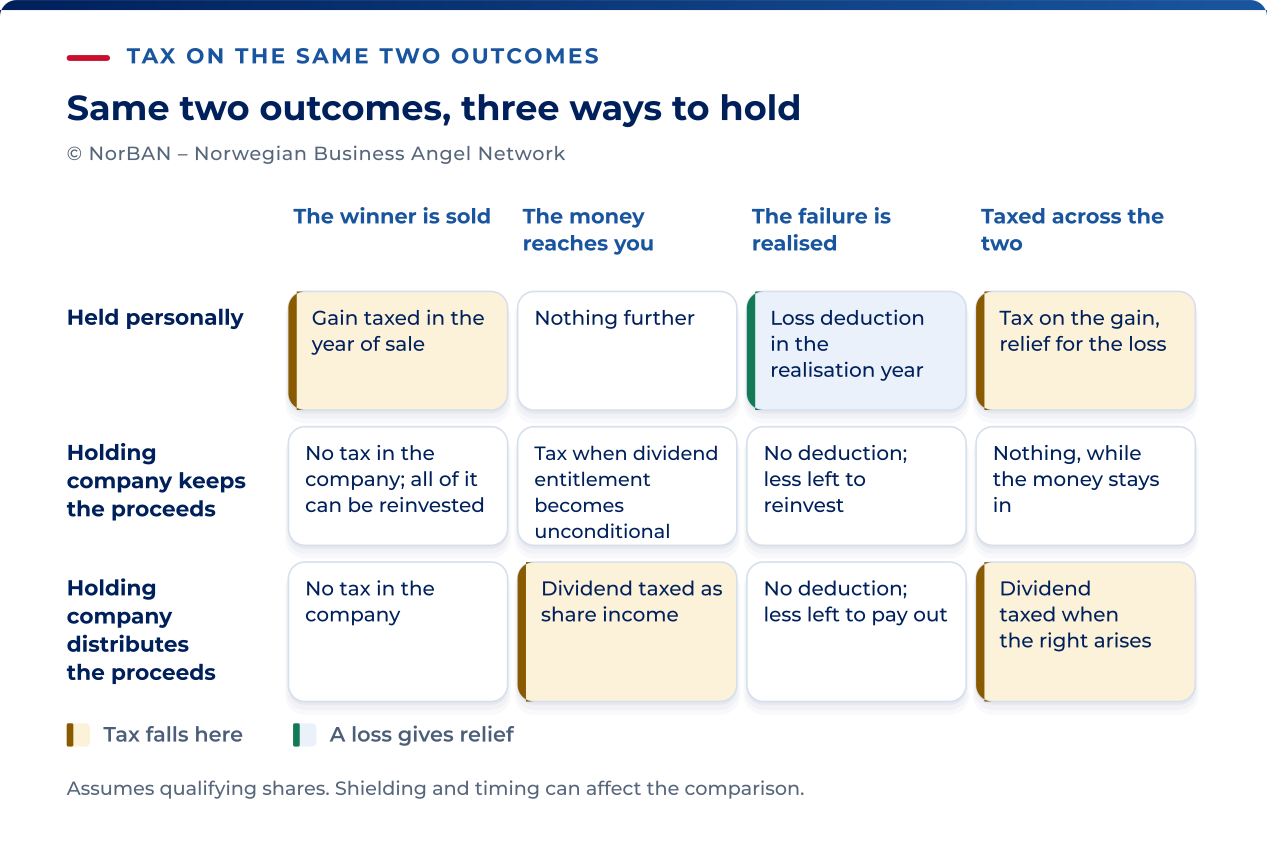
| Step | Personal holding | Holding company: proceeds retained | Holding company: proceeds distributed |
|---|---|---|---|
| Winner sold | Nine-times-cost gain, less accumulated shielding, is adjusted by the factor and taxed as general income in the sale year. | Exempt gain; all proceeds can be reinvested. | Exempt gain. |
| Money reaches you | No further tax. | No personal tax until a dividend. | Dividend less shielding on holding-company shares is adjusted by the factor and taxed as general income. |
| Failure realised | Loss adjusted by the factor is deductible against general income in the year of sale, liquidation or bankruptcy opening. | No deduction; less to reinvest. | No deduction; less to distribute. |
| Both positions | Gain minus loss, each in its realisation year. | No tax while proceeds remain. | Dividends are taxed when the right arises; the loss gives no separate deduction. |
For the profitable investment alone, equal total tax assumes:
- The company’s gain is fully exempt.
- The whole gain is distributed, and the invested capital is returned tax-free as paid-in capital.
- Shielding is equal.
- Rates and the factor stay unchanged.
- There are no company costs or wealth-tax differences.
This is a conditional comparison, not a result Skatteetaten guarantees.
For a qualifying company holding, the participation exemption defers personal tax while proceeds remain invested. The small taxable fraction applies to dividends received, not exempt share gains. Model the actual distribution and timing with your adviser.
Personally, a qualifying realised loss is deducted in its realisation year, with an unabsorbed deficit carried forward. A company’s exempt share loss gives no deduction and leaves less available to distribute.
Deferral can favour a company that reinvests proceeds; direct ownership can give earlier usable loss relief. Compare the whole portfolio, including how the holding company was funded and whether a withdrawal is a dividend or repayment of paid-in capital. Many failed investments do not by themselves establish which route has lower total tax.
Also allow for annual wealth tax on both routes and the cost of running the holding company. The start-up deduction reduces your personal general income on either route, provided no more than one company sits between you and the start-up.
You can leave existing personal holdings where they are and use a company for new investments. An ordinary sale or contribution of existing shares to your own holding company normally counts as realisation under skatteloven § 9-2. Keeping indirect ownership does not itself make the transfer tax-free. Specific reorganisation rules need a separate assessment. The historical transition rule in Skatte-ABC A-5-6.14 is not a general exemption for a transfer today. Choose the structure before value builds where possible.