
What the choice changes
The most common vehicle for a Norwegian angel is a personal holding company (holdingselskap), a private limited company you own alone and invest through. Some angels invest through a sole proprietorship (enkeltpersonforetak, ENK) and some hold every share in their own name. Both can suit a small or occasional investor, and none of the three is a mistake in itself.
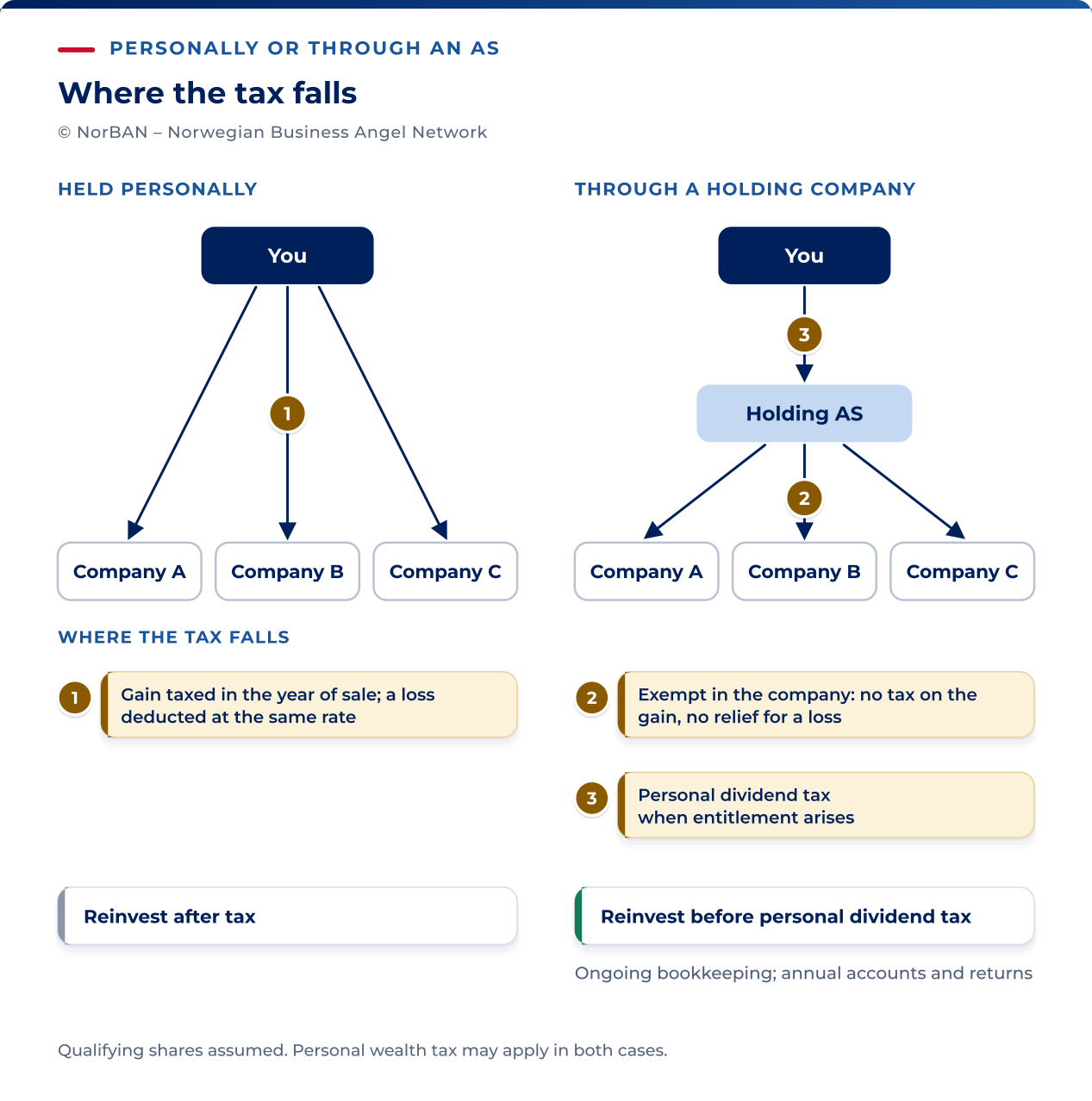
The tax rules treat two of those positions differently: shares in your own name, and shares owned by a company you own. The rules themselves are settled. Apply them to your own circumstances with your adviser. The comparison assumes a Norwegian-resident individual and qualifying shares in Norwegian AS companies. Corporate exemption is conditional; see the linked tax article for foreign investments and exceptions.
| Decision variable | Held personally | Held through a holding company |
|---|---|---|
| When tax falls on a gain | In the year of sale, under the shareholder model. | Not in the company, under the participation exemption. In your hands, when the company pays a dividend. |
| Relief for a loss | Yes, at the same effective rate as a gain is taxed, in the year the loss is realised. | None. |
| Reinvesting a gain | After tax. | Before tax. |
| Dividends from portfolio companies | Share income above your shielding deduction. | A small fraction is taxable income for the company; the rest is exempt until paid out to you. |
| Wealth tax | On a discounted share of each company’s tax value. | On a discounted share of the holding company’s tax value. The tax falls on you either way. |
| The start-up deduction | In your general income, on your own contribution. | In your general income, on your share of the company’s contribution, through at most one company. |
| Taking money out for yourself | Nothing to do; the money is yours. | Dividends are share income. Documented capital repayments and genuine loan repayments follow separate rules. New loans to you are generally taxed as dividends and also restricted by company law. |
| Administration | Your own tax return, with the shares pre-filled from the companies’ reporting. | A company with books, annual accounts, a tax return and a shareholder register statement every year, even when nothing happened. |
If you invest through a sole proprietorship, take its tax position to your adviser before the first investment.
Holding shares personally
In your own name, each position is taxed on its own facts. A gain is realised when you sell, when the company is wound up, or in the year bankruptcy is opened, and is taxed as share income after the shielding deduction.
A deductible loss belongs to its realisation year; unused deficits can be carried forward. Under Skatteetaten’s bankruptcy practice, an estate returned to the company normally reverses the treatment of opening as a realisation.
The start-up deduction lands in your general income when you subscribe for new shares in a qualifying company and keep them for the holding period. On a direct holding the allocation question does not arise; the whole contribution is yours to test against the minimum and the annual cap.
Personal ownership suits some circumstances better than a company does. Consider how you intend to use the proceeds and the practical consequences below.
- You expect to make one or two investments, and the money coming back is for spending. The deferral a company offers is worth little if the proceeds leave the structure at once.
- Your salary or other general income is large enough that a failure relieved against it matters. A loss in a company gives you nothing that year.
- You want no separate company accounts for the holding, though personal tax reporting still applies and no accountant for a portfolio of two or three positions.
- You are inside the start-up deduction’s holding period on shares you already hold. Selling them to your own holding company breaks the period and loses the deduction, and the Skatte-ABC records exactly that outcome.
Personal ownership limits how much you can reinvest after an exit. Every exit is taxed before the proceeds reach the next investment, and a deductible realised share loss can create a deficit carried forward under skatteloven § 14-6 if current general income cannot absorb it. The deduction is not lost merely because it cannot be used that year.
The holding company
A holding company is a private limited company established to own shares in other companies and manage the return. Altinn gives the two reasons the structure exists: risk separation between businesses, and the fact that gains on a sale, and dividends received, are close to tax-free at the company level.
For shares within the participation exemption, gains can be reinvested without company-level gains tax; most dividends received are also exempt. A dividend to you is taxed personally. Repayment of documented paid-in capital or genuine loan principal follows different rules.
The participation exemption allows qualifying share gains to be reinvested without gains tax in the company. A small fraction of qualifying dividends is normally taxable, with exceptions such as qualifying group dividends. Keeping more capital invested can increase long-term returns. Check the conditions, particularly for foreign holdings.
The exemption also determines how the company treats losses. A loss on the sale of shares is not deductible in the company, on the same Skatteetaten page. In a portfolio where most positions fail, most of what happens inside the company has no tax effect; the losses simply reduce what is left to reinvest.
A dividend from the holding company is share income for you, after shielding on your holding-company shares. A documented repayment of paid-in capital, including share premium, is not a dividend under skatteloven § 10-11, but affects tax basis and future shielding. Repaying genuine loan principal is also different from paying a dividend. Keep records of how you financed the company and comply with the company-law rules for the payment.
Since 7 October 2015, credit or security provided directly or indirectly to a personal shareholder or specified relatives has generally been taxed as a dividend under skatteloven § 10-11. There are narrow exceptions in FSFIN § 10-11-1, including credit below NOK 100,000 repaid within sixty days. Check all conditions; a company loan is not a general way to withdraw money tax-free.
Company law is a separate check. The main rule in aksjeloven § 8-7 limits shareholder credit to funds available for dividends and requires adequate security. The section also contains exceptions, including specified ordinary commercial credit and group transactions. Unlawful credit is subject to the invalidity and repayment rules in § 8-11. A tax exception does not make a loan lawful under company law.
A loan from the holding company to a portfolio company is deductible when it is finally lost only if the loss was suffered in the holding company’s own business, on the tests in Skatte-ABC F-18-8.3.
An investment motive alone does not establish the necessary business connection. The related-company restriction in skatteloven § 6-2(3) and FSFIN § 6-2-2 must also be checked.
An active investor’s own activity can amount to a business. It is a question of facts for your adviser, decided before the loan is written.
Wealth tax (formuesskatt) does not go away. The discount on shares applies once, at your level, to the holding-company shares, and the holding company has counted its own portfolio at full value when it set its tax value (Skatte-ABC A-4-5.1).
The arithmetic that decides
Consider five investments costing one unit each. Four are realised at zero and one is sold for ten units. Assume the corporate gains qualify for exemption, the personal losses qualify for deduction, tax rates stay unchanged, and there are no costs, shielding or wealth-tax differences. Also assume the owner funded the holding company with five units of documented paid-in capital that can lawfully be repaid.
| Step | Held personally | Held through a holding company |
|---|---|---|
| Four investments are realised at zero | Four units of deductible losses, in the years of realisation. | No deduction for the four units lost. |
| The winner is sold for ten units | Nine units of taxable gain. Together with the losses, the net tax base is five units before the adjustment factor. | The ten units remain in the company without gains tax. |
| Reinvestment | Use the proceeds after tax, taking account of when the loss relief can be used. | All ten units can be reinvested. |
| All proceeds are withdrawn instead | No further tax on withdrawing your own cash. | Five units repay documented paid-in capital without dividend tax; five units are a taxable dividend. The net tax base is five units before the adjustment factor. |
Apply the current factor and rate from Skatteetaten to the stated assumptions. The holding company has more money available for reinvestment before withdrawal. Direct ownership can give usable loss relief earlier.
Under these assumptions, both routes have the same total tax base after withdrawal, even though four investments failed. The difference is timing: direct losses may reduce tax on other income earlier, while a holding company can reinvest exempt gains before personal dividend tax. Different funding, distributions, shielding, rates or costs can change the comparison. A loss-heavy portfolio does not by itself prove that direct ownership means less lifetime tax.
Allow for annual wealth tax on the same underlying value under both routes. A holding company also has running costs.
Founding and running the AS
The company is incorporated when all founders sign its incorporation document (stiftelsesdokument), containing the articles of association (vedtekter). Before registration in the Register of Business Enterprises (Foretaksregisteret), its capacity is limited under aksjeloven § 2-20. People undertaking other obligations in its name can be personally and jointly liable until the company takes them over on registration.
The documents are short and standard for a single-owner holding company. A founding pack for one is the kind of template worth taking to your adviser, and it saves drafting from a blank page.
| Step | What the rule requires |
|---|---|
| Share capital | Aksjeloven § 3-1 sets the minimum share capital, which may be paid in cash or in assets that can be sold for money. Non-cash contributions require an auditor. For payment through a foreign bank, clarify the currency, contribution type and confirmation requirements before paying. |
| Articles of association | Aksjeloven § 2-2 requires four items in the articles: the company’s name, its business, the amount of the share capital, and the nominal value of the shares. |
| Payment confirmation | An auditor confirms receipt of the contribution. For cash-only contributions, a qualifying financial institution, lawyer or state-authorised accountant may also confirm receipt under § 2-18. The declaration identifies the amount, company and confirming party. Brønnøysundregistrene does not accept a bank statement in its place. |
| Registration | Aksjeloven § 2-18 requires the company to be filed within three months of the date the incorporation document is signed. The filing goes through the coordinated register notification in Altinn or one of the digital formation providers that work with the register, and Brønnøysundregistrene charges a registration fee it publishes on its fee page. |
| Processing | Brønnøysundregistrene processes filings according to its published queue. Check it before setting a completion date. |
Once registered, the company has the same annual obligations whether it made ten investments or none. The filing duty applies to a dormant company too.
| Annual duty | What it involves |
|---|---|
| Bookkeeping | The company keeps books under bokføringsloven, current at least every four months if it is not registered for VAT (Altinn). |
| Annual accounts | The general meeting adopts the annual accounts within six months of the year end, and every board member signs them. Regnskapsloven § 8-2 requires the accounts to be filed with Regnskapsregisteret within one month of adoption, and, for a calendar-year company, by 31 July to avoid a late-filing fee. |
| Audit | Under aksjeloven § 7-6, eligible founders can opt out in the incorporation document. A general meeting can also decide before the first accounts using the special formation tests, or later using the last accounts. Apply the revenue, balance-sheet and headcount tests, group-wide for a parent. The waiver takes effect only when registered; exceeding the limits brings audit back for the following year. |
| Tax return | The company files its own tax return with Skatteetaten by 31 May, through an accounting or year-end system, even with no activity. |
| Shareholder register statement | The company files the shareholder register statement by 31 January, covering every share event of the previous year. Late filing attracts an enforcement fine. |
| Register changes | Brønnøysundregistrene charges nothing for the ordinary annual changes: a board change, an address change, a change of auditor, a change of articles or a capital increase. |
After the founding fee, the running cost is the accountant who keeps the books, prepares the accounts and files the returns. The cost depends on the company’s activity, so ask your accountant for a quote covering the duties above.
A holding company that makes two subscriptions a year and holds cash between them is a small job; one that also runs a salary or a loan to its owner is not.
The set-ups Norwegian angels use
One personal holding company, wholly owned, is the usual pattern, with new positions subscribed by the company and the proceeds kept inside it between deals. Two rules shape how it is used.
The start-up deduction reaches through the company, once. Under skatteloven § 6-53 a personal taxpayer gets the deduction for a contribution made by a company they own shares in, and the wording requires them to be a shareholder in the company that subscribes.
That excludes a chain of two companies. If your holding company owns a second company and that company subscribes, nobody gets a deduction.
Where the intermediate company has several owners, the Skatte-ABC splits the company’s contribution among them in proportion to their stakes, and tests the minimum on each personal shareholder’s allocated amount. A shareholder whose slice falls below the minimum gets nothing, and that slice is not reallocated to the others. Skatteetaten’s two examples make the rule concrete.
- Two spouses own a company half each, and the company subscribes for an amount below twice the minimum. Each is allocated half, both halves are below the minimum, and neither gets a deduction, although the company’s contribution was above it.
- A company owns thirty per cent of a holding company, and two people own forty and thirty. The holding company subscribes for an amount whose thirty per cent slice is exactly the minimum. The person at forty gets forty per cent of the contribution as a deduction, the person at thirty gets thirty, and the company’s slice lapses. Nobody else picks it up.
The holding period then applies twice: to the intermediate company’s shares in the start-up, and to your shares in the intermediate company. A tax-continuity merger or demerger of the intermediate company does not break it, even where the result is more than one company in the chain.
The no-distributions condition bites on distributions from the start-up to the intermediate company. The intermediate company may still pay dividends to you.
A syndicate vehicle owned by several angels is an AS like any other for tax, and everything above applies to it, with the allocation rule biting hardest where many small members share one contribution. What differs is the governance among the owners, which is the subject of the article on syndicates and SPVs in Norway.
You can leave existing personal holdings where they are and use a company for new investments. An ordinary sale or contribution of existing shares to your own holding company normally counts as realisation under skatteloven § 9-2. Keeping indirect ownership does not itself make the transfer tax-free. Specific reorganisation rules need a separate assessment. The historical transition rule in Skatte-ABC A-5-6.14 is not a general exemption for a transfer today. Choose the structure before value builds where possible.
Where fair market value genuinely equals tax cost, an ordinary transfer produces no gain. Merely setting the contract price at cost does not establish that result: related-party transfers may be adjusted to market terms under skatteloven § 13-1. A transfer inside the start-up deduction’s holding period can also forfeit that deduction.
Deciding, and with whom
The factors that push each way are few, and they scale with how much you invest and for how long, so start from where you stand.
- One or two investments, proceeds for spending. The personal route: loss relief against your other income, no company to run, and no deferral that you would not use.
- A portfolio built over years, proceeds reinvested. The company: exempt gains recycled in full, at the cost of unrelieved losses and an annual accountant.
- Investing alongside others in one vehicle. The vehicle’s structure is decided with the others. If your own holding company holds the shares in the vehicle, two companies sit between you and the start-up and the start-up deduction is gone, so hold the vehicle’s shares personally where the deduction matters.
- Existing positions with value in them. Leave them where they are, and put the decision into the next investment.
Take the choice to a tax adviser with your own numbers: your other general income, how many positions you intend to hold, how much of an exit you would reinvest, and whether the start-up deduction is in reach on your next subscription. The right structure for your portfolio depends on those circumstances.