
Why angels pool
Most angel investments in this network are made with other people. NorBAN’s published figures put the angels able to anchor or lead a round at roughly one in six, and pooled tickets reach a combined amount none of the members reaches alone.
Pooling also helps the portfolio company. One line on the cap table and one counterparty to negotiate with is easier to run than a register full of individual names, and a group that has funded one round together has follow-on capacity its members do not have individually.
Pooling through a vehicle requires coordination and the work of running a company. Someone founds the vehicle, keeps its accounts and its register, and settles how the group decides. That work, and how it is paid for, is the substance of the members’ internal agreement.
Members set these vehicles up and run them themselves. We advise and connect; the syndicate is the members’ own, and so is every decision it takes.
Is your vehicle a fund? The question you answer before you raise a krone
The definition sits in AIF-loven § 1-2 (a). An alternative investment fund (alternativt investeringsfond) is a collective investment undertaking, other than a UCITS, which raises capital from a number of investors in order to invest it according to a defined investment strategy for the benefit of those investors.
Finanstilsynet’s own circular says the definition is wide, that the legal form used is irrelevant, and that it makes no difference whether the vehicle invests in one object or in several. The circular was written for project-finance and syndicate structures, and it states that its criteria carry over to other investment structures.
Those features strongly indicate a collective investment undertaking: several investors provide capital under a defined strategy, with management delegated and an expected return. They are a reason to assess AIF status before fundraising, not a substitute for examining the full structure and statutory exclusions.
A single-asset vehicle is not automatically outside the definition. Neither a closed group nor a single fundraising round settles the question. Examine collective investment, capital raising, the defined strategy and the investors’ real ongoing control.
What a closed syndicate is relying on
A closed syndicate may rely on the investors themselves exercising operational control to fall outside the definition. It comes from regulator and ESMA guidance interpreting § 1-2 and is not written into the act, and Finanstilsynet applies demanding conditions to each part of the test.
- The control must go beyond the ordinary rights a shareholder exercises at the general meeting, and amount to a continuing decision-making competence over operational matters.
- Electing the board is expressly not enough, because the board is then the body running the company day to day.
- The influence must belong to all the investors equally. One or a few investors holding it does not satisfy the test, and a formal right constrained in practice by cost or forfeiture does not count.
- Once the investor group has any real size, the presumption runs against the investors having sufficient daily control.
Ordinary shareholder voting rights will rarely establish the required ongoing operational control. Check whether every investor actually has the same formal and practical ability to exercise it. If the structure is an AIF, choose an appropriate manager and investor group; registration alone does not permit marketing to everyone.
If the answer is yes
An alternative investment fund must have a manager. A manager whose total assets under management fall below the thresholds in AIF-loven § 1-4 is not subject to authorisation and must register with Finanstilsynet before starting. The thresholds are euro figures, and Finanstilsynet publishes them alongside the registration procedure.
Marketing restrictions are particularly important at angel scale. A fund managed by a registered manager may be marketed only to professional investors (AIF-loven § 6-1), and § 1-4 (6) confirms that the sub-threshold exemption does not extend to funds marketed to non-professionals.
Marketing to non-professional investors requires the manager to hold a full authorisation and a separate permission under AIF-loven § 7-1, whatever its size. Professional status runs through verdipapirhandelloven § 10-6, with opt-up under §§ 10-7 and 10-8, and most angels are non-professional unless they have opted up.
Marketing itself is defined in § 1-2 (h) as a direct or indirect offer to buy or place units in an alternative investment fund, made at the manager’s initiative. A circulation to a defined, closed group of existing members is caught where it is such an offer, and the audience being closed does not take it outside.
Reverse solicitation, where the investor approaches the manager unprompted, is construed narrowly and cannot be manufactured by pre-arranged requests. Classifying a particular circulation is fact-driven, and the safe working assumption is that an initiated offer to members is marketing.
Take advice here, before the first krone is raised. The structure is easier to build correctly than to unwind.
The single-deal SPV
The first pattern is a company founded for one investment. Founding it differs from founding an ordinary holding company (holdingselskap) in almost nothing.
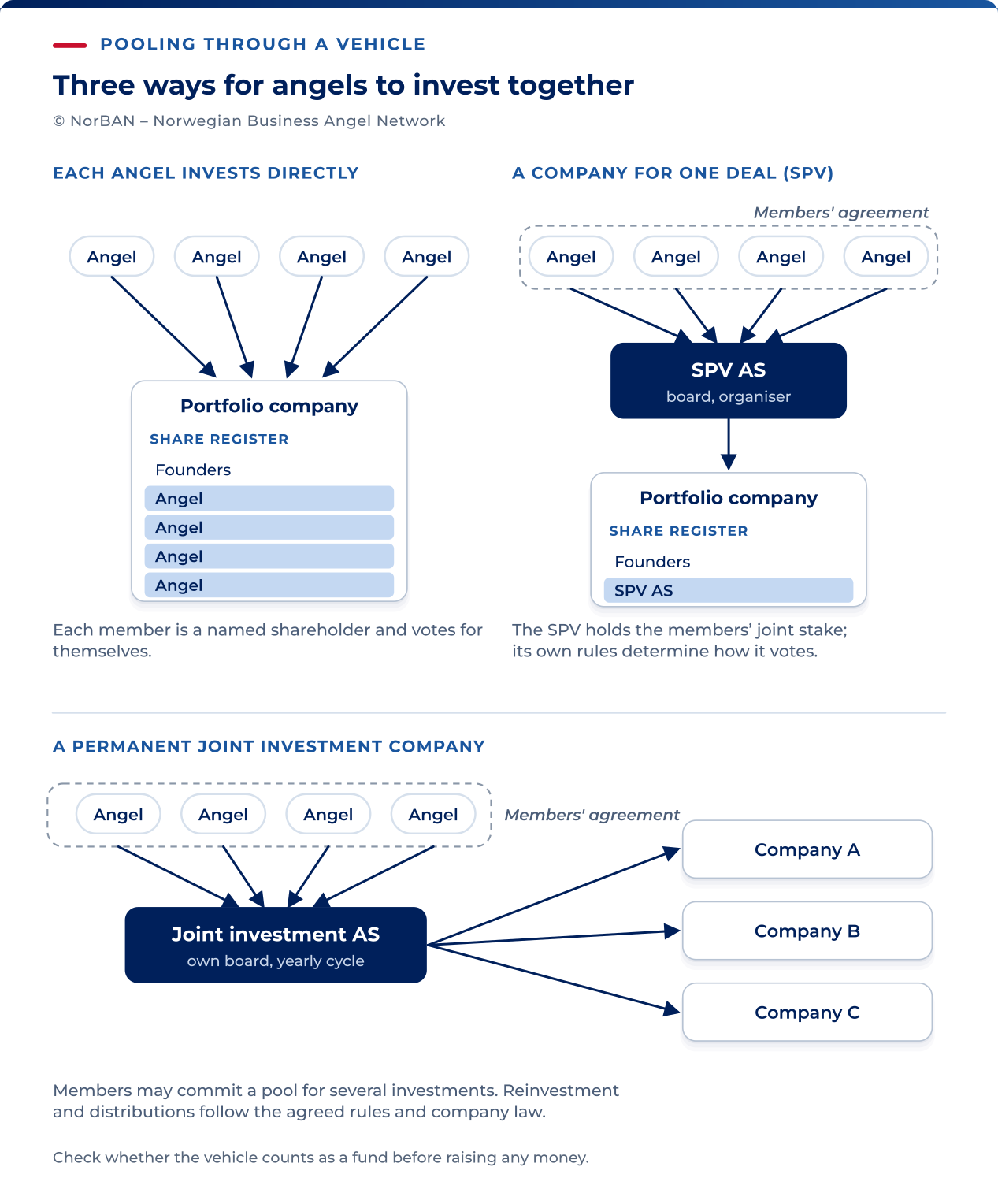
An AS used as an investment vehicle follows the ordinary formation rules: one or more founders, whether individuals or companies, and no company-law maximum number. The members’ agreement and regulatory classification need separate work; using an ordinary company form does not remove fund or investment-service requirements.
| Step | What it takes |
|---|---|
| Incorporation | The founders sign an incorporation document carrying the articles, subscribe the shares and pay in share capital of at least the statutory minimum (aksjeloven § 2-1, aksjeloven § 3-1). |
| Board | The company must have a board of one or more members (aksjeloven § 6-1). |
| Registration | A coordinated register notification enters the company in Foretaksregisteret, on the fee Brønnøysundregistrene publishes. |
| The internal agreement | The members’ own contract settles contribution and default, decision rules, follow-on participation, transfer of member interests, dissolution at exit, reporting and the lead’s role. No statute prescribes any of it. |
| End of life | At exit the vehicle distributes the proceeds and is dissolved (aksjeloven § 16-1), or the members keep it and use it for the next deal. |
The standing joint investment company
The second pattern is a jointly owned company the same group invests from across deals. It keeps its registration, its accounts and its member agreement between investments, so the cost of the next deal is lower than founding a vehicle each time.
Members commit capital to the company rather than a named deal. The decision rules must therefore allow the group to handle investments that some members would not choose individually.
The regulatory question is also sharper. A vehicle investing across deals on a defined strategy sits closer to the centre of the § 1-2 (a) definition than a one-deal company does, though a one-deal company is not automatically outside it either.
| Single-deal SPV | Standing joint company | |
|---|---|---|
| What a member commits to | One named investment, on terms known before subscription. | A pool used across deals the members have not yet seen. |
| Governance | One decision, then follow-on and exit. | A standing board, an annual cycle and rules for deals the group disagrees on. |
| Exit timing | The proceeds are distributed and the company is wound up. | The proceeds recycle unless the members resolve a distribution. |
| Leaving early | Agree transfer and exit arrangements for the single investment; its holding period may be long. | A member sells shares in the company, subject to its consent and pre-emption defaults. |
Two economics models
The two models differ in what members hold, how proceeds are shared and how the organiser is paid.
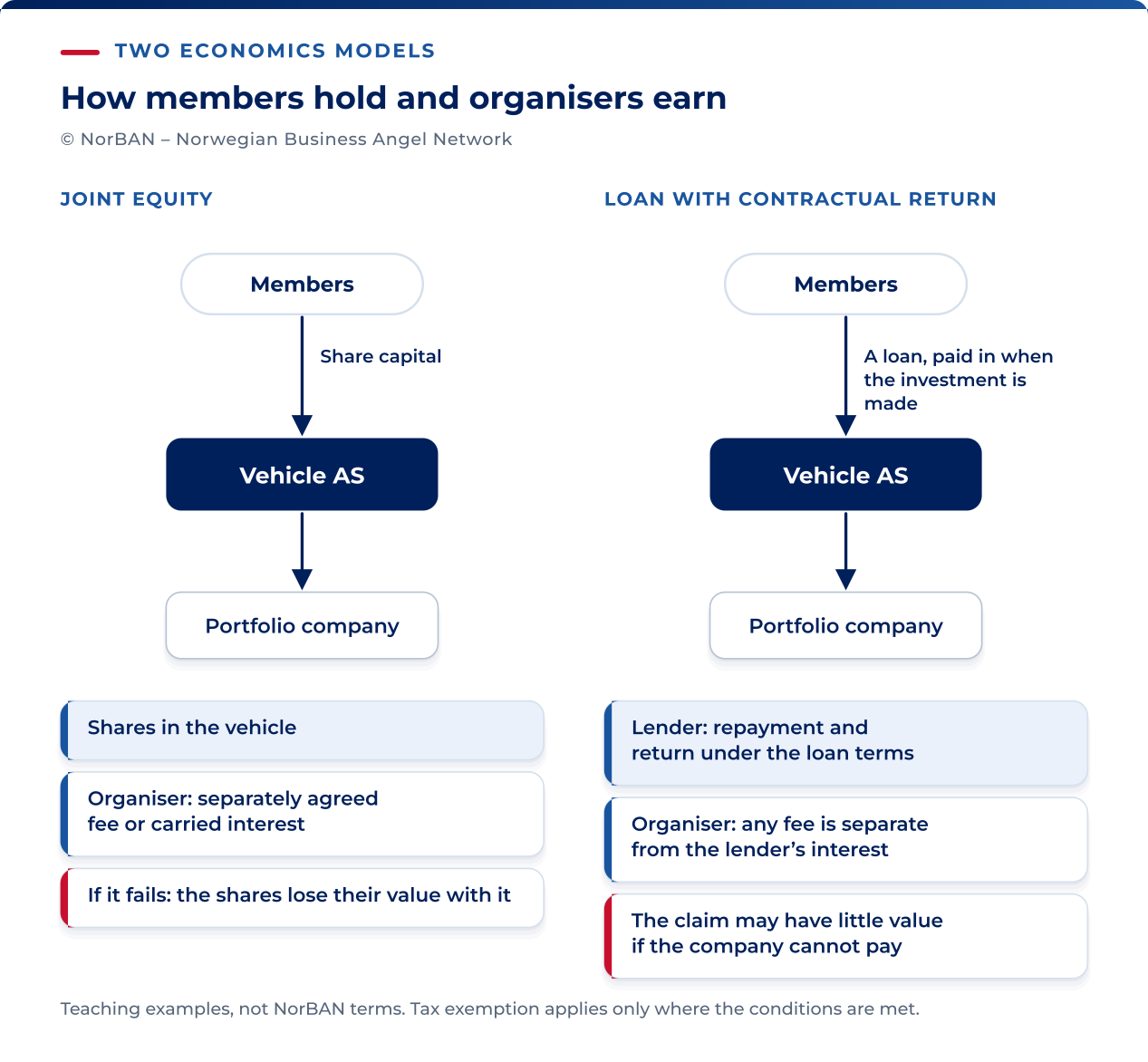
| Equity financing | Loans with performance-linked interest | |
|---|---|---|
| What the member contributes | Equity subscribed at incorporation or in a later capital increase. | A loan drawn when the investment is made. |
| What the member holds | Shares in the investment company, which owns the portfolio shares. | A repayment claim and the return specified in the loan agreement. |
| Return and organiser remuneration | Members receive returns through their shares. Any organiser carry or fee needs a separate agreed basis and calculation. | Interest is payable to the lender entitled under the agreement. An organiser receives it only if entitled as a lender; any service fee or success fee is separate. |
| Position on loss | The share value can fall to zero. | Recovery depends on the borrower’s assets, creditor priority and the loan’s loss-sharing or limited-recourse terms. A claim does not guarantee repayment. |
An AS used as an investment vehicle follows the ordinary tax rules for an AS. Portfolio-share gains are exempt and losses non-deductible only where the participation exemption applies. Loans, interest, fees and payments to members have their own treatment. Do not apply the share-investment example unchanged to every financing model.
Pay particular attention to the start-up deduction and loan-loss treatment in a shared vehicle. The start-up deduction reaches through at most one company between the member and the start-up, and Skatteetaten splits it proportionally by stake, so a member whose allocated share falls below the scheme’s minimum gets nothing and that share is not reallocated.
Keep the two loans separate. A member’s loan to the vehicle is that member’s tax position: a private lender outside a lending business generally cannot deduct its loss. A company lender needs the required connection to its own business.
The vehicle’s loan to the startup is a separate asset. Any deduction requires the vehicle’s own business connection and a finally established loss; it stays in the vehicle. The related-company restriction in skatteloven § 6-2(3) and FSFIN § 6-2-2 can bar either deduction. Test the ownership history, including the ninety-per-cent relationship and regulatory exceptions.
Who the portfolio company sees
The portfolio company’s share register (aksjeeierbok) records each shareholder by name and address (aksjeloven § 4-5), and anyone may demand access to it (aksjeloven § 4-6).
For the models discussed here, the registered shareholder is either each direct investor or the common investment company. Other legal forms can exist; the choice does not reduce to a universal two-option rule.
Nominee registration (forvalterregistrering) is not a third route. An ordinary AS has no nominee line at all. It reaches an AS only where the company has opted to register its shares in a securities depository, which requires a provision in its articles (aksjeloven § 4-4).
Where the shares are registered in a securities depository, allmennaksjeloven § 4-10 governs nominee registration. Its ordinary rule concerns approved nominees for qualifying foreign shareholders on a Norwegian regulated market; other cases require the prescribed consent. The Act defines foreign shareholder, so nationality alone is not the test. Depository registration by itself does not make nominee registration available to every investor.
The nominee’s position is narrow in any case. Under § 4-10 (3) it may exercise only the right to receive dividends and other distributions and holds no vote, and under § 4-10 (4) it must on demand disclose the beneficial owners to the company or a public authority.
On the SPV route the vehicle votes as one shareholder and consents as one party, and how it votes is decided by its own governance. What a member holds is shares in the vehicle, and selling means selling those, subject to the vehicle’s own consent and pre-emption defaults.
Cost and carry
The vehicle incurs the usual costs and obligations of an AS: a registration fee on founding, then accounts, an ordinary general meeting within six months of each financial year end (aksjeloven § 5-5) and a filing of the annual accounts with Regnskapsregisteret (regnskapsloven § 8-2).
Who bears those costs is settled in the internal agreement. The vehicle can pay them out of the pool, the members can pay them pro rata as they fall due, or the organiser can carry them and recover them at exit.
Compensating the lead is the other half of the same negotiation. The lead chooses the instrument and the legal framework, obtains counsel, sets the vehicle up, runs signing and follow-up, leads the final diligence and negotiation, takes the board seat where the group agrees it, and runs communication to the members.
Separate the members’ return from payment for organising the investment. An organiser may receive an agreed fee or carried interest. A lender may receive performance-linked interest. If one person has both roles, document each payment separately: recipient, payer, calculation, conditions and conflicts. Assess the regulatory and tax consequences before funding the vehicle.
How a carry arrangement is taxed in the organiser’s hands is worth advice before it is agreed. Skattedirektoratet’s commentary on the Supreme Court’s carried-interest judgment of 12 November 2015 turns on whether the recipient is a real owner taking a return on the business, or is being paid for work.
Signing and closing
In this model, the investment company is the investor in the portfolio-company transaction. It signs the relevant term sheet, shareholders’ agreement and subscription documents through an authorised representative. Check the investment decision and the authority to sign; the entire board need not personally sign every document.
The members are bound to each other through the internal agreement, and they are not parties to the portfolio company’s documents. The internal agreement therefore governs the members’ rights against each other and must be signed before capital is called.
| Document | Who signs it |
|---|---|
| The vehicle’s incorporation document and articles | Every founder member. |
| The members’ internal co-investment agreement | Every member, before money is called. |
| The board resolution to subscribe | The vehicle’s board. |
| The term sheet | The vehicle, as one investor among the round’s investors. |
| The portfolio company’s shareholders’ agreement | The vehicle, as a party alongside the founders and the other investors. |
| The subscription in the capital increase | The vehicle, on the resolution of the portfolio company’s general meeting. |
| The register entries | The portfolio company enters the vehicle in its share register, and the vehicle enters its members in its own. |
Keep that order. The vehicle exists before it signs anything as an investor, and the members’ agreement is in force before the first call goes out.