
Investing directly on your own
When you invest alone, you are responsible for the whole process. You find the case, screen it, meet the founders, run the diligence, negotiate the price and the terms, read or commission the documents, sign, and then follow the company for the years until it exits or fails.
You need the skills for each step, or the budget to hire help, and the time to repeat the process. It also presumes an investment large enough to matter on its own.
NorBAN’s published figures put the angels able to anchor or lead a round at roughly one in six, and those able to carry one alone at barely a handful.
Solo investing suits an angel with a sector background deep enough to judge the team’s claims without help, and enough capital to build a portfolio one full ticket at a time. For most new angels it is the route to grow into, after a few rounds spent watching how the work is done.
Syndicates and jointly owned investment companies
Angels who invest together in Norway commonly use one of two arrangements. Either each subscribes individually into the same round, bound to the others through the shareholders’ agreement, or the group pools its money in a jointly owned holding company (holdingselskap) set up for the purpose, which then sits on the cap table as one shareholder.
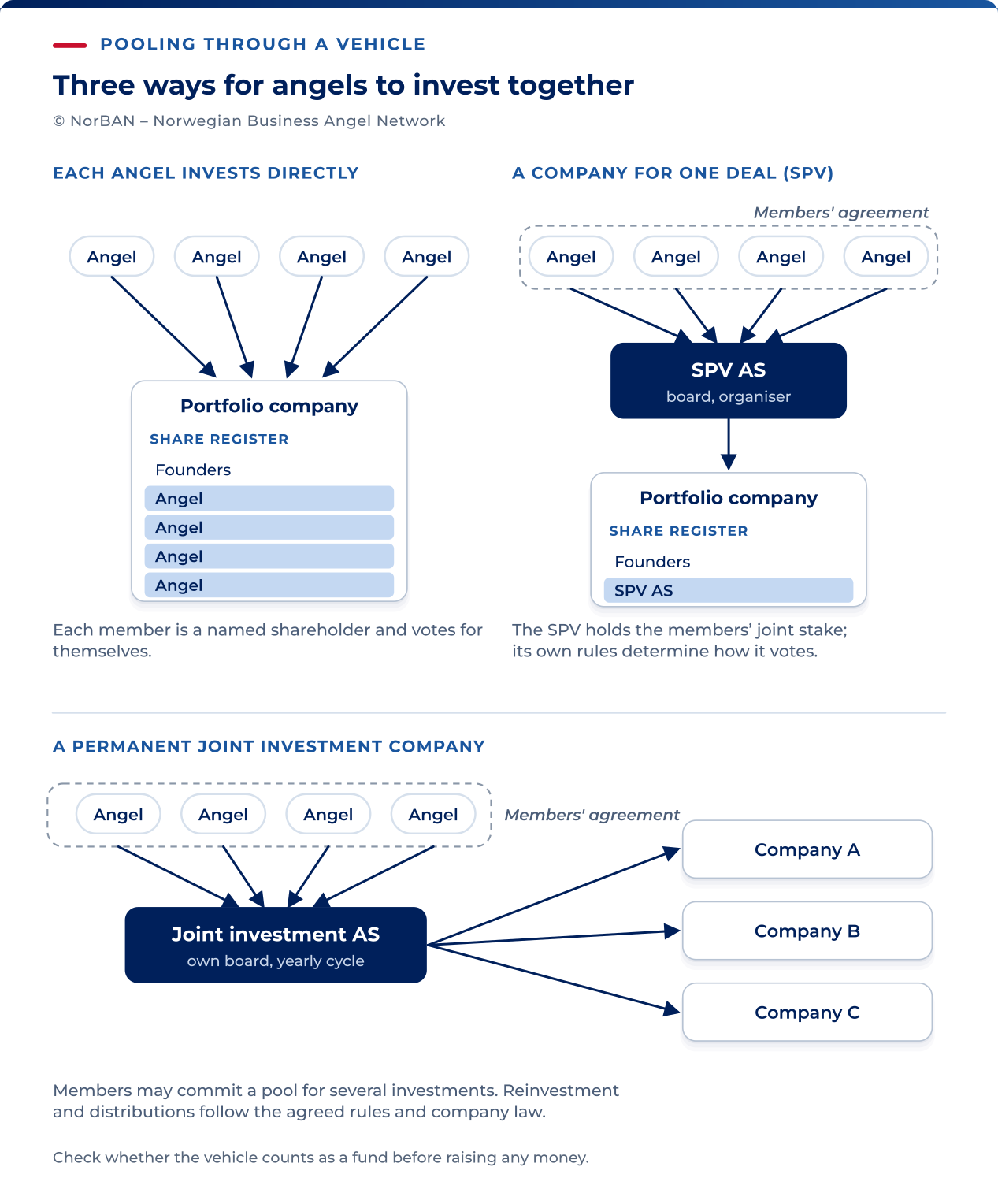
The second pattern is common enough that NorBAN’s list of regional organisations carries “angel investment company” as a category of its own, and the Danish network’s conduct code regulates it: members investing together through a joint holding company must know who their ultimate co-investors are.
The group shares the work and combines its capital. Evaluation is split by competence, the diligence is done once, and the founders deal with one voice on the shareholder list.
NorBAN’s page notes that networks, investment companies and syndicates can invest materially more together than their members can individually. That can put the group in a position to anchor a round.
A jointly owned vehicle also needs coordination and administration. Someone must run the company, keep its accounts and register, and organise the group’s voting decisions. Whether the vehicle counts as a fund under the alternative-investment-fund rules is the first question to settle with counsel; its structure, economics and documents belong to the article on syndicates and SPVs.
The vehicles are set up and run by the investors who use them. NorBAN connects members and advises them; it takes no part in the investment and holds no stake in any vehicle.
Leading and following
Every group deal has a lead. The lead runs the evaluation and the negotiation, engages counsel, chooses the instrument, keeps the other investors informed through the process, and often takes the board seat afterwards. Followers rely on the lead’s process but use their own judgement to decide whether to commit capital.
Every syndicate needs to consider compensation for the lead’s work. The Nordic networks’ published codes take a similar approach. The Finnish code says risks and returns should be shared equally, that the lead often takes on extra work, and that exploring fair compensation for it can make a willing lead easier to find.
The Danish code adds that the network itself takes and pays no fees on member deals, which leaves any compensation a matter between the investors in the round.
Agree any compensation for the lead’s work in advance: who pays, for which work, how it is calculated, when it is due and whether it depends on the investment’s outcome. Disclose any conflicts before members commit. A fee, expense reimbursement and a share of profits are different arrangements; neither peer code establishes a universal prohibition on profit-linked compensation.
Assess the activity as well as the compensation. Receiving or transmitting orders, making personal investment recommendations or placing financial instruments as a business can engage investment-service rules.
Pooling capital under a defined strategy raises the separate fund question. A fee, carry or an informal “lead” label neither settles nor removes those requirements; obtain advice before offering the service or raising the pool.
Following is the sensible first route for most new angels. You decide for yourself and invest your own money, and you see a full process run by someone who has done it before, at the cost of accepting terms you did not negotiate.
In the 2009 UK study, 83 per cent of investments involved co-investors, with a median of five angels in a round, and investors with prior entrepreneurial experience made significantly better exits, which is the experience a follower borrows from a lead.
A board seat rarely comes with following, and it rarely matters. Only about one in five angels in Norway require one, on NorBAN’s published figures, and the requirement is unrelated to ticket size.
Equity crowdfunding platforms
Equity crowdfunding (folkefinansiering) runs through platforms that must hold an authorisation. The Crowdfunding Act (folkefinansieringsloven), in force from 1 August 2026, incorporates the EU crowdfunding regulation into Norwegian law, and under it a crowdfunding service needs authorisation from Finanstilsynet. A platform may instead hold an investment-firm licence, which carries a different set of duties.
Check Finanstilsynet’s register of licensed entities when considering a platform. The register distinguishes crowdfunding authorisations from investment-firm licences. Check the authorisation and any cross-border permission needed to serve Norwegian investors.
An authorised platform classifies you as sophisticated or not. A non-sophisticated investor gets a knowledge test, an assessment of capacity to bear loss, a simulated-loss illustration and a short reflection period in which an order can be withdrawn.
Platform deals differ from network deals in kind. The minimum is whatever the issuer sets, and it is usually far below an angel ticket. The terms are the issuer’s and standardised, so you subscribe on them or you do not subscribe.
Subscribers usually enter the company’s own share register. If the issue uses a single-purpose vehicle, it holds one position for all subscribers. A later investor may ask for this restructuring before investing.
A platform can make smaller investments accessible. Do not assume the offer includes individual negotiation, access for your own diligence or a governance role. Check the access and rights the particular offer provides before committing.
Funds and managed vehicles
The last route is to commit capital to a fund that selects for you. A pre-seed or seed fund gives you diversification across many companies and professional selection, in exchange for management fees, a share of the profit to the manager, and no say in the picks.
Read the fund’s documents before its pitch. They set out which investors it can accept and on what terms.
A fund delegates selection and portfolio management to the manager. Do not assume your commitment gives you a say in individual investments or a role with the founders; opportunities to contribute depend on the fund’s arrangements. A fund can still suit part of your allocation.
What each route demands
Choose a route that fits your capital, time, temperament and investment thesis. Most angels use more than one route and adjust the mix as they gain experience.
| Approach | Capital per position | Time | Skill required | Control | Typical first user |
|---|---|---|---|---|---|
| Direct, alone | A full ticket, often anchoring a round | All of the work, every time | Evaluation, negotiation, documents, follow-up | Complete | An experienced angel with a sector background |
| Syndicate or joint investment company | A share of a pooled ticket | Shared, plus the vehicle’s administration | Whatever you contribute to the group’s split of the work | One vote in the group | An angel building a portfolio on a budget |
| Leading | A ticket large enough to anchor | The most of any route | All of it, and the credibility to be followed | Sets the terms for the group | An angel with several rounds behind them |
| Following | A ticket the lead will accept | The decision and the reading | Judging the lead and the case | Take the terms or leave them | Most new angels |
| Crowdfunding platform | The issuer’s minimum, usually small | A few minutes | Reading the offer critically | None beyond subscribing or not | An investor wanting exposure without involvement |
| Fund | The fund’s minimum commitment | Review reporting and meet any capital calls; the manager handles portfolio work | Choosing the manager | As specified in the fund documents | An investor with a large allocation and no appetite for the work |