
What a follower is actually buying
Followers rely on the lead’s work instead of repeating it. Clear expectations within the syndicate help them understand what they can rely on.
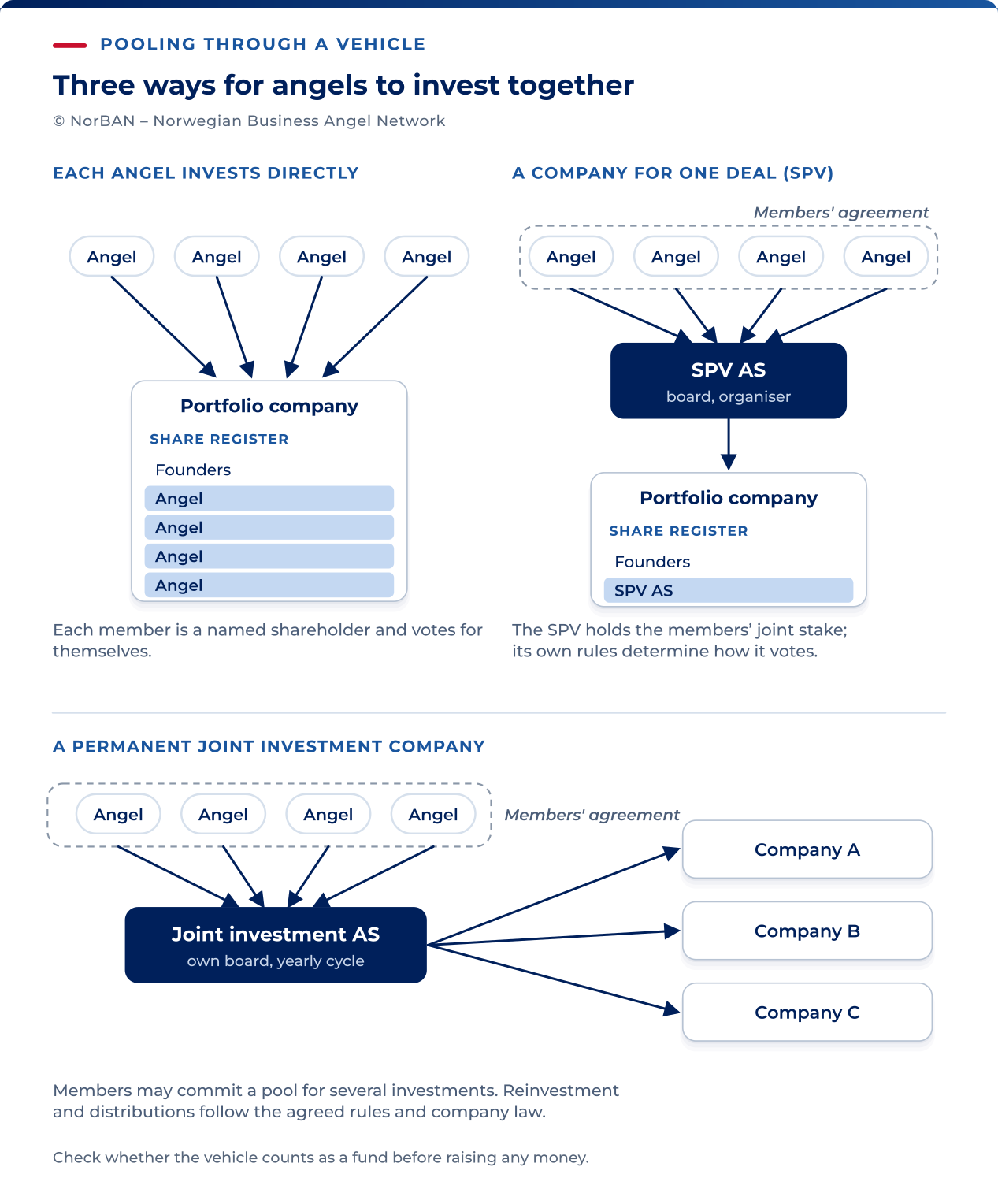
A lead’s work reduces a follower’s work, and the decision stays with the follower. Each member subscribes on their own account, signs their own documents and carries their own loss.
The UK association’s guidance on building a round describes syndication from the company’s side. In a direct-investment syndicate, members hold their own shares and join the relevant agreements. A lead may represent them only within an agreed authority. With an SPV, the SPV holds the portfolio-company shares; members’ rights must also be addressed inside that vehicle.
Members organise syndicates themselves. NorBAN trains angels, gives them a network and provides dealflow; members invest individually, or through a vehicle they set up and coordinate themselves. No body outside a syndicate decides anything about its deal or settles anything between its members.
The NorBAN Code of Conduct reaches conduct and membership. Disagreements about price, cost allocation or the lead’s judgement fall outside that process and must be resolved under the members’ agreements.
What a lead owes before the money
A lead who has been relied on owes disclosure, and the line the code draws is that a lead describes and does not recommend. Section 4 bars a member from providing capital management or investment advice inside the association’s operations in a way that may read as an investment recommendation.
The same section expressly permits members to share investment opportunities. Separate legal rules determine whether the activity requires authorisation.
A personal recommendation about a particular financial instrument may be investment advice under verdipapirhandelloven § 2-3. Offering fund interests can raise separate issues under the AIF Act. Neither label alone decides the permission required: assess the activity, its commercial nature, the investors, the structure and any applicable exemption.
The classification depends on the facts of the particular circulation. Finanstilsynet grants the authorisations and its virksomhetsregister records who holds one, and the vehicle and the fund question are a subject of their own.
Write the disclosure down and circulate it with the opportunity. Followers can then make a decision on stated information, and the lead has a record of what was disclosed.
| What the lead states | When it goes out | What it does for a follower |
|---|---|---|
| The due diligence (selskapsgjennomgang) actually run, and in as much detail the work not done | With the circulation | Tells the follower which gaps are theirs to close, to price, or to accept |
| The material relied on, made available in full | With the circulation | A follower who reads the source can disagree with the lead’s reading; a summary removes that option |
| The lead’s own ticket, entry price and terms | With the circulation | A lead’s conviction counts for something only if the lead is in on the same terms |
| Any compensation the lead receives, in what form, and who bears it | Before the decision window opens | A lead paid by the company stands somewhere different from a lead paid by the group |
| Conflicts of interest (interessekonflikt), including a position in the sector, a board seat and any commercial relationship with the company or the founders | On the lead’s own initiative, as soon as the conflict is apparent | Denmark’s DanBAN requires this of its own members at the earliest convenient moment, and for a possible conflict as well |
| The decision window, with the date it closes | With the circulation | A window too short to read the material in is not a decision |
A US angel-education publisher recommends sharing your diligence materials with prospective investors and answering questions about the process and findings. Make clear that the lead does not guarantee the outcome.
What the law requires, and what it has not decided
Norwegian law does not start from a duty to look after a co-investor. In HR-2025-1115-A the Supreme Court said in its own reasoning that causing someone a financial loss is not in itself wrongful, and that there is no general duty to act to safeguard the interests of others (avsnitt 45).
Where the loss is purely financial and the conduct complained of is an omission, the same paragraph requires a claimant to show that a general standard of conduct (allmenn handlenorm) exists and that it was breached.
At avsnitt 55 the court treated the contractual duties of loyalty and care at issue as duties owed within that contract, not a basis for liability to the claimant outside it. This does not abolish duties with another legal basis. The case ended in an oppheving, and its reasoning did not adopt a professional-liability framing.
A duty towards a non-party can arise where it comes from outside the defendant’s own contract. In HR-2022-1316-A an estate agent was held liable to a bidder rather than to his own client.
The standard was one which «både kontraktsparter og andre med rimelighet kan forvente at vedkommende overholder» (avsnitt 32), and the professional had to weigh loyalty to his principal against a statutory duty of care to the counterparty (avsnitt 46). That duty came from eiendomsmeglingsloven § 6-3.
An estate agent’s statutory duties do not automatically apply to a syndicate lead. Whether a lead performs regulated investment services depends on the activity, not the title. Neither judgment cites the other, so the contrast is a reading of both and not something a court has said.
A positive statement raises a separate enquiry: for example, a lead says that a round is oversubscribed or an ARR figure verified, and the statement is wrong. Assess that statement under the applicable rules on contract, company roles and misleading information.
Norwegian law recognises liability for misleading information (informasjonsansvar). Its established conditions require that:
- Someone giving information in a professional context was negligent and the information was misleading.
- The recipient had reasonable and legitimate grounds to rely on it and act accordingly.
- The information was intended for that recipient, or at least for a limited group they belonged to.
The conditions are put in that form in Rt-2015-556 avsnitt 43, as quoted in HR-2020-312-A avsnitt 39. That paragraph is the first-voting judge’s own reasoning, which opens at avsnitt 32, and the judgment was unanimous.
A statement circulated to prospective participants can be intended for a limited group. Reasonable and legitimate reliance still needs assessment: consider the caveats, supporting material, recipient’s knowledge and checks. Subscription after receiving the statement does not establish that condition by itself.
Whether a private lead speaks in a professional context is a question for advice on the actual arrangement. Repeated activity, expertise, remuneration and an agreed mandate may matter; a fee alone does not settle it. The authorities cited do not decide the ordinary private syndicate lead’s position.
Shareholder loyalty is not confined to a signed agreement. In HR-2020-1947-A avsnitt 45 and 47, the Supreme Court recognised an unwritten duty supplementing the Act, linked to minority protection and abuse of power. The case concerned a controlling shareholder; it does not settle every duty of a minority lead to followers.
Apply those distinctions to the lead’s actual role.
- A contract binds its parties according to its terms. Purchase remedies concern the seller of existing shares; they are not a general claim against any lead who circulated information.
- Aksjeloven § 17-1 concerns harm caused intentionally or negligently in a listed role, including shareholder or director, and participation in such harm. It does not make every information provider liable merely because the statement was wrong.
- Define the mandate, disclosures, decision authority and limits before inviting commitments. An agreement reduces uncertainty, but does not displace statutory or other duties that apply independently.
What a follower owes back
Followers also have obligations; failing to meet them creates costs for the group.
- Decide inside the window, or say no inside it. A lead holding a round open for one undecided member is spending the founders’ goodwill and everyone else’s.
- Do not negotiate separately with the founders once the group has a lead. Two prices in one round, or two sets of side terms, and the lead’s ability to close anything is gone.
- Do not re-run the diligence after the deadline and then criticise it. Questions asked inside the window are work; the same questions afterwards are a way of withdrawing without saying so.
- Keep what was circulated confidential. The material is the founders’, and the lead obtained it on terms the whole group inherits. Finland’s FiBAN binds its own members to use information received solely to evaluate the opportunity.
- Pay the agreed share when it is called. A shortfall lands on the members who did pay, or on the company as a smaller round.
Who pays, and for what
Agree costs before committing to the work. If you wait until the invoice arrives, the group must negotiate over a bill already incurred, especially when a deal fails to complete and costs go unrecovered. No figure belongs in that agreement until an adviser has quoted one, and the cap the group sets is its own.
| Cost | Payment arrangement to agree | What the group settles, and when |
|---|---|---|
| Outside counsel | Specify who instructs and pays each adviser, and any company reimbursement, cap and completion condition | Which side’s counsel drafts, and the cap, at term-sheet stage. A US trade association records that both sides’ fees are usually capped in early-stage deals |
| External diligence: technical, financial, background | Specify who commissions it and how the group shares the cost, including if the round does not close | Whether the group commissions it at all, and the exposure each member accepts, before anyone is instructed |
| The vehicle’s founding and running costs | The members, in the proportions their own agreement sets | Who funds the vehicle before the first close, and what happens to that money |
| The lead’s own time | Record whether and how it is compensated | Whether it is compensated at all, and by whom |
Agree how costs will be handled if the deal does not complete. The following approaches can be combined; choose the arrangement before instructing an adviser.
- Reimbursement conditional on completion leaves investors paying if the deal does not close; document any exception.
- A cap agreed in advance keeps each member’s exposure a known quantity.
- A split by intended ticket puts the largest share on the largest position.
- An equal split divides it by head. DanBAN recommends that to its own members where an investment does not complete, with the company carrying the cost only where it does.
Compensating the lead
Agree any compensation for the lead’s work in advance: who pays, for which work, how it is calculated, when it is due and whether it depends on the investment’s outcome. Disclose any conflicts before members commit.
Distinguish reimbursement of documented expenses, a fee for work and carried interest. A fee’s payment conditions are agreed terms; do not assume it is payable regardless of completion or outcome.
Carried interest links compensation to the investment’s returns under an agreed formula. Define the profit base, any hurdle, expenses, timing and treatment of losses. A success interest under a loan-based arrangement also needs its own defined calculation; its label alone does not establish the economics or tax treatment.
FiBAN publishes that risks and returns should be distributed equally among investors in a syndicate, and that a fair compensation model for a lead’s extra contribution is sometimes useful because it makes a willing lead easier to find.
Assess the activity as well as the compensation. Receiving or transmitting orders, making personal investment recommendations or placing financial instruments as a business can engage investment-service rules.
Pooling capital under a defined strategy raises the separate fund question. A fee, carry or an informal “lead” label neither settles nor removes those requirements; obtain advice before offering the service or raising the pool.
DanBAN publishes that the network itself neither receives nor pays fees on members’ investments unless it has disclosed this clearly. Whatever form is agreed, agree it before the round and take advice on its tax treatment before it is paid.
Information after closing
After investment, distinguish the information promised by the lead, the rights in the shareholders’ agreement and the statutory rights. The first is what the syndicate agreed the lead would circulate, and how often.
The second is what the shareholders’ agreement’s information rights give the vehicle or the members. The third is what a shareholder in a Norwegian AS can require regardless.
Shareholders have statutory information and minority rights, as well as any rights agreed by contract. The filed annual accounts are public, and anyone may inspect the share register. Shareholders also receive meeting documents and specified transaction disclosures, subject to the applicable statutory rules.
At a general meeting, a shareholder may ask for information relevant to the accounts, the agenda or the company’s financial position, unless disclosure would cause disproportionate harm. Where information must be obtained, a written answer follows within two weeks (aksjeloven § 5-15).
Holders of at least one tenth of total share capital may demand an extraordinary general meeting. Any shareholder may propose an investigation (granskning). Support from at least one tenth of the capital represented permits any shareholder to petition the court within one month; the court then assesses whether there are proper grounds (§§ 5-25 and 5-26).
Agree routine reporting, budgets and material-event notices expressly. Who can enforce the obligation, and against whom, depends on the agreement; an obligation on the company requires the company to be a party.
When an SPV owns the portfolio-company shares, the shareholder rights there normally belong to the SPV. Members retain their own statutory rights as shareholders of the SPV, plus any contractual rights they have. Direct rights against the portfolio company require a separate basis.
An SPV does not guarantee anonymity. Under the beneficial-owner rules, assess control starting with the company being registered. At that level, more than 25% ownership or votes, a right to appoint or remove more than half the board, or other control can qualify. At intermediate levels, the test is at least 50% of votes or a right to appoint or remove at least half the board. Do not simply multiply ownership percentages. Check the SPV’s own reporting duties too.
A director nominated by an investor holds a personal office with duties to the company. Altinn’s guidance describes an expectation of reporting through appropriate channels, alongside the responsibility to act in the company’s interests. It does not give unrestricted permission to pass on board material.
Reporting must respect the director’s duties to the company, the prohibition on unreasonable advantages in § 6-28, trade-secret protection and applicable confidentiality obligations. A nomination by an investor is not blanket permission to share board information. Agree what may be shared, with whom and for what purpose.
When the lead goes quiet
Reporting can gradually diminish and then stop, with every member assuming someone else will follow up. At the outset, record the reporting arrangements and a way to cover or replace the lead in the syndicate’s own agreement.
- A reporting cadence with a date on it, so a missed report is a fact anyone can point to.
- A deputy who holds the same material and can circulate it in the lead’s absence.
- A mechanism for replacing a lead who has stopped, on a threshold a small group can reach.
DanBAN publishes for its own lead corps that a lead who concludes this is not a case they will invest in owes the founders and the rest of the group a professional explanation before stepping down. The same page records that a lead’s commitment is to running the process professionally and never to guaranteeing capital.
A lead who steps down hands over the material relied on, the correspondence with the company, the cap table as it stands and any standing arrangement made in the group’s name.
The handover goes to whoever the group appoints, in the same meeting that accepts the resignation. Without a handover, followers are left without the information and coordination they relied on.
When the syndicate stops agreeing
A follow-on round can expose differences the group did not resolve when first investing. Some members will follow their money and some will not, and the right to subscribe sits with the vehicle or with each member, depending on what was signed.
Keep two rights separate. Statutory pre-emption on a cash issue gives existing shareholders a proportionate right to subscribe under § 10-4, subject to the applicable exceptions and a valid waiver under § 10-5. A contractual pro-rata right follows its agreed scope. Neither is the same as a right to buy existing shares when another owner sells.
Statutory pre-emption concerns existing shares that change owner. It is exercised by notice to the company under § 4-23, not by notice to the seller alone. Contractual first-refusal rights follow their own terms. Agreeing a right to participate in new issues does not also create a right to buy transferred shares.
Through a vehicle, the portfolio company sees one shareholder and one subscription, or none at all. The statutory fortrinnsrett in aksjeloven § 10-4 attaches to the vehicle’s holding, and a contractual pro-rata to whoever signed the agreement.
Differences between members must be resolved within the vehicle under its own agreed procedures; the portfolio company deals only with the vehicle. Settle these points while everyone still agrees.
- Whether a member who does not follow is diluted inside the vehicle, and on what valuation.
- Whether members who do follow may take the unfollowed share, and in what order.
- What the lead circulates before a follow-on, and how long before the deadline.
- What happens when the lead’s own position diverges from the group’s, which is where disclosure matters most and is least likely to be volunteered.
A lead who is not following says so, early enough for the others to reconsider. A lead taking a larger share of the follow-on says that too, before the window opens.