
What the border changes, and what it does not
A company answers to the law of the place it was formed. That law determines its governing bodies, register, share-issue process and minority protections. Signing an investment agreement does not change which company law applies.
Your own position is decided in Norway, by where you are resident and by what holds the shares. Assess the company’s legal position and your tax position separately, because they are governed by different systems.
Norwegian money into a foreign company
The participation exemption (fritaksmetoden) is a reason for a Norwegian angel to invest through a company, but its scope depends on where the investee is resident. Skatteloven § 2-38 sets the conditions, and Skatteetaten publishes the mechanism and the current taxable share of a received dividend on its exemption-method page.
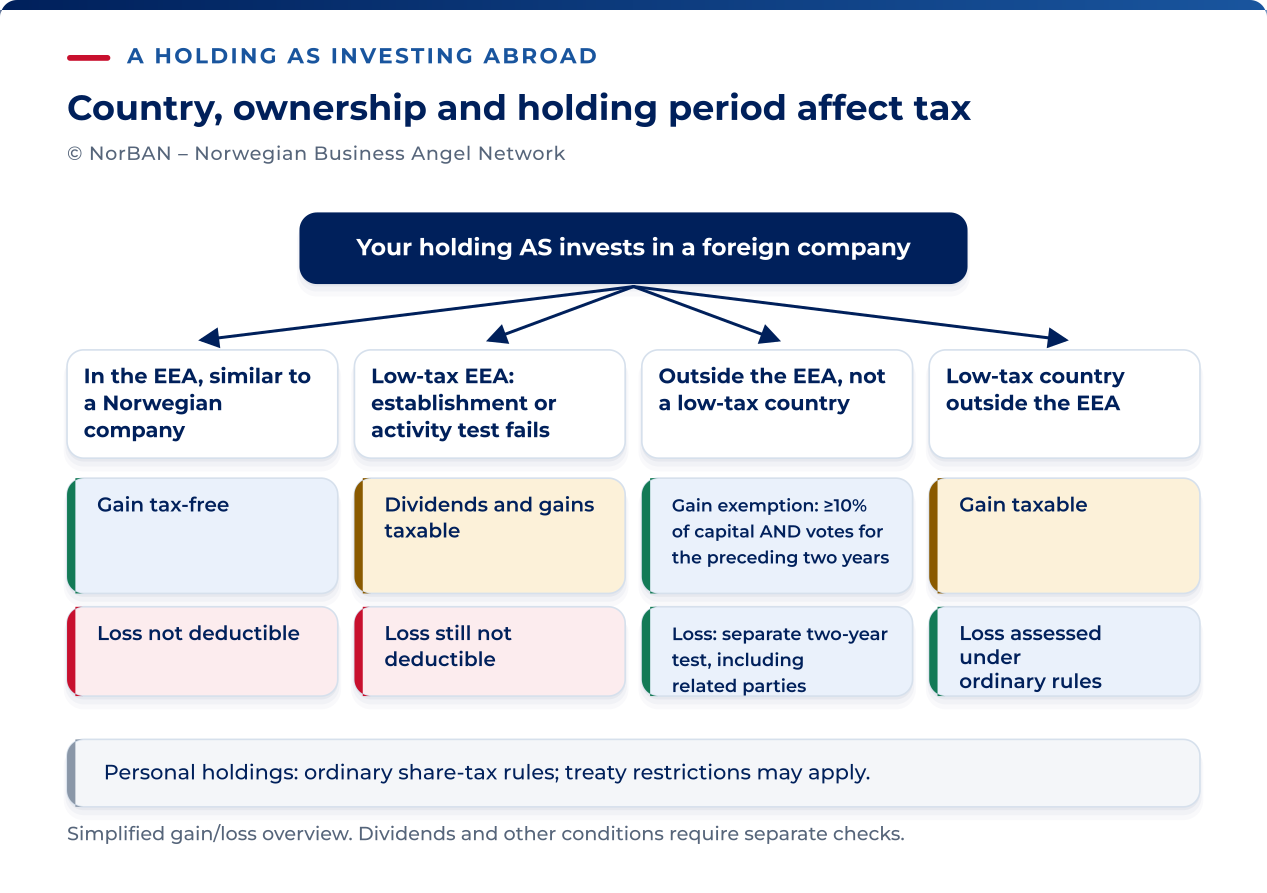
Distinguish the two residence tests, which answer different questions. An investee counts as resident in an EEA state when it is not resident in Norway under skatteloven § 2-2 and is tax-resident in an EEA state under that state’s own internal law.
Where its board and day-to-day management sit is the separate § 2-2 test of whether a company is Norwegian, and the two tests answer different questions (Skatte-ABC F-32-2.3). Whether the entity corresponds to a Norwegian company is a third question, decided under Norwegian law on its own characteristics, with limited liability for the members the central point.
Inside the EEA the exemption reaches lawful dividends, gains and losses on shares in such a company. Where that company is resident in a low-tax EEA state, the exemption applies only if it is genuinely established and carries on genuine economic activity in an EEA state.
The condition treats gains and losses differently. If the low-tax EEA company is not genuinely established its dividends and gains become taxable, while a loss on the very same shares stays inside the exemption and so remains non-deductible.
A different test applies outside the EEA. A dividend from a company in a country that is not a low-tax country is inside the exemption only where you have held at least a tenth of the capital and a tenth or more of the votes across a two-year period covering the moment the income is earned.
For a gain the same holding must have run for the two years up to realisation, and shares in a low-tax country outside the EEA sit outside the exemption altogether. The company’s residence therefore affects the after-tax value of your exit, with different results for personal and corporate holdings.
| Where the investee is resident | A gain in your holding AS | A gain you hold personally | Where the rule is published |
|---|---|---|---|
| EEA, and it corresponds to a Norwegian company | Inside the exemption under skatteloven § 2-38. A loss is inside it too, and is therefore not deductible | Taxable on realisation under skatteloven § 10-31, with a deduction for a loss | Skatte-ABC F-32-3.7 |
| EEA low-tax state, company fails the genuine-establishment and real-economic-activity test | Dividends and gains fall outside the exemption and are taxable. The loss stays inside it and is still not deductible | The domestic rule reaches foreign shares unchanged (skatteloven § 10-31) | Skatte-ABC F-32-3.7 |
| Outside the EEA, and not a low-tax country | Inside the exemption on the holding and two-year test in skatteloven § 2-38; losses have a separate test: the taxpayer and related parties must not have held at least 10% of the capital or votes at any point in the preceding two years | Taxable on realisation, subject to the treaty cut-backs in skatteloven § 9-4 and § 10-32 | Skatte-ABC F-32-3.8 and F-32-3.9 |
| Low-tax country outside the EEA | Outside the exemption altogether, so the gain is taxable and losses are assessed under the ordinary deduction rules | Taxable on realisation, with the same treaty cut-backs | Skatte-ABC F-32-3.10 |
When the foreign company fails
Skatteetaten normally treats bankruptcy as a realisation of the shares at nil in the year proceedings open. If the estate is returned to the company, that treatment normally falls away. This administrative practice does not change at the border; whether Norway allows the loss depends on the holder and the applicable tax rules.
Two treaty cut-backs reach the personal route. Where a treaty exempts the gain on shares in a foreign company, the loss is not deductible either; where a treaty exempts dividends from it, a computed loss is reduced by the dividends received in the ten years before realisation (Skatte-ABC A-5-2.1).
Wealth tax on an unlisted foreign holding
An unlisted share in a foreign company is valued at its assumed sale value at the end of the income year under skatteloven § 4-12 third paragraph, then reduced by the general valuation discount published in Skatteetaten’s wealth tax rates.
There is no company-filed Norwegian tax value to fall back on. You may instead require valuation on the Norwegian basis, provided you can substantiate the company’s total tax value under Norwegian rules and its allocation across the shares, which puts the valuation work and the risk of adjustment on you (Skatte-ABC A-4-6).
Taxed on profits nobody has paid you
A Norwegian participant in a Norwegian-controlled entity in a low-tax country can be taxed on a proportionate share of its profit without receiving a distribution. Under § 10-61, a loss is carried forward against later income from that entity, rather than deducted freely from other income. Low-tax status compares the ordinary tax on the entity’s total profit with two thirds of the Norwegian tax on that profit; see Skatte-ABC U-18-1.
Under skatteloven § 10-62, the main control test is at least half of the interests or capital owned or controlled directly or indirectly by Norwegian taxpayers at both the start and end of the income year. Previous-year control can carry forward. More than 60% at year end establishes control, while less than 40% rules it out, regardless of the main test. There is no minimum individual stake or requirement for the Norwegian owners to act together.
So a small stake in a low-tax vehicle can make you currently taxable on a share of its profits because of who the other shareholders happen to be. Ask who else is on the register before you join a pooled foreign vehicle, and ask again when it takes new money.
The rules have exceptions under § 10-64. In a treaty country, NOKUS taxation does not apply if the entity’s income is not mainly passive. For a genuinely established EEA business carrying on real economic activity there, the participant must document the conditions; information exchange or a tax-authority confirmation is also required as specified in the section.
As a participant, you remain responsible for reporting even if the vehicle has not supplied the figures you need. Skatteetaten publishes its country list at U-18-2.2 and the control test at U-18-3.1.
Foreign tax on the money coming back
Norway relieves double taxation by internal-law rules and by treaty, through an exemption, an alternative exemption, a credit and an income deduction (Skatte-ABC U-20-1.2). The credit provisions begin at skatteloven § 16-20, capped at the lower of the foreign tax paid and the Norwegian tax on the foreign income.
For a holding company, the restriction on relief for withholding tax is particularly important. Where a dividend is untaxed in Norway under the participation exemption, no credit and no income deduction is available for the foreign withholding tax (kildeskatt) on it (Skatte-ABC U-20-6).
The foreign withholding tax therefore becomes a cost when the dividend is exempt in your holding company. It does not affect a personal holding in the same way.
Where a foreign state withholds more than its treaty with Norway permits, you reclaim the excess in the paying state, on that state’s own form and with a confirmation from Skatteetaten that you are resident here under the treaty. Only tax within the treaty’s own rates may be credited in Norway.
The current rates for each treaty are published by Finansdepartementet. You self-assess the credit in your return and must document that the tax is creditable, that it was paid, and that it is final tax on ordinary assessment abroad (Skatte-ABC U-20-4.20).
A gain is a separate question, and the handbook’s structure says so. Its sections on real property and on movables send the reader to the credit rules; its section on shares sets out which state may tax the gain and does not mention credit at all.
What the credit rules require is one condition, and it is the condition a gain turns on. Foreign income counts only where it has a foreign source, is lawfully taxed in the source state, is included in what Norway taxes, and the foreign tax is paid (skatteloven § 16-21, Skatte-ABC U-20-4.11.2).
The income deduction under skatteloven § 6-15 is refused on the same principle. Where income earned abroad is not taxed in Norway, under internal law or under a treaty, no deduction is available for the foreign tax on it, and the handbook’s own example is a foreign withholding on a dividend inside the participation exemption.
Tax a foreign state levies contrary to its treaty with Norway is not creditable at all (skatteloven § 16-27). You appeal the assessment there, and where that fails you ask Skatteetaten to open a mutual-agreement case.
Norwegian credit cannot offset foreign tax on a gain exempt in Norway: § 16-20 requires income taxable here, and § 16-21 limits credit to Norwegian tax on the foreign income. Relief for tax charged abroad must be assessed under that state’s rules and the applicable treaty.
Two express denials are narrower than they look. Skatteloven § 16-20 første ledd tredje punktum and § 16-30 åttende ledd reach only income taxed under the three-per-cent rule, which applies to dividends, and do not govern gains.
The relief that stops at the border
The deduction for investment in start-up companies under skatteloven § 6-53 reaches an aksjeselskap resident in Norway under § 2-2, and an EEA company that corresponds to a Norwegian AS and already has limited tax liability to Norway.
A foreign start-up with no Norwegian branch and no Norwegian taxable activity does not reach the scheme however good it is. An ASA is outside it, so is a listed company, and the other conditions sit with the public instruments themselves (Skatte-ABC A-2-2.1).
If you leave Norway
Under skatteloven § 10-70, a personal taxpayer moving abroad is taxed as if shares and certain other assets had been realised on the last day before Norwegian tax residence ends under internal law, or before a treaty treats you as resident elsewhere.
The same rules apply on a transfer of those assets to a person or entity resident outside Norway, at a lower amount. Both amounts are set in the section itself and move only when the statute is amended, and Skatteetaten’s exit-tax page carries them with the payment options.
The rules changed substantially with effect from 20 March 2024, and the superseded rule is still published because it governs moves made on or before 19 March 2024.
The exit tax (utflyttingsskatt) is assessed for the year of the move. You choose between immediate payment, interest-free instalments over twelve years, and payment at the end of the twelve years with interest.
Realisation or a transfer abroad can make deferred exit tax payable sooner. A dividend normally triggers payment equal to 70% of the distribution, capped by the remaining exit tax, rather than ending the whole deferral. Death has exceptions where individual heirs take over the obligations. Net losses are deductible on a move to another EEA state or Svalbard, subject to the statutory conditions, but not on a move outside the EEA. See § 10-70 and Skatte-ABC U-10-1.1.
The rules also reach employment options under skatteloven § 5-14, and only where the holder can be regarded as owner of the option at the emigration date. Skatte-ABC summarises a 2025 Skatteklagenemnda decision, SKNS1-2025-38, in which an option exercisable only if the holder was still employed after emigration fell outside § 10-70 for that reason (U-10-3.1).
Employee options require a separate exit-tax assessment when the holder moves abroad. In SKNS1 38/2025, a divided Tax Appeals Board held that the particular conditional options were not owned at the taxpayer’s 2016 departure. Continued employment was required and the rights were not yet exercisable. The decision is fact-specific; it does not exempt every option with an employment condition. Check the actual rights and the law applying to the move.
The protections you are used to do not travel
Aksjeloven’s minority ladder, its consent requirement on a transfer, its pre-emption right and its silence on drag and tag are facts about Norwegian companies. They come with the company, and a company formed elsewhere brings its own set.
A foreign cap table often includes preferred share classes and contractual arrangements that may be unfamiliar to a Norwegian angel. Before signing, ask counsel qualified in that jurisdiction to explain the local position on these five points.
| Have this answered locally | What Norwegian law gives you |
|---|---|
| Who has to consent to a transfer of shares, and is there a pre-emption right? | Acquisition of a share needs the company’s consent unless the articles waive it, and consent counts as given if no refusal reaches the acquirer within two months after the company receives notice of the acquisition (aksjeloven § 4-16). Separately, the other shareholders have statutory pre-emption rights unless the articles provide otherwise (§ 4-19) |
| What can a minority of my size block? | Decisions under the two-thirds rule can be blocked by more than a third of votes cast voting against, or more than a third of represented capital withholding support (aksjeloven § 5-18) |
| What happens to me on a sale the majority agrees? | Aksjeloven gives no general drag-along or tag-along right; these need an agreed basis. Compulsory acquisition under § 4-26 is a separate statutory rule |
| What are the shares called, and what does the class actually carry? | Angel rounds in Norway are usually ordinary shares. Where classes exist they are created in the articles, which are filed and public |
| Where is a dispute heard, and under which law? | Mandatory company-law rules follow the company whatever the parties agree. The documented Norwegian pattern with foreign investors is English documents under Norwegian law with Norwegian venue |
Use the Norwegian rules as a reference for the questions you put to local counsel. Chambers’ Venture Capital 2026 carries a chapter per jurisdiction, each written by counsel in that market.
Two differences are documented, and each is stated as what that regime’s standard documents do. A US priced round runs on the NVCA model documents, which create preferred stock in an amended certificate of incorporation, put board composition and the drag-along in a voting agreement, and govern transfers through a separate right of first refusal and co-sale agreement.
A German GmbH round is a notarial act. The investment agreement is notarised, each investor signs a notarially certified subscription declaration, and the investor becomes a shareholder when the capital increase is registered (Orrick).
Foreign money into a Norwegian round you are in
A foreign co-investor does not change the company’s governing law. Prepare early for English-language documents and a tighter timetable.
Agree the governing law before the drafting starts. Norwegian angel practice uses English documents under Norwegian law. Document language does not decide governing law. Assess the need and cost of foreign-law advice from the chosen law and transaction.
Expect co-investor holdings to be accessible. The share register (aksjeeierbok) is open to anyone on demand (aksjeloven § 4-6), so a co-investor’s identity and holding are retrievable by anyone who asks for them.
Agree the payment date in writing, and early. Cross-border transfers can spend days in correspondent banking and compliance checks, with little visibility for the parties, and the three-month registration deadline does not move for them (aksjeloven § 10-9).
Dividends to a foreign shareholder are withheld at source, and the duty to deduct is the company’s. Exemption reaches an EEA company only where it is genuinely established and carries on genuine economic activity there, and a reduced rate at source needs documentation from the shareholder first (Skatte-ABC U-13-1.1).
Agree the reporting language and frequency in the shareholders’ agreement while the round is open. An investor in another country cannot rely on informal contact with the company for updates.
Before you wire money across a border
If you are following a lead, items one, three and four are yours and the rest belong to the lead in writing. If you are organising the round, all six are yours.
- Who holds the shares, and in which register. Your own name or your holding company decides the whole of the tax position above, and the register decides what you can prove.
- Which law governs the shareholders’ agreement, and where a dispute is heard. Mandatory company law follows the company anyway, so you are choosing the contract layer and the cost of enforcing it.
- Who withholds what, and who carries the duty. Check dividends and sales before money leaves.
- What reporting arrives, in what language and how often. Fix it while the round is open, because nothing informal crosses a border.
- How an exit in that jurisdiction reaches you. Trace the route from a signed purchase agreement to money in your account, naming each consent and withholding.
- Who is advising you on the other side. Name the firm before you sign; a round too small to pay for local advice is too small for a foreign cap table.
Where advice is not optional
Your tax outcome depends on your residence, your investment vehicle, the investee’s residence and the treaty between the two states. Have those facts assessed together for the proposed investment.
Take to a Norwegian tax adviser the exemption’s geography on your actual holding, any exposure to current taxation in a pooled foreign vehicle, the wealth-tax valuation, and your position if you move. Take the left-hand column above to counsel qualified in the company’s own jurisdiction.
Skatteetaten answers the rest directly, from the credit claim and its documentation to the exit-tax filing.