What public money changes for an investor
Most Norwegian companies seeking angel investment already have public funding or are about to apply for it. The company handles the application; your task is to understand the obligations attached to that funding.
A grant (tilskudd) takes no shares and can extend runway without ownership dilution. Its value still depends on eligible costs, required company funding, timing and obligations. Check the offer and conditions rather than assuming the money is unconditional or available without discussion.
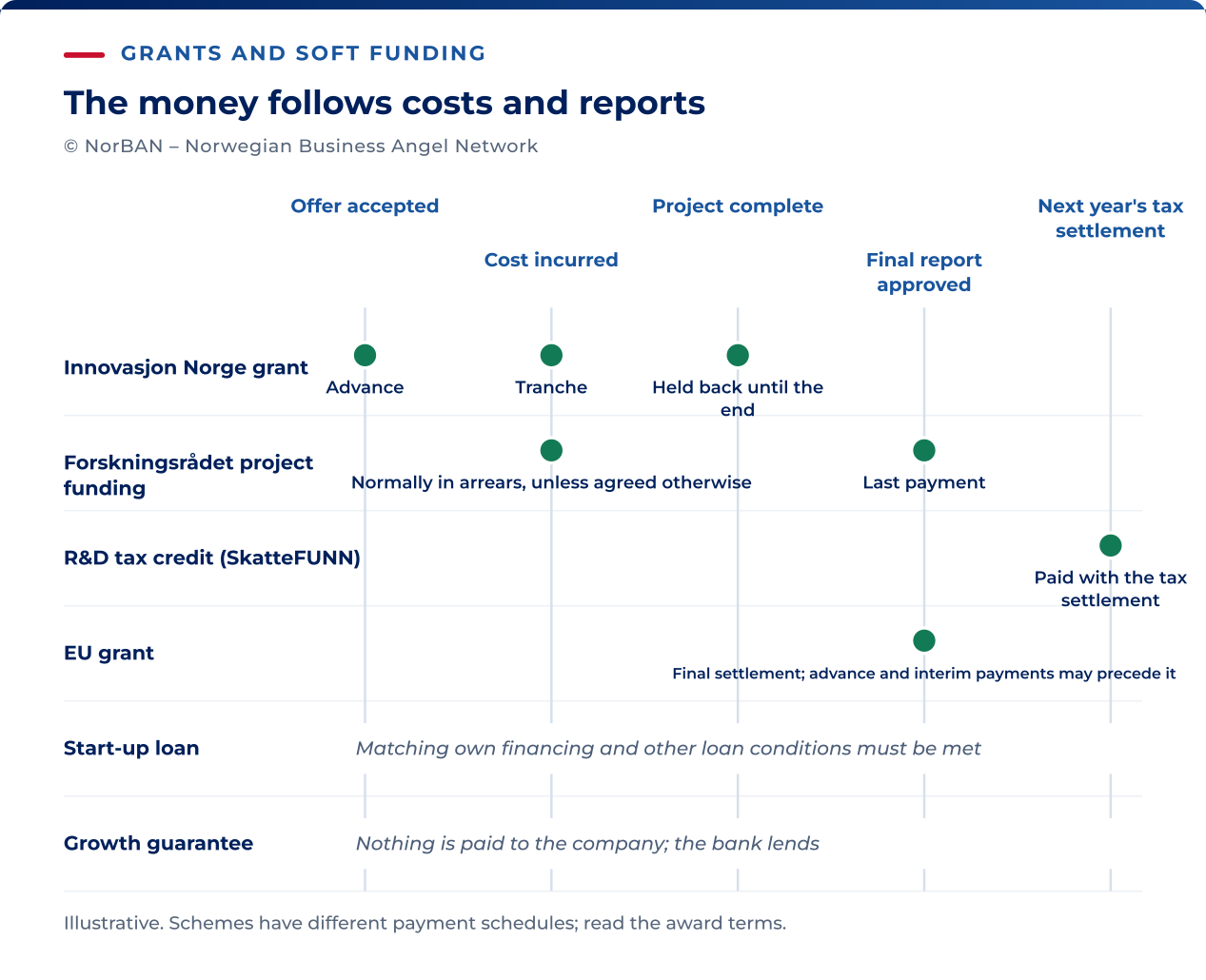
Public money comes with conditions and is paid in tranches against documented costs. Check the commitments attached to each award and the assumptions behind every grant included in the plan.
It also reimburses spending the company has already made, and a tax-based scheme reaches the company with a later tax settlement (skatteoppgjør). Neither closes the cash gap the round exists to close.
Support is also counted against a ceiling on public funding for the same project costs. Amounts already received therefore limit what the company can claim next.
The schemes
Identify which instruments the company holds and assess their effect on your investment. Check the authority’s current terms before relying on the funding.
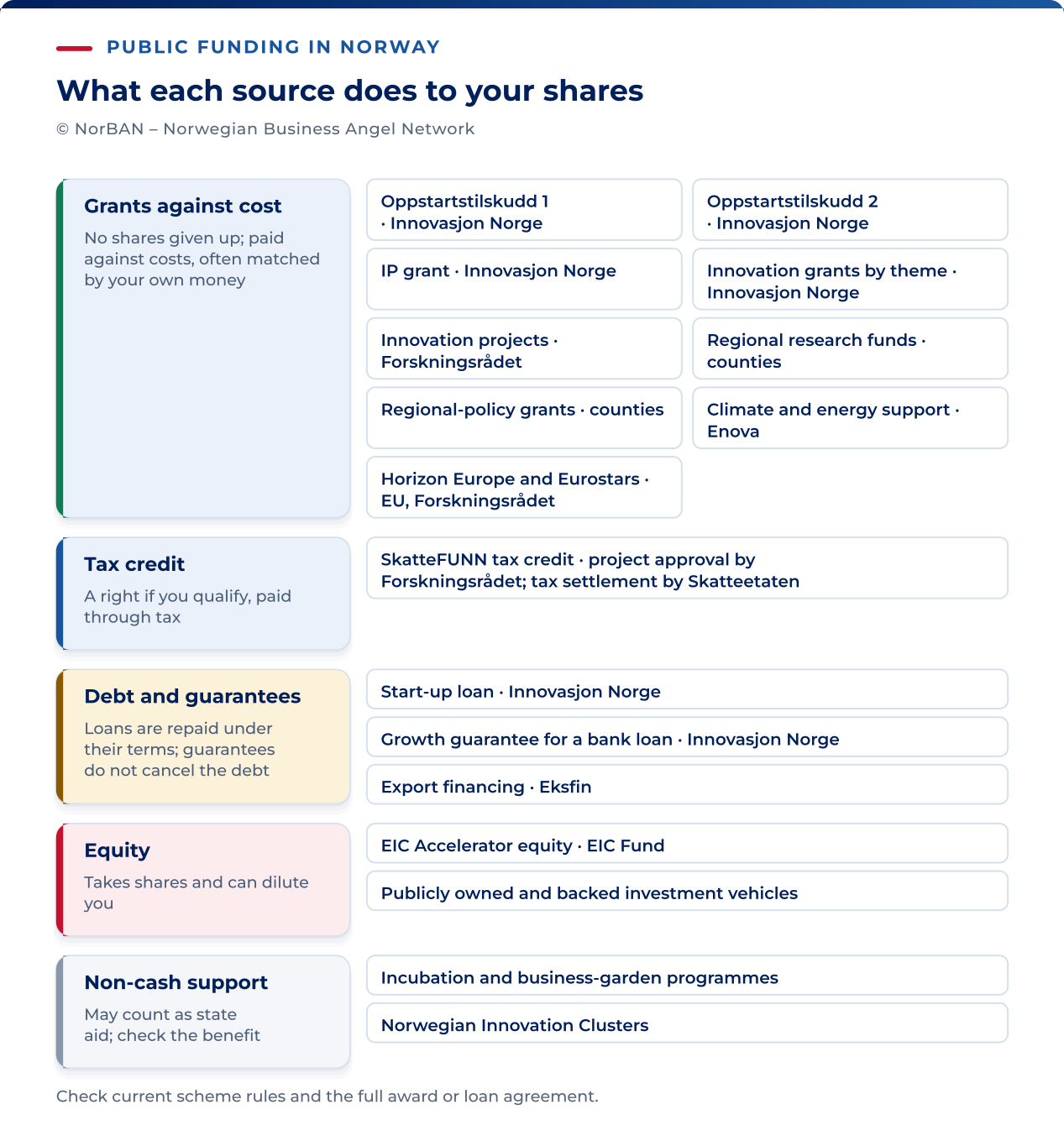
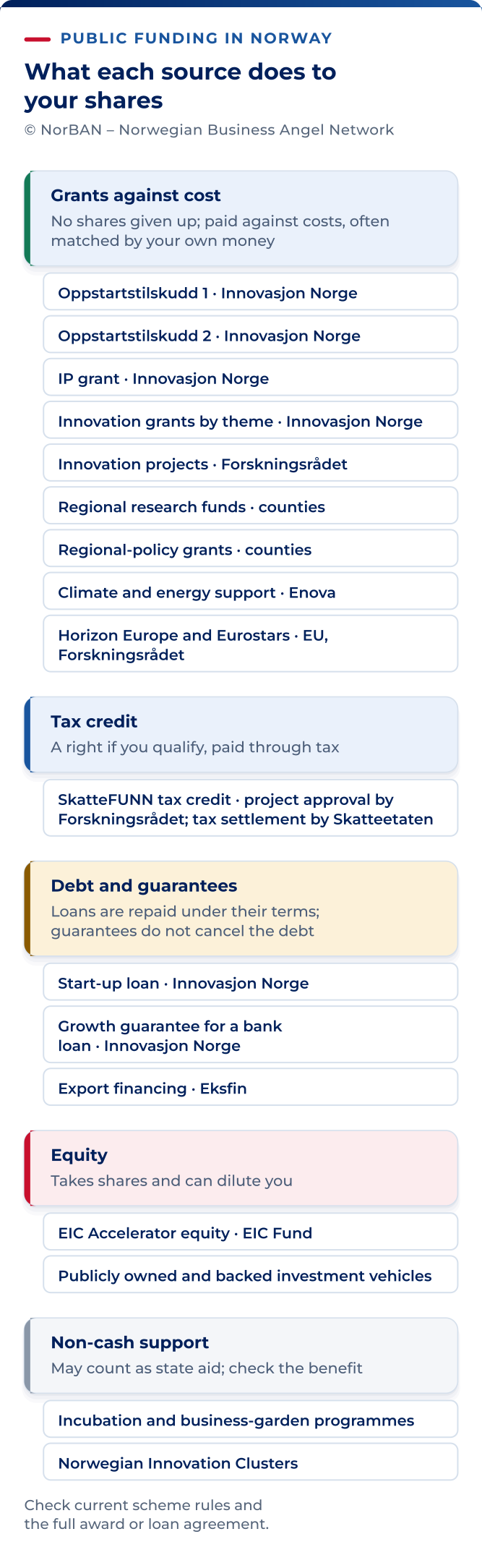
| Scheme | What it funds | Who runs it | What it means for your position | Where the current terms are published |
|---|---|---|---|---|
| Market-clarification grant (oppstartstilskudd 1) | Purchased external services for testing whether a market exists; not own labour | Innovasjon Norge | Non-dilutive. Paid against documented cost, with no private matching share stated | innovasjonnorge.no |
| Start-up grant (oppstartstilskudd 2) | Demanding technology development in a young AS | Innovasjon Norge | Non-dilutive. Include the required own financing in the funding plan; it need not all come from a new equity round | innovasjonnorge.no |
| IP clarification grant | Purchased external work on patentability, freedom to operate, IP mapping and IP strategy | Innovasjon Norge | Non-dilutive. Excludes filing fees, disputes and prototyping. Disclose other public support for the same costs; it may reduce or eliminate the grant | innovasjonnorge.no |
| Innovation grants by theme | Development projects with significant technical risk, run as separate schemes by theme, for example with a committed pilot customer or in environmental technology | Innovasjon Norge | Grant, sometimes with a loan beside it. State-aid rules cap the public share of the project and the company funds the rest | innovasjonnorge.no |
| Start-up loan | Working capital in a young AS | Innovasjon Norge | Debt ranking ahead of your shares, secured over assets, equipment, property and transferable IP rights. An ownership change needs the lender’s consent before it is carried out | innovasjonnorge.no |
| Growth guarantee behind a bank loan | Bank lending to an SME with repayment capacity and insufficient collateral | Innovasjon Norge, through participating banks | The guarantee supports the bank loan; it does not cancel the company’s debt. Check the bank’s loan agreement and the applicable guarantee conditions | innovasjonnorge.no |
| R&D tax credit (SkatteFUNN) | Approved R&D cost, including own personnel time and purchased R&D services | Forskningsrådet approves the project; Skatteetaten administers the credit through the tax settlement | Rights-based under skatteloven § 16-40. Reaches a loss-making company as cash with the tax settlement, and the approval is locked to the organisation number | skatteetaten.no |
| Innovation projects, demonstration projects and industrial PhD | Company-led research and development | Forskningsrådet | Project funding under contract. The Council’s general terms for R&D projects bind the company after payment and cover change of control and rights in results | forskningsradet.no |
| Regional research funds | Regional research and innovation projects | The relevant county authority | Project funding under the regional call’s terms. Availability and eligibility vary by county | regionaleforskningsfond.no |
| County and municipal regional-policy grants | Regional-policy measures set out per post and per county | The county authorities, under ministry regulations | Non-dilutive. FOR-2018-05-23-747 § 8 allows reduction, a stop in payment or repayment on five conduct-based grounds | The county authority’s own pages, and lovdata.no |
| Climate and energy support | Industry, maritime and land transport, buildings and energy systems | Enova SF, under a management agreement with its ministry | Grant per programme, with the conditions set in the programme | enova.no |
| Export financing | Working capital, investment and buyer financing tied to export activity | Eksfin | Loans and guarantees. The obligation is the company’s, and the security package matters to a later round | eksfin.no |
| Horizon Europe collaborative projects | Consortium research and development | The European Commission; Forskningsrådet is the Norwegian contact point | Grant under the Model Grant Agreement. Record-keeping and audit exposure run for a published period after final payment | ec.europa.eu |
| EIC Accelerator | Innovation activities, with a separate investment limb | The European Innovation Council; the EIC Fund holds the investment limb | Its investment limb can dilute, as can the public investment vehicles listed below. The Fund may take equity or quasi-equity and becomes a shareholder or a convertible creditor | eic.ec.europa.eu |
| Eurostars | International SME consortium projects | Eureka with the European Commission; Forskningsrådet funds the Norwegian participants | Project funding on the Council’s general terms for the Norwegian part | forskningsradet.no |
| Incubation and business-garden programmes | Facilities, concept development, mentors, investor network and links to research environments | Innovasjon Norge; delivered by local incubators and business gardens | Usually subsidised services. Record any state-aid value notified by the operator when assessing public-support limits | innovasjonnorge.no |
| Norwegian Innovation Clusters | Competence, network and joint innovation projects through a member cluster | Innovasjon Norge with Siva and Forskningsrådet | Services and collaboration through the cluster. The programme’s maximum support period concerns the cluster, not each company’s membership | nic.innovasjonnorge.no |
| Publicly owned and publicly backed investment vehicles | Equity, generally beside private capital | The state, the counties and the municipalities | A co-shareholder, on terms set by a published mandate | regjeringen.no |
What a grant does to the round you are pricing
The public share of a project is capped, and the rest has to be demonstrably available. The acceptable form of that contribution depends on the instrument, so check its specific matching requirements.
| Scheme | What the company must bring | What that does to the round |
|---|---|---|
| Market-clarification grant | No private matching share is stated. The company needs the liquidity to front the cost until it is reimbursed | A working-capital need before an equity need |
| Start-up grant | Own capital available to match, evidenced by an auditor’s or authorised accountant’s confirmation | The round has to fund the match as well as the plan |
| Start-up loan | Matching capital available before disbursement, which may not itself be other public support | A second public instrument cannot serve as the match |
| Innovation grants by theme | The public share is capped and the company funds the rest, with that financing documented before the first payment | Sets a floor under the size of the round |
| Eurostars | National funding capped at a published share of eligible cost | The consortium budget decides the company’s own share |
Public funding changes how much equity the company needs and when it needs it; the round is still required. A grant that requires matching capital enlarges the investment. A grant that reimburses cost already spent leaves the company needing the cash first, so the runway model runs on payment dates.
The conditions that can reverse it
Check the grounds for reduction or repayment against each instrument in the plan. The conditions differ, and a failure under one award can leave a gap in the company’s funding.
| What can go wrong | What happens to the money | What it means for a shareholder |
|---|---|---|
| Cost cannot be documented to the standard the letter of offer sets | The grant is reduced, and an overpayment that cannot be documented must be repaid | A liability outside the cap table, ranking ahead of your shares |
| Other public support arrives for the same costs after approval | The grant is reduced correspondingly or lapses entirely | Headroom the plan assumed is gone |
| Documentation misses the deadline in the applicable award conditions | Payment can lapse or be reduced under those conditions | A budgeted grant never arrives |
| False information, use contrary to the stated conditions, an unjustified award, or a state-aid breach | Support already paid may be reclaimed in whole or in part | The same, and the cause sits in the company’s own conduct |
| An R&D deduction loses its approval, project accounts, auditor signature in Altinn or reporting | The deduction falls away, and the adjustment reaches the company through the tax assessment | A refund in the model does not arrive |
| Cumulated state aid exceeds what the rules permit on one project | The deduction is limited in the project’s final year, under FSFIN § 16-40-6 seventh paragraph | Two instruments that looked additive were not |
| A Forskningsrådet project deviates from or breaches the contract | Payment suspended (point 4.2), repayment demanded (point 17), or termination for material breach with repayment and default interest (points 18.1 and 18.3) | Cash already spent becomes a debt to the Council |
| A county grant is spent on work begun before award, rests on wrong information, is used contrary to the regulation or the award decision, costs less than assumed, or is not reported | Payments reduced or stopped, or repayment of all or part, decided by the county authority | Starting early and underspending are both clawback events, and neither looks like misconduct (FOR-2018-05-23-747 § 8) |
| The company is an undertaking in difficulty (foretak i vanskeligheter) when a project is approved | It falls outside block-exempted aid | A rescue can put the company outside the scheme it was counting on |
| The company is ordered to repay unlawful state aid | Recovery under the state-aid rules | It is also excluded from the start-up option scheme and from the deduction for share contributions in start-up companies |
| An EU grant beneficiary does not comply | Rejection of costs (Art. 27), grant reduction (Art. 28), recovery (Art. 22), suspension or termination (Art. 32) | The consortium’s problem becomes the company’s |
What to check before you invest
Work through the list that matches your role in the round. Each level assumes the one above it has been done.
A first investment into a company holding public money
- Establish which public money is awarded and which is applied for. A plan that counts an application as secured funding overstates the cash available.
- Ask what the money pays for. An award tied to purchased external services does nothing for a salary runway.
- Ask when each tranche is expected and what triggers it, then compare that with the cash-flow model.
- Ask what has already been reported and what is outstanding.
- Ask what other public support the same project costs have attracted, because that decides the remaining headroom.
Running diligence as lead
- Get the letter of offer (tilbudsbrev) or the award decision for every instrument, with its annexes and the application as submitted. The conditions attach to what was applied for.
- Get the project accounts (prosjektregnskap) and the timesheet basis, and the auditor’s or authorised accountant’s statement where one exists.
- Get every status and final report filed, and the administering body’s replies to them.
- Get a schedule of amounts received, amounts still to be drawn, and the milestone each remaining tranche depends on.
- Get the company’s own written statement of what is repayable and on what trigger.
- Read what each award says about a change of control, which your round or a later trade sale may be. On Forskningsrådet funding the general terms for R&D projects (generelle vilkår for FoU-prosjekter) answer it expressly, and an approved R&D deduction cannot move to another organisation number.
- Check the company against the undertaking-in-difficulty test if the round is a rescue. The test bites at the moment a scheme approves an application, and a capital injection evidenced by an interim balance sheet dated before that approval is the published route back in.
On the board, once a year
- Confirm the project accounts have been kept continuously through the year, since they cannot be reconstructed afterwards.
- Confirm the reporting deadlines were met and the auditor’s signature reached Altinn.
- Confirm no new public support has landed on costs an existing award already covers.
- Confirm aid above the published threshold has been registered, and that a tax or duty reduction above the published annual threshold has been notified to Skatteetaten through Altinn on RF-1354.
The question that only the company’s own papers answer
Innovasjon Norge publishes standard terms for its advisory services, for its loans and for the EIF guarantee, and none for grants. Its own governing scheme rules say why, in terms: «Standardvilkårene skal følge tilsagnsbrev».
Innovasjon Norge sets the standard conditions within the ministry’s framework and includes them with the offer letter. Helsedirektoratet and Utdanningsdirektoratet publish standard grant terms openly.
Repayment and lapse conditions must be read for the specific scheme and award. They can cover false information, use contrary to conditions, overpayment, state-aid breaches and missed documentation deadlines. Do not apply a three-year deadline from one programme to every grant. Check change-of-control terms separately in the award documentation.
The county regulation behaves the same way, with five conduct-based grounds and no ownership condition. Whether a particular award’s own standard conditions add one cannot be read off any published page, so ask the company for the letter of offer and its annexes, and treat it as a document request with a deadline.
Small companies can use simplified note requirements under regnskapsloven § 7-1. This does not mean that a material grant or repayment risk can always be omitted: necessary supplementary information is still required. Do not rely on the notes as a complete list of grant conditions.
The specific contingencies note in § 7-33 belongs to the ordinary note requirements. A small company may instead use the small-company provisions, together with the supplementary disclosure duty in § 7-1.
Company-size categories are now defined in § 1-5, with threshold, group and two-year rules. Obtain the award letter and governing terms whether or not a grant is mentioned in the accounts.
Public capital that takes shares
Some public capital arrives on the cap table as a shareholder. The state divides its direct ownership into two categories, one where the goal is the highest possible return over time within sustainable limits and one where the goal is a sector-policy objective, and it publishes each company’s mandate in chapter 7 of the ownership white paper.
Other public and publicly backed equity comes through the following structures. Check the published terms for the vehicle involved.
- State capital placed with privately managed pre-seed and seed funds, where the private manager selects and follows the investments.
- Matching and syndicated mandates, where public money invests beside a private investor on the private investor’s decision.
- County and municipal investment companies and business funds, whose purpose clause sits in their articles of association in Foretaksregisteret.
- European instruments, whose terms the institution running them publishes.
Read the mandate of whichever vehicle sits on the cap table you are joining. Public risk capital is built to require private participation, because the state-aid framework asks that of it, so the co-investment condition lives in the mandate, and the mandate is published annually by the ministry that owns the vehicle.
A European co-investment framework addressed to an individual angel works on the same logic. The institution and the angel sign a framework committing a predefined amount of equity, and the angel has to show a track record and the financial capacity to invest over its life.
The angel takes the investment decisions and the institution matches them pari passu, no management fee is charged, and investment-related costs are shared pro rata. Country coverage is set by the institution and published on its own page, which is where a Norwegian angel checks whether the framework reaches them.
Your own schemes are elsewhere
The investor’s own tax rules are covered in tax for Norwegian angels: the start-up investment deduction, the participation exemption and wealth-tax treatment of unlisted shares. These are not all interchangeable state-aid schemes. Personal or company ownership changes how the rules affect you; compare the ownership structures.