
Reading a cap table
A cap table lists who holds what in the company. Most arrive as spreadsheets. Check that the ownership percentages use the correct share count.
| Column | What it must contain before the number means anything |
|---|---|
| Shareholder | Every registered holder, including holding companies, with the natural person behind each. |
| Shares and class | The number of shares per holder and the share class (aksjeklasse) they belong to. A company with one class has one column here. Where classes exist, the articles must say what separates them (aksjeloven § 4-1). |
| Fully diluted count | Issued shares plus every right that can become a share: granted options, the unallocated pool, warrants, subscription rights and convertible loans at their conversion terms. Each as its own line. |
| Ownership | Each holder’s shares divided by the fully diluted count. A percentage calculated on issued shares alone overstates every position. |
Ask for the fully diluted version and check what was added to get there. A founder who quotes 35 per cent on issued shares and 28 per cent fully diluted has told you two true things, and the second number is the one you are buying into.
Dilution (utvanning) is the fall in that percentage each time new shares are issued. You can model that dilution from the day you invest.
The table and the share register (aksjeeierbok)
Verify the spreadsheet against the legal record, the share register (aksjeeierbok), which the board is responsible for keeping at the company’s business address, normally electronically (aksjeloven § 4-5).
For existing shares, rights generally run from entry or from a notified and documented acquisition not blocked by transfer restrictions (§ 4-2); distributions and new-issue pre-emption are exceptions. The company must enter a documented acquisition without delay unless consent or pre-emption prevents it (§ 4-7). New shares follow § 10-11.
Anyone may see the register (§ 4-6), so obtain it and reconcile it line by line against the cap table. Entries are dated, which lets you check that the last round was entered when it closed.
The share register does not settle every question of priority or creditor protection. Where competing buyers of the same share are all in good faith, the right first notified to the company takes priority (§ 4-13). Protection against the seller’s creditors requires notice to the company from the buyer or seller. Check the underlying agreements and notices as well as the register.
Outside the company, two public sources let you test the table without asking anyone.
| Source | What it shows, and what it does not |
|---|---|
| Foretaksregisteret (Brønnøysundregistrene) | Share capital and every change to it, board and management roles, the articles, and whether a convertible loan, a board authorisation or subscription rights have been notified (aksjeloven § 11-6). It does not show who owns the shares, and it shows that dilutive instruments exist without their terms. |
| Skatteetaten’s shareholder register | Every holder’s name, share class and share count at the previous year-end, released the following May. Up to seventeen months old, and it carries no options, warrants or convertible terms. |
Investigate any mismatch between the three sources. Look for shares in the spreadsheet but missing from the register, a share count inconsistent with the capital in Foretaksregisteret, or a convertible missing from both.
Each discrepancy needs to be explained before pricing the round. The resulting negotiation may involve holders who are not in the room.
From valuation to price per share
The general meeting resolution for a share issue (emisjon) must state the nominal value (pålydende) of the new shares and the amount to be paid for each (aksjeloven § 10-1). The two are different numbers.
Nominal value is fixed in the articles, together with the share capital (§ 2-2), and it is the same for every share in the company (§ 3-1). The subscription price (emisjonskurs) is what the round agreed.
A low nominal value gives fine granularity for later issues and option strikes; a high one forces awkward ticket sizes. Neither is a defect, and changing it is an articles amendment.
Use one convention and state it. The round price is the pre-money divided by the fully diluted count before the round, excluding any shares a convertible will receive, so a converting loan dilutes the incoming investor too.
The other convention, conversion shares inside the pre-money, protects the new investor and lands on the founders. Term sheets are drafted both ways, so check which one you are reading.
| Step | Formula | Worked, hypothetical |
|---|---|---|
| Pre-money | Agreed | NOK 12 000 000 |
| Fully diluted shares before the round | From the reconciled table | 800 000 (700 000 founder shares plus a 100 000-share pool created in the pre-money) |
| Price per share | Pre-money ÷ pre-round fully diluted shares | NOK 15.00 |
| New shares | New capital ÷ price | NOK 3 000 000 ÷ 15 = 200 000 |
| Post-money | Pre-money + new capital | NOK 15 000 000 |
| Investor’s stake | New shares ÷ post-round fully diluted shares | 200 000 ÷ 1 000 000 = 20.0 % |
Every figure in the tables that follow is a NorBAN illustration in round numbers, built to show the mechanics. None of them is a market benchmark.
Dilution round by round
The company below starts with two founders holding 700 000 shares. It raises an angel seed round with a 10 per cent option pool created inside the pre-money, then a priced second round, then a Series A.
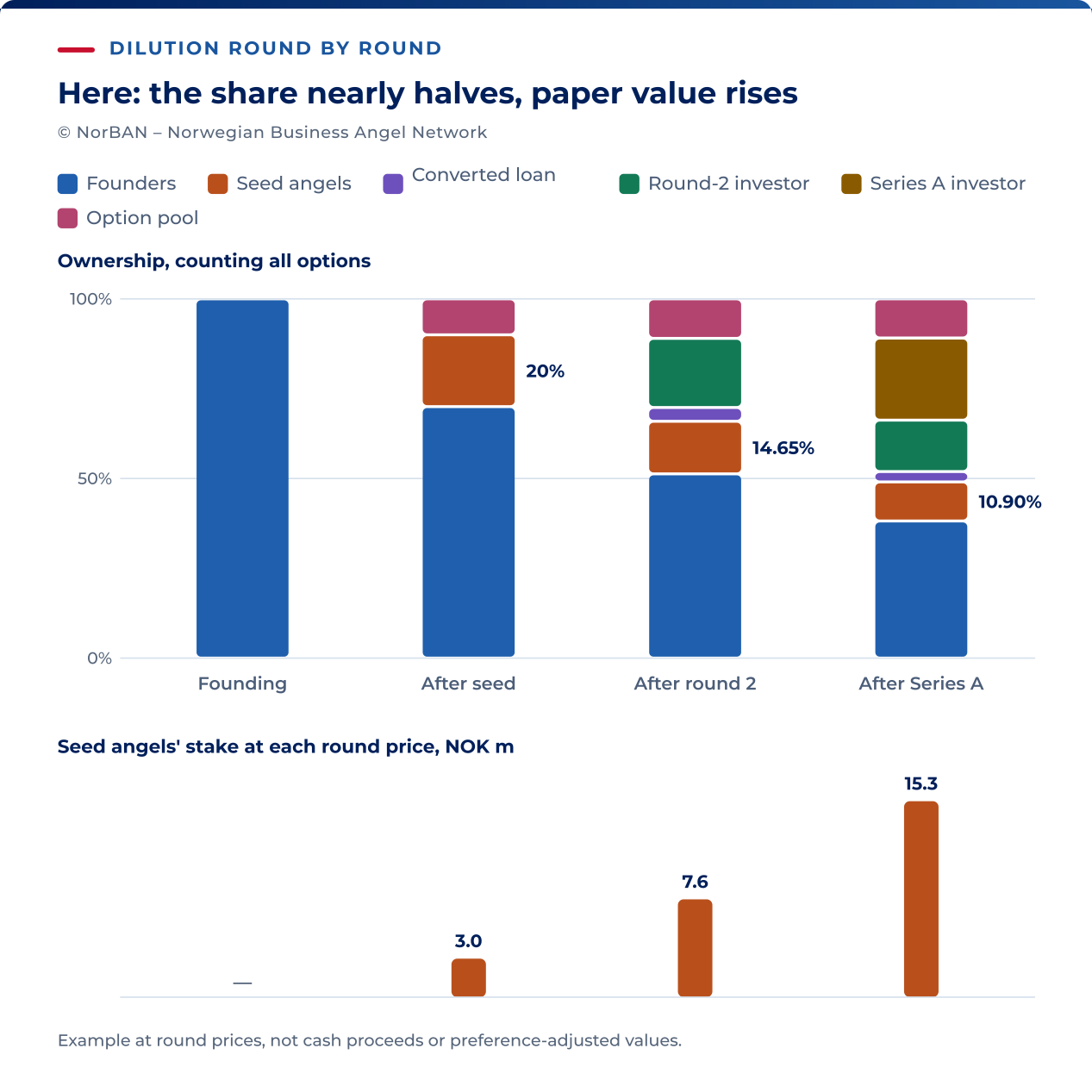
Between the first two rounds the company takes a convertible loan. Each 50,000-unit pool top-up enters the pre-money pricing count before the new investment. In round 2, the cap uses that same count of 1,050,000. Conversion shares themselves are excluded from the price denominator, so conversion dilutes the incoming investor too.
Keep those definitions explicit in the documents. These figures ignore interest and exercise proceeds; prices and theoretical fully diluted units are rounded for display, while percentages use exact values. An actual transaction needs a whole-unit implementation.
| Round | Pre-money (NOK m) | New money (NOK m) | Price (NOK) | New investor units | Other changes |
|---|---|---|---|---|---|
| Seed | 12 | 3 | 15.000000 | 200,000 | 100,000 pool units inside pre-money |
| Round 2 | 40 | 10 | 38.095238 | 262,500 | 52,500 conversion shares; 50,000 pool top-up inside pre-money |
| Series A | 108 | 32 | 76.325088 | 419,259.259 | 50,000 pool top-up inside pre-money |
Consider how both your percentage and the value of your holding change. The first angels’ percentage falls by nearly half across the two later rounds while the value of the position rises more than five times at the round prices.
| Holder | Founding | After seed | After round 2 | After Series A |
|---|---|---|---|---|
| Founders | 100% | 70% | 51.28% | 38.16% |
| Seed angels | — | 20% | 14.65% | 10.90% |
| Convertible holder | — | — | 3.85% | 2.86% |
| Round-2 investor | — | — | 19.23% | 14.31% |
| Series A investor | — | — | — | 22.86% |
| Option pool | — | 10% | 10.99% | 10.90% |
| Fully diluted units | 700,000 | 1,000,000 | 1,365,000.000 | 1,834,259.259 |
| Seed angels’ round-price value (NOK m) | — | 3.000 | 7.619 | 15.265 |
The dilution per priced round in the model, around 20 per cent, is a level a Norwegian investment partner, Lise Fulland, describes as ordinary and almost never exceeded by more than a few points.
Carta’s platform data, which is American, showed medians of about 20 per cent at seed and Series A in early 2024. Its founder ownership report put the median founder team at 56 per cent after seed and 36 per cent at Series A. Read those as the shape of the curve, and price a Norwegian round on its own facts.
Founders hold 38.16% after three rounds in this example. Discuss whether the remaining stake supports the team’s intended commitment; the percentage alone does not establish motivation. Include the planned pools and instruments when comparing offers.
Run the same model on any deal you are offered before you agree to a price. A forward cap-table and dilution model takes the pre-money, the round size, the pool and the convertible terms as inputs and produces these tables for the company in front of you.
The option pool in the model
An option pool is dilution you agree to in advance, and where the round creates it decides who pays. The seed round above, run both ways at the same pre-money and the same investor cash, gives different prices and different stakes.
| Pool created in the pre-money | Pool created after the round | |
|---|---|---|
| Pre-money | NOK 12 000 000 | NOK 12 000 000 |
| Investor cash | NOK 3 000 000 | NOK 3 000 000 |
| Price per share | NOK 15.00 | NOK 17.142857 |
| Founders | 700 000 shares, 70.0 % | 700 000 shares, 72.0 % |
| Investor | 200 000 shares, 20.0 % | 175 000 shares, 18.0 % |
| Pool | 100 000 shares, 10.0 % | approximately 97 222 units, 10.0 % |
| Fully diluted | 1 000 000 | approximately 972 222 |
For display, the post-round pool count is rounded and its percentages use the exact count; an actual issue needs an agreed whole-unit structure before the transaction can proceed.
A 10 per cent pool in the pre-money costs the founders two percentage points and leaves your 20 per cent untouched. It also means the stated NOK 12 million pre-money values the founders’ own holding at NOK 10.5 million, with the pool making up the rest.
Where the pool lands is negotiated in every round. Size it from the hiring plan to the next round, and check the tax scheme the options will be granted under, which the option-pool article covers.
Convertibles entering the table
A convertible loan converts at the lower of the discounted round price and the price implied by its valuation cap. Which one binds depends on how the round is priced, and the share count moves with it.
| Round pre-money | Round price (NOK) | Discount price | Cap price | Applied price | Lender units |
|---|---|---|---|---|---|
| NOK 40 million | 38.095238 | 30.476190 | 28.571429 | 28.571429 | 52,500.000 |
| NOK 30 million | 28.571429 | 22.857143 | 28.571429 | 22.857143 | 65,625.000 |
| NOK 20 million | 19.047619 | 15.238095 | 28.571429 | 15.238095 | 98,437.500 |
Compare the two prices. With the same denominator and a 20% discount, the NOK 30 million cap becomes the lower price above NOK 37.5 million pre-money; at that point they are equal. Once the cap binds, fixed principal converts into a fixed number of shares for that denominator. A higher round price increases their value, not their number.
In round 2 the incoming investor receives 19.23% after conversion. Founders fall from 70% to 51.28%, losing 18.72 percentage points or 26.74% of their former stake. These measures answer different questions; allocations to other holders are not founder percentage-point losses.
At the round price the fully diluted total is worth NOK 52 million: NOK 40 million of pre-money capitalisation, including the top-up, NOK 10 million of new investment and NOK 2 million assigned to conversion shares. The last includes NOK 1.5 million of principal and NOK 0.5 million of uplift; it is not new cash.
Break down every round in the same way before agreeing to it, and ask for every outstanding convertible’s principal, discount, cap and trigger in writing. Instrument terms and the choice between a priced round and a loan are covered in the instruments article.
The broken cap table
Some tables should stop a deal until they are fixed. Each pattern below is checkable from the documents you already have the right to see, and each is a negotiation with the existing holders before you can price the round.
| Pattern | What it looks like, and what it does to the round |
|---|---|
| Dead equity | A departed founder still holds a large block and does no work. Norwegian practice guards against it through founder vesting with good-leaver and bad-leaver pricing in the shareholders’ agreement, as Simonsen Vogt Wiig describe. Where no clause bites, the routes are a purchase by the other shareholders, the company’s own acquisition within the limits of aksjeloven chapter 9 (aksjeloven § 9-2), or redemption where the articles provide for it (aksjeloven § 12-7). All three have to be agreed or resolved before your money arrives. |
| Founders below a working stake | The founder team is already diluted to a level that two more rounds will take below anything that motivates. Your protection at the next round is the founders’ stake, so price this round with the model above and see where they land. |
| Unclear classes | Preference, voting or dividend rights that live only in a shareholders’ agreement. A class right binds the company only through the articles (aksjeloven § 4-1); anything else binds the signatories and nobody else. |
| Undocumented options and promises | Options in the table with no plan, no grant letters and no general-meeting authorisation behind them, or shares promised to an adviser and never issued. Each is either a future issue that dilutes you or a claim that surfaces at exit. |
| Earlier rounds at a lower price | A recent issue at a fraction of today’s price with nothing to explain the step. Either the earlier investor was under-priced or you are being over-priced. |
| Unwritten convertible claims | Money received as a loan with conversion terms agreed by e-mail or not at all. A convertible is a general-meeting decision that is notified to Foretaksregisteret (aksjeloven § 11-6); one with no paper is a dispute waiting for an exit. |
| Third-party rights the round triggers | Pre-emption, consent or anti-dilution rights held by existing shareholders or an earlier lender that your issue sets off. Read the articles and every earlier agreement for what a new issue triggers. |
| Table does not match the register | Any of the mismatches described above. Nothing prices until the register, the spreadsheet and Foretaksregisteret agree. |
How much of this work you do yourself depends on your experience and role.
- A first-time angel reconciles the table against the register and the public sources personally, because that is where the habit of reading a cap table is learnt.
- An experienced angel goes straight to the fully diluted count and the convertibles, and models the next two rounds before the first meeting about price.
- In a syndicate, one person builds the model and circulates it, so the group negotiates from the same table.