
What the instrument decides
Before any number is negotiated, the instrument settles what you will own on completion, when the price is fixed, and which part of the Companies Act (aksjeloven) governs the deal. Identify the instrument before reading the term sheet; its terms depend on the rights that instrument gives you.
| Instrument | What you hold on completion | When the price is set | Statute that governs it |
|---|---|---|---|
| New shares in a share issue (emisjon) | Newly created shares, registered in your name once the capital increase is registered. | Now, as the subscription price in the general meeting’s resolution. | Aksjeloven chapter 10 |
| Existing shares bought from a shareholder | Shares that already exist, transferred to you by a seller. | Now, in the share purchase agreement with the seller. | Kjøpsloven § 1 for the purchase; aksjeloven § 4-15 and following for the transfer |
| Convertible loan (konvertibelt lån) | A debt claim against the company, with a right to demand shares. | Later, derived from the next priced round through a discount and a valuation cap. | Aksjeloven chapter 11 |
| SLIP (Startup’s Lead Investment Paper) | A right to subscribe shares at nominal cost in a future share issue. No debt claim, no interest, no maturity. | Later, through a discount and a valuation cap. | Executed as a capital increase under aksjeloven chapter 10 when it converts |
New shares in a priced round are the standard where the parties can agree a price. Where they cannot, the SLIP is the standard deferred-pricing instrument at pre-seed, and it has displaced much of the convertible loan’s earlier use.
The convertible loan remains in use where a lender wants a debt claim, typically for a bridge. Simonsen Vogt Wiig record that US-style SAFEs appear occasionally, usually when US investors participate.
Buying existing shares is the exception in an angel deal. It happens when a founder or an early holder sells down, or when an investor takes a position in a company that is not raising, and the money goes to the seller rather than into the business.
New shares: the share issue (emisjon)
A priced round is a corporate act as much as a contract. The shares do not exist until the company creates them by a capital increase (kapitalforhøyelse), in a fixed sequence with fixed deadlines, and your ownership dates from the last step.
- The board proposes the increase with the supporting documents (aksjeloven § 10-3).
- The general meeting resolves it with two thirds of both the votes cast and the share capital represented, because the capital figure in the articles changes (§ 10-1 and § 5-18). The resolution states the amount or a band, the nominal value, the subscription price (emisjonskurs), who may subscribe, the subscription and payment deadlines, dividend rights and who covers the costs.
- Existing shareholders hold a pre-emptive right to subscribe pro rata in a cash issue (§ 10-4). A directed allocation to an incoming investor may require it to be set aside by the same two-thirds majority (§ 10-5).
- You subscribe, in the minutes or in a separate subscription document, and pay. The subscription deadline may run no longer than three months from the resolution (§ 10-1).
- The company files the increase with Foretaksregisteret within three months of the subscription deadline, with confirmation that payment has arrived (§ 10-9). Cash may be confirmed by an auditor, a bank, a lawyer or an accountant; a non-cash contribution or a set-off only by an auditor. Missing the deadline means the resolution lapses and the subscriptions cease to bind.
- The new shares confer shareholder rights from registration, unless the resolution provides otherwise (§ 10-11).
Two three-month periods run in sequence, so the outer limit from resolution to filing is about six months. Where the board acts under a standing authorisation (§ 10-14 and following), that authorisation must already be registered before the board can use it. A round that under-subscribes below the minimum the resolution set cannot be registered at all.
Never pay before the resolution exists. The subscription agreement (tegningsavtale) is the contract around the corporate act, and it cannot replace any step of it. The closing documents article takes the agreement clause by clause.
Buying existing shares
Buying from a shareholder is a purchase, and the Sale of Goods Act (kjøpsloven) applies to it. You have a seller to claim against, with statutory remedies underlying the terms of the share purchase agreement (aksjekjøpsavtale) says: complaint within reasonable time, price reduction, damages, and rescission for a material defect.
The Supreme Court has rescinded a share purchase where an undisclosed claim surfaced after completion.
Subscription in a share issue is not a purchase. There is no seller, the shares come into existence through the company’s own act under chapter 10, and once the increase is registered the capital-protection rules stand in the way of unwinding it. Your protection is the contract, and an omitted warranty is a risk with no statutory floor beneath it.
The duty to examine the shares creates a different risk for the buyer. A buyer cannot claim for defects they ought to have discovered, and that rule bites on a purchase of existing shares and not on a subscription. Diligence findings therefore have different consequences in the two structures.
The transfer itself runs through aksjeloven chapter 4. By default the company must consent to the acquisition, with consent deemed given after two months of silence (§ 4-15 and § 4-16), and the other shareholders hold a pre-emption right (forkjøpsrett) over shares that have changed hands (§ 4-19 and following).
Read the articles and the shareholders’ agreement before you sign, since either may have changed both defaults.
Buying existing shares also changes what your money can achieve. Your money leaves for the seller’s account and adds nothing to the company’s runway, so a purchase alone never funds the plan you are underwriting. Ask why the seller is selling, and at what price relative to the last round, before you ask anything else.
The convertible loan (konvertibelt lån)
A convertible loan has a statutory basis. Aksjeloven lets a company take up loans where the creditor may demand shares issued, and the decision belongs to the general meeting with the same two-thirds majority as an articles amendment (§ 11-1 and following). The resolution states the loan frame and the conversion terms.
- Existing shareholders hold a pre-emptive right to subscribe the loan itself, which the meeting can set aside by the same majority (§ 11-4).
- Once the amount the meeting fixed has been subscribed, the resolution must be notified to Foretaksregisteret without delay, stating the amount by which the share capital may rise and the deadline for demanding shares (§ 11-6). The statute sets no number of days.
- The meeting may authorise the board to resolve such loans within a frame (§ 11-8).
- Conversion is later executed as a registered capital increase under chapter 10, with everything that entails.
Norwegian guidance distinguishes a registered loan (ekte konvertibelt lån), which meets those form requirements and gives you a right to demand shares, from an unregistered one (uekte), which looks similar on paper but needs a fresh general-meeting vote before it can convert.
A chapter 11 loan gives the lender a right to convert within the resolution’s deadline, at most five years. The agreement can also require conversion at a qualifying round or maturity; have that mechanism drafted expressly. An ordinary loan promising later conversion needs a fresh capital-increase resolution, so check any voting undertakings as well.
The register shows that a convertible loan exists. It does not show the discount, the cap, the trigger or the holder, which live in the loan agreement and the minutes, so a company with instruments outstanding has to be asked for the documents.
Before the general meeting is called, check how the loan agreement sets the price, triggers conversion and deals with repayment.
Principal and ranking
What it does. The amount lent, and where the claim ranks. Angel convertibles are unsecured, and a public co-financier may require subordination to all other debt.
What to check. Whether the loan is secured on the company’s assets or intellectual property. Security you hold in a company that fails is rarely worth the fight for it.
Interest
What it does. Accrues on the principal and normally converts with it. Norwegian convertibles are typically referenced to NIBOR plus a margin.
What to check. Whether interest is paid in cash from a pre-revenue company, and whether you lend personally or through a holding company, which changes the tax on it.
Discount
What it does. The percentage below the next round’s price at which you convert. Norwegian guidance treats 20 per cent as customary.
What to check. That the discount and the cap apply as the lower of the two, and that the discount is stated against the round price rather than the pre-money.
Valuation cap
What it does. A ceiling on the valuation used at conversion, so a strong next round cannot price your early money at late-money levels. It is the term that decides your ownership.
What to check. Model the cap against the valuation you expect the next round to reach and read off the shares it gives you. A cap far above that valuation protects nothing.
Qualifying round
What it does. The financing that triggers conversion, defined by a minimum size.
What to check. That the round the company is planning would trigger it. A threshold set too high leaves the loan outstanding through a normal seed round.
Other triggers
What it does. A sale of the company, insolvency, maturity, and sometimes conversion at your discretion.
What to check. On a sale, whether you convert and share the exit or are repaid with a premium. Conversion is usually worth more.
Maturity and its fallback
What it does. What happens if no qualifying round arrives. The Norwegian default is repayment with interest.
What to check. A repayment claim against a company with no cash is a claim you will have to renegotiate. Automatic conversion at the cap gives you shares instead.
Conversion mechanics
What it does. Executed as a capital increase: resolution or registered board authorisation, subscription, confirmation and filing. Where the loan is set off against the subscription price, only an auditor may confirm it.
What to check. That the shareholders are bound in advance to vote the conversion through and the company to file it.
Why the SAFE sits awkwardly here
A US SAFE takes money now against a promise that the company will issue shares on the holder’s terms when a trigger fires, with no further corporate act. Norwegian company law blocks that at four points, each on its own.
- Only the general meeting can resolve a capital increase, or the board under an authorisation the meeting has resolved and that is registered before use (§ 10-1, § 10-14). No standing power to issue shares at will exists.
- The resolution must fix the price per share and the subscriber before anyone subscribes (§ 10-1). A SAFE defers both.
- The increase is effective only on registration, which requires confirmed payment and a filing inside the deadline (§ 10-9). Miss it and the resolution lapses.
- Money paid in before any resolution is not share capital. Turning it into shares later means a fresh cash subscription or a conversion of debt, which the resolution must say it is, with an auditor confirming any set-off.
The fourth point explains the Norwegian instruments. Money that arrives as a loan is something the statute recognises and chapter 11 regulates; money that arrives as an advance on shares is not. The SLIP takes the other route and plugs into chapter 10 as a subscription right.
The SLIP was created by Startuplab with the law firm SANDS and launched in April 2019 to make SAFE-like deferral work under Norwegian law. It gives you an irrevocable right to subscribe shares at nominal cost in a future share issue, triggered by a qualifying round above a stated size, by a corporate transaction, or, where agreed, at your discretion.
Its economic terms are a discount and a valuation cap. Norwegian guidance describes it as equity without a valuation, carrying no interest and no maturity. Startuplab withdrew its own convertible-loan template in May 2023 on the ground that the instrument was no longer relevant at that stage.
Keep the difference in mind when a US co-investor sends a document. Carta’s platform data, which is American, shows the US pre-seed default as a post-money SAFE with a cap and no discount. The Norwegian SLIP carries both, and a SAFE presented as standard in a Norwegian round is a document written for a different statute.
Choosing the instrument
Choose the instrument by considering when and by whom the price will be set, and what you will hold if the plan fails. Weigh these differences before negotiating the valuation.
| What you are weighing | New shares, priced now | Convertible loan or SLIP |
|---|---|---|
| The price | Settled in a negotiation you are part of, on the information available now. | Derived from a later round you may not be part of, bounded only by the cap and the discount. |
| Speed and cost | A general-meeting resolution, the closing documents and two registration deadlines before you own anything. | Fewer corporate steps now; the same capital-increase machinery at conversion, plus the loan’s own registration. |
| Dilution visibility | Your percentage is known on the day and reconcilable to the share register. | Your percentage is unknown until conversion, and every further instrument at the same cap takes another slice at the same low price. |
| Downside if no next round comes | You hold shares in a company that must find money or close. | A convertible loan matures into a repayment claim the company cannot meet; a SLIP has no maturity and sits outstanding. |
| What you hold in the meantime | Shareholder rights from registration: the general meeting, the share register, whatever the shareholders’ agreement adds. | A creditor’s position, or a subscription right. No vote, no shareholder standing until conversion. |
Price now when a price can be argued honestly, when the round is large relative to the company, or when you want the governance a shareholder has.
Defer when the amount is a genuine bridge to a round already in motion, when a pricing event lands inside months, or when the alternative is a valuation argument that neither side can support with evidence.
A deferred instrument is avoidance when the two sides simply disagree on the number. The disagreement returns at conversion with the cap standing in for the valuation nobody negotiated, and by then the money has been spent.
The instrument also determines the tax treatment, with particular consequences for a personal lender. Interest you receive on a loan to a company is taxed as general income, and interest above the rate Skatteetaten publishes for the purpose is additionally taxed under the rule for loans from personal taxpayers to companies, which brings it close to dividend levels.
A holding company lending instead is outside that rule. How accrued interest settled in shares is taxed is a question for your adviser before the rate is agreed.
The treatment of a loss is particularly important. Outside a business, a loss on a receivable is as a main rule not deductible, so a convertible lent personally and never converted gives no deduction when the company fails, while the same money contributed as share capital and lost would have. The tax article explains the treatment in detail.
If a convertible loan never converts, you may face three problems:
- No qualifying round takes place, leaving you with a repayment claim against a company with no cash.
- An unregistered loan needs a vote you may not win.
- Any loss is a loan loss rather than a share loss, with different tax treatment.
Negotiate a chapter 11 loan with an express mechanism for conversion at maturity within its five-year window. Confirm the tax consequences before lending or converting.
What the instrument means at the next round
A convertible enters the cap table only when it converts, and it converts at whichever of the discount price and the cap price is lower. The figures below are illustration, not a market benchmark.
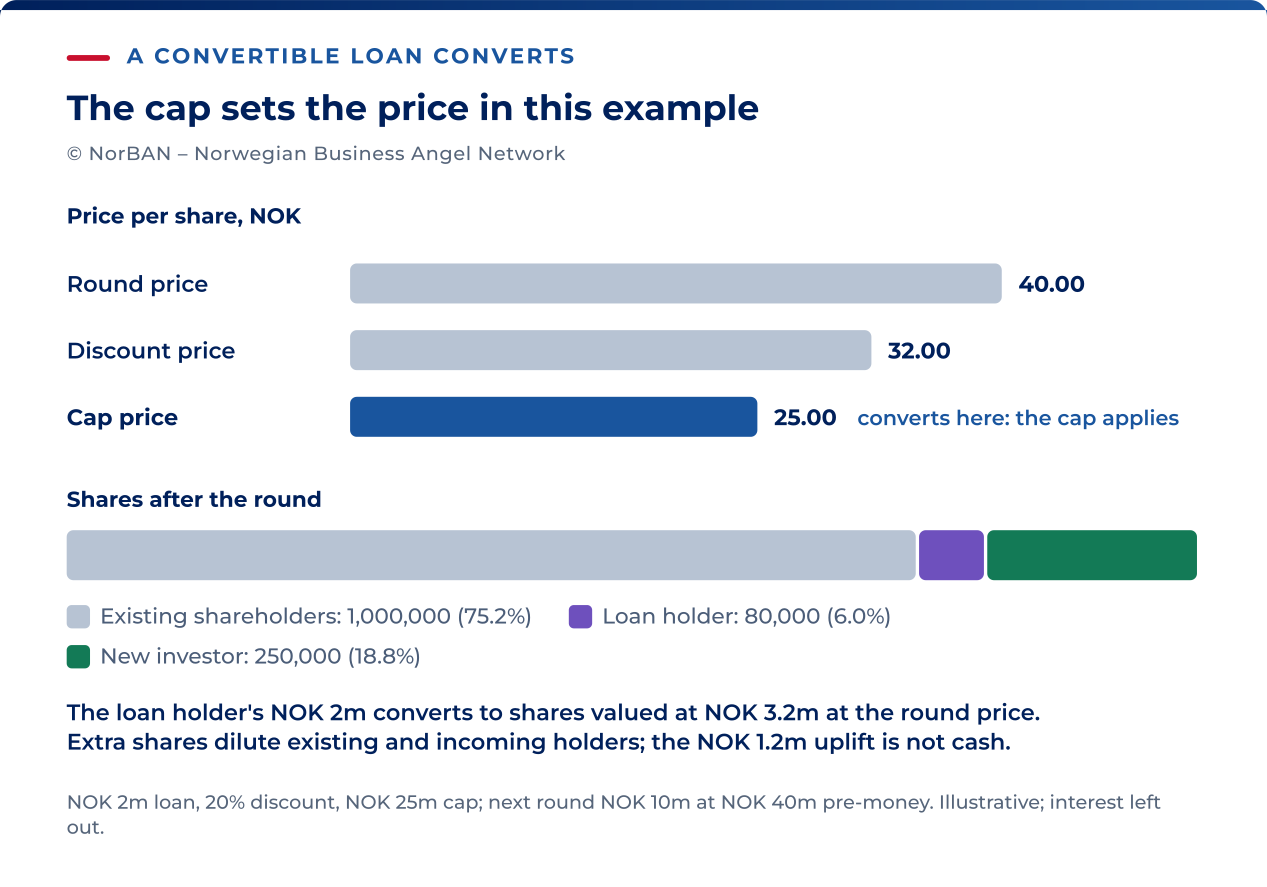
Take a company with 1,000,000 shares that raised NOK 2 million on a convertible loan at a 20 per cent discount with a NOK 25 million valuation cap, interest left out. A year later a new investor puts NOK 10 million in at NOK 40 million pre-money.
| Step | Figure |
|---|---|
| Round price per share | NOK 40,000,000 ÷ 1,000,000 = NOK 40.00 |
| Discount price | NOK 40.00 × 0.8 = NOK 32.00 |
| Cap price | NOK 25,000,000 ÷ 1,000,000 = NOK 25.00 |
| Conversion price | NOK 25.00, because the cap binds |
| Shares to the loan holder | NOK 2,000,000 ÷ 25 = 80,000 |
| Shares to the new investor | NOK 10,000,000 ÷ 40 = 250,000 |
| Loan holder after the round | 80,000 of 1,330,000 shares, 6.0 per cent, worth NOK 3.2 million at the round price |
At the round price, the loan holder’s NOK 2 million converts into shares valued at NOK 3.2 million. The NOK 1.2 million difference is a comparison at that price, not a cash payment. Under this example’s share-count assumptions, the extra conversion shares dilute both existing shareholders and the incoming investor.
Had the round been priced at NOK 30 million pre-money, the discount would have bound at NOK 24 and the same loan would have bought 83,333 shares. The better the next round, the more the cap is worth to you.
A fully diluted count that leaves out an unconverted instrument is wrong by the shares that instrument will take, and several instruments at the same cap take several slices at the same price. The cap-table article works through conversion across several rounds.