
Three clauses, one question
These clauses determine how an exit or a later financing affects your investment. The liquidation preference (likvidasjonspreferanse) answers it at exit, anti-dilution at a down round, pro-rata at the next round. All three are agreed in the term sheet and written into the closing documents, and they are read together because each one changes what the others are worth.
Where the clause is recorded determines whether it binds the company or only its signatories. Check that the proposed protections are in the right documents before agreeing a price.
| Clause | When it bites | Where it must be written to work |
|---|---|---|
| Liquidation preference | A winding-up, or a sale of the company | As a share class (aksjeklasse) in the articles of association (vedtekter) under aksjeloven § 4-1 for a winding-up; as a waterfall clause in the shareholders’ agreement for a share sale |
| Anti-dilution | A later round priced below yours | In the shareholders’ agreement, or as a term of the share class in the articles where the shares convert; delivered through a capital increase under aksjeloven chapter 10 when it triggers |
| Pro-rata | The next round | In the shareholders’ agreement. The statutory right in aksjeloven § 10-4 may be set aside for a directed allocation under § 10-5 |
All shares carry equal rights unless the articles create classes and state what separates them (§ 4-1). A dividend or liquidation preference is therefore a class right, and a preference written only into the shareholders’ agreement does not bind the company.
The articles reach only as far as the company’s own distributions. On a winding-up the surplus is distributed under chapter 16 and the class right governs it. On a sale of the shares the buyer pays the sellers, and the articles cannot allocate a third party’s purchase price.
The distribution of sale proceeds must be set out in a waterfall clause in the shareholders’ agreement, usually alongside the drag-along. It binds only the parties to that agreement.
A preference you want to hold at a trade sale therefore needs both documents. Read the term sheet for the commercial terms and then check that the articles and the shareholders’ agreement each carry their half.
Liquidation preference (likvidasjonspreferanse) in numbers
A non-participating preference is an election. At exit you take either your investment back or your as-converted share of the proceeds, whichever is larger. A participating preference takes the investment back first and then shares the remainder as well.
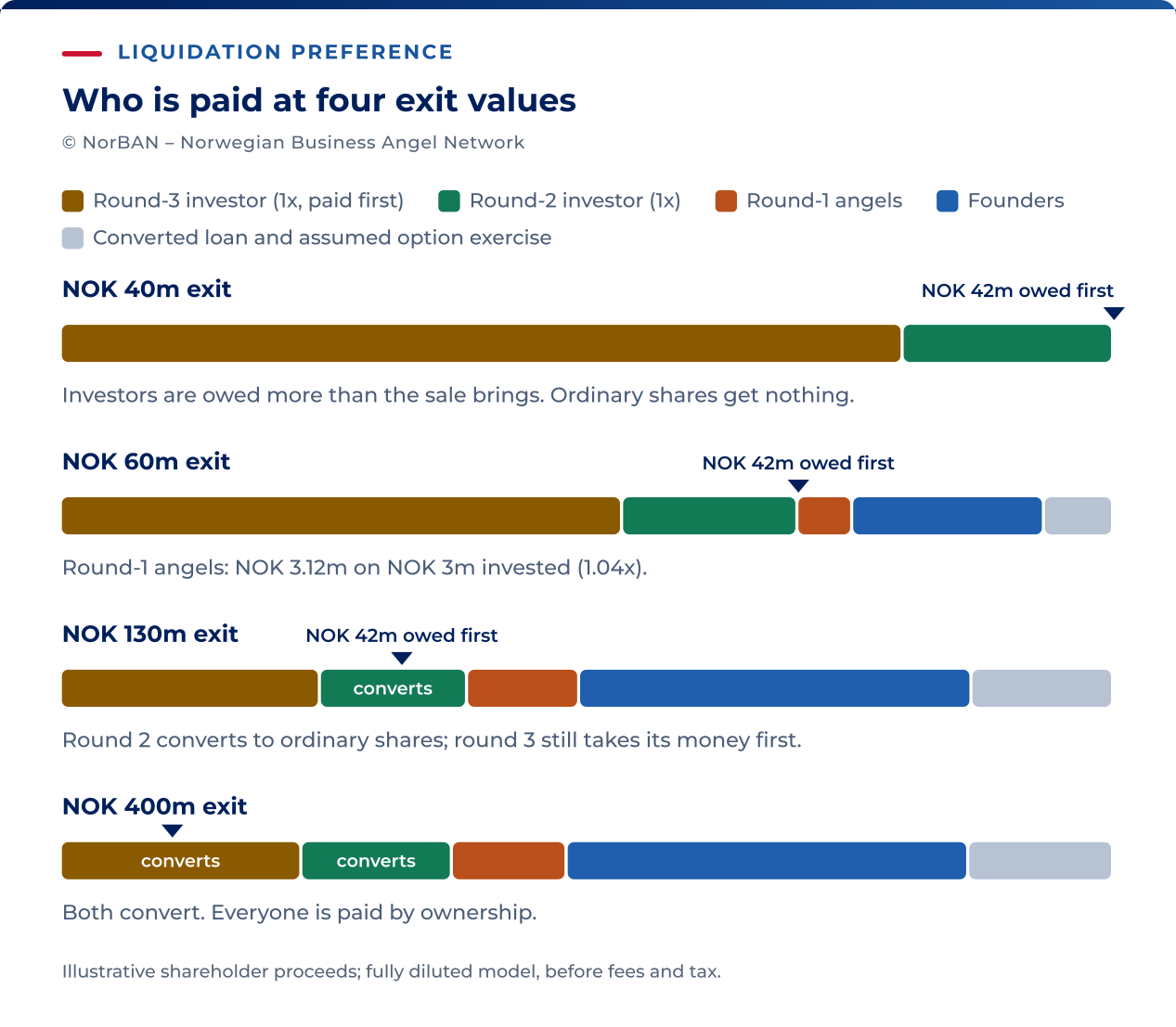
The worked examples use Nordvind AS after three rounds, with pool top-ups included in pre-money pricing. The figures are illustrations, with theoretical units rounded for display. Options participate at zero exercise price, and the round-three preference is senior to round two. Exit values are distributable equity proceeds before fees and tax.
| Holder | Fully diluted units | Ownership | Invested | Preference |
|---|---|---|---|---|
| Founders | 700,000.000 | 38.16% | none | none |
| Round-1 angels | 200,000.000 | 10.90% | NOK 3 million | none |
| Convertible holder | 52,500.000 | 2.86% | NOK 1.5 million | none |
| Round-2 investor | 262,500.000 | 14.31% | NOK 10 million | 1x non-participating |
| Option pool | 200,000.000 | 10.90% | none | none |
| Round-3 investor | 419,259.259 | 22.86% | NOK 32 million | 1x non-participating, senior |
| Total | 1,834,259.259 | 100% | — | Stack NOK 42 million |
The preference stack is NOK 42 million. As a first-round angel, pay particular attention to how much remains for you at each exit value.
| Equity exit (NOK m) | Round-3 investor | Round-2 investor | Round-1 angels | Founders |
|---|---|---|---|---|
| 40 | NOK 32,000,000 | NOK 8,000,000 | NOK 0 | NOK 0 |
| 60 | NOK 32,000,000 | NOK 10,000,000 | NOK 3,123,644 | NOK 10,932,755 |
| 130 | NOK 32,000,000 | NOK 18,180,212 (converts) | NOK 13,851,590 | NOK 48,480,565 |
| 400 | NOK 91,428,571 (converts) | NOK 57,243,816 (converts) | NOK 43,614,336 | NOK 152,650,177 |
At NOK 60 million the senior investor takes NOK 32 million. If the round-two investor converted, its allocation from the remaining NOK 28 million would be NOK 5,194,346, below its NOK 10 million preference. It therefore takes that preference, leaving NOK 18 million for the remaining 1,152,500 units.
The seed angels receive NOK 3,123,644, or 1.04 times their investment. The payout reflects the preferences as well as their ownership percentage.
The first angels hold 10.90% after the higher-valuation round. At the NOK 60 million exit, the preferences leave them with only a small gain on their NOK 3 million investment.
On these assumptions, the round-two holder converts above approximately NOK 85.90 million of exit proceeds while the senior holder takes its preference. The round-three holder converts above NOK 140 million. Check each election against the other holder’s treatment, rather than comparing its percentage with the whole exit in isolation.
At the NOK 130 million exit, making both preferences participating transfers about NOK 24.53 million from the ordinary holders to the two preference holders.
| Holder | Both non-participating (NOK) | Both participating (NOK) | Change (NOK) |
|---|---|---|---|
| Round-3 investor | 32,000,000 | 52,114,286 | 20,114,286 |
| Round-2 investor | 18,180,212 | 22,593,640 | 4,413,428 |
| Founders | 48,480,565 | 33,583,039 | -14,897,527 |
| Round-1 angels | 13,851,590 | 9,595,154 | -4,256,436 |
| Convertible holder | 3,636,042 | 2,518,728 | -1,117,314 |
| Option pool | 13,851,590 | 9,595,154 | -4,256,436 |
In this comparison both preferred classes participate. That reduces the seed angels’ proceeds by about NOK 4.26 million. Check precisely which classes receive participation when assessing the cost of the terms a later lead proposes.
Preference stacks across rounds
Seniority decides the order among preference holders when the exit is below the stack. It changes nothing for the ordinary shares.
| Exit NOK 40,000,000 | Round 3 senior to round 2 | Round 2 and round 3 pari passu |
|---|---|---|
| Round-3 investor | NOK 32,000,000 | NOK 30,476,190 |
| Round-2 investor | NOK 8,000,000 | NOK 9,523,810 |
| Founders, angels, convertible holder, pool | NOK 0 | NOK 0 |
Pari passu is the term to ask for when a later round comes in above you and you hold a preference. Where you hold ordinary shares, the question is the size of the stack, and every round adds to it.
Anti-dilution, worked
Anti-dilution adjusts your position when a later round is priced below yours. In converting preferred shares it lowers the price at which your shares convert. The broad-based weighted-average formula, as published in the VIMA model documents of the Singapore ecosystem, is CP2 = CP1 × (A + B) ÷ (A + C).
- CP1 is the conversion price before the new issue, CP2 the price after it.
- A is the number of shares outstanding before the new issue. Broad-based counts every ordinary share, every preferred share as converted and every option as exercised.
- B is the new money divided by CP1, the shares the round would have issued at your price.
- C is the number of shares the round actually issues.
Full ratchet resets CP2 to the new round’s price outright. Narrow-based counts only outstanding shares in A, which moves the result towards the ratchet.
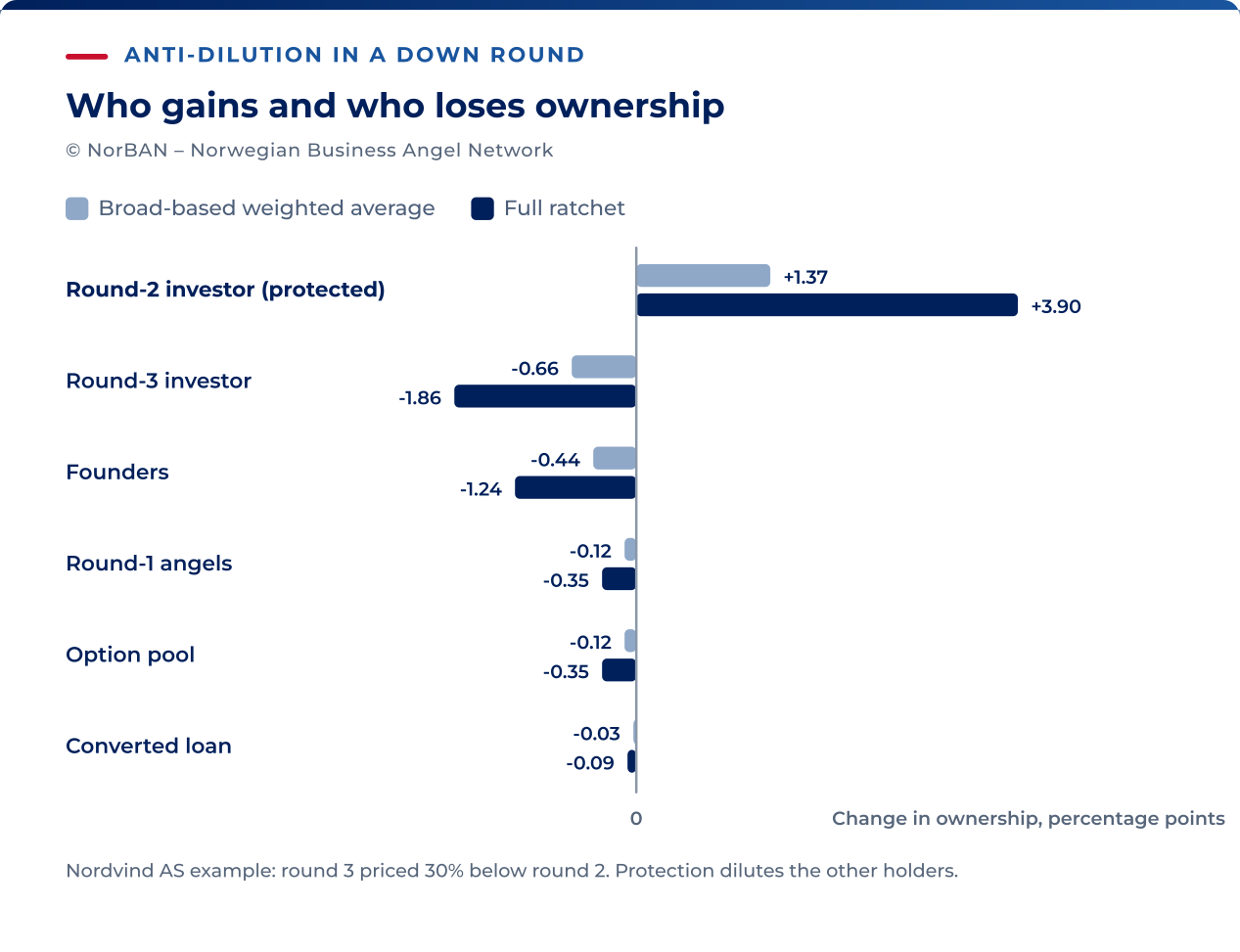
Keep NOK 28 million of new money and the original 30% fall from the round-2 price. The new price is NOK 26.666667 and the investor receives 1,050,000 units. Include the same 50,000-unit pre-money pool top-up used in the higher-valuation case.
For the broad-based weighted-average illustration, A is 1,415,000 units before the new money; B is NOK 28 million divided by the old price, or 735,000; and C is the 1,050,000 units issued. The adjustment is old price × (A + B) ÷ (A + C), giving NOK 33.227084.
The protected NOK 10 million position becomes 300,959.302 units, an increase of 38,459.302 over 262,500. Full ratchet gives 375,000 units at the new round price, an increase of 112,500. These are economic equivalents; the agreed clause and corporate steps determine how any adjustment is delivered.
| Holder | No protection | Weighted average | Full ratchet |
|---|---|---|---|
| Founders | 28.40% | 27.96% | 27.16% |
| Round-1 angels | 8.11% | 7.99% | 7.76% |
| Convertible holder | 2.13% | 2.10% | 2.04% |
| Round-2 investor | 10.65% | 12.02% | 14.55% |
| Round-3 investor | 42.60% | 41.94% | 40.74% |
| Option pool | 8.11% | 7.99% | 7.76% |
| Total units | 2,465,000.000 | 2,503,459.302 | 2,577,500.000 |
| Total ownership | 100.00% | 100.00% | 100.00% |
The adjustment reduces every unprotected holder’s percentage. Compare the additional allocation under each formula and the document’s actual delivery mechanism before agreeing to the clause.
In an ordinary-share round there is no conversion price to reset. Norwegian practice delivers the same economics by issuing the extra shares at nominal value, or by granting subscription rights (tegningsretter) for them at the round, through a capital increase when the trigger fires.
The Norwegian true-up variant
One structure used in Norwegian angel rounds delivers the protection as a time-limited true-up. A placement inside a set window after completion at a price more than a stated percentage below yours gives you extra shares at nominal value. In this illustration the nominal payment leaves your effective price slightly above the later placement price.
| Step | Figure |
|---|---|
| Angels subscribe | NOK 3,000,000 at NOK 15.00 = 200,000 shares |
| Two months later, a placement at | NOK 10.50, 30 per cent lower and past a 20 per cent trigger |
| Shares NOK 3,000,000 buys at that price | 285,714 |
| Extra shares to the angels at NOK 0.10 nominal | 85,714, for NOK 8,571 |
| Effective price paid | NOK 10.53 |
The illustration approximates a full-ratchet adjustment within two limits: a window of months and a percentage trigger. Unlike a weighted-average adjustment, it aims to match the lower price, but the nominal payment creates a small difference. Check the actual formula and expiry; the heading “anti-dilution” does not specify them.
Broad-based weighted average is the most common formula in Norwegian venture rounds, and unlike the preference it is negotiated between the company and the lead each time. At angel stage the protection is variable, and the true-up and the subscription right are the forms you will meet more often than a conversion-price reset.
Pro-rata: keeping your percentage
Existing shareholders hold a statutory pre-emptive subscription right (fortrinnsrett) to new shares in a cash issue, pro rata to their holdings (aksjeloven § 10-4). The general meeting sets it aside by the articles-amendment majority (§ 10-5), where the proposed allocation requires it; transferred subscription rights can offer another route.
Your pro-rata right therefore lives in the shareholders’ agreement, and in Norwegian venture practice it is granted to all investors whatever their share class.
Take the Nordvind angels before round 2, holding 200,000 of 1,000,000 units. The 50,000-unit pool top-up enters the pre-money denominator. The round issues 262,500 new shares at NOK 38.095238 and converts the loan into 52,500 shares, ending at 1,365,000 units. Any angel subscription below replaces part of the lead’s allocation within the same NOK 10 million round.
| Choice | Shares subscribed | Cash (NOK) | Shares held | After round 2 |
|---|---|---|---|---|
| Decline | 0 | 0 | 200,000 | 14.65% |
| Take 20% of new shares | 52,500 | 2,000,000 | 252,500 | 18.50% |
| Maintain 20% of the post-round total | 73,000 | 2,780,952 | 273,000 | 20.00% |
Taking 20% of the new shares leaves the angels at 18.50%, about 1.50 percentage points short of their former holding. Maintaining 20% requires another 20,500 shares and about NOK 780,952 beyond that subscription. Conversion and the pool top-up account for the difference.
A right intended to maintain ownership needs to address the post-round fully diluted total and the allocation available to existing holders. Here, the lead gives up about NOK 2.781 million of its NOK 10 million allocation. A right covering only new cash shares does not cover the other dilution.
At round 3’s price of NOK 76.325088, the 273,000-share position is worth about NOK 20.837 million on NOK 5.781 million invested. Declining the subscription leaves 200,000 shares worth about NOK 15.265 million on NOK 3 million invested. These are round-price values, before any preference waterfall, fees or tax.
The extra NOK 2.781 million buys shares worth about NOK 5.572 million at the round-3 price. With no further subscription, the angels’ holding then falls to 14.88%. A pro-rata right provides an opportunity to invest; exercising it in one round does not protect against dilution in later rounds.
How the clauses price each other
The valuation and the preference together determine the effective price. Compare two packages for the same NOK 10 million investment, one round, no later rounds.
| Exit value | NOK 40 million pre-money, 1x participating (20.0%) | NOK 30 million pre-money, 1x non-participating (25.0%) |
|---|---|---|
| NOK 60,000,000 | NOK 20,000,000 | NOK 15,000,000 |
| NOK 100,000,000 | NOK 28,000,000 | NOK 25,000,000 |
| NOK 160,000,000 | NOK 40,000,000 | NOK 40,000,000 |
| NOK 300,000,000 | NOK 68,000,000 | NOK 75,000,000 |
With the stated assumptions, both packages pay the investor the full available amount at exits up to NOK 10 million. Above NOK 10 million and below NOK 160 million, the participating package pays the investor more and leaves the founders less. The packages are equal at NOK 160 million; above that, the non-participating package pays the investor more. A higher headline valuation therefore does not necessarily give the founders a better outcome. Compare the actual payouts at the exit values you consider plausible.
Assess preference terms both as an incoming investor and as a holder facing later rounds. In the Nordvind comparison, making both later preferred classes participating reduces the seed angels’ proceeds by about NOK 4.26 million at a NOK 130 million exit. Participation and seniority are separate terms; check both when comparing offers.
Anti-dilution runs the same way. A high price defended by a ratchet moves the correction to the down round, when the founders’ motivation is the asset being financed and your protected position is the thing diluting them.
What is standard here
Preference shares are the standard in Norwegian venture rounds with an institutional lead, and the standard preference is 1x non-participating, as Simonsen Vogt Wiig record it. Angel rounds are often plain ordinary shares, with a cap on the price and a true-up in place of a preference. Read each clause against this table.
| Clause | Expect | Aggressive | Refuse, or price as a price increase |
|---|---|---|---|
| Liquidation preference | Ordinary shares in an angel round. 1x non-participating where preference shares are used. | A participating 1x preference, which occurs but less often. | Multiples above 1x. A preference written into the shareholders’ agreement only, with no class in the articles. |
| Seniority | Pari passu among preference holders, or a later round senior to an earlier one. | A later round senior to you where you hold a preference. | A stack that already exceeds the exit value you are underwriting. |
| Anti-dilution | Variable at angel stage. Broad-based weighted average, or a share true-up or subscription right in an ordinary-share round. | Narrow-based weighted average. A true-up with a long window. | Full ratchet without a window. |
| Pro-rata | A contractual right for all investors, drafted against the post-round fully diluted table. | A right limited to your share of the new shares. | No right, or a right the lead can waive alone. |
| At exit | A drag-along in the shareholders’ agreement, with the waterfall beside it. | A drag with no allocation mechanism. | A drag that binds you to a per-share price before the waterfall has been run. |
The per-share price in a drag notice does not by itself tell you what each holder receives. Preference holders choose between their preference and what they would receive on an as-converted basis.
Before you are dragged, ask for the allocation computed on the offer price and check it against the crossover points above. The drag itself and the same-terms rule belong to the exits article.