
The offer arrives
A trade sale is the route that returns money to a Norwegian angel. By the time you hear of one, the buyer has usually been talking to the founders and the board for weeks.
You enter the process when the shareholders’ agreement (aksjonæravtale) says you must be told, and aksjeloven does not move that moment forward. Its notice duties attach to a completed acquisition, running from the acquirer to the company (§ 4-12) and from the company to the holders of a pre-emption right (§ 4-20).
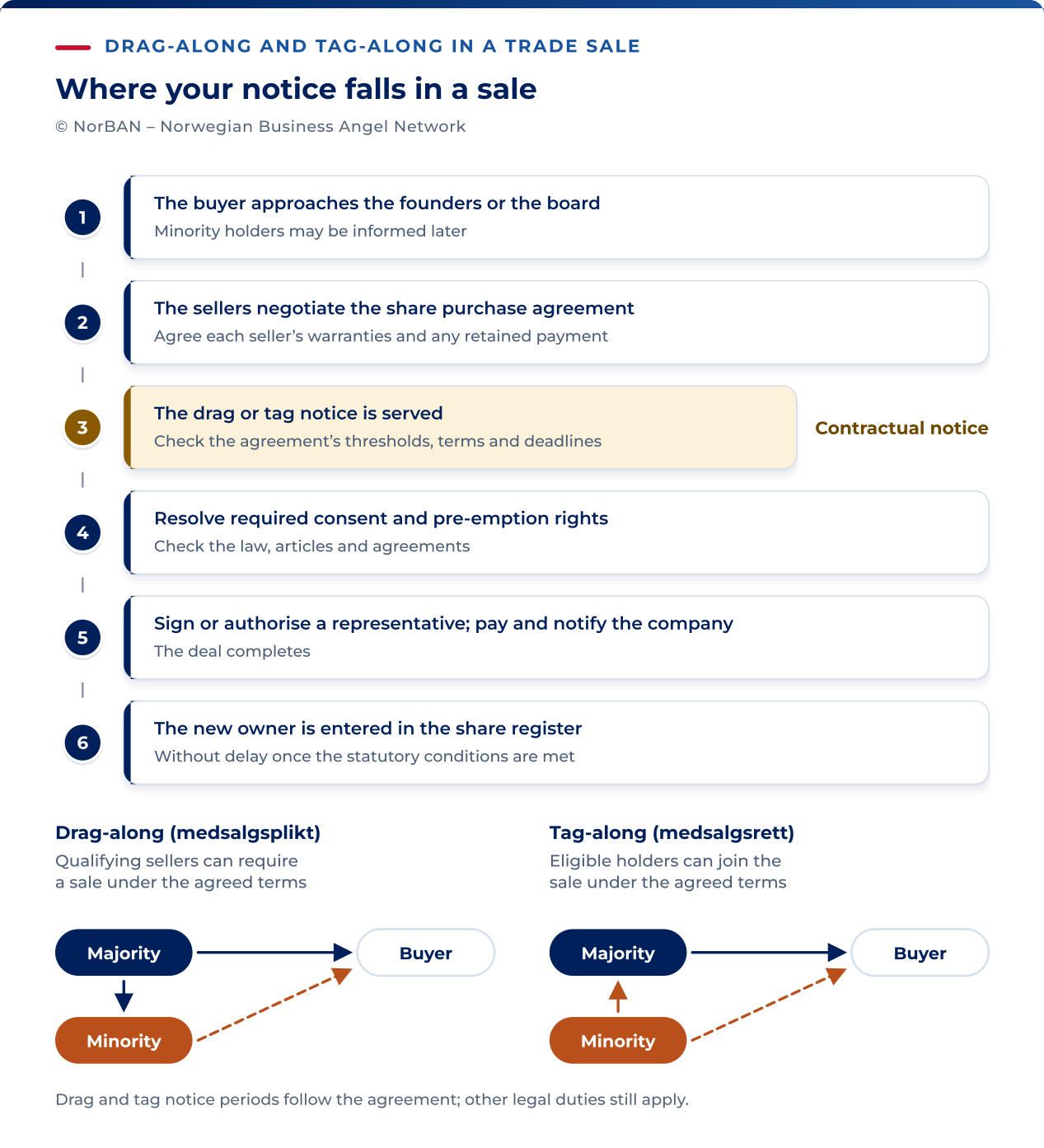
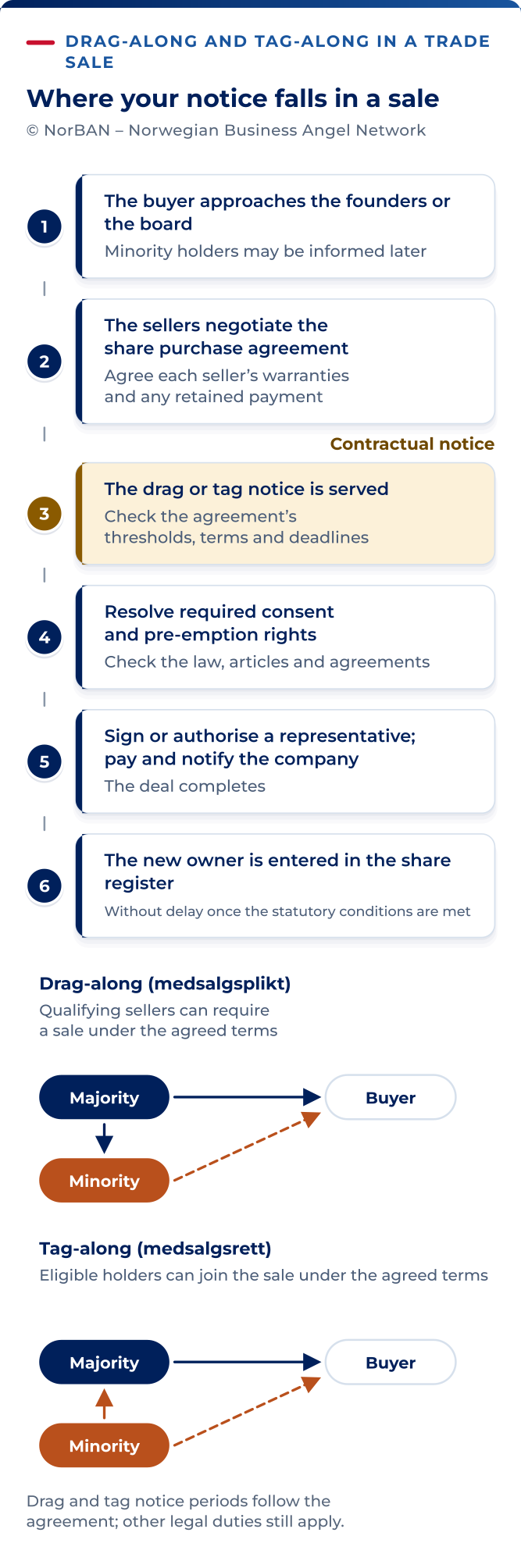
A seller owes co-shareholders no statutory warning before a sale, no notice period and no particular content. The agreement therefore determines the notice you receive under a drag-along (medsalgsplikt) or a tag-along (medsalgsrett). The sequence below is an example; the agreement and the required clearances determine the actual timetable.
- The buyer approaches the founders or the board. A minority holder usually hears nothing.
- The selling majority, often with the lead investor, negotiates the share purchase agreement, with the warranties and escrow every seller will be asked to sign up to.
- The majority serves the drag or tag notice in the form and within the time the agreement prescribes. Your process starts here.
- The board consents to the acquisition under aksjeloven § 4-16 unless the articles have removed the requirement, and any pre-emption right is waived on the record.
- Every seller signs, the buyer pays, and the company is notified of the transfer under aksjeloven § 4-12.
- The board enters the new owner in the share register (aksjeeierbok) immediately under aksjeloven § 4-7 and dates the entry.
Record the contractual deadlines as soon as notice arrives. For the statutory consent and pre-emption periods, record when the company received the relevant acquisition notice; signing alone is not a reliable starting date.
| Deadline | What runs, and from when |
|---|---|
| Exercising a tag, responding to a drag | The agreement sets the period and the form. Aksjeloven sets nothing. |
| Board consent | Consent is deemed given if the acquirer has not been notified of a refusal within two months of the company receiving notice of the acquisition, under aksjeloven § 4-16. |
| Pre-emption | The company notifies the rights holders immediately on receiving notice of the transfer, and the right normally lapses two months after the company received notice of the change of ownership, under aksjeloven § 4-20 and aksjeloven § 4-23. |
| Challenging a general-meeting resolution | Normally three months after the resolution; for a resolution outside a meeting, from dispatch of the minutes. Statutory exceptions apply, under aksjeloven § 5-23. |
| A redemption action | The action must be brought within a reasonable time, under aksjeloven § 4-24. |
Drag-along (medsalgsplikt): who triggers it, and on what
A drag lets holders of a stated share of the equity require every other shareholder to sell into the same transaction. In Norwegian venture practice the threshold sits between 50 per cent and two-thirds of the aggregate equity, as Simonsen Vogt Wiig describe for Chambers.
British practice commonly sets it at 75 per cent or more, and an agreement drafted from a British template carries that figure and the rest of the British package with it. Read the threshold before anything else.
The clause binds the parties and later holders who accede to it. A breach of the shareholders’ agreement does not by itself make a transfer invalid under company law, but other grounds may affect validity. Require the buyer to accede where the agreement calls for it, and check the consequences of a breach.
Putting a drag-along in the articles raises a different question from agreeing one in a shareholders’ agreement. The statutory rules on consent, holder qualifications and pre-emption in §§ 4-16–4-19 do not provide a ready-made drag-along clause.
Do not infer either that every such articles clause is prohibited or that an ordinary majority can impose it. Its legal effect and the consents needed depend on the proposed obligation and the existing rights.
A contractual drag binds the parties who accept it; it does not by itself bind a non-party through a corporate majority vote. Putting a drag in the articles raises a separate question about the clause’s legal character and the consent required under aksjeloven § 5-20. Do not assume every drag is statutory compulsory redemption.
Ordinary amendments to the articles require the two-thirds majorities in § 5-18; §§ 5-19 and 5-20 impose stronger requirements for specified changes. Have counsel classify the proposed drag and obtain the necessary consents before inserting it into existing articles.
Our practical recommendation is to agree the drag expressly with the shareholders it is intended to bind and require accession by new owners. Have any proposed articles clause assessed separately. Avtaleloven § 36 provides a fairness assessment; it does not prescribe a voting threshold. Negotiate the following protections explicitly.
- The same price per share and the same terms for every seller, which is the fairness expectation read into a drag and the one condition every clause should state expressly.
- Warranty liability that is several, each seller for its own share and capped at its share of the consideration.
- Escrow or holdback on the same terms and pro rata with the majority’s.
- Any earn-out on the same economic terms as the majority’s.
- No personal non-compete on a shareholder who is a pure investor.
Negotiate each condition expressly; the wording of your clause determines your obligations.
Tag-along (medsalgsrett): making the right work
A tag is the mirror of the drag. When holders of the stated share agree to sell, you may join on identical terms, and the buyer who wants the majority’s shares takes yours with them. Without a tag you can be left holding an illiquid position in a company whose new owner did not choose you.
The clause determines whether you may sell all your shares or only a proportion matching the majority’s sale. If the buyer is acquiring less than the whole company, that wording determines how much you can sell.
The notice that opens the right is contractual, and aksjeloven gives you no statutory right to hear of a sale in advance. So the clause has to say who tells you, in what form, within how long of the buyer’s offer, and how long you have to reply.
A clause saying only that the seller shall notify the other shareholders has left the period and the form to argument. On the day the notice arrives, work in this order.
- Read the tag clause and the drag clause together, and check the seller’s holding against the threshold, because the holding that triggers one usually triggers the other.
- Find the exercise deadline and the required form, and diarise the deadline a week early.
- Reply in writing, within the period, electing to sell all the shares the clause allows.
- Ask for the share purchase agreement, so you know what “identical terms” attaches to before the deadline passes.
The statutory pre-emption right (forkjøpsrett) is a different mechanism and arrives later, over shares that have already changed owner. A tag protects you before the sale.
Equal terms, and what has to be equal
The buyer’s allocation statement shows the price per share. To establish whether the terms are equal and what you will receive net, check the other obligations you are asked to accept.
Aksjeloven addresses none of those terms. The controls are the agreement’s own equal-terms condition, avtaleloven § 36 for a term that works out unreasonably, § 38 or employment law for a restraint, and the unwritten duty of loyalty between shareholders.
The statute supplies no standard drag-along terms. General protections, including the contractual fairness assessment under avtaleloven § 36 discussed below, still matter. Compare the proposed terms with the majority’s position before signing.
| Term | What to insist on as a dragged seller |
|---|---|
| Price per share | The same price per share as the majority, in the same form of consideration. Where the round carried a liquidation preference, the waterfall sets the per-share figure, and the preference article shows how. |
| Warranties, and who gives them | Those who ran the business give the business warranties. A dragged investor warrants title to its own shares and its capacity to sell them, and the clause should say so. |
| Liability cap | Several liability, capped at your own share of the consideration. Joint and several liability is enforceable in principle but at higher risk of revision under avtaleloven § 36 where it exposes a small holder to a loss out of proportion to its proceeds. |
| Escrow and holdback | The same percentage, the same release conditions and the same release dates as the majority’s, pro rata to your proceeds. |
| Earn-out | The same economic terms as the majority. A structure that defers only the minority’s money is exposed under avtaleloven § 36. |
| Non-compete and continuing obligations | None, for a shareholder who is a pure investor. A restraint on a seller is tested under avtaleloven § 38, and where the person is also an employee it may fall under arbeidsmiljøloven kapittel 14 A. It is the most vulnerable element in any drag clause and the first to strike. |
The best time to negotiate these protections is when the agreement is drafted, which the clause-by-clause article covers.
The clauses standing in the way
Check how these provisions affect the timing of a sale:
- Exercise drag and tag rights at the time and in the manner the agreement requires.
- Resolve consent and pre-emption in the transaction timetable; do not assume signing alone starts or ends the statutory periods.
- A lock-up can prevent a sale unless an exception applies. Check whether the agreement gives the drag priority.
Under aksjeloven § 4-15 an acquisition is conditional on the company’s consent unless the articles waive the requirement, and on a sale of the whole company someone is still acquiring shares. In a drag the board is normally in the room and resolves consent at closing.
Under § 4-19, the statutory pre-emption right concerns shares that have changed owner. Even on a sale of the whole company, check who holds rights at the relevant time and document any necessary waivers. Do not assume the drag clause itself extinguishes pre-emption. On a partial sale, address the remaining holders’ rights explicitly.
Both defaults can be removed in advance in the articles, since § 4-15 and § 4-19 each apply unless the articles provide otherwise. An advance waiver in the agreement binds as a contract and leaves the corporate step in place, so the waivers are still collected at closing.
Without prior arrangements, consent and pre-emption may delay completion. The full statutory periods need not always elapse: an express consent decision and valid waivers can resolve the issues sooner.
What a dragged minority can actually do
A dragged shareholder has limited grounds for challenge. A drag is governed by the general rules on transfer restrictions in aksjeloven §§ 4-15 to 4-23 and § 5-20 and, for the contractual clause, by avtaleloven § 36 and § 38.
The first ground is the clause’s own conditions. A threshold not reached, a notice served late or in the wrong form, or terms that differ from the majority’s are breaches of contract, and the remedy is whatever the agreement provides. Check these requirements promptly against the notice and sale documents.
The second is unreasonableness. A pre-agreed term or price that works out unreasonably can be set aside or revised under § 36, and an unwritten duty of loyalty between shareholders limits how a majority may exercise a drag.
A contract cannot replace a corporate consent required by mandatory law. Whether an advance promise to give that consent is enforceable, and with what remedy, needs advice on the clause itself. Review the terms under § 36 without assuming that every advance undertaking is void.
In HR-2025-251-A the Supreme Court set aside a settlement in which two founders cut four co-founders’ buy-out price to 30 per cent while withholding an imminent sale at double the valuation behind it. That dispute was a founder buy-out rather than a drag, but it shows § 36 working on exit terms.
The third ground is company law. Equal treatment under aksjeloven § 4-1, the abuse provisions in § 5-21 for the general meeting and § 6-28 for the board, and the three-month suit deadline in § 5-23 all attach to a corporate act.
Those company-law rules are not a general guarantee that every seller in a private share sale receives the same price. Identify the relevant company decision or right before relying on them. Contractual obligations and the duty of loyalty still need separate assessment.
The fourth is redemption (innløsning), and it answers a different problem. Under aksjeloven § 4-24 a shareholder may sue for the company to redeem their shares where weighty grounds support letting them leave, on one of three bases.
| Basis for a redemption claim | What it requires |
|---|---|
| Conduct by the company’s organs | A company organ, or someone representing the company, has acted contrary to aksjeloven § 5-21 and § 6-28, under aksjeloven § 4-24. |
| Misuse of influence | Another shareholder has misused their influence in the company, under aksjeloven § 4-24. |
| A serious and lasting conflict | A serious and lasting conflict has arisen between the shareholder and other shareholders over the running of the company, under aksjeloven § 4-24. The preparatory works read “serious” as deep-seated and “lasting” as more than transient. |
The court must refuse redemption where it would cause material harm to the company’s business or otherwise be unreasonable towards it, and the company can defeat the claim by naming someone willing to buy the shares at no less than the redemption sum.
The price is the shares’ actual value (virkelig verdi), which on this route means a proportionate share of the company’s underlying value with no minority discount. It takes a writ, a judgment and a valuation.
A shareholder being dragged is about to be bought out anyway, at a price the clause fixed as equal to the majority’s. If your objection is to the sale itself, the signed agreement limits your negotiating position. Ask counsel to focus on compliance with the clause and on unreasonableness.
Running the process from the minority seat
Work through the checklist in order, because the deadlines at the top are the ones that lapse.
Read first, the same day.
- The drag and tag clauses, the threshold, and the notice provisions, including the period and form your reply must take.
- The articles, for whether consent and pre-emption have been removed or still run at completion.
- The waterfall and any liquidation preference, so you know what the per-share price pays you.
- The lock-up, and whether the drag overrides it.
Ask the seller for, in writing.
- The share purchase agreement, with the warranty schedule, the liability cap, the escrow terms and any earn-out mechanics.
- The computation showing the sellers’ holding meets the threshold, and the buyer’s identity.
- The allocation of proceeds across the cap table, per share and per shareholder.
- The completion timetable, and who is collecting the waivers.
Sign.
- Sign the transfer documents and join the share purchase agreement once the terms comply with the drag or tag clause and the agreed protections.
- Give any pre-emption waivers you are required to give, and check that the company has given any required consent.
- Obtain confirmation that the company received notice of the transfer. Protection against the seller’s creditors requires notice from the buyer or seller. Priority between competing buyers also depends on the statutory good-faith conditions (aksjeloven § 4-13).
Diarise.
- The reply deadline under the agreement, a week early, and the statutory windows that are still live.
- Escrow release dates and earn-out measurement dates, with the evidence you will need to test them.
Payment and tax, before completion.
- Check that the register entry is made and dated immediately after completion, and that the company reports the transfer in its shareholder register statement by 31 January of the following year, since that filing pre-fills your tax return.
- Held personally, the sale is a realisation. The gain is taxable and a loss deductible under the shareholder model, at the adjustment factor Skatteetaten publishes. No shielding allowance accrues for a share you no longer hold on 31 December.
- Where a corporate shareholder and the shares qualify for the exemption method, the gain is exempt and the loss non-deductible. A later dividend to you personally is generally taxable; documented repayment of paid-in capital follows different rules. The tax article explains the treatment in detail.
- Where consideration is deferred or held in escrow, ask counsel what is realised in which year before the numbers are fixed.