
How a sale starts, and when you hear about it
A whole-company sale is one of the routes in exit routes for Norwegian angels. The buyer has usually been talking to the founders and the board for weeks before a minority shareholder hears.
Do not assume you will receive notice of sale negotiations. Check the shareholders’ agreement for notice, drag and tag procedures. Statutory pre-emption can require notice after a transfer, and articles, contractual undertakings or a person’s role may create other duties. Read the notice clause for its threshold, reply period and required form.
Check whether your terms match the majority’s before signing.
The timeline, stage by stage
Prepare early; response periods can be short.
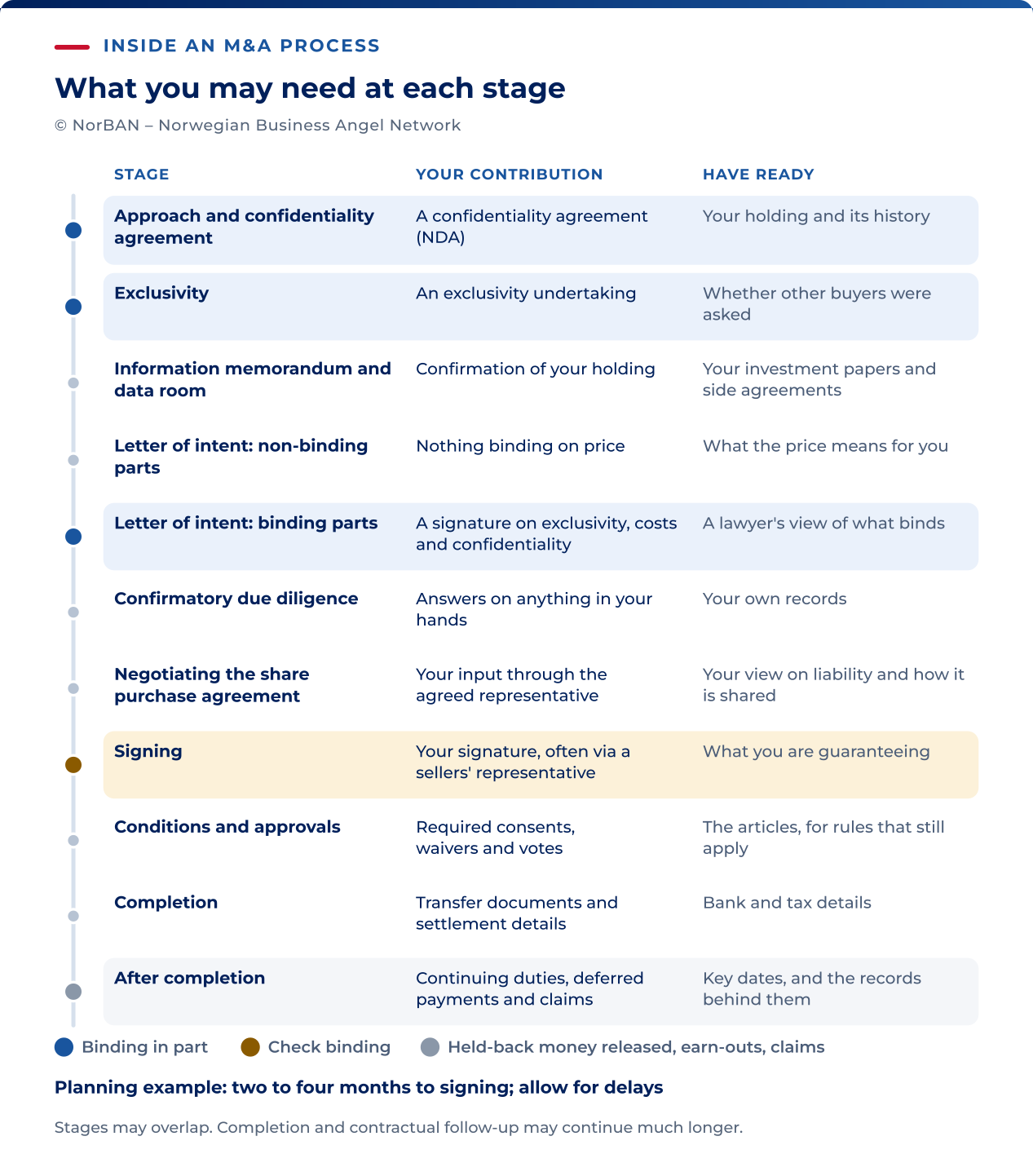
Approach and confidentiality agreement
What happens. The buyer approaches the board.
What you are asked for. A non-disclosure agreement, binding on any shareholder who takes material under it.
What to have ready. Your holding and its history.
Exclusivity
What happens. The sellers stop talking to other buyers.
What you are asked for. An exclusivity undertaking, alone or inside the letter of intent.
What to have ready. Whether the field was tested.
Information memorandum and data room
What happens. The company assembles the material.
What you are asked for. Confirmation of your holding, and anything you hold that the company does not.
What to have ready. Subscription papers, register extracts, side letters.
Letter of intent (intensjonsavtale), non-binding limbs
What happens. Price and structure are recorded as intention.
What you are asked for. Nothing binding on price.
What to have ready. The waterfall, and what the price pays you.
Letter of intent, binding limbs
What happens. Exclusivity, costs and confidentiality bind from signature.
What you are asked for. A signature binding on those limbs alone.
What to have ready. Counsel’s read of what binds.
Confirmatory due diligence (selskapsgjennomgang)
What happens. The buyer verifies, red-flag focused, through legal, financial and tax teams.
What you are asked for. Answers on anything in your hands.
What to have ready. Your own records.
Negotiating the share purchase agreement (aksjekjøpsavtale)
What happens. Warranties, the cap, the claim period and deferred consideration are settled.
What you are asked for. Attention, spent through the lead.
What to have ready. A position on liability and allocation.
Signing
What happens. The agreement and disclosure letter are executed.
What you are asked for. Signature, and often a power of attorney to a sellers’ representative.
What to have ready. The disclosure letter against your warranties.
Conditions and corporate steps
What happens. Consent and pre-emption waivers are procured.
What you are asked for. Any waiver you must give, and your vote if needed.
What to have ready. The articles, for what still runs.
Completion
What happens. The buyer pays and the register entry is made.
What you are asked for. Transfer documents and settlement details.
What to have ready. Bank and tax details.
After completion
What happens. Escrow releases, the earn-out is measured, the claim window runs.
What you are asked for. Nothing, until a measurement date or a claim.
What to have ready. The diary, and the evidence behind it.
A Norwegian sale runs two to four months from launch to signature, many taking longer (Chambers Corporate M&A 2026, Norway), and the longest part begins after completion.
Your role, and where it ends
The founders and the lead negotiate the terms, usually without you in the room. You are neither their principal nor their agent.
Seek the same economics as the majority: price per share, pro-rata escrow and earn-out, and several liability capped at your proceeds, allowing for share-class rights.
For other terms, you can make requests. Prioritise the allocation of proceeds and the liability structure before asking for a different price.
A director who is also selling shares holds two positions that can pull apart. The office is personal and the duty runs to the company (aksjeloven § 6-12); the shareholding is the person’s own.
Where a board decision has particular significance for the director or a close associate and the director has a prominent personal or economic special interest in it, the director must not take part in the treatment or the decision (aksjeloven § 6-27).
Where the company contracts with a shareholder, director or related party, check aksjeloven § 3-8. Its main threshold is the company’s performance exceeding 2.5 per cent of total assets in the last approved accounts, with alternative bases and exceptions. These include ordinary-course agreements on normal terms and performance below NOK 100,000.
Where the procedure applies, obtain board approval, the prescribed statement and declaration, and send them to shareholders and Foretaksregisteret. The board duties article explains the director’s separate duties and conflict rules.
And throughout, the board must not act so as to give some shareholders an unreasonable advantage at the expense of others or of the company (aksjeloven § 6-28). What the statute does not do is prevent a director from selling; it governs who decides what, and on which side of the table.
What you are asked to warrant
A warranty (garanti) is a promise about a company you did not run. It is the part of the deal that survives longest.
| Element | Meaning | Minority-seller check |
|---|---|---|
| Title and capacity | Ownership, no encumbrances and power to sell. | Verify your own position before promising it. |
| Business warranties | Facts about accounts, contracts, tax and compliance. | Limit promises about operations you did not manage. |
| Disclosure | Qualifies warranties as agreed. Buyer knowledge can matter under § 20. | Explain the risk clearly; a document’s presence alone need not establish sufficient disclosure. |
| Liability cap | Agreed payment ceiling. | Negotiate a cap tied to your proceeds. § 36 supplies no automatic proceeds-based limit. |
| Claim period | Contractual notification deadline. | Separate from statutory limitation. |
| Allocation | Individual/pro-rata or joint-and-several liability. | Negotiate individual limits; do not assume courts will remove joint liability. |
| Statutory remedies | Kjøpsloven, including defects (§ 17) and rescission (§ 39). | Check how the agreement modifies these default rules. |
What the buyer’s examination does to your warranties
Kjøpsloven § 20 first paragraph concerns defects known or necessarily known at purchase. The second concerns what inspection should reveal, including an invitation declined without reasonable cause, with an exception for gross negligence or dishonesty by the seller. Check the agreed disclosure standard: data-room availability alone is not necessarily disclosure.
A buyer’s examination can narrow its later claims. The buyer takes that into account in the price.
The floor under the contract, and a remedies clause
A domestic sale of existing shares falls within the general part of kjøpsloven. In Rt. 2002 s. 1110 the Supreme Court applied the act’s defect remedies to a purchase of all the shares in an AS and rescinded it.
The act yields to the contract, to established practice and to binding trade usage (kjøpsloven § 3), so an exhaustive-remedies clause between commercial parties displaces the statutory scheme as far as it reaches.
Kjøpsloven § 33 preserves claims despite failures to meet the examination and notice duties in §§ 31 and 32 where the seller acted with gross negligence or contrary to honesty and good faith. It is not an exception to every part of § 20. The effect of a liability exclusion must also be assessed under avtaleloven §§ 33 and 36.
Where the unreasonableness is said to come from later events, the threshold is high. In HR-2025-251-A the Supreme Court reported Norrønafly‘s requirement of kvalifisert urimelighet for revision «på grunn av endrede forhold» (avsnitt 74).
It adopted the sliding scale from ND-1990-204 Ula, so the threshold rises with the parties’ professionalism (avsnitt 77), counterweighted by the balance of strength between them and whether one side could shape the terms (avsnitt 78).
The same judgment shows that changed circumstances are not the only basis for revision. Where the unreasonableness traced to defects at formation, opplysningssvikt with a heightened duty of loyalty, the Court set aside a negotiated commercial settlement in its entirety between advised parties (avsnitt 113, 117), avsnitt 70 placing tilblivelsesmangler inside the § 36 assessment.
Both the source of the unreasonableness and the parties’ sophistication and bargaining position matter. Later events can also enter the § 36 assessment. The judgment says nothing about exclusivity-of-remedies clauses, and avsnitt 71 concerns a party’s choice among available grounds.
Escrow and holdback
Subscription funds must be paid before a capital increase can be registered (aksjeloven § 10-9). In an ordinary sale of existing shares, the parties can instead agree to defer or secure part of the price. The sale agreement must specify the conditions; other transaction rules may still apply.
Norwegian firms describe two ways to hold the funds. The broker standard for sales of shares in a property-holding company puts it on a blocked account in the seller’s name for a year, preferably pledged to the buyer (DLA Piper Norway).
Another arrangement places funds with an independent third party, as discussed by Wikborg Rein. An account in someone else’s name is not by itself proof of protection against insolvency. Check ownership of the funds, separation from other money, security and the account terms.
Agree the following points in the escrow agreement:
- Who holds it, and what pledge secures the buyer where the account is the seller’s.
- A release date that is a date, never a condition the holder must assess.
- Partial release as items clear, and who takes the interest.
- A period matched to the remedy deadline, most often got wrong.
- What a notified claim freezes, and which procedure decides it.
- Pro rata, on the majority’s terms.
A Norwegian lawyer may hold escrow on a client account. Client funds (klientmidler) are governed by advokatloven § 41 and advokatforskriften, under Advokattilsynet’s supervision. Agree the release conditions and dispute procedure. This is separate from the blocked share-capital account required for a subscription unless the statutory exception applies.
In the Norwegian private equity market escrow arrangements are rare, and warranty and indemnity insurance is the primary route to a clean exit (Chambers Private Equity 2026, Norway). That is the institutional market, above an angel exit.
At angel scale the agreement still has to answer the same three questions: whether any part of the price is held back, who holds it, and on what terms it is released. A warranty with nothing held back behind it is worth what the seller’s solvency is worth when a claim arrives.
Earn-outs
An earn-out (tilleggsvederlag) ties some sale proceeds to later results. Value that uncertainty when agreeing the price.
In HR-2026-1233-A, decided on 3 June 2026, the Supreme Court applied ordinary principles of commercial contract interpretation, including loyalty considerations (paragraph 33). The judge stated that he knew of no previous Norwegian Supreme Court case on earn-out clauses and loyalty (paragraph 37).
The preference share carried 19,75 per cent of post-tax profit for two years. During that period the buyer sold two holdings to its shareholders at 80 per cent of cost, reducing the earn-out by 574 781 kroner (avsnitt 27, 47).
The agreement required the business to be carried on «slik den har vært drevet frem til dags dato», read by the Court as an obligation to abstain from extraordinary or unusual dispositions without the seller’s consent (avsnitt 43). The sale was no continuation of normal operations (avsnitt 49).
The operative protection for a seller is the burden of proof. Loyalty «kan i seg selv tilsi at kjøper sørger for at innholdet i og bakgrunnen for disposisjoner som avviker fra det vanlige i en earn-out-periode, er godt dokumentert, og at tvil går ut over kjøper» (avsnitt 39).
The related-party sale reduced the earn-out, and the buyer had the evidence. It therefore had to prove market value (avsnitt 51).
The duty was grounded in construing the clause, coloured by loyalty. The Court adopted HR-2026-280-A (Isola) avsnitt 52 to 54, where loyalty may colour interpretation and may also be an independent basis, and its limits: loyalty cannot set aside public-law or company-law requirements, or agreements with others (avsnitt 34, 38).
A second disposition survived challenge: a valuation report showed 7 per cent, a 10 per cent write-down lay «innenfor en naturlig margin», and the buyer had shown a sufficient accounting basis (avsnitt 68, 69). Ordinary management is untouched.
The seller had lost outright in the lagmannsrett and recovered 574 781 kroner of a claim of 807 446, with costs for three instances (avsnitt 78).
Norwegian firms discussing the judgment recommend specific restrictions rather than brief, general wording. Negotiate controls over the following matters:
- Bonus and remuneration schemes.
- Accounting principles, since the measure is an accounting figure.
- The financing structure, interest and intra-group debt.
- Disposals, particularly to related parties.
- Notification and approval rights over material dispositions.
- Documentation from the buyer for anything unusual.
The judgment awarded additional consideration, not damages: the earn-out was calculated as if the disputed loss had not occurred (paragraph 59). The seller’s alternative damages claim was not admitted for hearing in the Supreme Court (paragraph 13). This distinction matters when formulating a claim; the agreement and the facts determine which remedies are available.
An earn-out may be sale consideration or remuneration for work. Continued employment, personal performance conditions and the relationship between price and share value can affect classification; the absence of a work clause does not guarantee capital treatment. Have the clause assessed before signing.
For sale consideration, skatteloven § 14-2 and Skatte-ABC U-4-2.14 distinguish an unconditional right from a future uncertain amount. The handbook’s general rule does not name earn-outs; on its wording it covers a revenue-contingent instalment. Tax timing follows the right to payment, not simply when cash arrives. Settle classification and timing with your adviser.
Where a transfer is combined with strong regulation of the former owners’ employment, part of the apparent share consideration can be reclassified as advance payment for work and taxed as salary (Skatte-ABC U-4-6.4). A transaction bonus is employment income, reported by the employing company with the employer’s contribution whoever funds it.
Even without a written commitment to keep working, part of the payment may need closer tax assessment. Skatte-ABC T-7-4.8.2 considers three questions:
- Is the agreed payment higher than the company’s value and earning capacity would justify if the former owners stopped or sharply reduced their work soon afterwards?
- Have the former owners committed to work for the business for a period?
- Have they agreed not to compete?
The first of those bites whether or not anything was signed. The handbook adds that such ties are often camouflaged and not always express, and that the authorities go on what is most probable.
Leaving the undertakings out therefore does not by itself make an instalment that turns purely on revenue or profit capital gain in full, and the handbook draws no conclusion for that case. Take a concrete structure to an adviser, or to a binding advance ruling, before it is signed.
Personal undertakings: non-compete and the rest
A restraint you accept purely as a seller sits outside employment law, governed on its face by avtaleloven § 38 read with § 36, neither setting a cap or a duty to pay for it.
Where you are also an employee, the employment chapter applies to the employment restraint. A non-compete clause (konkurranseklausul) must be written, may go no wider than the employer’s particular need for protection, and lasts at most a year from termination (arbeidsmiljøloven § 14 A-1).
The employer must state in writing whether it will invoke the clause (§ 14 A-2), and owes compensation set as ratios of the National Insurance basic amount (grunnbeløpet, G), reset by NAV each 1 May (§ 14 A-3).
Where the seller is both investor and employee, the classification is a recognised grey zone: a shareholders’ agreement restraint that substitutes for an employment non-compete may be pulled inside the chapter, or judged by its standards.
Both readings are live, and the working assumption is to size the restraint as if the chapter applied: a year at most, a genuine protection need, and an employment-linked restraint carrying the § 14 A-3 compensation.
A personal non-compete on a minority holder who is a pure investor is the most vulnerable element in a seller’s package, and the one worth refusing or trimming.
Completion, the money and the diary
Before anyone is paid the corporate steps have to be in place. The board consents under aksjeloven § 4-15 and § 4-16 unless the articles have removed the requirement, and any pre-emption right is waived on the record.
Then every seller signs and the buyer pays, the company is notified (§ 4-12), and the board enters the new owner in the share register at once, dated (§ 4-7).
Seek the necessary waivers early and document the company’s receipt of the acquisition notice. Consent is deemed given only if the acquirer has not been notified of refusal within two months of that receipt (§ 4-16). The statutory pre-emption right normally lapses two months after the company received notice of the change of ownership (§ 4-23).
A general meeting is needed only where the transaction requires one, on a week’s notice unless every shareholder consents (§ 5-10). The transfer is reported on the aksjonærregisteroppgave by 31 January. Tax belongs to the tax article.
Put these in the diary on the day you sign:
- Every escrow release date, and what triggers a partial release.
- Each earn-out measurement date, and the figures that test it.
- The buyer’s last day to notify a warranty claim.
- The limitation dates, on their own clock.
The ordinary limitation period is three years (foreldelsesloven § 2). The starting date depends on the claim. For a guarantee covered by § 3 no. 4, it runs from the buyer’s notice of the relevant matter, but no later than expiry of the guarantee. Do not assume every clause called a warranty falls within that rule; have the claim and the wording assessed.
Under § 10, missing necessary knowledge of the claim or debtor can delay limitation until at least one year after obtaining—or being expected to obtain—it. Total extension is generally capped at ten years, not ten years from sale. Preserve documents and dates for counsel’s deadline calculation.