
What a buyer checks, and why it decides the price
At venture stage, a buyer’s advisers focus on a limited set of matters that an angel-backed company should be ready to document. Buy-side work here is usually red-flag focused and run by a legal, financial and tax team.
Published Norwegian practice puts that list as ownership of the technology, the cap table and dilutive instruments, founder and key-employee employment including incentives, material agreements, intellectual property, and disputes.
Check these records before a buyer asks for them. Due diligence gives the investor’s approach to examining them.
| What the buyer examines | What they want to verify without asking you | What an absence does |
|---|---|---|
| Ownership of the technology | A chain of assignment from every person who wrote or designed anything, including contractors and pre-incorporation work | Repricing where the author is reachable, a carve-out or an aborted deal where they are not |
| The cap table and dilutive instruments | That the share register, the filed capital and every option, warrant and convertible agree | Escrow against the gap, and a condition that it is closed before completion |
| Founder and key-employee employment | Notice periods, non-competes, and what each person is owed if the company changes hands | A retention package funded out of the consideration |
| Material agreements | Who the counterparties are and which agreements react to a change of ownership | A consent condition in the timetable, and a counterparty with a lever |
| Intellectual property registrations | That applications and registrations are in the company’s name and maintained | A price adjustment, or a warranty the sellers carry personally |
| Disputes and contingent claims | That what is disclosed is all of it | The warranty catalogue widens and the escrow grows |
The four defects that cannot be fixed late
Most diligence findings are repairable while the buyer waits. These four are the ones where late discovery reprices the deal or ends it, because each of them needs something the company no longer controls.
Intellectual property nobody assigned
Employee software normally passes under åndsverkloven § 71, unless otherwise agreed. Other employee work can pass to the extent required by the employment’s purpose. Patentable inventions follow arbeidstakeroppfinnelsesloven, with a statutory claim procedure, possible advance agreements and protected compensation rights. Do not assume that every employee contribution needs a separate assignment, or that every right passes automatically.
For contractor and pre-incorporation work, check the engagement and any express or implied transfer or licence. Establish whether the company has the rights its business needs, and document gaps before agreeing a repair. A licence may be sufficient; ownership, modification and onward-transfer rights are separate questions.
Where the person owns the rights and can transfer them, a written confirmation or new assignment can document the arrangement. Ordinary copyright assignments generally need no notarisation, but special rights, registrations, consents and the original contract may require additional steps. A later signature does not erase earlier infringement or competing rights.
The following view of compelling a former employee or contractor to sign is reasoned principle, not case-tested in the sources reviewed.
An express or clearly implied obligation to assign in the original engagement is a contractual duty, and specific performance is in principle available. Where the original contract is silent, there is generally no free-standing duty to sign. The acquirer is left with whatever passed under the unwritten rules and must negotiate any further assignment.
The cost of obtaining a missing assignment depends on whether the person is still reachable and willing to help. Securing the signature matters more than drafting the document.
Model weights and training data sit outside all of this. Where they fall in Norwegian law is genuinely unsettled, and a company whose value is in a trained model should take advice on it before a buyer raises it.
A share register that never matched the filings
The board must ensure that an AS keeps a share register with dated entries. Under § 4-7, notify and substantiate an acquisition; enter it promptly when transfer restrictions do not prevent it. Access is public within the statutory and regulatory limits.
The register helps establish who may exercise shareholder rights towards the company under § 4-2. It is not conclusive proof of ownership, and the section also recognises notified and substantiated acquisitions in the specified circumstances. Reconcile entries with the underlying acquisition documents.
Under § 4-13, priority between competing buyers depends on notification and the statutory good-faith conditions. Protection against the seller’s creditors requires notice from the buyer or seller. Notice and register entry can have different dates. The register alone cannot rule out a competing transfer that has not been notified.
Reconciling the register against registered capital and the Foretaksregisteret entries may take an hour in year two. By year six it can require substantial reconstruction if the people who know what happened have left.
Equity promised outside any scheme
Promises of shares or options in an employment contract, offer letter or email can create obligations without appearing in a register. Check who made the promise, their authority, its conditions and the corporate decisions needed to deliver it. A buyer may discover it in the data room, interviews or after completion.
Clarify the promise early and record whether it is binding and how it can be fulfilled. A sale does not make an existing obligation disappear. An unresolved promise can become a negotiating issue when the buyer needs certainty.
A capital increase resolved and never filed
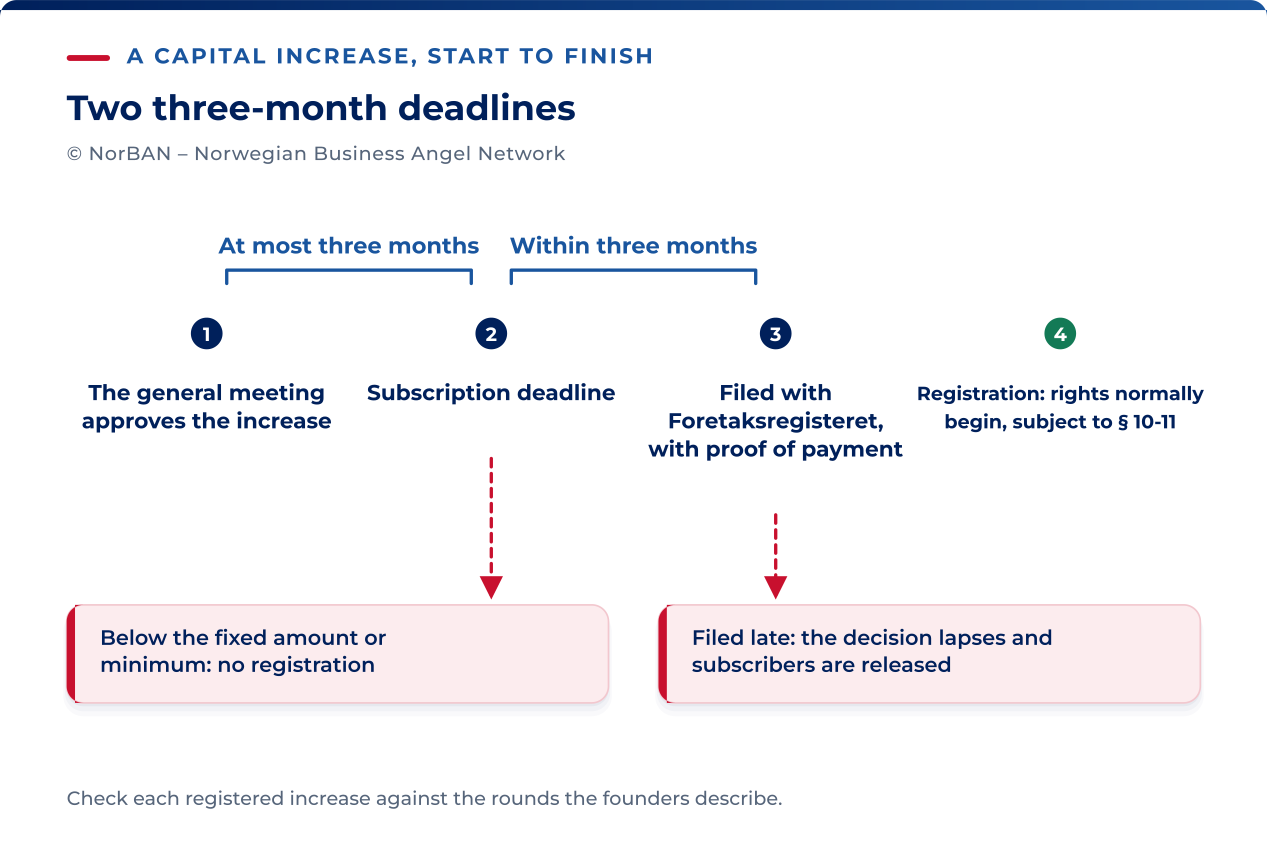
An increase must be filed with the Foretaksregisteret within three months of the subscription deadline, which is itself capped at three months from the resolution — an outer limit of roughly six months from resolution to filing, aksjeloven § 10-9. Miss it and registration cannot occur, the subscriptions cease to bind, and the resolution lapses.
The missed filing cannot be remedied under the old resolution; the whole sequence must be repeated.
New shares confer rights from registration unless the resolution provides otherwise; attendance and other rights every shareholder has arise no later than registration (§ 10-11). An unregistered increase may still be within its filing period. Check the resolution, subscription deadline and filing status before concluding that it has lapsed.
If filing is late, or registration is refused for a defect that cannot be corrected, the subscriptions cease to bind. Money in the blocked subscription account must then be repaid without delay (§§ 10-9 and 10-13). Check whether the resolution instead permitted direct payment to the company, and whether it has spent the money.
The corporate record: register, minutes and filings
A buyer expects a company to hand over its own history without reconstructing it. What each document proves is narrower than its name suggests, and a gap is cheapest to close in the year it appears.
| Document | What it proves | Where the rule sits |
|---|---|---|
| The share register | Who may exercise shareholder rights, with dated entries; open to anyone on request within three business days | Aksjeloven § 4-5 and § 4-6 |
| General-meeting minutes | What was resolved and by whom; signed by at least two people, one of them the chair of the meeting | Aksjeloven § 5-16 |
| Board minutes (styreprotokoll) | That the board met, and what it decided; signed by the members taking part | Aksjeloven § 6-29 |
| The registered capital history | Every increase and reduction, because capital is articles content and each change is filed | Aksjeloven § 2-2 |
| Filed annual accounts | That the accounts were adopted and filed, and whether they were audited | Regnskapsloven § 8-2 |
One rule catches reviewers out. Where the company has a single shareholder, that shareholder’s signature alone suffices on the general-meeting minutes. A great many Norwegian startups spend their first year as one-shareholder companies, and their early minutes look defective to someone who does not know the exception.
Minutes of both organs are kept for the company’s whole life, so a gap in year one is still a gap at exit.
The contract file and change of control
An AS is a separate legal person and its shareholders are not liable for its obligations (aksjeloven § 1-2). A change in who owns the shares does not change who the contracting party is.
The company remains party to its own agreements, and nothing is assigned, novated or transferred. This continuity makes a share purchase the simpler structure where contracts matter.
The distinction also affects employees. Where a business changes hands, arbeidsmiljøloven chapter 16 transfers employees’ rights to the new employer and imposes information and consultation duties.
A share sale is outside that chapter, and the preparatory works say so in terms. The employees remain employed in the same company, and acquiring dominant influence through a share purchase is not a transfer of an undertaking.
What changes the position is an express change-of-control clause. There is no statutory rule restricting them in Norwegian commercial contracts, the starting point is freedom of contract, and avtaleloven § 36 is the outer limit. In a confirmed rekonstruksjon a counterparty cannot rely on the company’s breach before the proceedings opened.
| Where the clause turns up | What it typically requires |
|---|---|
| Key customer and framework agreements | Consent, or notice with a termination right |
| Distribution, reseller and agency agreements | Consent, sometimes with a renegotiation window |
| Software and technology licences in | Consent to a change of control of the licensee |
| Leases and equipment finance | Landlord or lessor consent, occasionally a guarantee refresh |
| Bank facilities and security | Mandatory prepayment or an event of default |
| Public grants and support | Terms that live in the award documentation rather than in the regulation |
Grants are the one place where the instrument most people reach for does not answer the question. The county regional-policy grant regulation sets out conduct-based grounds for withdrawal and says nothing about a change of ownership, so that condition, where it exists, comes from the individual award decision.
Research council project funding is different again and addresses control expressly, and the research and development tax deduction’s approval is locked to the organisation number. Ask the company for the award letter and its annexes; the published scheme rules alone are insufficient.
The effect of a change-of-control clause depends on its actual wording, the transaction and the applicable law. Ask counsel to assess that clause rather than assuming that every clause with the same heading works alike.
The financial record a buyer can rely on
| What is examined | What makes it usable |
|---|---|
| Filed accounts | Adopted and filed on time, with the auditor’s report where the company is audited |
| Bookkeeping material | Retained and retrievable, five years for bokføringsloven § 13 første ledd nr. 1–4 and three years six months for nr. 5–8, with § 13 b requiring electronic material to stay electronically available |
| VAT and payroll | Returns filed and reconciled to the ledger, with no open enforcement |
| Grant conditions | The award documentation, its reporting obligations and anything that survives payment |
| Debt and security | Registered security matched to the facilities it secures |
The 2026 bookkeeping reform introduces electronic invoice issuance from 1 January 2027, subject to exceptions and, during transition, the recipient’s ability to receive it. The general duty to receive e-invoices and keep books in an electronic accounting system starts on 1 January 2030. The 30 September 2026 guidance explains the transition. The five-year and three-year-six-month main retention periods are unchanged.
Check the issuing authority for penalty and fee amounts. Late-filing penalties and enforcement fines are set in regulation and published by the body that levies them.
People, incentives and what the founders are paid at exit
A buyer will investigate dependence on key people before deciding how it affects the price. A buyer wants to know who the company cannot operate without, what each of them is contracted to, and what happens to them on a change of hands.
The option scheme is where the founders’ incentive and the buyer’s price meet, and the commonest exit treatment is the one that costs most. Cancelling options and paying the holders cash out of the consideration takes them out of the start-up scheme.
Skatteetaten treats this compensation under the ordinary rules for employment options. The payment is employment income, so the tax deferral and capital treatment are lost.
The employing company must withhold tax, report the payment through the a-melding and pay employer’s contributions.
A restructuring is a different question and has a clearer answer. A change in the underlying object following a merger, a demerger or a change in group structure does not in itself mean the option is treated as exercised.
What that does not settle is whether options already granted stay inside the scheme when the company becomes a subsidiary of a new parent. FSFIN § 5-14-12 tredje ledd bokstav b requires the option to give a right to acquire shares in the employer company, and it carries no time marker at all.
Check the condition and its assessment date separately: some company conditions are tested at grant, while employee conditions can apply through exercise. A reorganisation should therefore be assessed against the option agreement and the exact tax rules. If a material uncertainty remains before the transaction, consider a binding advance ruling; it is not the only way to obtain guidance.
Do not let anyone reason from “not deemed exercised” to “still inside the scheme”; they are different questions.
A transaction bonus is ordinary employment income under skatteloven § 5-10, personal income, and subject to employer’s contributions. Establish who is responsible for reporting it and paying contributions.
Under skatteforvaltningsloven § 7-2 annet ledd, where an employee receives such a benefit from someone other than their employer, the reporting duty still falls on the employer. So whether the company, the selling shareholders or the buyer funds the bonus, the employing company reports it and pays the contributions.
That makes it a term to allocate in the purchase agreement. The employer has to be told the per-employee amounts, and the contribution cost has to be allocated, or a seller-funded bonus leaves a liability in the company after completion.
What a minority shareholder can actually do
As an angel, your ability to influence preparation depends on whether you hold a board seat, contractual information rights or only your statutory shareholder rights.
Shareholders have statutory information and minority rights, as well as any rights agreed by contract. The filed annual accounts are public, and anyone may inspect the share register. Shareholders also receive meeting documents and specified transaction disclosures, subject to the applicable statutory rules.
At a general meeting, a shareholder may ask for information relevant to the accounts, the agenda or the company’s financial position, unless disclosure would cause disproportionate harm. Where information must be obtained, a written answer follows within two weeks (aksjeloven § 5-15).
Holders of at least one tenth of total share capital may demand an extraordinary general meeting. Any shareholder may propose an investigation (granskning). Support from at least one tenth of the capital represented permits any shareholder to petition the court within one month; the court then assesses whether there are proper grounds (§§ 5-25 and 5-26).
Agree routine reporting, budgets and material-event notices expressly. Who can enforce the obligation, and against whom, depends on the agreement; an obligation on the company requires the company to be a party.
With a board seat, the reach is different in kind. A director receives the board papers as of right, may require any matter to be dealt with by the board, and may have their view entered in the minutes. The director’s information is continuous, forward-looking and decision-grade; the shareholder’s is periodic, backward-looking and filtered. Consider that difference when deciding how to monitor the company’s preparation.
With information rights in the shareholders’ agreement, the obligation has to sit on the company, which must therefore be a party to the agreement. Such an agreement cannot bind the board to disclose what § 6-28 forbids, cannot turn a director into the nominating shareholder’s agent, and a decision taken in breach of it is not thereby corporately invalid — the remedy is contractual.
With neither, use the annual general meeting to raise a specific question each year. Submit it in writing beforehand so it reaches the agenda, while problems are still inexpensive to fix. For example:
- Does the share register reconcile with registered capital and acquisition documents?
- Is there documented ownership or a sufficient licence for the code, designs and other IP the business needs?
- Has anyone been promised ownership outside the option scheme?
- Has every capital increase been registered, or is there a documented valid filing still in progress?
An investigation requires the meeting support and court petition described above. A small shareholder can propose it, and a supported proposal permits any shareholder to petition within the deadline; a court order still depends on the grounds and carries a cost.
The annual rhythm matters more than any single intervention. An angel who asks the same four questions every year has a dated record of the answers, and a company that expects the questions keeps the file.
When the company is put in play
Preparation ends the moment an approach becomes a process. In structured Norwegian sales the seller commissions its own examination first, a vendor due diligence usually produced by the sell side’s legal advisers, which the buyer’s advisers then rely on and top up.
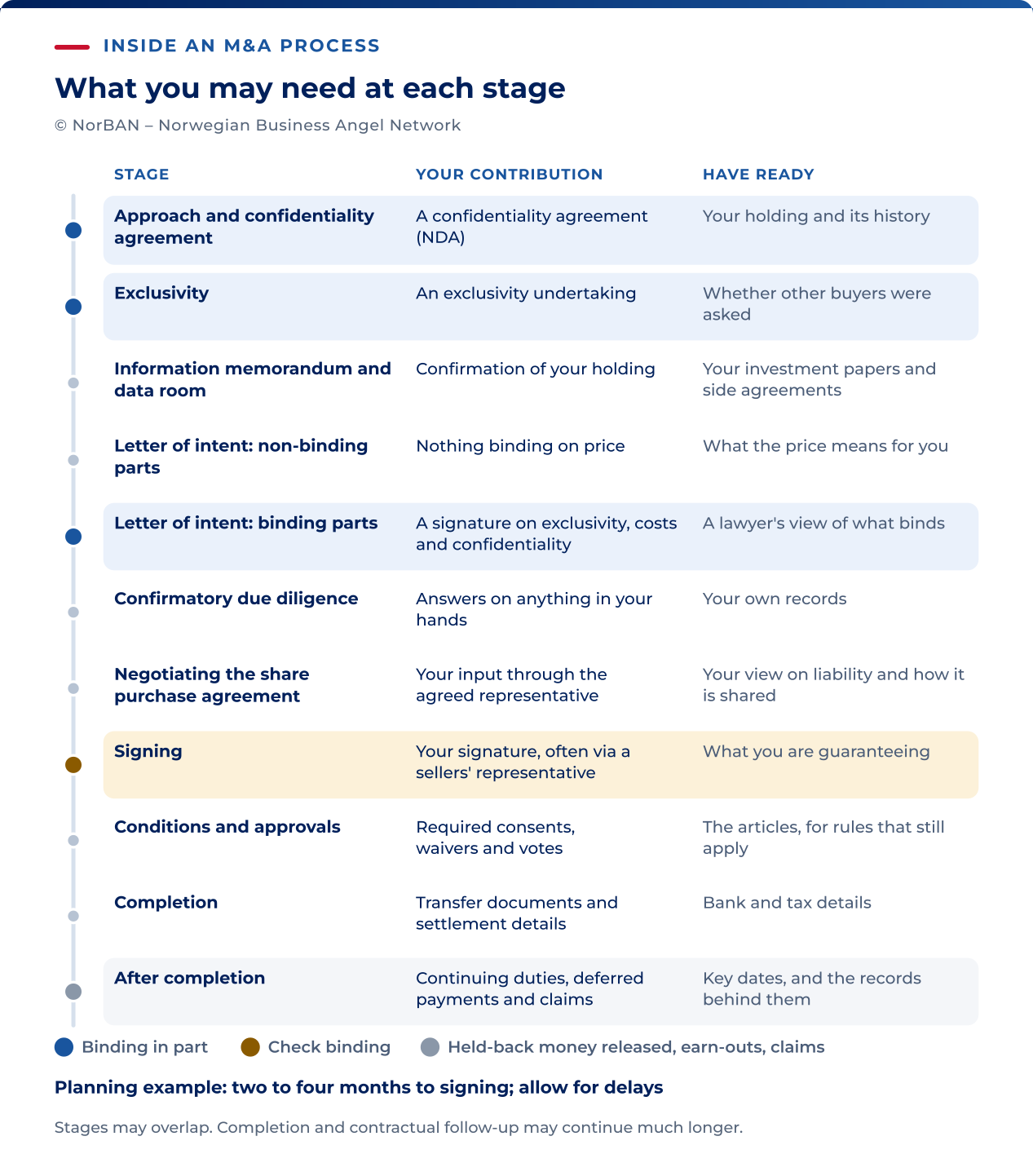
Preparation is an audit the seller commissions on itself, in the same areas the buyer will examine. A small company sold bilaterally will not always commission a formal report, and the work is the same either way.
Published Norwegian guidance suggests two to four months from launch to signature, with wide variation and many sales taking much longer.
American practitioner guidance suggests six to nine months from first contact to close, and twelve to eighteen months from engaging an adviser. That is a different market and process: use it to understand the stages, not to set a Norwegian timetable.
Either way the record has to be right before the clock starts, because none of it can be built during the process.
Once the sale process starts, you must consider the documents you will be asked to sign. The M&A process explains that next stage.