
When a secondary is actually available
An angel wanting to sell before the company exits needs a willing buyer. Unlisted shares have no quoted price and nobody is obliged to bid, so the opportunities below depend on someone else’s decision.
Identify the opportunity available to you. It determines whom to approach and how long a sale may take.
| Occasion | Who sets it in motion | Where it leaves you |
|---|---|---|
| A financing round with secondary room | The incoming investor, with the board’s agreement, wanting more than the round issues | The only moment at which a price, a willing buyer and the company’s attention exist together. Ask to be on the list before terms are agreed |
| A buyer who wants your block | A shareholder consolidating, or an outside buyer whose threshold your holding crosses | Your strongest position, because the buyer wants something specific. The price still has to survive the transfer machinery |
| A repurchase by the company or the founders | The board, where there is distributable equity and a reason to retire a holding, or the founders themselves | A corporate act with statutory conditions. A purchase by the founders personally carries none of them |
A company-run liquidity programme is a fourth route, rare at angel scale. Simonsen Vogt Wiig, in their Norway chapter for Chambers, record that some Norwegian companies trade off the counter through broker desks at investment banks, in limited volumes, and that those trades are not an exit opportunity.
Who buys, and what each wants
At angel scale the buyer is almost always someone the company already knows, and each kind wants something different from your block.
- Another shareholder on the cap table. Your first buyer structurally, because the transfer machinery routes a block to existing holders first, and practically, because they have already done the work.
- An incoming investor in a round, taking part of an allocation as existing shares. Most angel-scale secondaries happen here.
- The founders, personally. Usually a small block, usually after a liquidity event of their own.
- The company itself, by repurchase. A corporate act, on the chapter 9 conditions below.
- A specialist buyer of private positions. Least available at angel ticket sizes, where the position is small, the information thin and the transfer consent-gated.
A buyer will want information and assurances that a minority seller often cannot provide. Information means the data room and management’s answers, and you can give only what your own rights entitle you to. Warranties about the business mean warranting a company you neither run nor can verify.
Board seats, information rights and pro-rata rights often belong to a named holder or depend on a minimum shareholding. Do not assume they transfer with the shares. Where board consent is required, that decision also affects whether the sale can complete.
Price is hard to defend either way. Of the American market, the publisher Carta records that in an opaque market “an accurate, market-based price can be difficult to ascertain.”
If a provider arranges the sale, check that it is authorised for the actual service. Share brokerage is not automatically crowdfunding. Finanstilsynet’s register also lists firms operating across borders; an EEA firm may operate under home-state authorisation and the required notification.
Consent, pre-emption (forkjøpsrett), and the clock each one starts
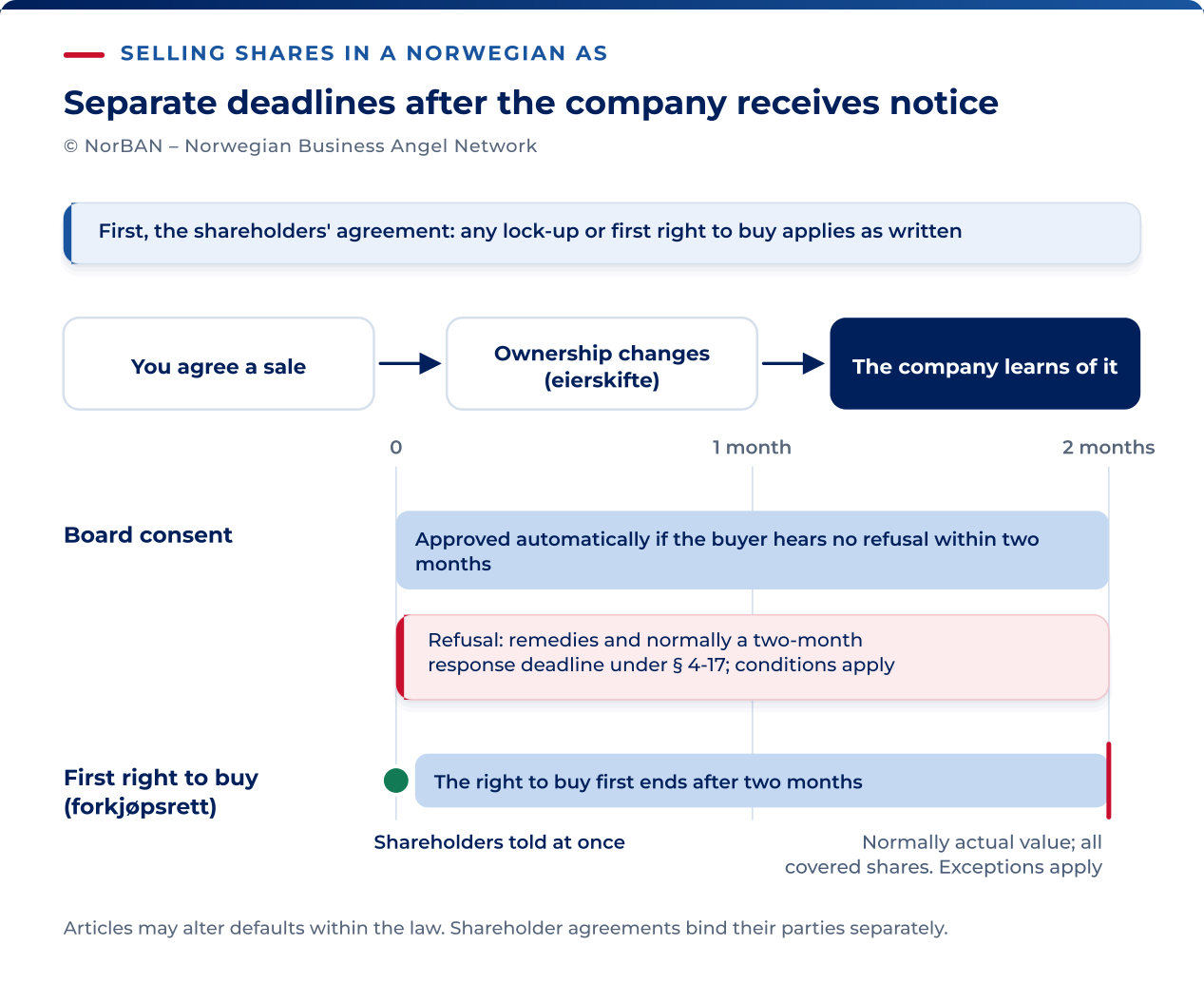
Agreeing a price is only part of a secondary. The consent process before your name comes off the share register (aksjeeierbok) can take months. Read your articles first, because they can remove both statutory defaults.
| Step | The rule, and its provision | The clock |
|---|---|---|
| The contractual layer | A lock-up, a right of first refusal or a right of first offer in the shareholders’ agreement (aksjonæravtale) binds you as contract, over the statute | Whatever the agreement says |
| Board consent | An acquisition needs consent, and the board decides unless the articles say otherwise, under aksjeloven § 4-15 and aksjeloven § 4-16. It may be refused only on objective grounds, with reasons, but not where the acquirer is the previous owner’s personal close associate as defined by the Act, or a relative in the direct ascending or descending line. This applies to inheritance and other transfers; not every heir qualifies | Deemed given if no refusal reaches the acquirer within two months of the company receiving notice, under aksjeloven § 4-16 |
| A refusal | The acquirer may reverse the sale unless the agreement says otherwise, sell on, challenge the refusal or seek redemption subject to the statutory conditions. Redemption is barred if the company provides an alternative buyer on the same terms or if redemption would materially harm the business or be unreasonable towards the company, under aksjeloven § 4-17 | Normally two months from receipt of the refusal; check the separate rules for the chosen action and any longer period in the articles, under aksjeloven § 4-17 |
| The pre-emption trigger | Forkjøpsrett arises only after ownership has changed (eierskifte), so it takes over shares already transferred, under aksjeloven § 4-19. A holder takes all the offered shares or none; several holders split them pro rata | Assess the change of ownership and notice; conditional signing needs care |
| The company’s notice | The rights holders must be told immediately the company learns of the change, under aksjeloven § 4-20 | Immediately |
| Exercise and price | The right lapses two months after the company learned of the change, and the price is virkelig verdi, generally assessed as market value here; check any articles-based valuation rule, which can be adjusted under avtaleloven § 36, under aksjeloven § 4-23 | Two months |
| What the articles can do | Both defaults can be waived, excluded, tightened or replaced in the articles, under aksjeloven § 4-15 and aksjeloven § 4-19. A shareholders’ agreement cannot, because it binds its parties, not the company | — |
| Once you have transferred | A transferring shareholder loses the right to exercise shareholder rights, pre-emption included, once the aksjeloven § 4-2 conditions are met for the new owner (HR-2013-1164-U) | From the new owner’s entry, or notification with proof |
| Completion | The acquirer notifies the company under aksjeloven § 4-12, and the board enters and dates the transfer in the share register under aksjeloven § 4-7. No share transfer is registered in Foretaksregisteret | Without delay once the acquisition is notified and substantiated and transfer restrictions do not prevent entry |
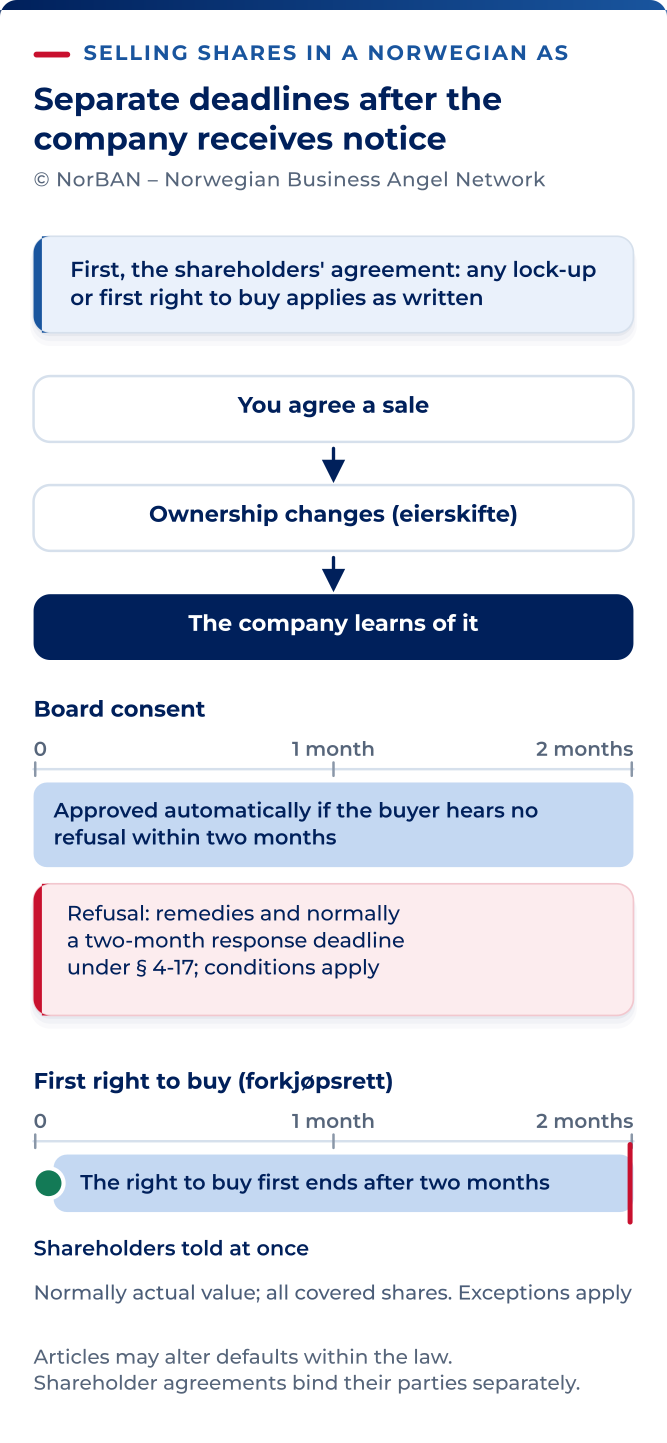
The consent and pre-emption periods each run for two months from the company’s receipt of the relevant notice. Where one notice serves both, they run in parallel. Exercise, payment or a valuation dispute can extend the process. Seek specific written waivers and board consent, document receipt of notice, and make completion conditional on the required clearances.
The consent decision belongs to the board, and at angel stage the board often contains the founders. A director must not take part in deciding a question in which they have a prominent personal or economic special interest (aksjeloven § 6-27).
A board decision apt to give some shareholders an unreasonable advantage at the expense of others is caught by § 6-28. A refusal that keeps one shareholder in while the others stay free is that fact pattern, and counsel decides whether yours crosses it.
For a purchase by the company itself, aksjeloven §§ 9-2 and 9-3 require fully paid shares. Share capital after deducting the nominal value of the company’s own shares must remain at least the statutory minimum. The price must fit within the funds available for dividends, and the company must retain adequate equity and liquidity.
Under § 9-4, the general meeting must authorise the board with the majority required for an articles amendment: normally at least two-thirds of both votes cast and represented capital. The authority lasts no more than two years and specifies the maximum total nominal value, the price range and how shares may be bought and sold. It must be registered before use. A selective buy-back must also respect § 4-1 and the abuse provisions.
What a price can rest on
The last funding round is a useful starting point, but compare the rights attached to the shares and the investor. That round may have included a liquidation preference, information rights or a board seat. Your shares and the buyer may have different rights; ordinary shares do not automatically lack all such protections.
Where your shares sit in the waterfall decides what that price means. A liquidation preference above you takes its money first at every outcome below the top, so an ordinary share under a stacked preference is worth materially less than the headline.
What the buyer acquires is a minority position with no control and no timetable, and the last price is historic. The discount they ask for covers both, plus the information they do not have.
Aksjeloven prescribes a valuation measure only when a statutory route has been invoked. The measure differs under each of the four provisions below.
| Provision | The route | The authority | The measure |
|---|---|---|---|
| Aksjeloven § 4-17 femte ledd | Redemption after the board has refused consent | Rt-2007-1392 (Flesberg) | Market value where one can reasonably be established (omsetningsverdi). The measure that governs a refused secondary |
| Aksjeloven § 4-24 | A court-ordered exit for a serious and lasting breakdown (uttreden) | HR-2016-1439-A (Bergshav), avsnitt 165 | Underlying value, with no discount for minority position, absent votes or illiquidity. Valued at the date the claim was made, § 4-24 tredje ledd read with § 4-17 femte ledd |
| Aksjeloven § 16-19 annet ledd | Redemption instead of dissolution (innløsning i stedet for oppløsning) | LB-2022-32089-3 (Eagle Group), the 2024 quantum judgment | A proportionate share of underlying value, with no reduction for minority position, illiquidity or anything else, at the date the claim was made |
| Allmennaksjeloven § 4-25 | Compulsory acquisition of a minority holding in an ASA | Rt-2003-713 (Norway Seafoods) avsnitt 74, as quoted in HR-2016-1439-A avsnitt 150 | A share of the underlying values in the company. An ASA provision; it does not reach an AS |
The four are not interchangeable, and the Supreme Court has said so. In Bergshav it held that what Flesberg said about an acquirer being made whole at omsetningsverdi does not apply to an uttreden under § 4-24, which weakens the weight the earlier judgment would otherwise carry there (avsnitt 163).
Bergshav distinguishes its withdrawal case from Flesberg. For redemption following refused consent, use expected market value where it can reasonably be established (Flesberg, paragraphs 41–44). Do not apply the valuation rule for one statutory remedy automatically to another.
These measures can inform your price negotiation, but they do not bind your buyer. Establish which statutory route would apply if consent were refused.
What you sign, and what you can honestly warrant
A secondary is papered as a share purchase agreement (aksjekjøpsavtale) with the angel as seller. The subscription and purchase agreement treats the clauses one by one.
For a secondary, the consent requirements need particular attention alongside the price. Permissions come from the statute, the articles and the shareholders’ agreement, and all three belong in the agreement as conditions to completion.
The statutory pre-emption right follows a change of ownership. Whether a particular conditional agreement starts the process needs advice on its terms; do not rely on the clock alone where the trigger is uncertain. Obtain specific waivers where possible, and state what happens if another holder exercises at virkelig verdi rather than the price agreed with your buyer.
Accession is the second addition. A shareholders’ agreement binds only its parties while the articles bind everyone, so your buyer takes the shares without the agreement, and a buyer who does not accede is a shareholder with statutory rights and no contractual ones.
On warranties, title to your shares, your capacity to sell and freedom from encumbrances are promises you can keep. The company’s affairs are not.
The Norwegian route to narrowing anything wider is the distinction between objective and subjective warranties: an objective warranty binds regardless of what you knew, and a knowledge qualification limits it to what you know.
Rime Advokatfirma identify the questions to settle in the draft: whether the standard is actual knowledge or what you ought to have known (burde visst), whose knowledge counts, and whether the agreement discloses your limited familiarity with the company.
One asymmetry separates this from subscribing for new shares. A domestic sale of existing shares falls within the general part of kjøpsloven, and the Supreme Court applied its defect remedies to a purchase of all the shares in an AS and rescinded the sale in Rt. 2002 s. 1110, on § 39 read with § 17.
The Sale of Goods Act therefore matters alongside the share purchase agreement. Under § 20, a buyer cannot claim a defect they knew or must have known about at purchase. Separate rules cover what an examination should have revealed, including where the buyer ignored an invitation to examine without reasonable cause. The latter rule has an exception for gross negligence or conduct contrary to honesty and good faith by the seller. Check how the agreement allocates these risks.
Negotiate four points to limit your exposure after the sale:
- Which matters your warranties cover.
- Whether they are limited to what you know, or subject to a financial cap.
- Who bears the risk that another shareholder uses a pre-emption right.
- Whether the buyer must join the shareholders’ agreement before completion.
What you may tell a buyer
Check your confidentiality obligations before discussing a price with a buyer. Information qualifies as a trade secret on a three-part test that Patentstyret states and forretningshemmelighetsloven § 2 carries: unknown to others, valuable because it is secret, and actively kept confidential by the business.
Where information meets that test, unauthorised acquisition, use or disclosure is unlawful whether or not anyone has signed a non-disclosure agreement. Forretningshemmelighetsloven § 3 reaches a secret obtained in connection with a service, office-of-trust or business relationship, which is where an angel who has sat in on board discussions stands.
Protection continues while the information remains a trade secret. For injunctions and corrective measures under §§ 5 and 6, legal steps must be taken within three years after the holder obtained or should have obtained the necessary knowledge of the infringement and infringer. Do not treat this as one deadline for every claim; damages also require a separate limitation assessment.
Your shareholders’ agreement usually adds to that, as practice rather than as law: an undertaking covering information received in any capacity and surviving your shareholding, a restriction on disclosing the agreement’s own terms, and a requirement that a transferee sign a non-disclosure agreement.
You may be able to share public information and facts about your holding, but check confidentiality restrictions even for your purchase price and agreement terms. Having access to company information does not itself authorise disclosure. Agree with the company what the buyer may receive.
Arrange a mutual non-disclosure agreement and seek the board’s cooperation. Without that cooperation, the buyer has less information and will reflect the uncertainty in the price.
Tax on the sale
A sale of shares is a realisation. Held personally, the gain is taxable and the loss deductible under the shareholder model, reported in your own tax return (skattemelding) for the year of realisation, and no shielding deduction accrues if you do not hold the share on 31 December.
Where the corporate shareholder and shares qualify for the participation exemption, gains are exempt and losses are not deductible. A later dividend to you personally is generally taxable; a documented repayment of paid-in capital follows different rules. Skatteetaten publishes the rates and adjustment factor. Tax for Norwegian angels explains the scope and exceptions.
Make sure the buyer understands the limit on the skatteloven § 6-53 deduction. It reaches only shares subscribed on incorporation or in a new issue, so a purchase of existing shares never qualifies.
Deciding whether to sell at all
Selling part of a position is read as a signal whether you mean it as one or not. Founders hear a loss of conviction, an incoming investor hears a chance to buy cheaply, and co-investors staying in hear a decision about them.
None of that is a reason to hold. It is a reason to say why you are selling, to the founders first, before your buyer gives them a version of their own.
Why you are selling changes the answer. Take them separately.
- You need the cash. Say so, plainly. It is the one reason nobody reads as a verdict on the company, and the one most likely to get the board’s cooperation on information and consent. Sell the smallest block that solves the problem.
- You are rebalancing a portfolio. Wait for a round with secondary room. Finding a buyer without an occasion costs months and gives you the weakest version of the price conversation. A partial sale retains some upside; check whether your remaining holding meets any threshold for contractual pro-rata and information rights.
- You have lost conviction. The hardest case, because the discount is largest and the buyer’s questions are the ones you least want to answer honestly. If you would not follow on, you are out of the company in every way except the cap table. Take the offer you can get, and do not warrant your way out of a position you no longer believe in.
A partial sale also changes your follow-on reserve needs. A smaller holding generally needs less capital to maintain its percentage. Check whether any contractual pro-rata right survives the sale or depends on a minimum holding before adjusting the reserve.
Within a syndicate, selling also affects your relationships. If you are the lead and sell while the group holds, members will take that into account when considering the next allocation.
Subject to confidentiality obligations, tell your co-investors why you want to sell and consider offering them the shares first. They know the company. Whether they have a right to buy depends on the articles, agreements and applicable pre-emption rules; they are not obliged to buy.
Whatever your reason, start with the shareholders’ agreement and the articles. Settle the consent and pre-emption position with the board before you agree a price, and take the agreement to counsel.