
What the seat actually is
A Norwegian AS board seat normally starts when an accepted election takes effect. Registration in the Register of Business Enterprises (Foretaksregisteret) provides public notice and third-party reliance effects; it does not start the office or its duties.
An investor-nominated director holds office personally and owes duties to the company. The board (styret) manages the company collectively under aksjeloven § 6-12.
An individual shareholder has no power to instruct you, and the board must not comply even with a general-meeting decision that conflicts with the law or the articles (aksjeloven § 6-28, second paragraph).
From taking office, you receive board information and must act on it. The managing director (daglig leder) reports to the board; agree access and reporting arrangements before accepting.
The duties of a board member in a Norwegian AS
The act imposes duties on the board collectively. A court assesses each member’s conduct against those duties when deciding individual liability.
| Duty | What the act requires |
|---|---|
| Management | The board manages the company: it sees that the business is soundly organised, sets plans and budgets, keeps itself informed of the financial position, and keeps accounts and asset management under adequate control (aksjeloven § 6-12). |
| Supervision | The board supervises the day-to-day management and the company’s activity (§ 6-13). |
| Sound equity and liquidity | The board keeps equity and liquidity sound at all times and acts when they are not (§ 3-4, § 3-5). |
| Equal treatment | The board must not do anything apt to give certain shareholders or others an unreasonable advantage at the expense of other shareholders or of the company (§ 6-28). |
| Proceedings and decisions | Any member or the managing director may require a matter to be dealt with (§ 6-20), and in a meeting (§ 6-19). Quorum is more than half the members, all given the chance to take part so far as possible (§ 6-24); decisions need a majority of those taking part (§ 6-25). |
| Minutes | Time and place, participants, how matters were handled, the decisions and, if not unanimous, who voted which way. All participants sign; a board of five or more may choose two (§ 6-29). |
The act sets no minimum number of board meetings. Official guidance recommends the call, agenda and papers about a week ahead, and a meeting at least every four months.
Reporting to the investors who nominated you
Reporting must respect the director’s duties to the company, the prohibition on unreasonable advantages in § 6-28, trade-secret protection and applicable confidentiality obligations. A nomination by an investor is not blanket permission to share board information. Agree what may be shared, with whom and for what purpose.
For routine syndicate reporting, agree what the company will provide, who receives it and how confidentiality is protected. A director may participate in an authorised reporting arrangement, but the agreement cannot override their duties to the company or other legal restrictions. Record the board’s assessment where appropriate.
The information right at the general meeting in § 5-15 is one statutory right, not an exhaustive account of shareholder access to information. Other rules cover meeting documents, registers and specified transactions. Agree routine reporting with the company explicitly.
Capital, liquidity and the duty to act
Equity and liquidity must be sound given the risk and scope of the business (aksjeloven § 3-4). Liquidity is a separate test. Six weeks of cash calls for assessment of obligations, burn, committed or realistically available funding and monitoring; the number alone does not establish a breach. Act promptly where the position is inadequate.
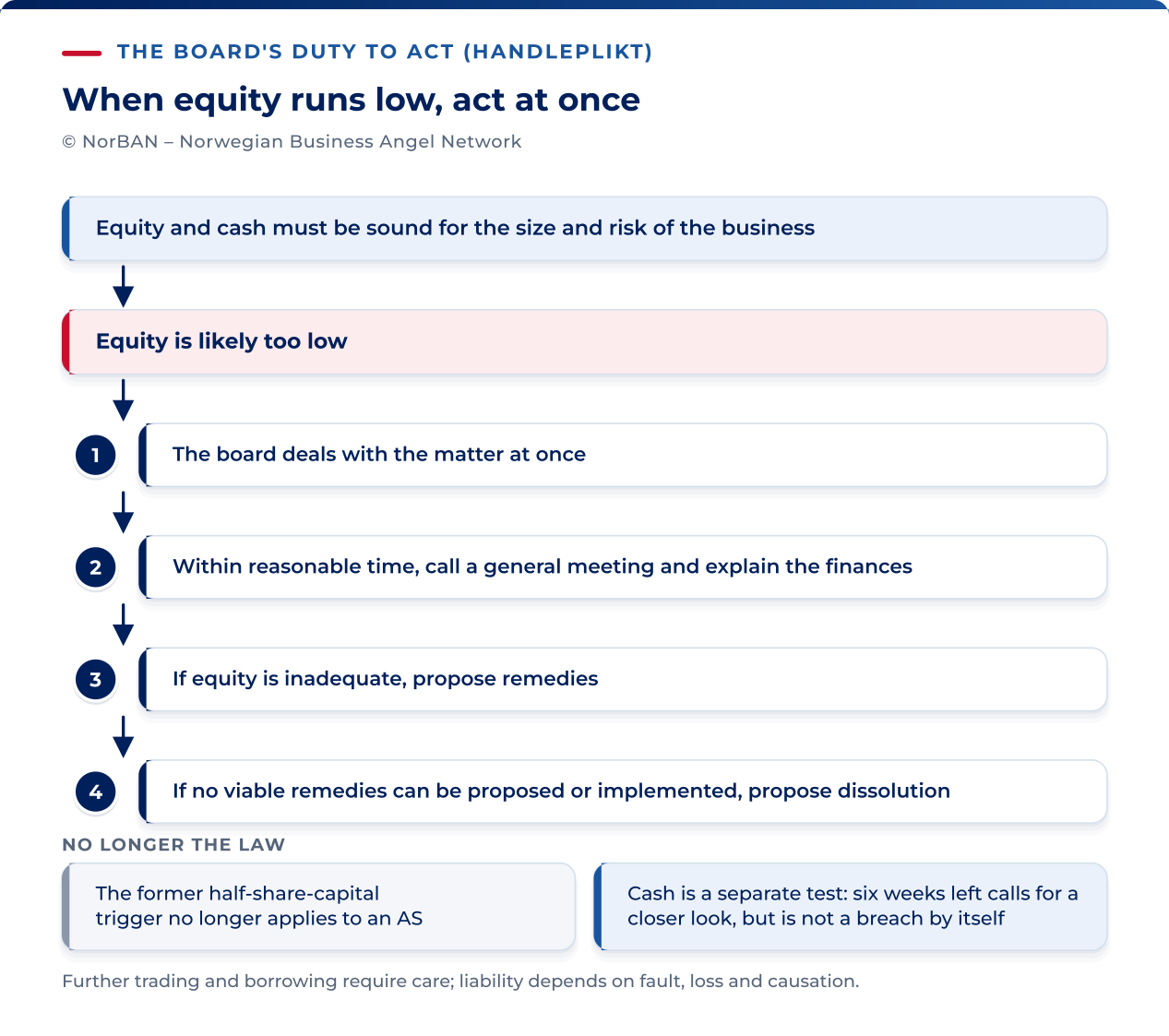
The duty to act (handleplikt) in aksjeloven § 3-5 then runs in steps. Nothing in the section lets the board wait for the next scheduled meeting.
- If it must be assumed that equity is lower than is sound, the board deals with the matter at once.
- Within reasonable time it calls the general meeting and accounts for the company’s financial position.
- If equity is not sound, it proposes measures to put it right.
- Where it finds no basis for measures, or they cannot be carried through, it proposes dissolution.
Much secondary material still describes a second trigger at half the share capital and a six-month deadline. Both are gone. The trigger was repealed by Lovvedtak 99 (2016–2017), in force 1 July 2017, and the deadline is “within reasonable time”.
Official guidance names the soundness assessment as the typical situation in which a board is held liable. The board must monitor equity and liquidity and refrain from acts that make either unsound, which catches a board that keeps ordering, hiring and taking credit through the last quarter of a runway.
Withheld employee tax is subject to separate rules. The company is financially liable for withholding tax (forskuddstrekk) it fails to deduct or to pay over under skattebetalingsloven § 16-20, and the older duty to hold it on a separate account was abolished from 1 January 2026.
Under skattebetalingsloven § 18-1 an employer who does not make the deductions may be fined or imprisoned for up to two years, on intent or gross negligence.
Skattedirektoratet states that the chair, the managing director and whoever runs the withholding function can all be caught, and a chair who knows the company is struggling cannot assume the rules are being followed.
Unpaid employer contributions are normally the company’s debt, not automatically a director’s personal debt. A separate liability basis, such as culpable loss-causing conduct under § 17-1, must be established. On liquidation, check the applicable rules on retaining funds and distributing assets rather than assuming all taxes and charges have identical liability rules.
Board liability (styreansvar) in practice
Board liability (styreansvar) rests on aksjeloven § 17-1. The company, a shareholder or anyone else may claim compensation from a board member or managing director for loss caused in that capacity, intentionally or negligently, and the second paragraph reaches anyone who contributed to it.
The standard is what can reasonably be required of a board member in the same circumstances. Liability is individual, and each member is assessed on their own conduct.
Only those found liable for the same loss answer jointly and severally (skadeserstatningsloven § 5-3 nr. 1), and only as far as each person’s own liability reaches, so a director who joined after part of the loss had arisen answers for the overlapping part alone.
Between the directors, § 5-3 nr. 2 apportions the settlement by the basis of liability and the circumstances, so a more culpable director bears a larger share and one who has paid more has recourse. A court may also reduce a director’s liability under aksjeloven § 17-2, the mitigation rule (lemping).
The general meeting can decide to pursue a company claim under § 17-3. After a decision granting discharge or rejecting a damages claim, holders of at least 10% of the capital may in specified circumstances sue in the company’s name under § 17-4. With 100 or more shareholders, at least 10% of their number is an alternative threshold. The action requires a common representative and normally must be filed within three months of the decision; a statutory investigation changes the starting point. This route is unavailable after a decision passed with the majority required for an articles amendment, or an agreed settlement. The claimants initially bear the costs, recoverable from the company only up to what the action brings it.
A shareholder’s or creditor’s own claim rests on § 17-1 directly, and where it derives from the company’s loss it ranks behind the company’s (aksjeloven § 17-6).
These Supreme Court cases concern creditor and bankruptcy-estate claims as companies ran out of cash. They show how an investor-director’s conduct may be assessed.
- Normount (Rt-1991-119) sets the threshold. A creditor needs something special, “noe spesielt”, beyond the company’s failure to reach the individual board members; there, the board had chartered a larger vessel on an unsound footing.
- Ulvesund (HR-2017-2375-A) draws the conditions. A company taking supplies on credit while insolvent must as a rule tell the counterparty it does not expect to be able to pay, and a managing director who let it go on incurring such obligations was personally liable to the supplier.
- HR-2026-1181-A, decided 27 May 2026, applies that framework and closes one route out of it. The managing director and sole board member of a company buying goods on credit was asked by the supplier whether the financing was in order, and answered that it was and there was nothing to worry about, knowing the company was insolvent. He was held personally liable, unanimously. Not giving a counterparty incorrect or misleading information is the core of contractual loyalty, and the room management has to save the company is no answer to a statement like that. It took the Ulvesund limits unchanged — management’s exposure does not necessarily reach as far as the company’s own duty to warn — and left open whether taking credit without a defensible basis for believing the company solvent is enough on its own.
- HR-2021-967-A measures the loss. Three board members who had negligently failed to tell a subcontractor about the company’s weak finances were acquitted, because the recoverable loss is the increase in the creditor’s claim between the negligence and the bankruptcy, and the claim had shrunk over that period.
- HR-2025-1841-A measures the other common claim. A bankruptcy estate’s claim against a former chair for filing for bankruptcy too late is measured as the reduction in the company’s asset position across the delay.
- HR-2020-1947-A shows the shareholder-side claim. A majority owner wound up a controlled company’s business and continued it in a sister company — a disloyal disregard of that company’s interests, and the breach is presumed negligent. The claim against the managing director failed: the steps predated him.
A non-contractual damages claim is generally time-barred three years after the claimant knew or should have known of the loss and the person responsible, with a general twenty-year outer limit from the end of the act or omission (foreldelsesloven § 9 nr. 1).
In HR-2011-01322-A the Supreme Court held on those facts that the period did not begin before bankruptcy opened. The relevant claimant, knowledge and any exceptions need assessment in the particular case.
Resignation does not start that limitation period. The outer boundary is twenty years under § 9 nr. 2, running for an omission from when the duty to act ended, and the three-year rule is the one that operates.
The conflicted director
Your interests can diverge from the company’s in the situations below. The act sets the relevant rules, while official guidance provides the procedure for dealing with disqualification.
| Situation | Rule | Practical response |
|---|---|---|
| Joining the proposed round | § 6-27 tests a prominent personal or financial special interest. A proposal under § 10-3 goes to the general meeting. Pro-rata participation, preferential pricing and a directed issue under § 10-5 affect the assessment. | Assess before participation; record the decision and any withdrawal. Same terms do not automatically settle eligibility. |
| Related-party contract | § 3-8 requires board approval above 2.5% of balance-sheet total, with the required statement and declaration sent to shareholders and Foretaksregisteret. Check alternative bases and exceptions, including ordinary business on normal terms and performance below NOK 100,000. | Disclose interests; exclude disqualified participants and complete required documentation and filings. |
| Third-party fee | § 6-17 prohibits outside remuneration connected to company transactions. Covered payments and returns belong to the company; shareholder consent cannot waive this. | Separate board fees (§ 6-10) from other work; check authority, conflicts and § 3-8. |
| Competing position | Assess duties (§ 6-12), abuse (§ 6-28), conflicts (§ 6-27) and the Trade Secrets Act for each matter. | Disclose the position and withdraw where disqualified; protect both companies’ information. |
Board liability insurance (styreansvarsforsikring), and what it does not cover
The scope of cover depends on the insurer’s wording; it is not set by a regulator. Board liability insurance (styreansvarsforsikring) is bought by the company, and the premium is quoted per company.
In If’s published wording the insured are the board members, deputies and managers who can incur personal management liability.
| What the cover answers | What falls outside it |
|---|---|
| Claims first made in writing against the insured during the policy period, for acts or omissions in a period of continuous cover. Related claims count as one. | Loss covered by other insurance; loss from an unlawful gain; taxes, duties, fines and punitive damages; intellectual-property infringement; professional liability; product defects; pollution. |
| Defence costs and the damages awarded, up to the sum insured. | Claims arising from facts that were, or ought to have been, known to the insured or the policyholder before inception. In one wording, claims from a shareholder group holding more than half of the shares, which can put a founder majority’s claim against an investor-director outside cover. |
The policy is claims-made, so what matters is whether cover is in force when the claim is made. The same wording ends the insurance on a change of control: an acquisition of more than half of the voting shares, a merger, or a sale of more than half of the assets.
An exit can therefore end your policy. A later claim about conduct before the sale may then fall outside cover.
Run-off cover can address that gap. It is negotiated as part of the transaction and is not prescribed by law. How long a reporting period it buys, who pays for it, and whether a director who has already resigned sits inside it are terms of the policy, so they come from the broker placing it.
No provision requires a company to disclose whether it holds board liability insurance, so the accounts will not tell you. Ask before you accept the seat: whether a policy is in force, the sum insured, whether shareholder claims are excluded, and what is arranged for run-off at an exit.
The discipline that protects you
Liability is assessed on what the board knew, decided and recorded. Build the following habits into the board’s routine so the record is kept as decisions are made.
- Papers about a week before the meeting, with the cash position and the runway in every pack, so that the soundness assessment rests on numbers the board has seen.
- Meetings at least every four months on the official recommendation, and more often as revenue fails.
- Minutes (styreprotokoll) that record what each decision rested on. The statute does not require the basis; record it, because a court otherwise reconstructs the reasoning from the outcome.
- Dissent entered, not remembered. Any member may require an entry recording their own view, and official guidance says the entry counts when a board member’s liability is later assessed.
- A standing board pack, with an agenda template, a minutes template and the annual cycle of budget, accounts, general-meeting preparation and strategy.
To resign before the end of your term, give reasonable advance notice to both the board and whoever elected you under § 6-7. Do so in writing, state the departure date and retain the notice. Arrange for the company to report the change promptly; sending a notice is not a universal immediate-effect rule.
If it does not, de-register yourself: Brønnøysundregistrene lets every role-holder withdraw from their own role in the coordinated register notification.
Foretaksregisterloven § 7-1 governs the effect of registration and publication towards third parties. It is not a universal rule that the office continues until registration. Keep the record accurate and document the actual departure. Resignation does not erase responsibility for earlier conduct; any later liability still requires its own legal basis.
Taking the seat, an observer place, or neither
In NorBAN’s published figures, only about one in five investors require a board seat, and the requirement is not connected to the ticket size. Declining is the ordinary answer in this market, and a seat at this stage is usually unpaid or nominally paid.
An investor observer appointed by agreement is not thereby a director and normally has no board vote. Agree attendance, document access and how participation is recorded. Distinguish this voluntary role from statutory observer arrangements, including employee representation. The observer’s actual conduct, not only the title, matters for liability.
Put confidentiality in writing, including permitted use and sharing. An observer may also be bound by trade-secret law and other duties even without that agreement. § 17-1 second paragraph can apply to someone who intentionally or negligently contributes to the specified harm.
Merely attending a board meeting does not by itself establish liability. Assess what the observer did or failed to do, any duty to act, fault and the link to the loss. Helping a harmful decision or the withholding of information from creditors may raise a contribution question; the particular facts must be assessed.
Match the role to your competence, available time and contribution, as well as your investment.
- A single small ticket, or your first investments. Decline the seat, and put the information right on the company in the shareholders’ agreement. You get the reporting and none of the office.
- A member of a syndicate. Nothing individually. If the group wants a seat, the lead takes it, and the members are informed through a reporting obligation on the company.
- The lead of a syndicate. One seat, held personally, with the reporting arrangement agreed at the company before you accept, so that your co-investors are informed as a company act.
- A sector specialist the founders want on the board. Take the seat if the work you bring justifies a director the company must service, and if you are prepared to hold the office through a bad quarter. Check the insurance first.
- Anyone offered a seat on a company already short of cash. You do not inherit earlier directors’ liability. From joining, you are responsible for your own actions and omissions, including dealing promptly with inadequate equity or liquidity. Review the position and the duty to act before accepting.
If declining, explain the reason and the support or reporting arrangement you can offer instead.