
The statutory starting point
The general meeting (generalforsamling) normally elects the board (styret). Under aksjeloven § 5-17, candidates with the most votes win, and an election tie is resolved by drawing lots. The meeting can decide in advance to hold a new ballot if no candidate wins a majority. The articles may set different voting or tie rules. The body that elected a director may remove them before their term ends, except for employee-elected directors covered by the statutory exception (§ 6-7, second paragraph).
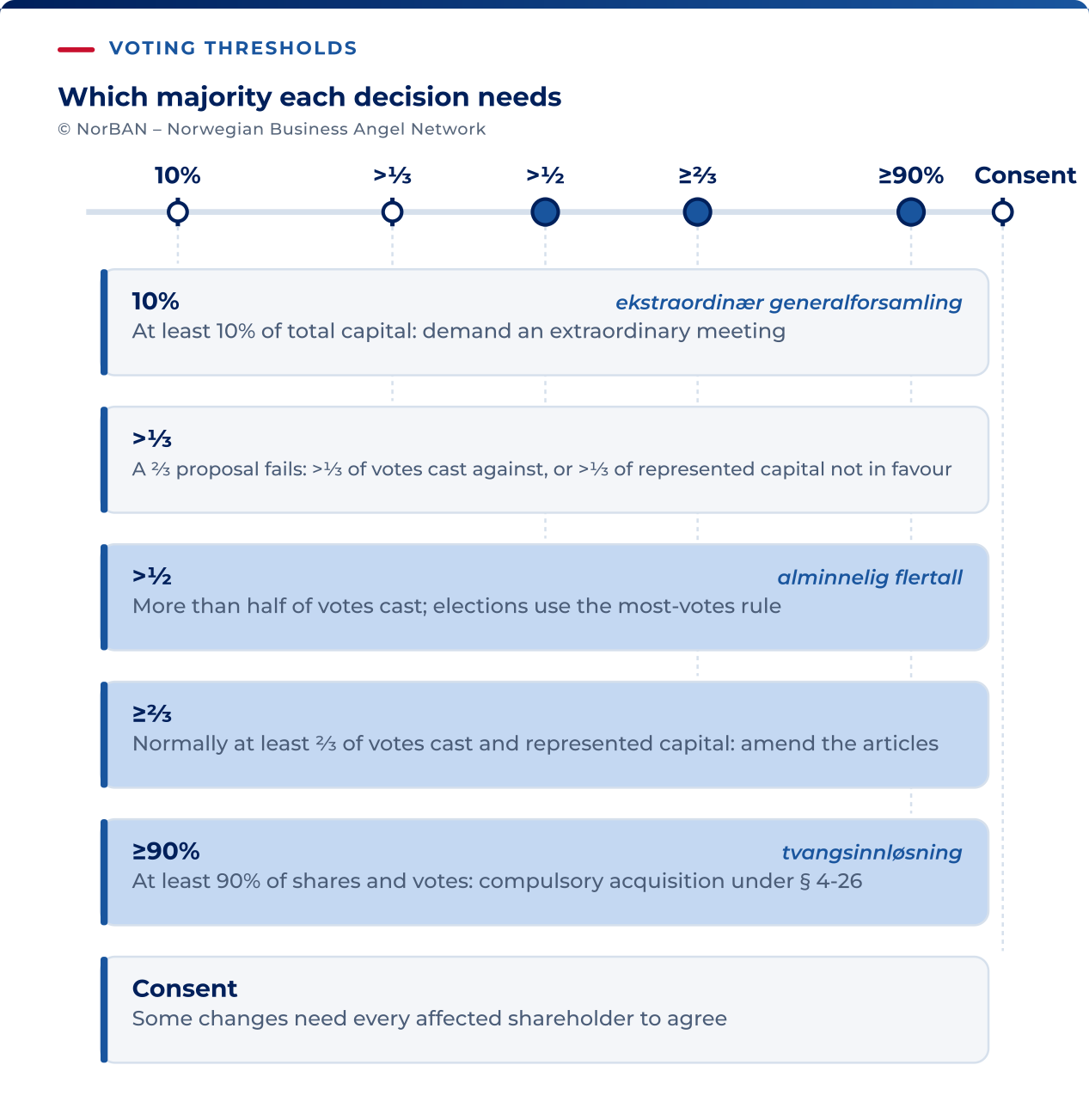
A founder bloc with more than half of the votes therefore chooses the board on its own, and your statutory position below that is thin. At the general meeting you can require information on the accounts, on the matters before the meeting and on the company’s position, unless the answer would cause the company disproportionate harm (§ 5-15).
Anyone may inspect the share register (§ 4-6). If an investigation proposal receives support from shareholders holding at least one tenth of the capital represented at the general meeting, any shareholder may ask the district court to order an investigation within one month after that meeting (§ 5-25). The proposal must be raised at the ordinary general meeting or at a meeting whose notice includes the matter.
The Act gives minority holders several protections, including rights requiring special consent in some cases. Under the usual two-thirds test, more than one third of votes cast against a proposal blocks it; withholding support from more than one third of represented capital also blocks it (§ 5-18). These are separate tests. A contractual veto can add protection over specified decisions.
An individual angel’s stake generally falls below that threshold, though a syndicate acting together sometimes reaches it. The company-law essentials set out the whole ladder.
Every governance right an angel actually holds exists because the shareholders’ agreement (aksjonæravtale) or the articles of association (vedtekter) created it. Decide which rights you need and record them in the document that makes them binding.
Board seat, observer, or neither
A board seat gives you a vote, board papers as of right, the power to require a matter to be dealt with, and the duties that come with the office. An observer place gives you attendance and the papers specified in the contract, without the statutory rights attached to board membership.
An appointment right binds the company only one way. The articles may transfer the general meeting’s right to elect board members to someone else, which is the hook a named investor’s or a class’s appointment right hangs on (§ 6-3, third paragraph).
The same subsection normally requires more than half the board to be elected by the general meeting. There is an exception where election rights are transferred to a corporate body established in the articles. Election rights cannot be transferred to the board or a board member.
A seat promised only in the shareholders’ agreement obliges the other parties to vote for your candidate. If they do not, you have a breach of contract and no director.
An investor observer has no status in aksjeloven. The only observer the act provides for is the employee observer in larger companies (§ 6-4). Your observer’s rights therefore depend entirely on the agreement, with consequences for voting, access to information and liability.
| Statutory position | Board member | Investor observer |
|---|---|---|
| Elected and registered | Elected by the general meeting or an articles appointment right; entered in Foretaksregisteret | Neither. Contracted in the shareholders’ or investment agreement |
| Quorum and vote | Counts towards the quorum and votes (aksjeloven § 6-24 and § 6-25) | Neither. Attendance and papers are whatever the contract gives |
| Disqualification | Must step aside from a matter of particular personal or financial significance (aksjeloven § 6-27) | Outside the rule as a member |
| Minutes | Has the statutory right to have dissent recorded; signing follows the rules and limited exception in § 6-29 (aksjeloven § 6-29) | Has no director’s statutory signing duty or right to recorded dissent; any additional arrangements must be agreed |
| Liability | Personal liability for loss caused intentionally or negligently in the office (aksjeloven § 17-1) | Not liable as a member. Reachable under aksjeloven § 17-1, second paragraph, for active contribution to a loss |
| Confidentiality | No general statutory duty. Built from the duty to the company, the abuse rule and the trade-secrets act | Agree confidentiality in writing. Statutory restrictions, including trade-secret protection, can also apply |
An observer faces less exposure, but can still be liable. The second paragraph of § 17-1 reaches anyone who intentionally or negligently contributes to a loss caused under the first, and it is not limited to office-holders, so an observer who pushes a decision they knew or should have known was unlawful or damaging can in principle be caught.
An observer does not acquire a director’s duties merely by attending. But the title does not settle liability: assess the person’s actual conduct, any contractual obligations and whether the conditions for intentional or negligent contribution under § 17-1(2) are met. Do not treat silence or observer status as a guarantee against liability.
Choose between a seat and an observer place according to the size of your investment and the work you will undertake. What counts as standard here is angel-network practice. In venture rounds with an institutional lead, Simonsen Vogt Wiig record that the lead typically appoints one or two directors.
| Your position | What to ask for |
|---|---|
| A single small ticket | An observer place, or information rights alone. A board seat for an investment that does not carry the work marks you as inexperienced and adds a director the company has to service. |
| A syndicate member | Nothing individually. The syndicate’s lead takes the seat if the group agrees it, and the members are informed through a reporting obligation on the company. |
| A syndicate lead | One seat, held personally, with the reporting arrangement below agreed at the company before you accept. |
| A sector specialist the founders want on the board | The seat, on the strength of what you bring, and the duties that come with it. Read the board-member article before you say yes. |
| A holding above a tenth, or a syndicate above a third | The statutory rights you already hold, written into the agreement so the rest of the cap table knows them, plus a seat or an observer place by agreement. |
The reserved-matters list
A reserved-matters clause requires investor consent before specified decisions. It adds contractual protection to the statutory voting rules. Under § 5-18, an ordinary amendment to the articles needs at least two thirds of both the votes cast and the share capital represented. A holder who attends and controls more than a third of either relevant base can prevent that threshold from being met. This does not block every decision: for example, the board may already have a valid authorisation to issue shares. Check the voting rights, attendance and existing authorisations before treating a stake as a veto.
In Norwegian venture rounds the package is a consent right, held by two thirds of the preferred shares, over amendments to the articles, changes to the capital structure, debt, mergers and reorganisations, major contracts and investments, dividends and key hires, as Simonsen Vogt Wiig record it. Read a proposed list against this table.
| Matter | Why it belongs on the list | Overreach at angel scale |
|---|---|---|
| Amendments to the articles; new shares, options and convertibles | Each one changes what you own or the rights attached to it. The usual amendment test is two thirds of votes cast and represented capital (aksjeloven § 5-18). Check the legal route for each instrument and any existing board authorisation; not every grant requires a fresh general-meeting vote | A veto over the employee option pool the round itself agreed |
| Borrowing and security above a threshold | Debt ranks ahead of you and security removes the assets you are underwriting | A threshold so low that ordinary supplier credit needs consent |
| Sale of the company or its business, mergers, reorganisations | The exit and the waterfall run through these decisions | A veto that lets a single small holder block a sale the drag-along was written to carry |
| Related-party agreements | Value can leave the company to founders or their companies. Section 3-8 requires board approval for agreements within its scope, thresholds and exceptions; the clause can add investor consent | Consent over every founder expense claim |
| Founder and management remuneration | Salary is the founders’ first call on the money you put in | A veto over ordinary hiring below management level |
| The annual budget and material deviations from it | The budget is the plan you funded; a deviation is a change of plan | Line-by-line budget approval, or consent over every contract above a trivial amount |
| Dividends | Cash leaving the company before the exit | None. This one is short and uncontroversial |
Give the veto to an investor majority, so the company negotiates with one voice and no single holder can freeze it. Pair it with a way out of deadlock, an escalation step first and ultimately a mechanism that lets one side buy the other out. Both matter more than the length of the list.
A veto that produces stalemate is not unlawful in itself. Its use is bounded by the abuse rules: neither the general meeting (§ 5-21) nor the board (§ 6-28) may act so as to give some shareholders an unreasonable advantage at the expense of the others or of the company.
A shareholder may ask the court for redemption where weighty reasons justify exit because of a serious and lasting conflict about the company’s operation (§ 4-24). The claim must be brought within a reasonable time. It cannot succeed if redemption would substantially harm the business or otherwise be unreasonable to the company, or if the company identifies another buyer willing to pay at least the redemption amount. The provision also covers certain abuse cases.
Information rights
The statutory fallback is the general-meeting right in § 5-15, the public accounts and the share register. There is no statutory right to board papers, to management accounts, to a monthly report or to a data room. Without contractual information rights, an investor may have to rely on the annual meeting and historical accounts.
Information rights are market standard in Norwegian venture shareholders’ agreements, covering operations, financials and performance. Contract these, and put the obligation on the company, made a party to the agreement, so the information leaves the company as a company act.
- Management accounts and a cash and runway figure, at an agreed cadence.
- The operating metrics the investment case rests on, in the same form each time.
- The annual budget before the year starts, and material deviations from it when they arise.
- Every change to the cap table, including options granted and instruments issued.
- Access to the auditor and the accounts on request, and a data room kept current between rounds.
Agree the cadence to the company’s stage and the cost of producing the report. Then use what you receive, because a right that is never exercised teaches the founders that the reporting is a formality.
The nominee director’s reporting line
A director nominated by an investor holds the seat personally and owes the duty to the company, not to the investor who nominated them. Norwegian guidance expects a director to report back to whoever elected them through natural channels, so the answer is not that board information can never move.
The limit is that the board must not act so as to give some shareholders an unreasonable advantage at the expense of the others or of the company (aksjeloven § 6-28), and that a shareholder’s own information right is a metered right exercised at the general meeting (aksjeloven § 5-15). These limits require judgement in each case.
Where a syndicate needs to be kept informed, the reporting obligation is put on the company in the shareholders’ agreement, the board consents on the record, and the recipients are bound by confidentiality. What a shareholders’ agreement cannot do is make the director the investor’s reporting line.
The board is competent to resolve such an arrangement, because it manages the company’s affairs (§ 6-12). The resolution should cover the following points.
- It records that the reporting line is in the company’s interest.
- It defines the scope of what may be shared.
- It binds the receiving investor by a confidentiality undertaking, with use restricted to monitoring the investment.
- It carves out inside information, third-party secrets, personal data and matters on which the investor is conflicted.
- It rests on something the other shareholders have accepted, in the shareholders’ agreement or the articles.
A board resolution does not by itself make every disclosure lawful. The company must still respect the prohibition on unfair advantages, trade-secret protection and other applicable restrictions. It also leaves the director’s duties to the company intact. Treat this reporting arrangement as a practical proposal to assess for the particular company, not as a statutory safe harbour.
Where each right lives and how it binds
Aksjeloven does not regulate shareholders’ agreements at all. The agreement is an ordinary contract, and the standard commentary on the act (Aarbakke and others) states the consequences that follow. They rest on commentary and general contract law, and no section of the act or single judgment lays them down.
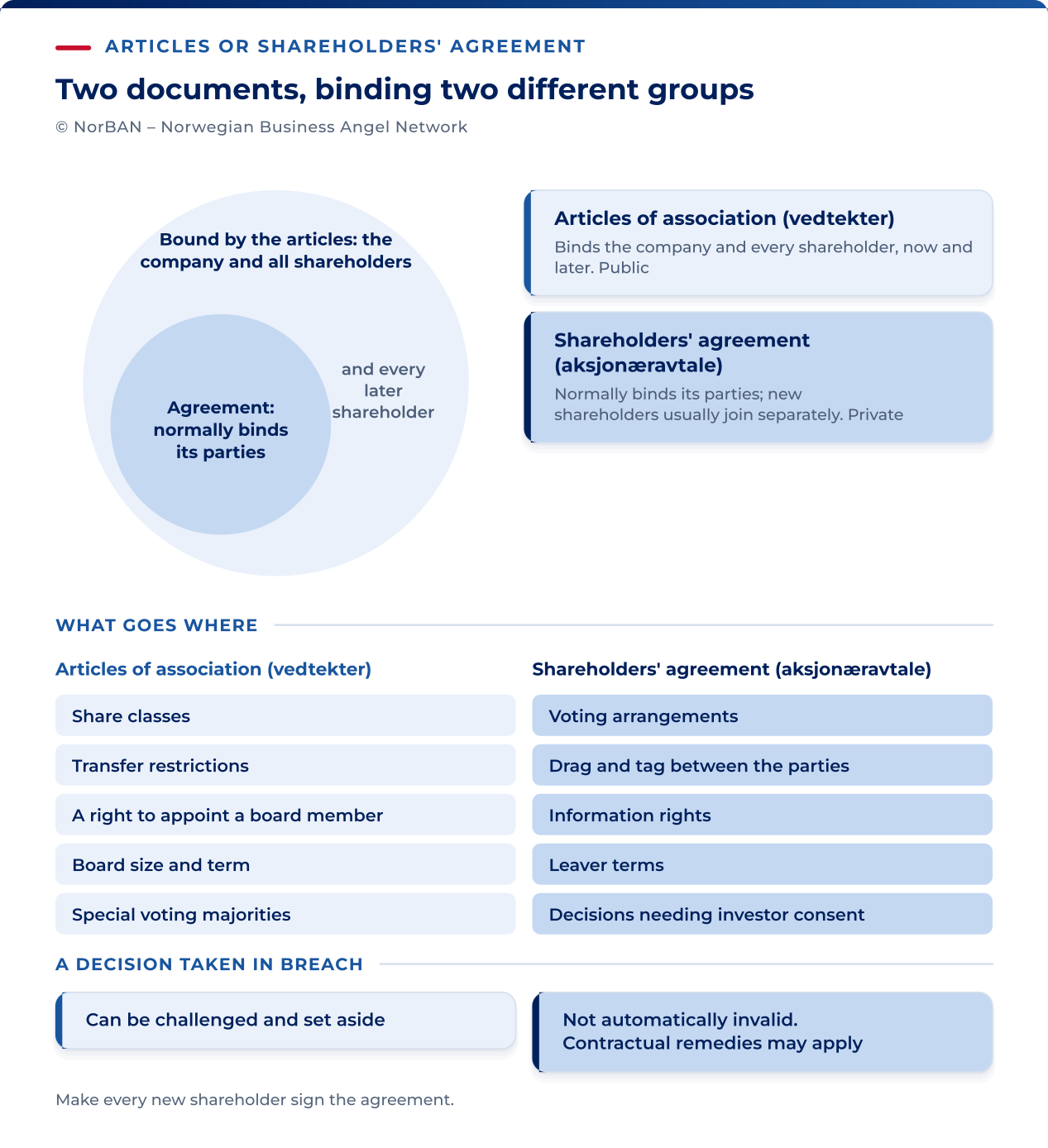
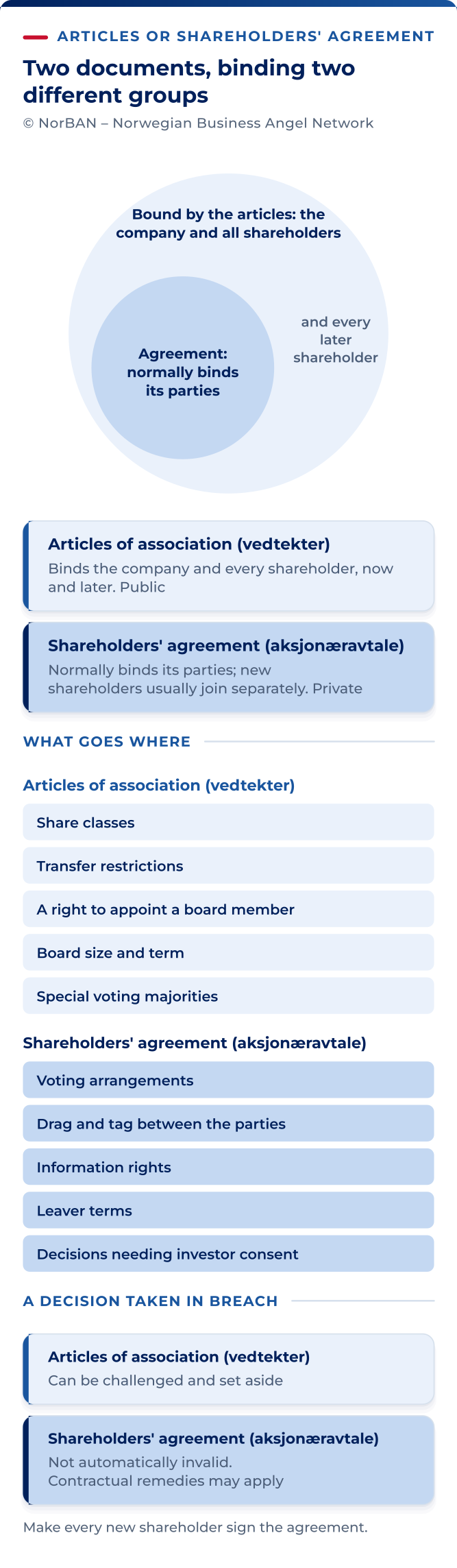
| Question | Articles of association (vedtekter) | Shareholders’ agreement (aksjonæravtale) |
|---|---|---|
| Who is bound | The company, its organs and every shareholder, present and future | The parties who signed. The company only if it is a party, and even then not out of mandatory company law |
| A new shareholder | Bound automatically | Bound only by acceding, so make an accession declaration a condition of every transfer and subscription |
| A decision taken in breach | A corporate act contrary to the articles can be challenged and set aside | The act stands. The remedy is contractual, damages or an injunction between the parties, never annulment |
| What goes here | Share classes, transfer restrictions, an appointment right under aksjeloven § 6-3, board size and term, deviating majority rules | Voting arrangements, drag and tag between the parties, information undertakings, leaver terms, reserved matters |
| Visibility | Public, filed at Foretaksregisteret | Private |
On a conflict the articles govern the corporate act and the agreement governs liability between its parties. An agreement cannot displace mandatory company law, whose recognised core is equal treatment, the abuse rules, the majority thresholds, capital maintenance and the allocation of competence between the organs.
Where every shareholder is a party to the agreement the distance between the two documents narrows, and unanimous shareholder action can stand in for some formalities. It still cannot override the rules that protect creditors and third parties. The shareholders’ agreement article takes the clauses in order.
The seat’s price tag
A board seat is an office, and the office comes with the duties in chapter 6 and the personal exposure in § 17-1. The board manages the company and must keep itself informed of its financial position (§ 6-12).
A member is liable for loss they cause the company, a shareholder or a third party intentionally or negligently in the office. That is board liability (styreansvar), and an observer place avoids the office half of it.
Subscribing in the round your board is proposing raises the disqualification question. A member must not take part in a matter of such particular significance to themselves that they have a prominent personal or financial interest in it (§ 6-27). The board’s proposal for a capital increase under § 10-3 is a proposal. The general meeting decides, and the rule does not apply there, which reduces the problem at board stage.
Whether a director subscribing on the same terms as everyone else, or pro rata to an existing holding, is disqualified from the proposal is contested in Norwegian doctrine. The commentary treats equal-terms subscription as generally not disqualifying, and says so without drawing a sharp line; a preferential price or allocation points the other way.
Assume the cautious position: settle the question first, leave the room for that item, and have it minuted. Aksjeloven prescribes nothing beyond § 6-27 itself, so those steps are guidance and practice.
No statutory confidentiality duty attaches to the seat either. What binds you is the duty to the company, § 6-28, the Trade Secrets Act and whatever the company’s own documents say. The board-member article explains the duties, liability and insurance in detail.
Take the seat when the investment or the work justifies it and you are prepared to hold it for the company. Take the observer place when what you need is the information. Take neither, and contract the reporting, when the ticket is small.