
What you have that the company cannot buy
A business angel (forretningsengel) brings capital, experience and contacts. As a co-owner, you can make introductions and offer judgement that the company cannot simply buy with the round.
- An introduction to a customer, a partner or a next-round investor who takes your call.
- A named candidate for the hire the company needs next.
- Credibility with the next round, because an angel who has stayed engaged and can explain the company is evidence in itself.
- Judgement in a market the founder has not sold into, when it is a market you have.
NorBAN’s published figures rank the competences angels bring as technology and product, then operator experience, then commercial and go-to-market, then finance and fundraising. The same page tells founders to choose some angels for the competency they offer beyond the capital, so the founder may already have a job in mind for you.
The evidence favours relevance. In the 2007 US study of angel groups, investments connected to the investor’s own industry expertise returned roughly twice as much as those outside it, and half of the sample’s deals had been made outside it.
When you invest, name the contributions you can make. A general offer of “help with whatever you need” leaves the founder to work out when to call you.
Agree the role in the first month
In the first month after closing, agree how often you will be in contact and through which channel. Be clear about the help you can offer and the questions the founder should take elsewhere.
Agreeing the role is easier while both sides are pleased with the investment. Waiting until the first missed quarter makes the conversation harder.
The other investors are agreeing the same things at the same time, and the shareholders’ agreement (aksjonæravtale) sets what all of them receive, as the governance article sets out.
Statutory rights include annual accounts before the ordinary general meeting (§ 5-5), public filed accounts (regnskapsloven § 8-1), and information at the general meeting within § 5-15. Other statutory document and minority rights also exist. Routine management reporting between meetings should be agreed separately.
Cadence and channel
Two streams of contact run after closing, and they should stay separate. The first is the reporting every shareholder receives, in writing and in the same form each time, which the monitoring article specifies, and the second is the working contact one investor keeps with the founder.
A standing slot every few weeks suits an angel working inside their own field with a job to do. A call when the founder asks suits everyone else. Agree it and hold to it, because a founder who gets three unscheduled calls in a week from one shareholder starts managing that shareholder.
The same 2007 US study found that angels in contact with a company once or twice a month recorded 3.7x, against 1.3x for once or twice a year. Read it with care. Angels stay close to the companies that are going well and drift from the rest, so it measures which companies earned attention as much as what attention did.
Where the effort pays, and where it costs
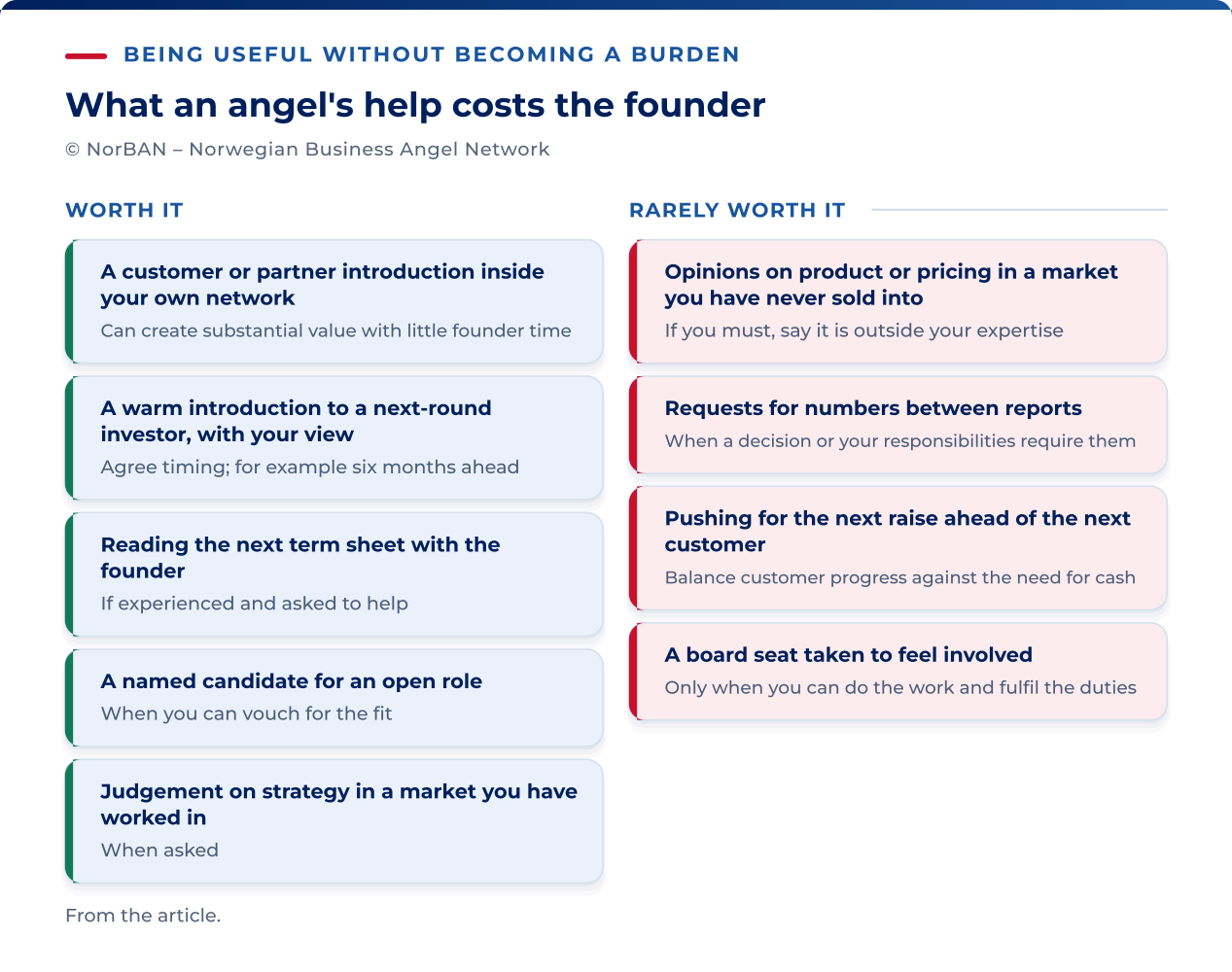
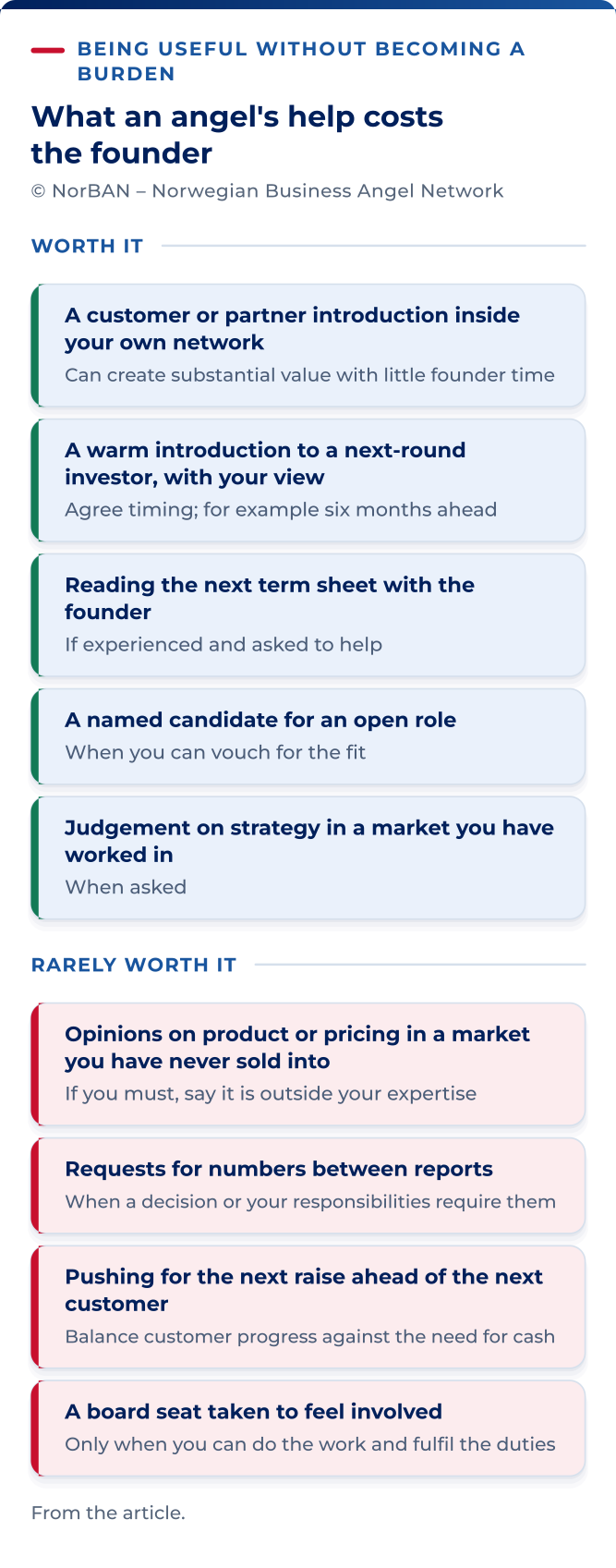
Consider how much work your offer creates for the founder as well as what it contributes. Choose what to offer this quarter on that basis.
| Contribution | What it costs the founder | When it is worth it |
|---|---|---|
| A customer or partner introduction inside your own network | One prepared meeting, if you brief the other side first | Whenever the company sells into a market you know. The highest-value hour an angel has |
| A named candidate for the next hire | Interview time, and the awkwardness if the candidate is wrong | When the role is open and you can vouch for the fit. A CV for a role that does not exist costs more than it gives |
| A warm introduction to a next-round investor, with your own view attached | Almost nothing, and it raises the odds of the meeting | When the company is within two quarters of raising and the investor works at that stage |
| Reading the next round’s term sheet with the founder | An hour, and a better negotiation | Every time, if you have read one before |
| Judgement on strategy in a market you have worked in | A conversation the founder wanted anyway | When asked, and when the founder has not sold into that market |
| Opinions on product or pricing in a market you have never sold into | Management hours spent politely considering them | Rarely. Say once that it is outside your competence |
| Requests for numbers between reports | An afternoon each time, taken from selling | Only when a decision of yours depends on the answer, and say which decision |
| Pushing for the next raise ahead of the next customer | The founder’s attention, the company’s scarcest input | Almost never. Money follows customers at this stage |
| A board seat taken to feel involved | A director the company has to service, with papers, meetings and minutes | When the investment or the work justifies it and you accept the duties |
On a first position, choose one contribution and deliver it well. A single introduction that becomes a customer is worth more to the founder than a year of general availability.
Holding several positions, put your hours where your experience is. Give the companies inside your field the standing slot and the introductions, and be a reliable, low-cost shareholder to the rest.
Asking, offering and saying nothing
Make each request easy to act on. Ask one question, explain why you need the answer, give a deadline and say what you will do with it.
An opinion lands as an instruction unless you say otherwise, because it comes from a shareholder. Label it as one view, say what evidence would change it, and leave the decision with the managing director (daglig leder).
Silence is the right move more often than it feels. When the company is executing the plan you funded, when a better-placed investor is already on the question, and when the founder has asked, listened and decided, let the work proceed and read the next report.
The board seat is a different job
In NorBAN’s published figures, only about one in five investors require a board seat, and the requirement is unrelated to ticket size. Most of the useful involvement in this market happens without a seat, through the contact and the contributions above.
Accepting a seat on the board (styret) converts an adviser into a director, with duties owed to the company and personal liability attached. The duties, the liability and the insurance belong to the board-member article. Before you say yes, be sure the investment or the work justifies a director the company must service.
When the news is bad
A difficult quarter is a chance to offer practical help. Offer time, an introduction to a co-investor who might bridge, a candidate for the gap that opened, and your honest read of the options. Ask for the cash position and the runway, what the founder intends to do, and what would help most.
Do not demand a new plan by Friday, a daily call or an account of whose fault it was. Time spent reassuring a shareholder takes the founder away from resolving the problem.
An angel cannot fix a company from outside. You can contribute through follow-on capital, introductions and, if you are a director, your work on the board. The monitoring article explains when the reporting calls for one of those responses, and the mistakes article collects the involvement failures in one list.