
Where the company actually is
Start by comparing cash with committed spending and progress with the plan the last round was raised to fund. The remaining weeks of runway determine how long you have to decide; the gap between the plan and delivery shows what further funding would need to achieve.
Assess the legal position at the same time, because it determines the timetable for the board and shareholders. A Norwegian AS must at all times have equity and liquidity that are sound (forsvarlig egenkapital) given the risk and scope of its business, under aksjeloven § 3-4.
Where it must be assumed that equity is lower than is sound, the board’s duty to act (handleplikt) bites under § 3-5. The board treats the matter straks, calls the general meeting within reasonable time to account for the company’s position, proposes measures, and proposes dissolution where nothing can be carried through.
The provision sets no deadline in days or months. The trigger at half the share capital was repealed for an AS in 2017 and survives only for an ASA in allmennaksjeloven § 3-5.
So a general meeting is coming and the board has to bring a proposal to it. Down rounds are an ordinary part of that sequence.
On one American equity-management platform’s own customers they run at roughly one priced round in ten in a normal market and double that in a bad one (published data index). The figure is American and platform-specific, and carries nothing about Norwegian levels.
Three shapes of money
Identify the structure being proposed. Check the corporate steps required and how the terms would affect your holding.
| Form | Purpose | Corporate route | Effect and limits |
|---|---|---|---|
| Bridge | Loan to reach a named event, often convertible. | Statutory conversion rights follow § 11-1, including an applicable registered mandate. Ordinary loans follow board authority; later conversion needs a valid issue route. | Dilution on conversion. An unchanged plan or underfunded gap remains. |
| Priced down round | New shares at a lower price. | § 10-1 decision or valid board mandate. Waive cash subscription rights only where required and authorised (§ 10-5). | Immediate dilution; reassess terms. Does not remove accumulated losses or permit below-nominal issue prices. |
| Recapitalisation | Loss-covering reduction, sometimes new classes, followed by funding. | Reduction under § 12-1; assess the simultaneous-increase exception and other notice rules under § 12-5. | Preferences and protections may be renegotiated. Creditors’ claims remain. |
A Norwegian issue fixes two separate numbers, the nominal value (pålydende) of the shares and the amount payable for each. A contribution cannot be lower than the nominal value, and where a share is subscribed for less the nominal value must still be paid in (asl. § 2-12, reaching a capital increase through § 10-12).
If the proposed subscription price is below the current nominal value, nominal value must first be reduced; an issue at nominal value needs no such reduction. A reduction solely to cover losses can take effect on registration without creditor notice under § 12-5(1), but restricts dividends for three years unless the statutory exceptions are used. Under § 12-5(2), no notice is needed where a simultaneously notified new cash or non-cash issue restores restricted equity to at least its previous level. Other routes may require six weeks’ notice under § 12-6.
The bridge, and the bridge to nowhere
Bridge financing (mellomfinansiering) is money sized to reach a defined event by a defined date. Settle what the event is, what reaching it costs and who else is in, before anyone opens the discount and the cap in the instruments article.
Ranking matters more here than at entry. The loan is an ordinary unsecured claim under dekningsloven § 9-6, and the two things that move it both need your signature.
Contractual subordination drops the claim behind every other creditor (§ 9-7 nr. 2); security moves it the other way, leaving only the shortfall as an ordinary claim. In a rescue you are usually asked to lend, to subordinate and to accept conversion terms in one conversation, and only the first is neutral.
Debt conversion requires a valid subscription and permission to settle by set-off. Set-off does not discharge the contribution obligation to the extent it could harm the company or its creditors (§ 2-12, applied through § 10-12). The board’s report and auditor confirmation must address the contribution. Do not confuse its company-law value with the lender’s tax basis.
For company-law purposes, a debt conversion may use the claim’s face value even when its market value to the creditor is lower: the company is released from the debt. The creditor’s tax result can still depend on market value. The Ministry of Finance expressly distinguishes the two in its 2016 clarification. Have the auditor and tax adviser check their respective calculations; financial distress alone does not require the company-law contribution to be limited to the claim’s market value.
A personal lender outside a lending business generally cannot deduct a lost ordinary loan. On conversion, tax cost follows market value when the conversion becomes binding, not face value; converting a nil-value claim leaves nil tax cost in the shares (Skatte-ABC A-5-6.10). Instrument classification and any business exception need tax advice.
The common failure is a second bridge and then a third, funding a plan nobody has changed. Decide before the first what would make you fund a second, and say it in the room at the time.
Pay-to-play, and what it can reach in an AS
A pay-to-play makes an existing holder who declines their share of the new money lose something beyond dilution, such as a reclassification into a weaker class, a redemption, or a right. Norwegian law has no pay-to-play provision, so the real question is which ordinary company-law route the structure is using.
Establish exactly what the proposed clause would do. The consent required depends on whether it imposes a funding obligation, changes rights, forces a redemption or only dilutes the holding.
| Formulation | Provision | What it needs |
|---|---|---|
| A duty to fund or subscribe pro rata | asl. § 5-20 første ledd nr. 1 | all shareholders |
| Non-participating shares reclassified into a weaker class | asl. § 5-20 første ledd nr. 4 | all, or every affected holder plus the articles majority |
| Compulsory redemption of the non-participant | asl. § 5-20 første ledd nr. 3 | all |
| A dividend or asset right cut in some other way | asl. § 5-19 første ledd | more than nine tenths of represented share capital, plus the articles-amendment majority |
| Dilution alone, at a low price with pre-emption waived | asl. § 10-5 with § 5-18 | two thirds of votes cast and of capital represented |
The table is a starting point for classifying the proposed change, not an automatic approval of a pay-to-play clause. Under § 5-20(2), a change affecting only some shareholders requires all affected shareholders’ consent plus the articles-amendment majority. A shareholders’ agreement binds its parties; share-class rights also require the appropriate articles and company decisions.
The first rows are about validity rather than fairness. A resolution taken without the assent the provision requires can be attacked as contrary to the Act (asl. § 5-22), and the ordinary three-month deadline for such a suit does not run where the Act required a consent that was not given (§ 5-23 annet ledd nr. 2).
Two limits follow from the words utgitte aksjer, shares already issued. Redemption written into the articles before the shares were issued is a separate route with its own machinery (§ 12-7), and a new issue priced to punish those who do not subscribe leaves the non-participant’s shares untouched, which puts it under the equal-treatment rule instead.
How the provision applies to a particular pay-to-play clause, and whether a holder’s assent given in advance in a shareholders’ agreement satisfies it, are questions for advice on the clause itself. The cautious course is to obtain each affected holder’s assent to the resolution when it is taken.
Two general clauses sit over all of it and neither can be contracted away. The general meeting may take no decision apt to give certain shareholders an unreasonable advantage at the expense of others or of the company (asl. § 5-21); § 6-28 binds the board to the same.
Both provisions govern how a validly adopted power is exercised, as well as how it is adopted. Check the proposed use of the power even if the approval requirements have been met. In HR-2020-1947-A the Supreme Court read § 6-28 as an expression of a general prohibition on abuse of power, and found a duty of loyalty between shareholders.
The remedies ladder then runs to court-ordered exit under § 4-24 and to redemption in place of dissolution under § 16-19. The closest Norwegian facts are HR-2016-1439-A (Bergshav), where a dividend funded by an issue priced far below underlying value diluted a minority unless it subscribed.
The Court treated starving a minority out as an abuse of authority within § 16-19 (avsnitt 95). It held that the company’s profit purpose (vinningsformål) entitled shareholders to a reasonable ongoing return (avsnitt 97).
The remedy was an exit at the underlying value without a discount (avsnitt 165). The case did not decide whether a pay-to-play clause was valid.
The valuation rule depends on the legal route. For redemption after refused consent under section 4-17, Flesberg (Rt-2007-1392), paragraphs 41–44, uses expected market value where it can reasonably be established. This differs from the underlying-value approach in Bergshav for court-ordered withdrawal under section 4-24.
Recapitalisation and the stack
A clean-up renegotiates the old structure as the price of the new money. Earlier preferences are extinguished or reset, protections waived, and the incoming investor asks the existing table to give something up first.
Before signing, establish your place in the preference stack after the round. Check whether anti-dilution protection is triggered and what it delivers on an ordinary-share cap table, then assess your pro-rata right at the proposed distressed price.
Use the preference and anti-dilution article to work through the figures. In a rescue, also check whether the protection can be executed and whether the pro-rata right covers all the dilution.
Norwegian price protection is delivered as extra shares or subscription rights, so it cannot execute itself and needs a general-meeting resolution the funding group controls. And a right drafted as a proportionate share of the new shares will not hold a percentage in the round where a convertible converts and the pool is topped up.
When you are also on the board
A director owes duties to the company; an investor deciding whether to fund it is deciding for themselves. Where a decision has particular significance for a director or a close associate and that director has a prominent personal or economic special interest in it, the director must take no part in the treatment or the decision (asl. § 6-27).
Declare your interest before a rescue-financing item and assess disqualification under § 6-27. Same-terms, pro-rata participation does not automatically settle that question; preferential allocation, price-setting or security can change the assessment. A disqualified director takes no part in discussion or decision. Record the assessment and participation, and have counsel resolve any resulting quorum problem.
A loan from a shareholder or a director is an agreement with a related party, and aksjeloven § 3-8 has no general exclusion for loans. Check its thresholds and specific exceptions, including ordinary-course agreements on normal terms. It does not apply at all where the company’s own performance is worth less than NOK 100,000 (sjette ledd nr. 2).
Where there are no approved annual accounts the 2.5 per cent threshold is measured against paid-in nominal plus share premium, which a company that has raised once and earned nothing crosses easily.
The board must prepare a statement on the agreement and a declaration confirming that:
- The agreement is in the company’s interest.
- What each side gives is reasonably equal in value.
- The equity and liquidity requirement is met.
Both documents must go to every shareholder with a known address and to Foretaksregisteret (tredje og fjerde ledd).
An agreement made without the required board approval still binds the company unless it can show that the other party knew or should have known approval was missing. If the agreement does not bind the company, anything transferred under it must be returned (femte ledd).
For a shareholder loan, have counsel assess the fair value of the company’s repayment, interest and other obligations at signing. Do not assume the incoming loan cash can simply be netted off. The reviewed wording supports that cautious approach but does not settle every valuation issue, particularly in distress; follow the procedure where applicability remains doubtful.
The board-liability article explains the personal exposure behind these steps.
When the creditors are the constraint
Sometimes the constraint is the company’s creditors, and the route is a restructuring (rekonstruksjon). A debtor that has, or in the foreseeable future will have, serious financial difficulty may petition the tingrett, which is a lower threshold than insolvency (rekonstruksjonsloven § 2).
Norway has two statutes for this, and which one applies depends on when the case arises. The temporary rekonstruksjonsloven, LOV-2020-05-07-38, provides for rekonstruksjonsforhandling, and konkursloven’s own gjeldsforhandling rules are suspended while it runs rather than repealed (konkursloven § 1).
Its replacement, adopted and sanctioned on 19 June 2026 as LOV-2026-06-19-48, is an amending act in 28 parts whose del I rewrites konkursloven’s first part. Del I takes effect on a date the King in Council sets, provisions may take effect at different times, and the temporary act is repealed the day del I takes effect (del XXVIII nr. 1–2).
Proceedings already running on that day are left to transitional rules the ministry may issue (del XXVIII nr. 3). So the first question in any case is which regime applies on the day the proceedings open, and Lovdata’s page for the amending act records whether del I has commenced.
The sharpest difference between the two regimes is who can be swept into a debt-to-equity conversion. Under the temporary act, rekonstruksjonsloven § 34 tredje ledd, the arrangement «kan bare omfatte fordringshavere som samtykker til dette», so active consent is required.
The court may extend it to a refusing creditor only by kjennelse, on weighty grounds, and only where that creditor «åpenbart ikke har rimelig grunn». Under LOV-2026-06-19-48 del I, § 33 fjerde ledd, passivity suffices, because the conversion covers «fordringshavere som ikke motsetter seg det», so a creditor who does nothing is inside it.
An objector may still be overridden on the same «åpenbart ikke har rimelig grunn» test. Del I’s best-interest floor is also wider, measured against «konkurs eller ved det alternative sannsynlige utfallet dersom rekonstruksjonsforhandlingen ikke lykkes» and no longer against bankruptcy alone.
Under the temporary act the general meeting still resolves the capital increase, at a reduced threshold with two limbs. At least half the votes cast and at least half the capital represented, in place of the usual two thirds, and the proposal carries on a tie (rekonstruksjonsloven § 35).
So under the temporary act a holder of more than half of what is represented controls that resolution. Under del I a confirmed plan replaces those resolutions.
Shareholders then vote in their own class at half the votes cast and half the capital that voted, they can be crammed down, and no new money can be forced on them.
They have no best-interest test of their own and no standing to object under § 46 nr. 8. Their route is aksjeloven § 5-21, with the participation rights, discontinuation on proof of solvency, and a ten-day appeal against the confirmation order.
They are, however, deliberately left outside absolute priority, so they may keep some equity even where senior classes are not paid in full.
Two things reach you on the creditor side. A nærstående claim, a subordinated claim and a conditional claim each lose their vote by name (rekonstruksjonsloven § 41), the bridge lender is often all three, and the confirmed akkord binds them anyway.
For restructuring proceedings opened on or after 1 July 2026, the temporary suspension of tax priority no longer applies. Earlier proceedings remain covered by the transition rule in Regulation 2020-05-11-974. Priority under section 9-4 covers specified claims subject to time limits, not all tax arrears. A plan normally does not bind a creditor for the priority-covered portion unless the priority is waived as provided by law. Calculate the protected and unprotected amounts separately.
The test before you invest
Treat the rescue as a new investment. Money already invested is spent either way; decide whether another investment at this price is your best investment.
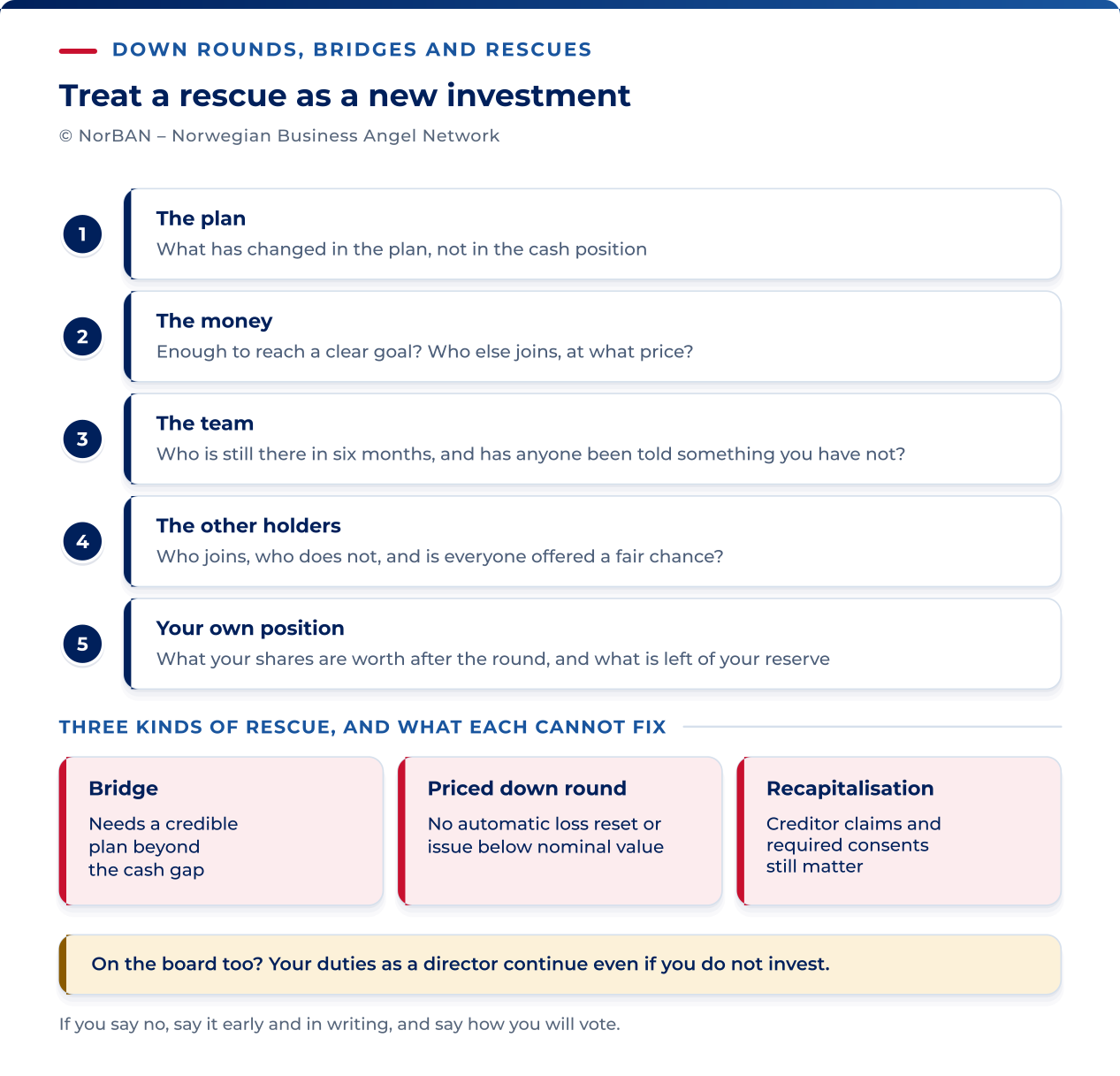
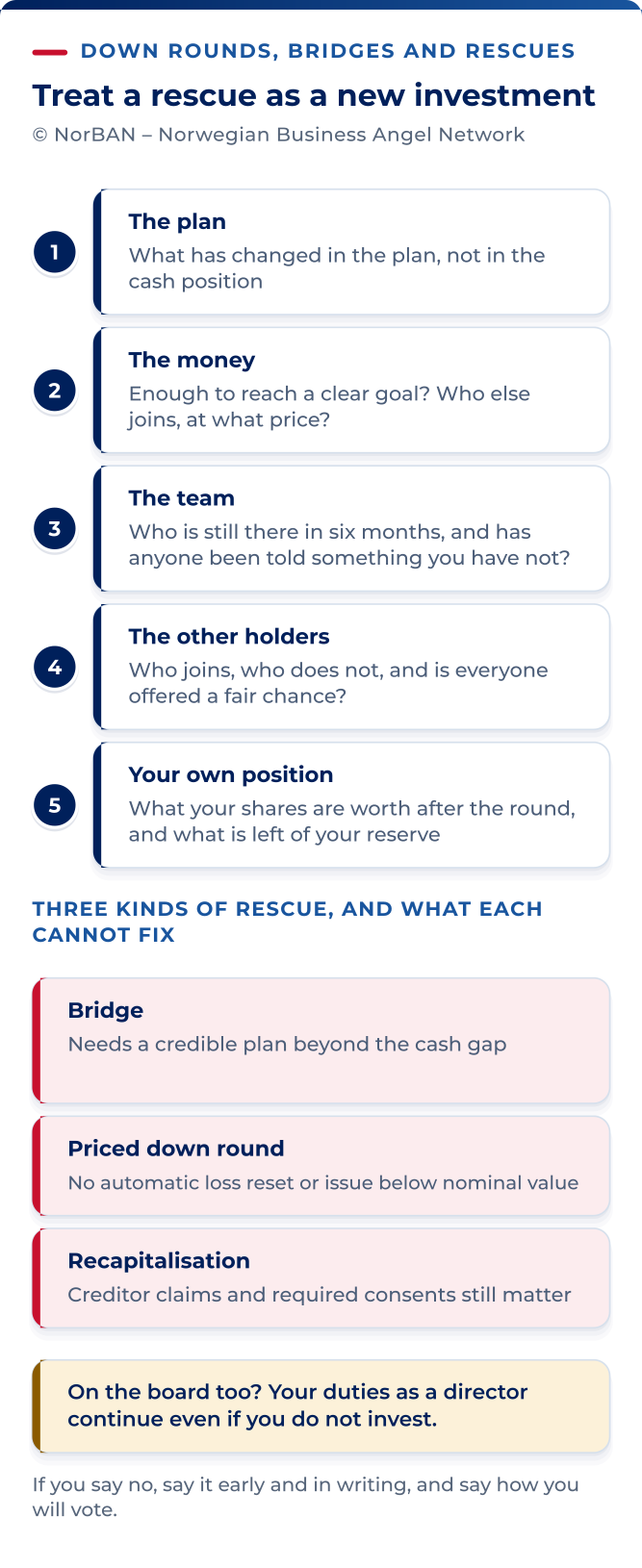
- Plan. What changed besides cash? Running out is a symptom; rescue funding needs a changed plan.
- Money. Which event does it fund, who joins at what price, and what follows that event?
- Team. Who stays for six months? Check notice, retention and undisclosed promises.
- Other holders. Who joins? Does the board’s subscription-right proposal cover the requested decision? The meeting cannot depart further without affected holders’ consent.
- Your position. Value your post-round holding through the preference stack and dilution, alongside reserves for other companies.
Your role also affects the decision. If you hold a board seat, address the § 6-27 and § 6-28 process before deciding whether to invest; declining to fund does not end your duties as a director.
As the largest outside holder your decision sets the price for everyone smaller, and silence from you reads as a verdict. If you lent into an earlier bridge you are deciding as a creditor and as a shareholder at once.
Decline early, in writing, with your reason in one paragraph, and without conditions that would make the round fail for the others. Say whether you will support the resolutions and whether you are waiving pre-emption.
Standing aside in a rescue round has greater consequences than declining a round in a healthy company. Establish those consequences before the meeting.