
The follow-on is a new investment
The question at a follow-on is whether you would open this position today, at this price, on the evidence in front of you. The money already invested is committed; its amount does not tell you whether to invest again.
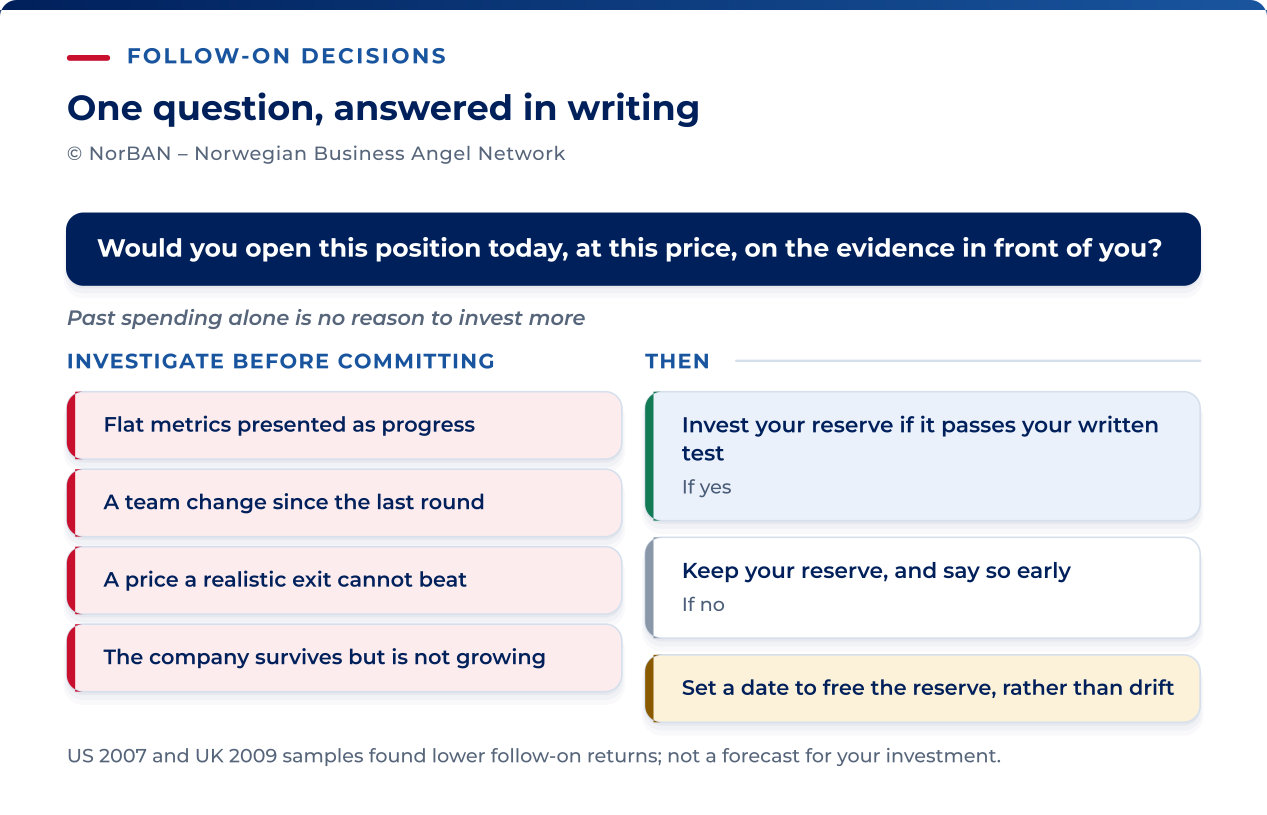
What has changed since the first investment is that you have watched the team work for a year or two. That experience gives you stronger evidence than the original deck, but it can also create an attachment to the company. Keep the evidence separate from that attachment.
Someone else sets the price at a follow-on, usually a new lead with reasons of its own, and the founder is in the room asking. Both push you towards a view you have not formed yet.
Form your own view before the meeting. Write down what you would need to see, read the reporting against it, and arrive with a position you could defend to someone who has no money in the company.
What the pro-rata right gives you
Existing shareholders hold a statutory pre-emptive subscription right (fortrinnsrett) to the new shares in a cash capital increase (kapitalforhøyelse), pro rata to their holdings (aksjeloven § 10-4).
The general meeting sets that right aside for a given issue by the articles-amendment majority, two thirds of the votes cast and of the share capital represented (§ 10-5). An external round may require a waiver for its proposed allocation; it does not invariably do so.
A contractual pro-rata right in the shareholders’ agreement can protect participation beyond the statutory default. It binds its parties within the agreed scope. A corporate waiver does not itself erase that contract, but exercising it preserves your percentage only for the issues and instruments it covers.
Failure to make a contractual pro-rata offer can give a claim against the parties who breached the agreement, without itself invalidating the issue. A statutory waiver does not remove all protection: invalidity, equal treatment and abuse-of-power rules may still matter. Act promptly on advice if the corporate decision itself is challenged.
Base the decision on the documents the company must produce. The board’s proposal comes under § 10-3, with its background papers.
The notice goes in writing to every shareholder at least a week before the meeting, unless the articles set a longer period, and any attachments must be available by the same deadline.
The resolution under § 10-1 states the amount of the increase, the subscription price, who may subscribe and any departure from the pre-emptive right, the subscription and payment deadlines, and the rights attaching to the new shares. Subscription is then made in the minutes or in a separate subscription document (§ 10-7).
Your pro-ratan investment is your percentage of the round, so it rises with the round size while your holding falls without it. On a company priced at NOK 40 million before the money, a ten per cent holder faces this.
| Round size | Your investment to hold ten per cent | Your holding if you decline |
|---|---|---|
| NOK 5 million | NOK 500,000 | 8.9 per cent |
| NOK 10 million | NOK 1,000,000 | 8.0 per cent |
| NOK 20 million | NOK 2,000,000 | 6.7 per cent |
The preference and pro-rata article runs the same right across three rounds, with a convertible converting and an option pool topped up in the same numbers.
Where the majority waives the pre-emptive right and places the round without you, the grounds are equal treatment (aksjeloven § 4-1) and the abuse provisions for the general meeting (§ 5-21) and the board (§ 6-28).
An action challenging the general meeting’s decision is brought against the company. The normal deadline is three months after the decision; for a decision outside a meeting, it runs from the day the minutes were sent to shareholders. Section 5-23 contains exceptions, including serious consent or notice defects. Get advice promptly rather than assuming an exception will save a late claim.
The evidence that earns the reserve
Practitioner guidance and measured outcomes point in opposite directions here, and both belong in the decision.
On the guidance side, Seraf puts the first investment at 25 to 50 per cent of what an angel plans to put into one company, which leaves reserves of 50 to 75 per cent.
An undated American best-practice paper for the Angel Capital Association tells prudent angels to reserve 50 to 100 per cent of invested capital or more, and builds its worked portfolios on 35, 50 and 100 per cent.
On the evidence side, in the United States in 2007 Wiltbank and Boeker found that 29 per cent of exited angel investments had received follow-on money from the same angel, and that those exits returned 1.4 times capital against 3.6 times for the exits without it.
In the United Kingdom in 2009, NESTA found follow-on exits returning 1.2 times and significantly less successful than the rest. The two studies were run independently, in different markets and different years, and they found the same direction.
The companies seeking follow-on investment differ from the portfolio as a whole. The companies that come back for more money are disproportionately the ones that need it, so a follow-on investment is drawn from a weighted part of the portfolio and not from the whole of it.
Those figures come from American and British studies published in 2007 and 2009. They give reason to scrutinise follow-on investments, but do not establish a rule that you should decline them.
So hold the reserve, and release it against a test rather than a ratio. Seraf’s own test is performance against the specific concerns diligence identified, which is a narrower question than general progress and much narrower than loyalty.
Make the test specific in your own policy. Release the reserve on evidence that the company reached the milestone the last round was raised for. Where it did not, ask what it reached instead, and price that.
Read the reporting for these, one line at a time, before the round has a closing date.
| Signal | What qualifies | What does not |
|---|---|---|
| The concerns diligence raised | A named concern closed, with evidence you can check yourself | The concern unmentioned in two consecutive updates |
| Revenue | Paying customers won without the founder in the meeting, in cohorts old enough to have renewed | Bookings, pipeline and letters of intent |
| Unit economics | Gross margin and paid acquisition cost improving as volume grows | Growth bought at a widening loss per customer |
| Runway | The new money reaches a milestone the next investor has already named | The new money reaches the next conversation |
| The team | The gap the last plan named has been filled, and the hire has started | The same gap, described in different words |
| The price | A price the plausible exit clears with your preference stack intact | A price justified by the last round rather than by what happened since |
When to stand aside
Apply the same evidence and record your reasoning when deciding to keep the reserve. Each of the cases below is checkable before the meeting.
- Flat metrics dressed as a flat round. The price has not moved because nothing has, and the round funds another year of the same plan.
- A team change since the last round. The people you underwrote are not the people spending the money, and you have no evidence on the ones who are.
- A price the plausible exit cannot clear. Work the waterfall at a realistic sale value, and if your money does not come back at that price, the round is not investable at any size.
- The company is alive rather than working. Revenue covers some costs, nobody will buy it, and the next round exists to postpone the question.
Where one of these applies, say no now and keep the reserve for a company with better evidence behind it. The earmark should lapse on a date you set rather than drift.
The sunk-cost trap, and the rest of the room
Research has measured the tendency to keep committing money after an earlier investment. A meta-analysis of 98 effect sizes from 45 studies published between 1976 and 2013 finds clear evidence that the sunk-cost effect emerges, at a moderate overall effect size.
It also separates two kinds of decision. Allocating further resources to a failing project is a progress decision, which is exactly the follow-on, and there elapsed time makes the effect stronger.
The longer you have held a struggling position, the harder it is to stop funding it. Experience does not protect you here, which is why the correctives have to be procedural.
The room adds its own pressure. The founder is asking you directly, a co-investor has already committed, and the lead wants the round full by Friday.
- Write the release test into the reserve policy before the first investment, where no company is in front of you.
- Reach your number before the meeting, from the reporting, and put the date and the reasoning in writing.
- Ask someone with no position in the company to read the reasoning and say what is missing.
- Size the investment from the reserve you set, and treat any increase as a separate decision made on a separate day.
What not following signals
An existing investor who passes is read as a judgement on the company, by the new lead and by the founder. Assume it will be read that way, and decide whether you are willing to send it.
Sometimes you are. A thesis that has moved, a reserve already committed elsewhere, or a position at its full intended size are all honest reasons, and they say nothing about the company.
Decline early, before the round has an allocation problem, and decline to the founder and the lead at the same time. Give the reason in one sentence, in terms of your own portfolio where that is true, and say what you will still do.
Following at a reduced size sends a different message from standing aside, and it is often the accurate one. Say which it is, so nobody has to guess.
When you cannot follow
You can choose to accept dilution (utvanning); the table above shows what that would mean for your holding. Decide it once, at the size of the round you expect, instead of discovering it when the notice arrives.
A statutory subscription right can be transferred once the increase is resolved, under § 10-4. A contractual participation right follows its own assignment terms. An unexercised statutory right lapses at the subscription deadline, with remaining shares allocated under the resolution and § 10-4.
Following through a syndicate lets you take a smaller position in the round than your own pro-rata would require, with the lead doing the work. What the vehicle owes you afterwards is written in its own agreement.
NorBAN’s published figures put this in proportion. Fewer than a third of the angels in the network will consider investing at Series A, about a third have capacity to follow on in later rounds, and the page describes their money as round-completing rather than round-sustaining.
So plan the next round on the assumption that most of your current co-investors will not be in it, and that the reserve holding your percentage is yours alone to find.
Write four things into the reserve policy before the next new investment. Record the amount earmarked, the test for releasing it, the date the earmark lapses and whether you can follow at all.
A bridge or a rescue round at a lower price is a different decision. It turns on the terms offered to the money that arrives first, and the reserve is only the question of whether you are at the table.