
Deciding the position is over
Start with what a further krone of money, time or attention would achieve. Use the evidence gathered through your regular reporting to decide whether the investment has reached its end.
If the company is still worth saving, assess the options for rescue financing. If you conclude that it cannot be saved, work out how to end the holding and what that will cost.
Record your answers in the investment file so you can explain the decision and refer back to the evidence.
- Is there a plan that could still be funded, and by whom. Name the investor, the grant or the customer contract that would fund it.
- Has the team stopped. Count who is still working full time and who is still being paid.
- Is the company trading, or has it stopped trading. A company still invoicing customers is in a different position from one that has stopped.
- Is the model broken, or only late. A model that works only at a scale the company cannot reach is broken.
- What would have to be true for anyone to buy this company or fund it. Write that sentence out and see whether you believe it.
A company that has stopped trading is not necessarily insolvent. Under konkursloven § 61, inability to pay debts as they fall due must not be temporary. The company is nevertheless not insolvent if its assets and income can be assumed to cover all its obligations, even if payments are delayed because assets must first be sold.
Insolvency is also absent where assets and income together are expected to cover obligations fully, even if selling assets delays payment. Assess both liquidity and coverage; a shortfall alone does not choose the route out.
So a dormant company with no debt it cannot pay can go through a solvent winding-up (avvikling), while a company that cannot pay is heading for a bankruptcy (konkurs) whoever petitions first.
Where creditors are the constraint and a plan is still possible, the route is a court-supervised restructuring, under the temporary rekonstruksjonsloven or its adopted replacement depending on which applies when proceedings open, and funding one is part of the rescue decision.
What writing it off does, and what it does not
Recording the holding at zero changes your own valuation. The shares still exist, the shareholding is still registered, the reporting obligations still attach, and no deduction has arisen.
A deductible share loss normally requires a tax realisation. The relevant event and timing depend on the route below. A fall in value or an inactive company is not enough. Whether you can deduct the loss also depends on your tax position, including personal or company ownership; see tax for angels.
| Event | What has actually happened | When the loss is timed | Where the rule is published |
|---|---|---|---|
| Bankruptcy opened over the company | The court has opened proceedings, appointed a trustee (bostyrer) and announced the opening | The income year bankruptcy is opened. Where the estate is handed back to the company, realisation is normally taken not to have occurred at the opening | Skatte-ABC A-5-3.7 |
| The company wound up and dissolved | The general meeting has resolved dissolution, the creditor period has run and the obligations are covered | When the decision to distribute is taken, after the obligations are covered and the creditor period in aksjeloven § 16-9 has expired | Skatte-ABC A-5-8 |
| The shares sold or otherwise realised | Ownership has passed to a new owner on real terms | The realisation itself, on ordinary principles | Skatte-ABC A-5-5.2 |
| The company simply dormant | Nothing. No organ has resolved anything, no court has been asked, and no ownership has moved | No loss is timed and none can be claimed | — |
The routes out
Identify which route you can initiate yourself. Most of these decisions are outside a minority shareholder’s control.
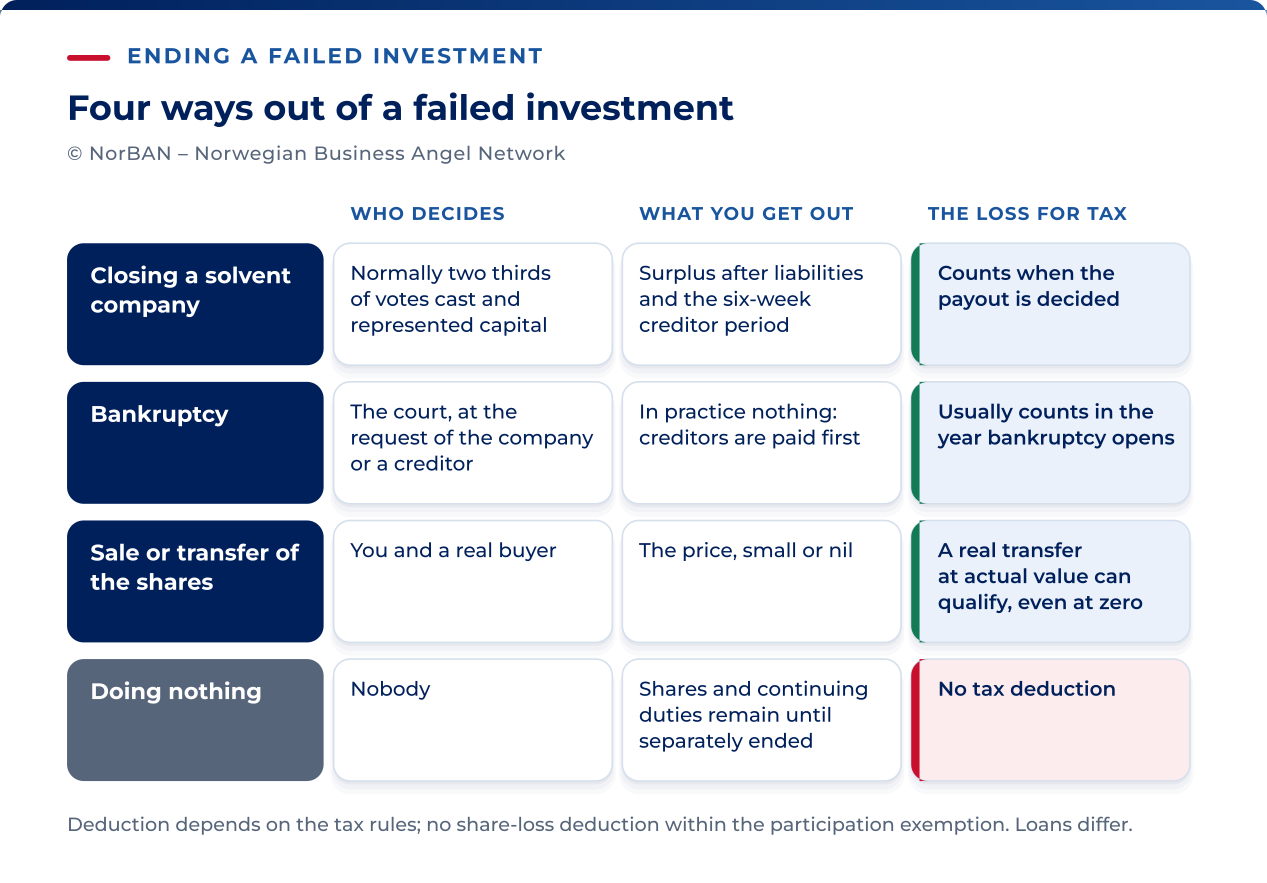
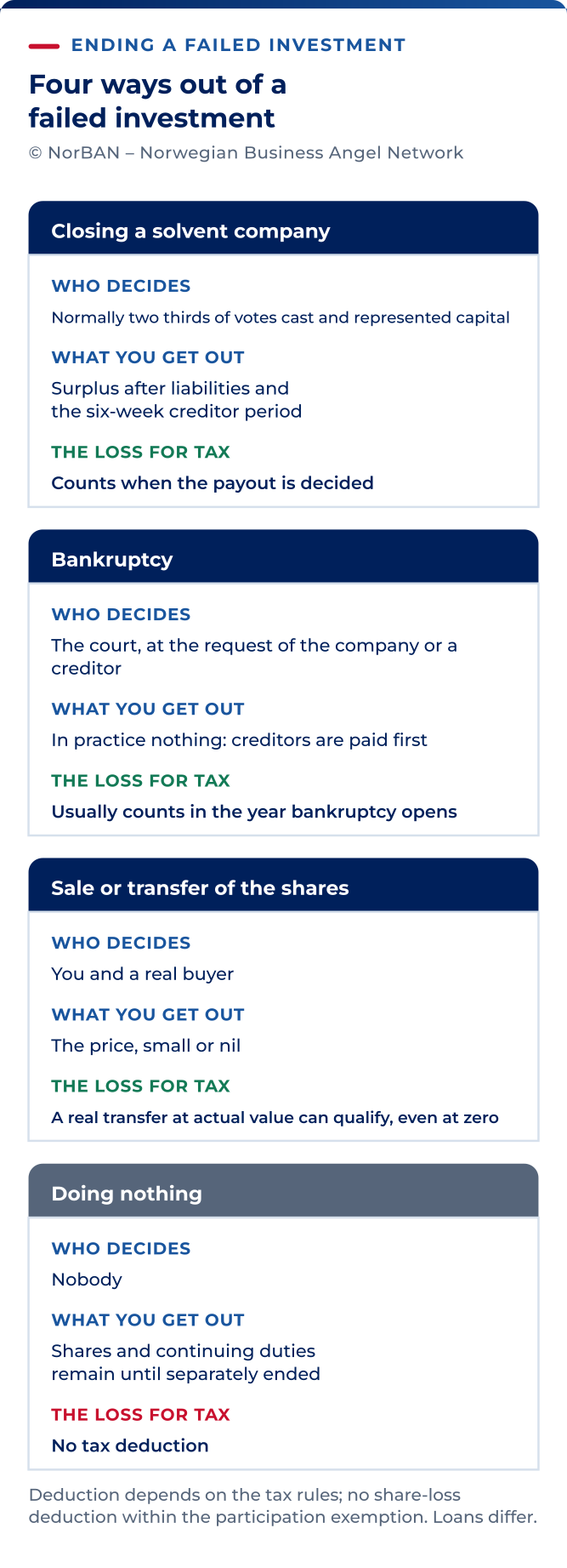
| Route | What it takes | Who decides it | What you get out | What it costs you | What it does to the loss |
|---|---|---|---|---|---|
| Solvent winding-up | Two general-meeting decisions and two filings, a six-week creditor notice published by the register, and deletion requested within a year of registration | The general meeting, on two thirds of the votes cast and of the capital represented (aksjeloven § 5-18) | Any surplus after the obligations are covered, at the earliest six weeks after the announcement (aksjeloven § 16-9) | Adviser and audit time, and a tail: money taken out can be reclaimed up to the amount you received | Realisation, timed to the distribution decision |
| Bankruptcy | A creditor’s petition, or the board’s own petition (oppbud); the company must be insolvent on both limbs of konkursloven § 61 | The district court, on the company’s or a creditor’s petition. Shareholding alone is insufficient, but a shareholder who is a creditor may petition in that capacity | In practice nothing, because share capital ranks behind all creditor claims | Normally no further contribution solely as a shareholder. Guarantees, unpaid subscriptions, liability for conduct or other commitments may create separate exposure | Normally realisation at nil in the opening year; an estate returned to the company is an exception |
| Sale or transfer of the shares | A real buyer, real terms, and a price you can document against value | You and the buyer | The price, which here is small or nil | The documentation burden, and a related-party buyer raises a separate question | A genuine sale may realise a deductible loss. A gift does not. For a gift sale, only the actual loss may be deductible; the gift element is excluded |
| Doing nothing | Nothing at all | Nobody, until the register moves | Nothing | The shareholding, the register entry, the reporting line and any board seat stay in place | No realisation, and no deduction |
If you take no action, any process for ending the holding depends on someone else. Where complete annual accounts have not reached Regnskapsregisteret within six months after the filing deadline, the company can be compulsorily dissolved (tvangsoppløsning) under aksjeloven § 16-15.
The sequence is statutory. A notice gives one month to put the matter right, an announcement then gives four weeks, and the district court decides without any further notice (aksjeloven §§ 16-16 and 16-17).
That order has the effect of an order opening bankruptcy, and the company is then wound up under konkursloven and dekningsloven (aksjeloven § 16-18). Formally it is a compulsory dissolution and not a bankruptcy on a creditor’s petition, because nobody has petitioned and no insolvency has been proved.
It is nonetheless administered as a bankruptcy estate (konkursbo), and it appears in the registers as an insolvency event. The estate returns to the company only if the ground for dissolution has gone.
Selling a holding that is worth almost nothing
Where the shares have little or no market value and the price is correspondingly low, that price is not symbolic (Skatte-ABC R-1-3.9). The transfer is then a realisation if it is real, meaning the ownership interest still exists and passes to a new owner on market terms.
A genuine transfer at market value can be a realisation even if that value is very low or zero. A sale partly intended as a gift needs a separate calculation: where market value is below your tax cost, the difference may be deductible, but the additional reduction you give the buyer is not. The ordinary conditions for loss relief still apply (Skatte-ABC A-5-5.2).
A gift does not count as a realisation for tax purposes. Skatte-ABC can also treat a transfer for a symbolic payment as a gift, based on the amount and how it compares with market value (Skatte-ABC R-1-3.3).
The recipient generally takes over your tax cost and unused shielding. If they later realise the shares, they may qualify for a loss deduction under their own tax rules. A corporate recipient covered by the participation exemption cannot deduct that share loss.
You must be able to support the valuation. Skatte-ABC states in terms that the taxpayer must be able to document that market value is lower than input value, so the file you kept is what any deduction rests on.
Selling to a company you own yourself is expressly a realisation, and realisation is not defeated by your retaining an indirect interest through another company (Skatte-ABC A-5-3.3). The same page records that such a sale may nonetheless be caught by the general anti-avoidance rule in sktl. § 13-2.
Read together, those pages suggest that the transfer must be a realisation before any question of avoidance arises. That sequence is reasoning from the pages cited above and not a rule Skatteetaten states.
The avoidance doctrine’s reported applications are a different shape. They are a sale followed by a repurchase that leaves the seller holding the same position, and Skattedirektoratet’s summaries of the early cases turn on how soon the repurchase followed and on whether the decision to buy back was taken after the sale on new information.
Those cases predate the statutory rule, and none of them is a sale to a related party with nothing bought back.
The handbook recognises a realisation while warning that skatteloven § 13-2 may apply. Documenting market value addresses pricing; it does not by itself defeat anti-avoidance. That rule considers tax purpose and an overall assessment of the arrangement. Take a planned related-party loss sale to an adviser, or seek a suitable binding advance ruling, before proceeding.
What does not end when you decide to leave
Writing an investment down does not end your board position. Under aksjeloven § 6-7, give reasonable advance notice to the board and whoever elected you. This can end the office before the ordinary term under § 6-6. Removal by the appointing body is a separate route.
The company must then notify Foretaksregisteret without undue delay through the Samordnet registermelding, and registering a board change is free (foretaksregisterloven §§ 3-2 and 4-2). You do not have to wait for a company that has stopped answering, because every role-holder may de-register their own role in the same form.
Specify when your resignation takes effect and promptly ensure it is registered. The third-party rules in foretaksregisterloven § 7-1 concern what can be relied on from registered and published information. They are not a rule that every resignation takes effect only on registration, or that notice to the board alone automatically ends every duty.
Resignation does not remove liability for earlier conduct. Aksjeloven § 17-1 concerns loss caused intentionally or negligently in the relevant capacity. A later claim can concern acts or omissions before departure. Record the handover and assess any separate guarantees, loans or other continuing commitments.
The board-liability article carries the depth, and it matters most where you sat close to the payroll or to the money.
Check whether your resignation leaves the company without a compliant board. An AS must have a board that meets the statutory requirements, and a company that has not notified one is on the same road to compulsory dissolution under aksjeloven § 16-15 as a company that has stopped filing accounts.
- Give the board and whoever elected you reasonable advance notice under section 6-7. Use writing so you can document the notice and departure date.
- Follow up registration promptly. Check that the register is updated and notify your own departure if needed.
- Keep the records you are entitled to retain, including relevant board minutes, and request up-to-date accounts and confirmation of your shareholding.
The money you lent is not the money you invested
A shareholder loan, a convertible or an unpaid bridge is a claim against the estate. The equity investment itself is not a creditor claim. File any separate debt claim in that capacity; do not use the rules for distributing a voluntary liquidation surplus as the rule for a bankruptcy estate.
In bankruptcy, distinguish secured claims from claims against the free assets of the estate. Estate expenses and other qualifying claims under section 9-2 rank ahead of ordinary debt. Specified employment claims have first-class priority under section 9-3, followed by specified tax and duty claims under section 9-4. Each category has conditions and time limits. The temporary tax-priority exception concerned qualifying restructuring proceedings, not bankruptcy generally.
Ordinary unsecured claims share rateably after those (§ 9-6), and subordinated claims come last (§ 9-7). Your loan is an ordinary claim unless you signed a subordination agreement, which moves the same claim to § 9-7 no. 2 and behind every other creditor.
- Read the estate’s announcement at brreg.no, which carries the deadline for filing claims and the time and venue of the first creditors’ meeting.
- File the claim (fordringsanmeldelse) with the named trustee, with documentary proof of the claim and of any security attached.
- Expect a report to the court within three months of the trustee’s appointment, an annual account where the estate runs beyond a year, and a final report at the close.
- Watch for at least eight days’ notice of the examination of claims, and for the distribution where there is anything to distribute.
The deadline is set case by case in the announcement, so read it there. Missing it does not automatically destroy the claim, which can still be examined afterwards, though it can carry a costs consequence (konkursloven § 109, with the trustee’s reporting duties at § 120).
Whether the lost loan is deductible differs sharply between a personal lender and a company lender. Outside a business there is as a main rule no deduction for a loss on a receivable (Skatte-ABC F-18-6), while a company lender’s deduction turns on whether the loss was suffered in that company’s own business.
The paperwork that makes the loss real
The route out determines which evidence is available and who supplies it. In a bankruptcy, be prepared to calculate the figures from your own investment records if nobody makes the company’s filing.
| Route | What arrives, and from whom | What you have to produce | What the return has to show |
|---|---|---|---|
| Bankruptcy | The opening announcement at brreg.no, the trustee’s reports, and notice of the examination of claims | Your input value, and the investment file behind it | A realisation at nil consideration, timed to the income year bankruptcy was opened |
| Winding-up | The liquidation accounts (avviklingsregnskap), the resolution to delete the company, and the distribution statement | The same file, plus what you received on the way out | Liquidation proceeds as the consideration, timed to the distribution decision |
| Sale | The sale agreement, and evidence of what the buyer paid | Documentation that market value was below input value, and that the transfer was real | An ordinary realisation at the agreed price |
| Dormant | Nothing | The register searches that establish which of the other three you are in | Nothing yet |
The company reports the liquidation, bankruptcy included, in the shareholder register statement (aksjonærregisteroppgave), in post 11 at company level and post 25 at shareholder level. Where no liquidation consideration was paid the amount goes in as kr 0 in both posts, and Skatteetaten uses that figure as the sale price in computing your gain or loss (worked examples).
Be prepared for the company not to file the statement. The statement is due 31 January after the income year, and where it is not filed or not approved, taxable and deductible amounts are not pre-filled, shareholders lose their exemption from filing, and each must compute and enter the figures themselves (Skatteetaten).
Check the registers before you compute anything. Brønnøysundregistrene’s Konkursregister holds bankruptcy and compulsory-liquidation estates, every opening is published as an announcement, and the Løsøreregisteret entry is deleted once the bankruptcy is concluded (Om Konkursregisteret).
Retain the investment records for the applicable statutory periods. Where you hold through a company, bokføringsloven § 13 annet ledd requires five years for annual accounts, specifications, documentation of entries and the auditor’s written communications, and three years and six months for contracts, correspondence, packing notes and price lists.
Also check the existing rules on electronic availability and extended retention. Bookkeeping information that was electronic to begin with must stay electronically available for three years and six months after the end of the financial year (§ 13 b), and skatteforvaltningsloven § 11-3 første ledd lets the tax authorities order retention beyond five years in connection with a control.
The 2026 bookkeeping reform introduces electronic invoice issuance from 1 January 2027, subject to exceptions and, during transition, the recipient’s ability to receive it. The general duty to receive e-invoices and keep books in an electronic accounting system starts on 1 January 2030. The 30 September 2026 guidance explains the transition. The five-year and three-year-six-month main retention periods are unchanged.
Nothing here is advice on a transaction or on a claim. Where insolvency is in view, take the position to your own counsel and to an insolvency practitioner before anything is signed or filed.
What to say, and to whom
Send the co-investors who hold the same position a clear message explaining your decision and what you will do with the shares. Tell them directly before they discover the change in the register.
Tell the founder clearly that your decision is final, without reopening the plan. If you can provide a reference, explain what you can honestly say while the work is still fresh.
Record what you learned while you still remember the detail: the entry price and investment case, the first warning sign and your response, and any term you wish you had negotiated. Use those lessons when assessing the next investment.
Complete the necessary steps and records before ending your monitoring. Until the holding is closed, the shares and associated obligations remain.