
What travels, and how it is read
Your pitch deck is rarely the first thing an investor sees. The first thing is a short email, and often a one-page summary attached to it, forwarded by someone who read it on a phone between meetings.
Angels share promising companies with one another. A lead who likes your case will send the summary to people who might join the round.
Each new reader decides within seconds whether to spend more time on the company. Aim for a short meeting or a request for the deck; neither an email nor a one-pager will secure the investment itself.
A network can help relevant investors discover your company. Startups seeking investment can submit their company to NorBAN for sharing with the network’s investors through our digital channels.
Each angel who then sees the case decides alone whether to reply. The text still has to persuade one reader at a time, and it will be forwarded by the ones it persuades.
Investors also talk to one another. In his 2013 fundraising essay, Paul Graham emphasised how investors influence one another’s opinions. This is advice drawn from his US experience, not a measured rule for Norwegian angel rounds. Write a summary that another investor can accurately explain and pass on.
Write both documents for the third reader, who knows nothing about you and may be less patient than the first. They will also have seen the forwarding investor’s assessment.
The one-pager’s contents
The fields below provide a practical structure for explaining the company to an investor. They also make it easier for that investor to summarise it for someone else. Check your draft against the common mistakes in the right-hand column.
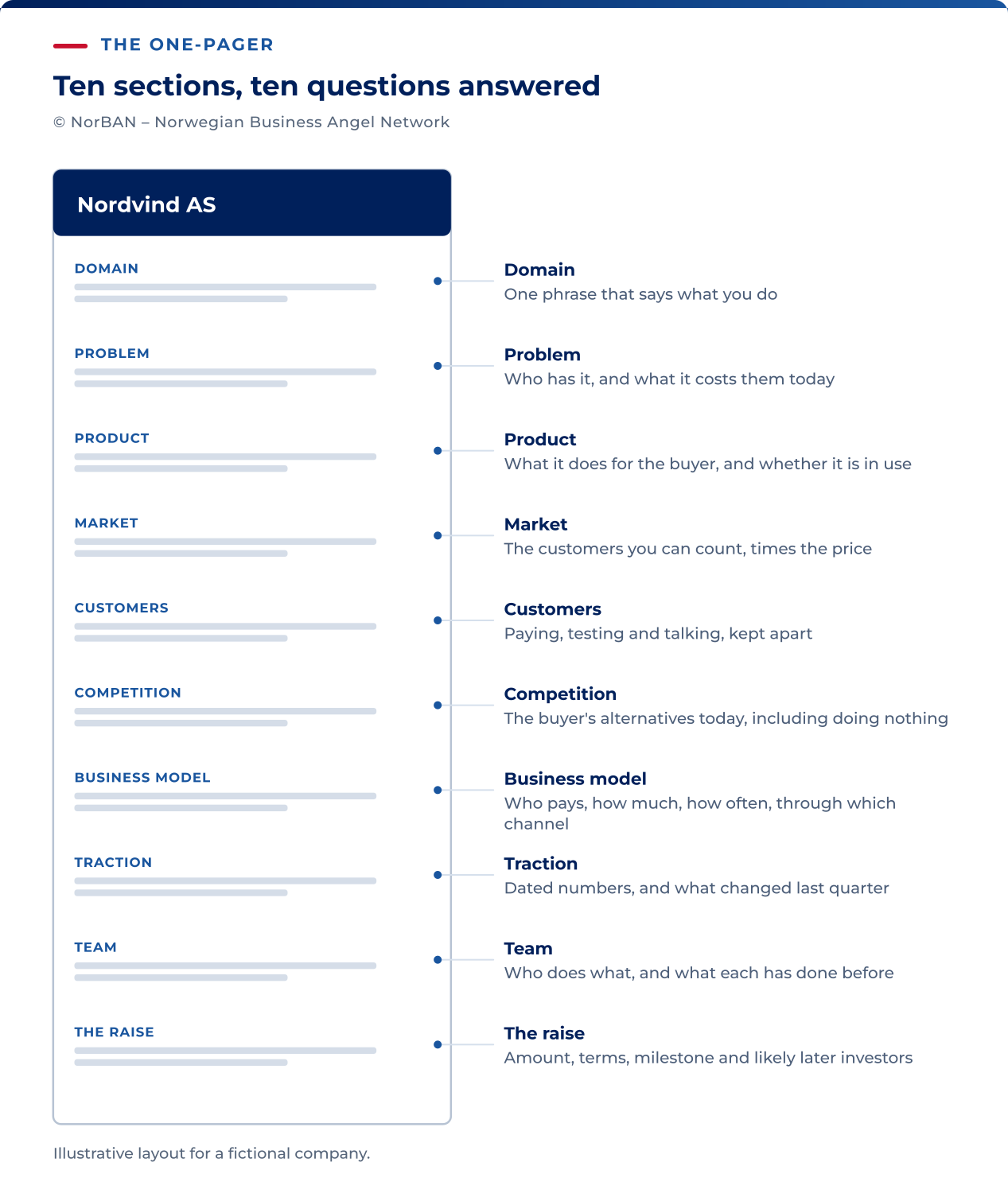
| Field | What it must state | The common failure |
|---|---|---|
| Domain | The sector and the type of company, in a phrase the reader can place at once. | A category invented for the company, which the reader cannot place. |
| Problem | Who has the problem, and what it costs them today in money, time or risk. | A problem stated for the world in general, with no buyer attached. |
| Product | What you sell, what it does for the buyer, and whether it is in use. | A description of the technology with the use left implicit. |
| Market | The segment you can count, sized from the number of buyers and what each pays. | A research-firm figure for the whole industry. |
| Customers | Who has paid, who is piloting and who is in discussion, labelled separately. | Nine “customers” that are two invoices and seven conversations. |
| Competition | The alternatives the buyer has today, including doing nothing, and why they would choose you. | “No direct competitors.” |
| Business model | Who pays, how much, how often, and through which channel. | Revenue described as a plan for later. |
| Traction | Dated numbers: revenue, paying customers, retention, and what changed last quarter. | Sign-ups and followers leading the line. |
| Team | Who does what, and the relevant thing each has done before. | Titles with no history behind them. |
| The raise | The amount, the instrument, the milestone the money reaches, and who is expected to fund the round after. | An amount and a runway, with nothing about what comes next. |
The raise line carries a test of its own. Angels ask who takes the baton (stafettpinnen) in the next financing, because only about a third of Norwegian angels have the capacity to follow on in later rounds, and NorBAN’s published figures tell founders to expect new core investors in each round.
Include both the milestone the money will reach and the type of investor it could attract next. The amount and runway alone leave that financing question unanswered.
One page means one page. If it runs over, the reader concludes that you cannot say what matters, which is the conclusion a forty-slide deck produces too. Cut the adjectives first, then the second paragraph of every field, and keep the numbers.
Writing the one-pager so it forwards well
Make the document easy to read on an unfamiliar screen by someone who has not met you and cannot ask you to explain it.
- Put the strongest evidence first. Under the company name, give a verifiable fact: revenue, a named paying customer or customer retention.
- Use numbers rather than adjectives. “Eleven paying customers, NOK 1.4 million annualised revenue, nine of the first ten still paying after one year” is concrete. Report the actual position and its date, even if modest. Label future targets separately.
- Keep the documents consistent. Use the same dated figures in the one-pager, deck and model.
- Use an accessible file. Make it easy to open and read on a phone. Avoid unnecessary logins or special software.
- Include contact details on the page. Give your name, role, phone number and email so a recipient of a forwarded copy can reach you.
- Write for forwarding. Leave sensitive details out of the one-pager. Do not assume that entering a data room automatically creates a duty of confidentiality. Agree protection before sharing information that needs it; access controls and appropriate confidentiality terms may form part of the reasonable measures required to protect trade secrets.
The investor email, line by line
Keep the email focused on getting the one-pager read and agreeing a short meeting. It should fit on a phone screen without scrolling. Use this order for the content.
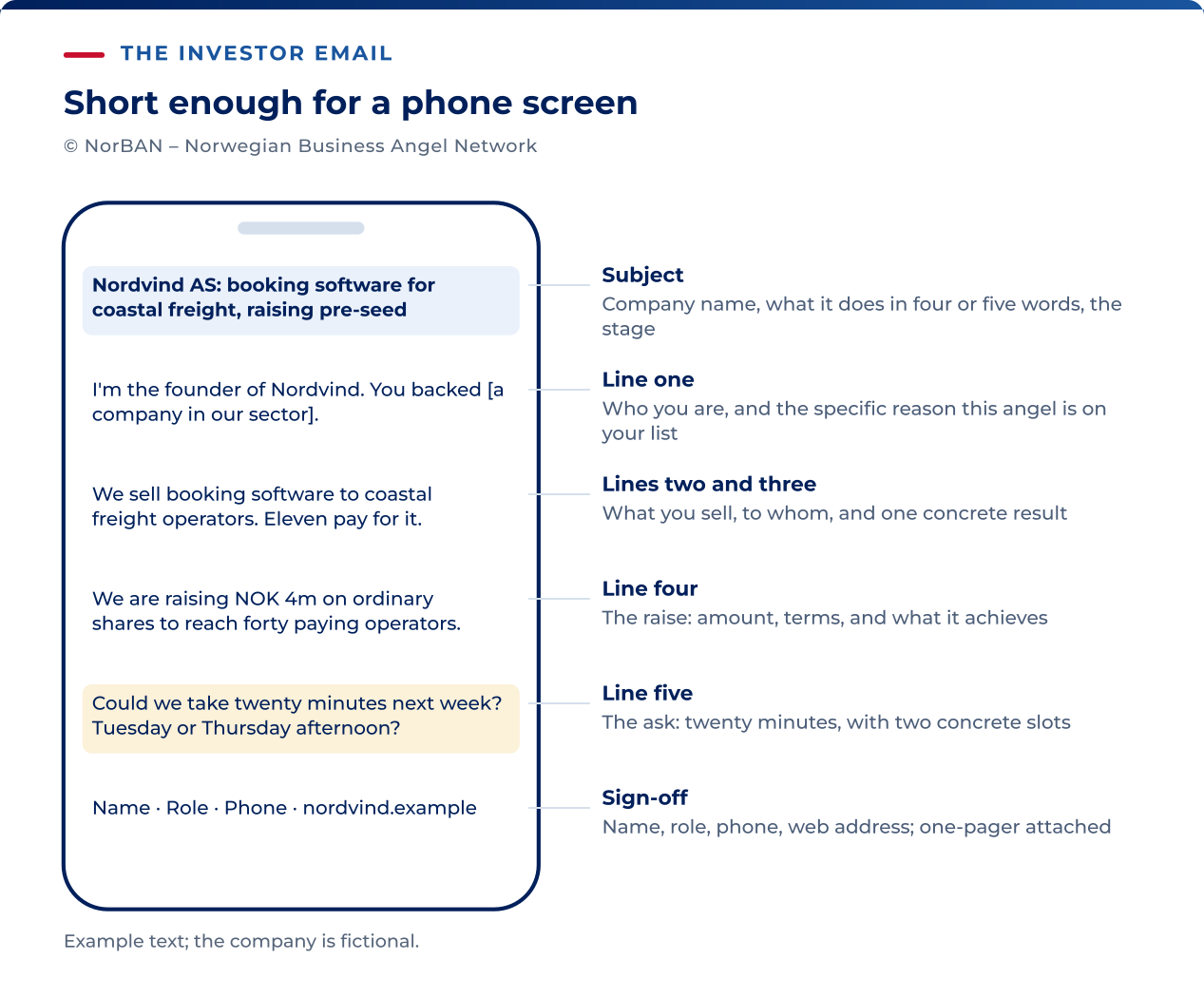
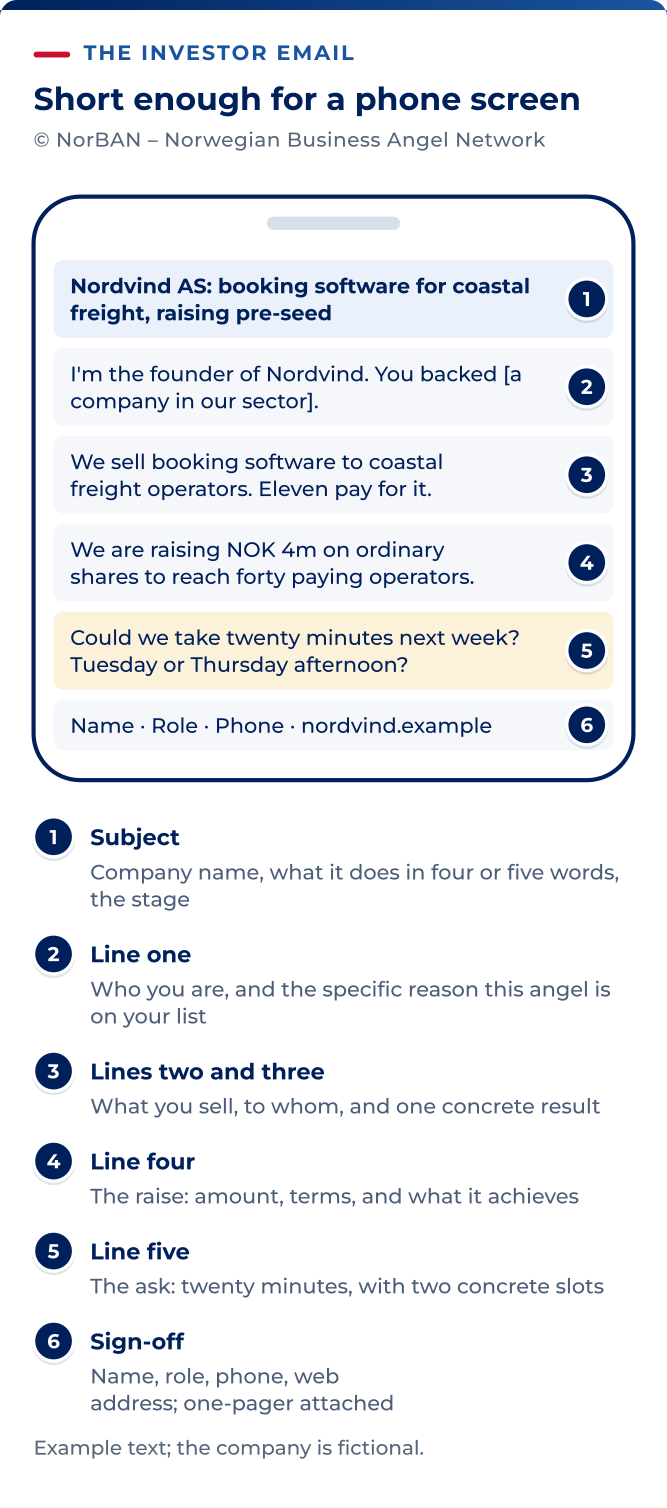
The subject line. The company name, then what it does in four or five words, then the stage: “booking software for coastal freight, raising pre-seed”. A subject that reads as a newsletter or a sales pitch is deleted unopened.
Line one, who you are and why this investor. Your name and role, and the specific reason this angel is on your list: a company they backed, a sector they have operated in, an introduction they will recognise. An angel who sees the fit reason in the first line reads on. One who sees a template does not, and templates are easy to recognise.
Lines two and three, the company. What you sell, to whom, and the one proof point. Two sentences, the same ones that open the one-pager. “We sell booking software to coastal freight operators. Eleven operators pay for it, and monthly revenue has doubled since March.” No vision statement and no origin story.
Line four, the raise. Amount, instrument and what it reaches. “We are raising NOK 4 million on ordinary shares to reach forty paying operators and a seed round led by a fund.” One sentence.
Line five: the request. Suggest a short meeting with two possible times, or ask whether you may send the deck. “Do you have twenty minutes next week? Tuesday or Thursday afternoon works for me.” A concrete request is easier to answer than a general invitation to get in touch.
The sign-off. Name, role, phone and the company’s web address, with the one-pager attached or linked.
Read the finished email once as the angel would, on a phone, in the thirty seconds between two meetings. If the proof point and the ask are not visible without scrolling, move them up.
Warm route and cold note
A relevant introduction can give the investor a reason to read your message. US venture firm NFX recommends introductions through early investors, advisers, friends and customers. Treat this as a practical recommendation, not a guarantee that an introduction will outperform every direct approach.
The 2013 European booklet for entrepreneurs published by EBAN and HBAN gives the same advice from the angel side. Start the relationship early, ideally before you need any money, and research investors before you pitch them.
A warm introduction lets you shorten the email in three places.
- The introducer is named in the first line, exactly as the relationship is. “Kari, who sits on our board, suggested I write” is checked in one message. If Kari agreed to be mentioned once at a conference, say that; the exaggeration is discovered in the same message and costs you both.
- The fit reason is already supplied, so the first line gets shorter and the proof point moves up.
- Ask the introducer for one thing. To forward the one-pager with a sentence of their own. Their sentence is the endorsement Graham describes, and it is worth more than anything you can write about yourself.
For a cold email, keep the same order but put more work into the opening line. Without an introducer, the fit reason has to prove you chose this angel: the portfolio company you learned from, the talk they gave, the sector they operated in. A cold email that could have gone to anyone is read as one that did.
What a network changes is practical. A published case, or one of our structured startup-investor sessions, puts the one-pager in front of many angels at once, each of whom decides alone. Expect several short conversations run in parallel, and expect the angels to compare notes. Send the same one-pager to all of them, so that the notes agree.
Following up without pestering
A lack of reply can have several explanations: timing, workload, poor fit or lack of interest. Do not infer a definite answer from silence. Send a brief, relevant follow-up, then move on if the investor does not respond.
A cadence that works in practice runs to three messages. After the third, the angel goes on the list for the next milestone.
- Send the email. If an introducer is involved, wait for them to send theirs first.
- After seven to ten days with no reply, send a short follow-up in the same thread. Two lines: one new fact, and the ask again.
- After another two weeks, one more, with something new again. Then stop.
The new fact is what makes a follow-up worth opening. A customer signed, a number that moved, a co-investor committed, a milestone reached. “Just checking whether you saw my email” gives the reader nothing to react to and reads as pressure. A follow-up that carries fresh proof reads as a company that is moving.
Mention a new investment commitment only when it is real. Distinguish interest from an actual commitment. Exaggeration can damage trust with both the recipient and the investor you name.
Run the outreach in parallel. Graham’s rule is to talk to investors in parallel, never one at a time, and it is the reason a follow-up cadence works at all: while one angel is silent, ten others are at different points of the same sequence, and the raise does not stall on any one of them.
The arithmetic tells you how many emails that means. Start from your own assumptions and work backwards from the round.
- Decide what the round needs. Say one anchor and six smaller tickets, so seven commitments.
- Assume how many first meetings produce a commitment. If you assume one in four, seven commitments need about twenty-eight first meetings.
- Assume how many emails produce a first meeting. If you assume one in five, twenty-eight meetings need around a hundred and forty emails, warm and cold together.
- Replace the assumed rates with your actual ones after the first month, and run it again.
Replace the example rates with your own assumptions, then with your results. The calculation gives you a practical target for the number of investors to approach.
The mistakes that get the email deleted
Check for these mistakes before sending; a reader can spot each within the first five seconds.
| Mistake | What the reader concludes | The fix |
|---|---|---|
| A mass send with every recipient visible | The founder wrote to everyone and chose nobody. | One email per angel, with the fit reason in the first line. |
| Requiring an NDA before the one-pager | Reading the summary becomes a negotiation | Prepare a summary suitable for forwarding. Agree confidentiality before sharing sensitive details; a data room alone does not create it |
| A vague ask | There is nothing to reply to. | Twenty minutes, two slots offered, or a request to send the deck. |
| A claim the one-pager cannot support | Every other claim may be the same. | Keep each line to what the deck and the model can back. |
| A subject line that reads as marketing | It is a newsletter. | Company name, what it does, the stage. |
| A “just checking in” follow-up | Nothing has happened since the last email. | One new fact, and the ask. |
| “Several other investors are interested” | The founder is running a line the reader has heard before. | Name the committed investors, or say nothing about the others. |
| A one-pager with no contact details | The forwarded page is a dead end. | Name, role, phone and email on the page. |
| Numbers that differ from the deck | None of the numbers can be trusted. | One model, one set of figures, dated. |