
Establishing what exists
Start by asking the founders to describe the product, then ask to see it. A demonstration is a quick, inexpensive way to test the product claims, and a founder with a working product should be willing to show it.
Use a test account with synthetic or properly anonymised data, and ask to try the relevant workflow. Access to real customer or employee data needs a lawful basis, necessity, appropriate permissions and controlled access; investor interest alone is not enough.
The maturity ladder has five stages, and each has evidence that marks it. Ask which stage the company is at, and then ask for the evidence.
| Stage | What marks it | What to ask for |
|---|---|---|
| Idea | A problem and a proposed solution, on paper. | The customer conversations that shaped it, with names. |
| Prototypes | Something that runs, for the founders, on a happy path. | A demo on the founder’s laptop, and the list of what is faked. |
| MVP | A version real users can use for one job, end to end. | Test access and appropriately anonymised usage evidence. |
| Problem/solution fit | “We have demand for this kind of solution.” Customers use it and some pay. | The paying customers, the renewal dates, and what they used before. |
| Product/market fit | “We are ready to scale.” Customers arrive without the founders selling each one, and stay. | Cohort retention, acquisition cost by channel, and the sales the founders did not make personally. |
Angels typically invest from just after the prototypes through problem/solution fit, so most cases you see sit in the middle three rows. The stage claimed should match the evidence in the row, and a company describing itself as at product/market fit with six customers, all sold by the chief executive, is at problem/solution fit at best.
Usage data shows whether customers have adopted what the company has built. Ask how many users logged in last week, how many used the feature the pitch is built around, and who inside each customer uses it.
A product with two hundred registered accounts and eleven weekly users is adopted by eleven people, and the eleven are the ones to call.
Customer validation of the product
The reference customers on the deck were chosen by the founder. Seek further evidence from customers you choose yourself and from the product’s usage data.
- How often do customers use it, and has that frequency risen or fallen since they started?
- Who has renewed, who has expanded, and who has left, with the reason for each departure?
- What did each customer use before, and what did they stop paying for when they switched?
- Which customers pay, which are on a free tier, and what would happen to usage if the free tier closed?
- How satisfied are they, in their own words, and what do they ask for that the product does not do?
Distinguish paid pilots from free ones. Even a small payment shows that someone obtained a budget and approval. For free pilots, ask how many convert to paid contracts; agreement to try a product at no cost does not establish willingness to pay.
Published retention benchmarks, such as SaaS Capital’s annual survey of private business-software companies above USD 1 million in recurring revenue, describe companies well past seed.
At seed the evidence is the cohort, named and counted: who bought, who renewed, who expanded and who left. With eleven customers, review each one by name; a percentage alone hides too much detail.
Novel technology and improved technology carry different risks
Ask whether the technology is novel and disruptive, or an improvement on what exists. The two carry different risks and need different proof, and a founder who claims both at once has not decided which business they are in.
A disruptive claim is a claim about an unproven market. It needs proof that the technology works, in a form an independent user or test can confirm, and a justified account of how the market will adopt it: who changes their behaviour first, why, and what it costs them.
The adoption plan needs to explain how customers will learn about the product and begin using it. Ask to speak to the first customers it names.
An improvement addresses an established market, which can reduce uncertainty about the underlying need. Customers must still have a reason to switch, and the advantage must survive an incumbent response.
Ask how much better it is, on a measure the customer uses, and whether that delta covers the cost of switching. A ten per cent improvement in a market where switching takes a quarter is a feature the incumbent will add.
Dependencies
Every product depends on things the company does not control, and each dependency is a question about what happens upstream. Trace them with the founder, and for each one ask what the company would do in the ninety days after the provider changed its terms, its price or its policy.
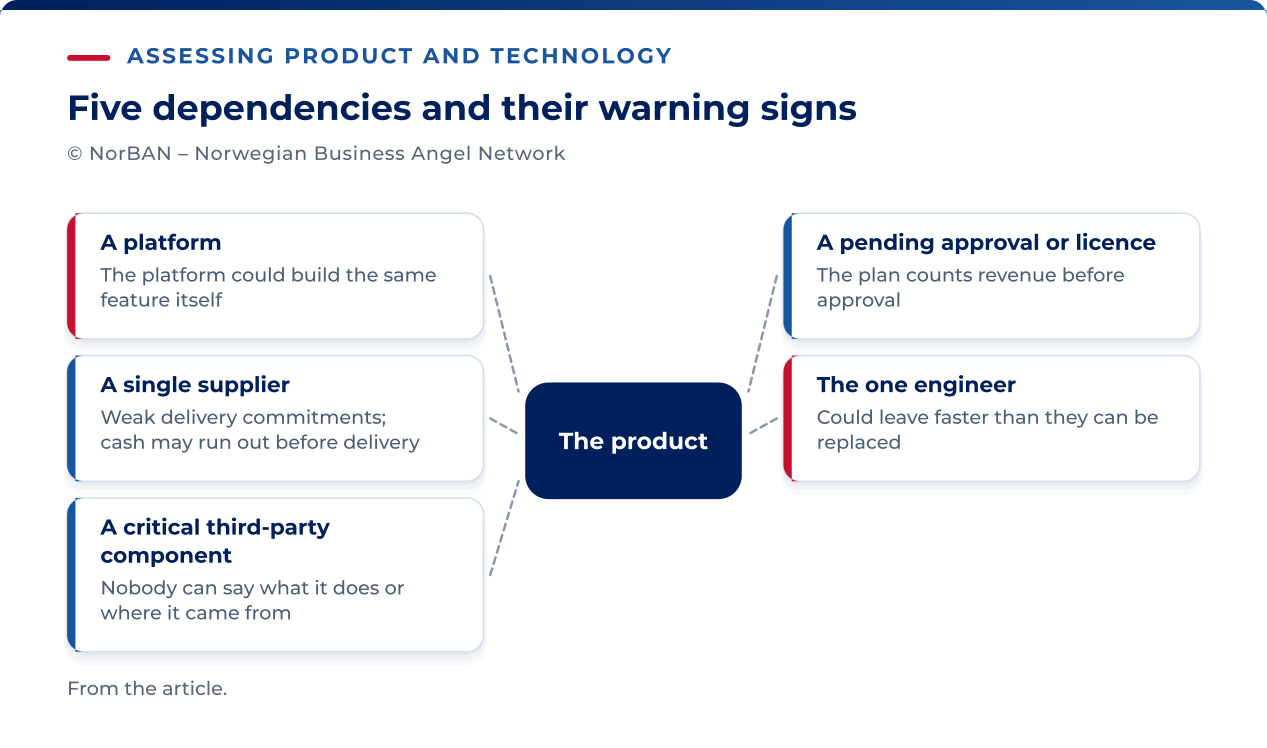
| Dependency | What to ask | Warning sign |
|---|---|---|
| A platform: someone else’s API, app store, marketplace or foundation model | What share of the product’s value runs through it, what the terms allow, and whether the company has ever been rate-limited, delisted or repriced. | The product is a feature of the platform, and the platform could ship it. |
| A single supplier of a component, a dataset or a manufacturing step | Whether a second source exists, how long qualifying it would take, and what stock or contract cover the company holds. | One supplier, no contract beyond purchase orders, and a lead time longer than the runway. |
| A critical third-party component inside the product | What it does, what the licence permits, and what replacing it would cost in months. | Nobody in the company can say what the component does or where it came from. |
| A regulatory approval, certification or licence still pending | Which authority grants it, what stage the application is at, what the timeline and cost to grant are, and what the company sells until then. | Revenue in the plan before the approval date, or no date at all. |
| A person: the one engineer who understands the system | What is documented, what the founders can operate without them, and what their agreement and vesting say. | A single maintainer with a notice period shorter than the time to replace them. |
Assess these warning signs through the founders’ explanation and supporting evidence. A dependency is acceptable when the founders have named it, priced it and have a plan for the ninety days. If the founders have not recognised the dependency, record it as a finding.
Defensibility of the technology
Ask what is genuinely hard to replicate, and test each answer against what a funded competitor with a good team could build in a year. Accumulated data that customers generated, integration depth inside a customer’s systems, a certification that took eighteen months, and protected intellectual property rights (immaterielle rettigheter) are hard to copy. Code is easy.
A unique selling point that a competitor could ship in a quarter is a head start, and worth having. It is a plan to build a moat, and the plan is what you are pricing.
Ask whether there is anything else like it, and what is unique enough to give the company an advantage. Then ask whether the product can be protected by intellectual property rights, how and where, whether by a patent (patent), a design registration or a trade mark.
The answer separates founders who have thought about defensibility from founders who put “patent pending” on a slide.
Registered rights, in orientation only
The registrable rights differ in what they cover, how long they last and what keeps them alive. Patentstyret grants and registers all three in Norway, and its design guidance states the terms in one place.
| Right | What it protects | Term, and what maintains it |
|---|---|---|
| Patent | A technical invention that is new and has inventive step. | Up to 20 years from filing, provided the annual fees are paid, under patentloven. |
| Design registration | The appearance of a product, provided it is new and has individual character. Technical solutions are excluded. | Five years from filing, renewable in five-year periods to 25 years, under designloven § 23. |
| Trade mark | A sign that distinguishes the company’s goods or services. | Ten years from filing, renewable indefinitely ten years at a time, under varemerkeloven § 32. A mark not put to genuine use in Norway within five years of the final decision to register it can be removed by a court or through administrative review (§ 37). |
Due diligence (selskapsgjennomgang) examines the rights in detail. At this stage, establish the basic position on software and disclosure.
Under patentloven § 1, a computer program alone is not an invention. That exclusion does not apply where the program has technical character: it must produce a further technical effect beyond its ordinary interaction with the hardware.
Patentstyret’s examination guidelines give examples: controlling a technical process, compressing video, restoring a distorted image, encrypting communication. The same guidelines treat algorithms and neural networks as abstract mathematics in themselves, while a claim to a method using technical means, or to a device, has technical character as a whole.
For the initial assessment, ask whether Patentstyret or the European Patent Office has told the applicant that the claim fails the technical-character requirement.
Disclosure is the other point. Under patentloven § 2 an invention must be new, and Patentstyret states that any publication anywhere in the world can block the application, including a lecture, an exhibition, a brochure or an oral description.
Ask when the invention was first shown outside the company and when the application was filed. A founder who pitched the mechanism at three demo days before filing may have nothing left to file.
Check public applications and registrations against the company’s claims:
- Patentstyret’s search service shows Norwegian patents, trade marks and designs, including status and holder.
- The European Patent Register covers European applications and patents.
- EUIPO eSearch covers EU trade marks and designs.
Search for the company and each founder. Note any rights registered to someone other than the company.
The ownership questions to ask now
Verify ownership in due diligence, but ask the basic questions now. The answers help you set the scope or identify a problem serious enough to end the case before commissioning the work.
Check who wrote the code and under what arrangement. Under åndsverkloven § 71, copyright in a computer program passes to the employer if it was written in the course of employment or on the employer’s instructions, unless otherwise agreed.
That transfer includes the rights to modify the program and transfer it onward.
That rule covers computer programs and nothing else. Documentation, designs, data and models fall back on an unwritten rule or on the contract, so ask what the employment contracts say about them.
For contractors, agencies and pre-incorporation founders, establish the rights through the agreement and the circumstances of the engagement. Payment alone does not transfer copyright. An express or implied licence may allow use, and software rules can permit changes needed for its intended use; neither establishes ownership or an unrestricted right to transfer the work.
Check what the company is actually entitled to do with commissioned code. Payment alone does not establish ownership or an unrestricted right to modify or transfer it. The agreement may grant those rights. A lawful user can also have statutory rights to make changes necessary for the intended use, subject to the applicable contractual limits (åndsverkloven § 41). Document the rights needed for development and the planned exit; do not assume that a licence transfers automatically to a buyer.
Was any code created while a founder worked for a previous employer? Check the employment duties, instructions and agreements. The employee-software rule concerns programs created in carrying out employment duties or under the employer’s instructions; use of its time or equipment alone does not settle ownership. Obtain evidence that the company has the rights it needs, including a release or transfer from the previous employer where necessary.
Are there patentable inventions, and who made them? Under arbeidstakeroppfinnelsesloven, an employer acquires no rights in an employee’s patentable invention automatically. It acquires them by demanding a transfer within four months of the employee’s written notification, and how much it can demand depends on how close the invention sits to the job.
Ask whether the employee gave written notice and whether the employer made any required written claim within four months after receiving it. If no notice was given, do not assume that the employer’s statutory rights disappeared or that a transfer has already occurred. Review the statutory route and any agreement, including the employee’s possible right to reasonable compensation.
Was a university, university college or research institute involved? Establish who employed the inventor and which rules and agreements apply. Teachers and scientific staff at universities and university colleges have a specific publication right under section 6, subject to its notice and third-party-rights conditions; do not extend that exception to every research institute. Ask for the agreement with the institution or its technology-transfer office and the notice and claim records. Missing evidence is a due-diligence finding.
What open-source components sit in the core, and under which licences? Permissive licences allow use in a proprietary product on condition of attribution and notice-keeping. Copyleft licences additionally require that what the company distributes is made available on the same terms, and the network variants trigger on offering the software as a service.
A third group, source-available licences, publish the code but restrict commercial use and are not open source by the Open Source Initiative’s definition.
Ask for the component list with licences. A founder who does not have one has not looked, and the diligence scope must include building it.
List what due diligence must establish, starting with the issues whose worst-case consequences are most serious. Put the list in the diligence scope before the term sheet is drafted, so that the conditions can be written from it.
Contractor code without an assignment, a founder-name patent application and a copyleft component in a distributed product may be repairable, depending on the rights and the cooperation of those involved. Establish the repair, its cost and whether it can be completed before deciding the price or closing conditions.