
The chain of title, contributor by contributor
For each contributor, establish whether the company owns the relevant rights or holds a sufficient licence. Keep evidence of the agreement, employment relationship or statutory rule supporting that position. Ownership of intellectual property rights (immaterielle rettigheter) is checked one contributor at a time; a licence is not necessarily a defect, but its limits matter.
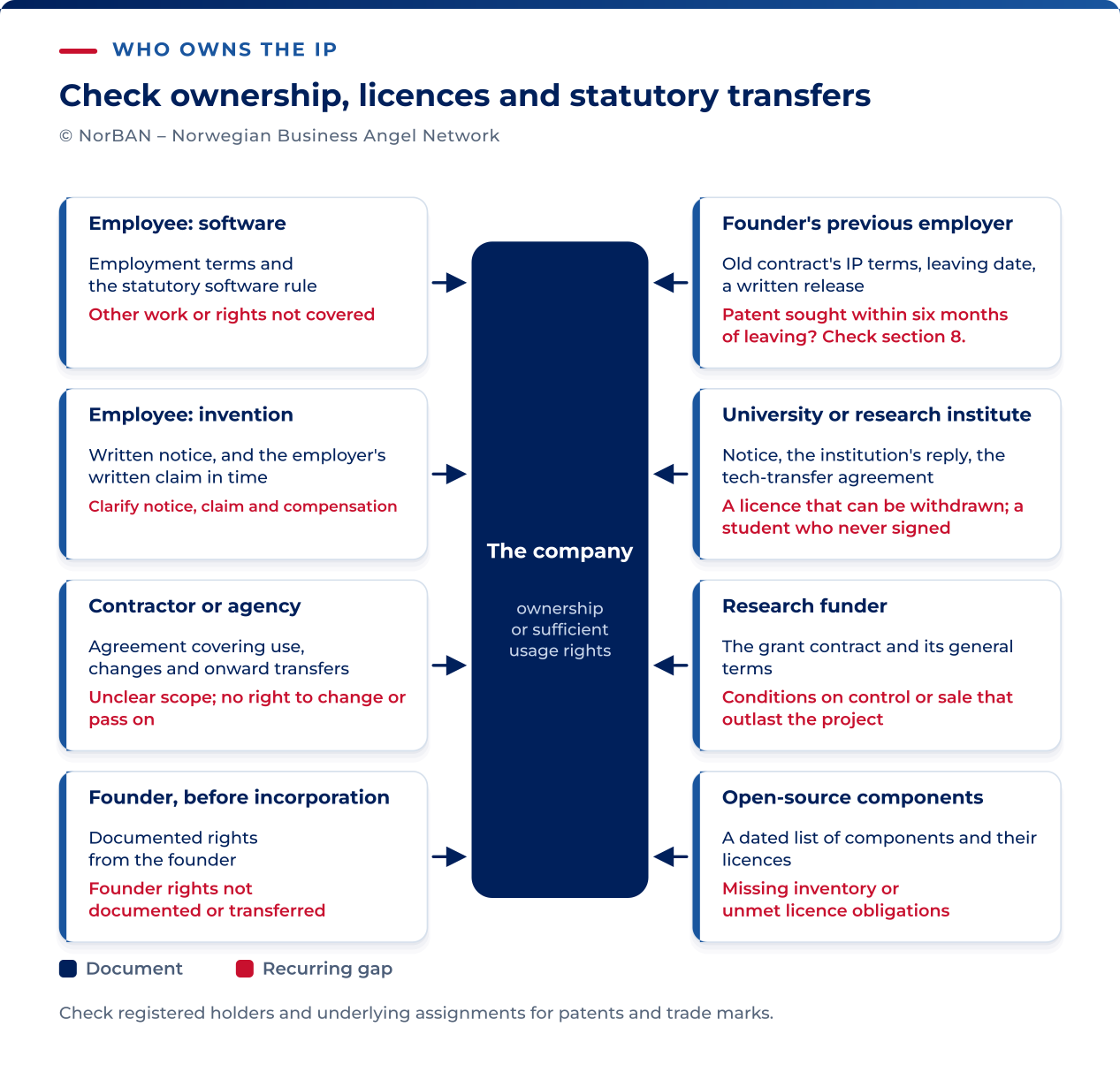
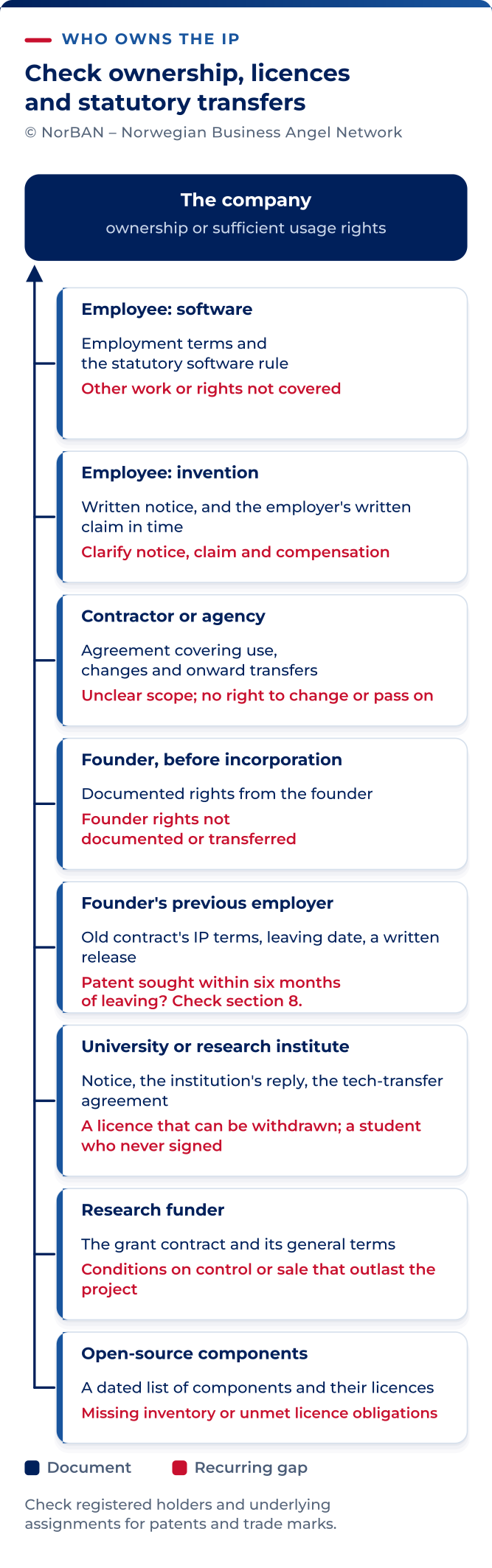
Build the contributor list from records before discussing it with the founders. The development history shows who wrote which part of the system and when, the payroll shows who was an employee on those dates, and the repository’s commit history shows the names that appear in neither. Those are the names to ask about first.
Check for contributors the founders may have overlooked. Work done before the company existed, a designer paid a weekend fee for the brand, a friend who wrote the first prototype, a master’s student, and the founders’ previous employers all belong on the list, because very little moves to the company by operation of law.
Employees: what the statutory default actually transfers
Under åndsverkloven § 71, copyright in a computer program created by an employee in the course of the employment, or on the employer’s instructions, passes to the employer, together with the right to modify it and transfer it onward, unless otherwise agreed. Moral rights stay with the developer.
That section names computer programs and nothing else. Documentation, design material and written know-how pass under an unwritten rule, to the extent the job presupposes their creation and the transfer is needed for the employment to serve its purpose. That reach is reasonably solid for documentation and designs, arguable for databases, and unsettled for model weights and training data.
A separate act governs patentable inventions, with ownership initially resting with the employee. Under arbeidstakeroppfinnelsesloven an employee invention (arbeidstakeroppfinnelse) belongs to the inventor unless the employer claims it, whether or not a patent is ever sought.
How much the employer can claim depends on how close the invention sits to the job (§ 4). Where the employee was engaged for inventive work, or the invention answers a task the employer set, the employer may demand all or part of the rights. Where the connection is looser, the default claim is a right to use it.
The statutory claim procedure starts with the employee’s written notice without undue delay (§ 5); the employer has four months to claim rights in writing under § 6. Check any advance assignment in the employment agreement separately. Missing notice does not prove that the company lacks rights, and an advance agreement does not remove the employee’s protected compensation entitlement.
A claim may also concern an application made after employment ends. A patent application filed within six months after an employment ended is presumed to concern an invention made during it (§ 8), so for a founder who left a technology employer shortly before filing, ask when they left and when the priority date was.
Acquiring the rights does not settle the employee’s entitlement to compensation. The employee is entitled to reasonable compensation (rimelig godtgjøring) under § 7, even where a contract signed before the invention said otherwise, unless the invention’s value is no more than the salary could be expected to buy.
The amount turns on the invention’s value, the rights taken, the terms of employment and how far the job contributed, and it can be revised later if circumstances change materially (§ 10). Disputes go to a state mediation board, Meklingsnemnda for arbeidstakeroppfinnelser, whose proceedings are confidential, so the absence of a court record says nothing about whether a claim exists.
Contractors, consultants and agencies
Contractors do not fall within the employee-software default. The Storting declined to extend that rule to commissioned work. Establish the rights through the contract, including terms implied from the purpose and circumstances; silence does not establish either full ownership or an absence of every right.
Under åndsverkloven § 67, receiving a copy does not itself transfer copyright. A commissioning arrangement may grant an express or implied licence. For software, § 41 also addresses acts needed for intended use, including correction of errors, unless otherwise agreed. Check its scope before saying the company cannot modify the code.
Two further rules govern the scope of a signed assignment. The specification principle (spesialitetsprinsippet) in § 67 reads an assignment as covering no more than it clearly expresses, so an ambiguous clause is read against the company.
Under § 68, an assignment does not by itself give a right to alter the work unless agreed. Onward transfer normally needs consent, but the provision permits transfer with a business or part of a business, with the party making the onward transfer remaining responsible under its agreement with the author. Check the contract and any applicable software-specific rules.
Ask contractor and agency agreements to specify modification, onward transfer, sublicensing and delivery of source and build files. A clause assigning “all rights” needs interpretation in context; it is not automatically ineffective. An agency licence can be adequate if its duration, scope and change-of-control terms support the business and proposed transaction.
The contractor who assigns keeps two things. A claim to reasonable remuneration under § 69, which cannot be contracted away, so a confirmatory assignment for a token sum settles less than it appears to. And moral rights under § 5, which can be waived only for a use limited in kind and scope.
Work done before incorporation needs its own title enquiry. Check the founder’s previous employment, collaborators and any later express or implied transfer to the company; obtain a written confirmation where the position is unclear.
Universities, research institutes and technology-transfer offices
Since 1 January 2003 an employed researcher’s patentable invention has run through the same claim machinery as any other employee’s. The former exemption that gave academic staff the first right to exploit their inventions was repealed, with the researcher’s right to publish kept as the counterweight.
The publication exception in § 6 applies to teachers and scientific staff at universities and university colleges. They must reserve publication in the invention notice, and third-party rights must not prevent it. If those conditions are met, the employer cannot take over under section 4. If no steps towards publication are taken within one year after the notice, the employer may nevertheless take over. Do not assume this exception covers every research institute.
The right can be waived by contract, and an externally financed project or an industry partner can have closed it off without anyone saying so. To establish who owns the core asset, ask for the notification, the institution’s written answer and the dates.
What a technology-transfer office then does is set out in the policies institutions publish, and NTNU’s is the fullest. Employees, contractors, students and guest researchers report results with commercial potential to the office. The main rule for a start-up is a licence from the office to the company, with an outright sale used only exceptionally, against cash or a shareholding.
The commercialisation rights can be withdrawn if the results are not exploited. That clause is a condition on the company’s core asset that appears nowhere in the cap table, so read the licence for it, together with its field, territory and term.
Review student contributions separately. Identify the student’s rights and any employment, project, assignment or licence agreement. A spin-out needs evidence that it owns the relevant rights or has a sufficient licence to the work; the absence of a signed assignment alone does not settle that question.
Public research money adds conditions of its own. Under Forskningsrådet’s general terms the project owner must secure the rights to exploit the results, and results must be exploited within a reasonable time or their creators may demand the rights back.
The same terms carry a control condition. A person or company outside the EEA taking control of the project owner must be reported at once, and Forskningsrådet may then impose conditions on the results or terminate and demand repayment, for three years after the project ends. Transferring the results to a non-EEA party in that period needs written consent.
Horizon Europe’s model grant agreement carries a similar objection right for four years after the action ends. For a grant or loan from Innovation Norway the conditions arrive with the individual award, so read the award letter. For every funder, check which edition of the terms the contract incorporates and when the obligations that continue after the project expire.
Open-source components and what their licences require
Every software product carries open-source components, and each carries a licence that was accepted by using it. What matters is which licences, and what each requires of a company that distributes the product or runs it as a service.
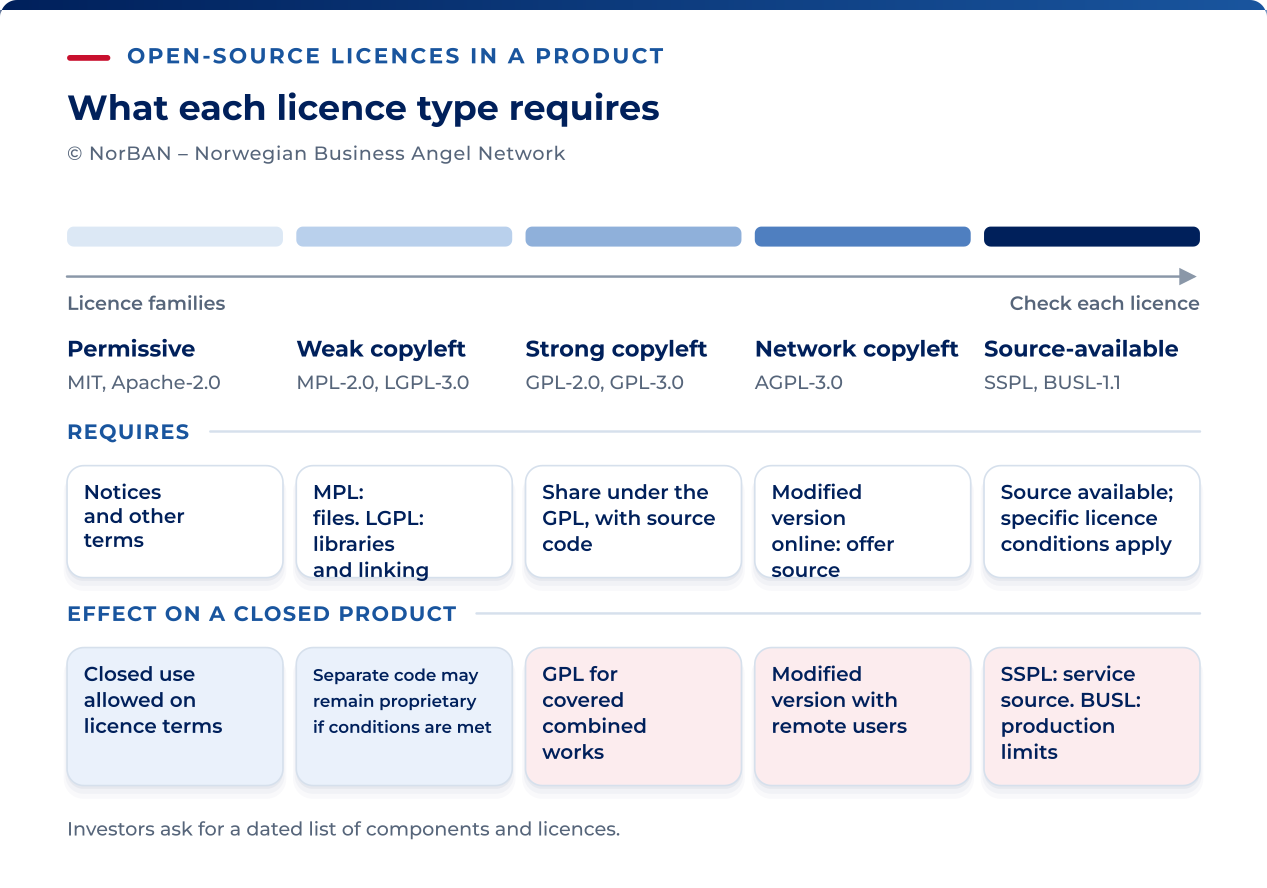
| Licence family | What it obliges | What it does to a proprietary product |
|---|---|---|
| Permissive, such as MIT and Apache-2.0 | Keep the copyright and licence notices in every copy. Apache-2.0 also requires marking modified files and reproducing any NOTICE file. | Nothing beyond the notices. Apache-2.0’s patent licence ends for anyone who sues over the work. |
| Weak copyleft, such as MPL-2.0 and LGPL-3.0 | Distribute the covered files under the same terms and make their source available. For a library, let recipients relink or replace it. | The company’s own files can stay proprietary as long as the covered parts comply. |
| Strong copyleft, GPL-2.0 and GPL-3.0 | Distribution of a covered or derivative work can require licensing under the GPL and provision of corresponding source. Charging for copies is permitted; assess whether the combined work is covered. | A distributed product built on it must itself be released under the GPL. Running it on the company’s own servers without distributing it does not trigger the licence. |
| Network copyleft, AGPL-3.0 | Users who interact with a modified version over a network must be offered its source. | Offering the modified software as a service triggers the obligation. No distribution is needed. |
| Source-available, such as SSPL, BUSL-1.1 and Elastic License 2.0 | Publish the source but restrict use. SSPL demands the source of the whole service stack from anyone offering the functionality as a service, BUSL allows no production use before its change date without a grant, and Elastic forbids offering the software as a hosted service. | Not open source under the Open Source Initiative’s definition. Offering such a component’s functionality as a service may need a commercial licence. |
The version decides whether a finding can be cured. GPL-2.0 terminates the licence automatically on breach and has no reinstatement clause, so a component distributed in breach can leave the company with no licence at all unless the rights holder restores it. GPL-3.0, AGPL-3.0 and MPL-2.0 reinstate the licence once the breach stops, on a 30-day and 60-day cure structure.
Whether a piece of code is derived from a copyleft component or merely sits alongside it is the contested question in the field, and for a real product only counsel reading the code answers it.
The Court of Justice of the European Union has held that breach of a licence clause concerning the rightholder’s intellectual property is an infringement of that property under the Enforcement Directive. The directive is outside the EEA Agreement, so in Norway a breached licence condition is judged under Norwegian copyright and contract law.
Ask for the component inventory with the licence of each component, then ask how it was made. An inventory generated from the build by a scanning tool, and dated, is evidence. An inventory assembled from memory after your request needs further verification. If the company has never produced one, record that gap in its review of dependencies.
Registered rights and where they sit
Patents, trade marks and designs are registered facts, and the register shows the holder of record. An application filed in a founder’s name stays there until an assignment is notified, so search Patentstyret’s register by the company’s name and by each founder’s name, and compare the holder against the company.
Do the same in the European Patent Register, EUIPO’s register and Norid’s lookup, which lists every .no domain held by an organisation number.
Where the holder differs from the company, ask for the assignment and the notification of the change. A transfer of a patent or an application is entered in the register on request under patentloven § 44, and Patentstyret accepts a copy of the assignment as documentation.
The assignment moves the right. What registration adds under § 44 a is priority against later good-faith acquirers. Between competing transfers, the one whose registration request reaches Patentstyret first prevails, unless the later acquirer knew or ought to have known of the earlier right when the request was received.
The register also shows whether an application is pending, granted, lapsed or refused, and the trade-mark gazette publishes renewals and changes. Note the territories, since a Norwegian patent protects nothing abroad.
Copyright cannot be registered in Norway. It arises on creation and is proved by the chain of documents this workstream assembles. Know-how that is neither code nor an invention is protected only as a trade secret, and only while it meets the statutory test of being secret, valuable because it is secret, and reasonably protected by the holder.
Evidence that ownership holds
Accept documents, and treat everything else as an assertion to verify. Use the table against the contributor list, one row per name.
| Contributor | Evidence of sufficient rights | Common gap |
|---|---|---|
| Employee software | Contract and work scope. Unless otherwise agreed, § 71 transfers rights in programs made within employment duties or employer instructions, excluding moral rights. | Software wording does not settle documentation, designs or data rights. |
| Employee invention | Written notification (§ 5); employer’s written claim within four months of receipt (§ 6), where statutory acquisition applies. | Missing notices, unclear contractual rights or compensation under § 7. |
| Contractor or agency | Assignment or sufficient licence covering deliverables, modifications, onward transfers, background material and source/build files. | Unclear scope under § 68, contract and software rules. |
| Founder before incorporation | Dated evidence covering prototype, brand and domain. | Missing rights, including a departed co-founder’s code. |
| Previous employer | Former employment terms, departure and priority dates; release where needed. | Applications within six months of departure can trigger the rebuttable § 8 presumption where its business-scope and work-task conditions apply. |
| University or research institute | Notification, any publication reservation, response and technology-transfer licence or sale agreement. | Unexamined withdrawal clause or missing student rights. |
| Research funder | Award contract and incorporated terms edition. | Control/transfer obligations continuing after the project. |
| Open source | Dated build-based component and licence inventory. | Missing inventory or unmet GPL-2.0 distribution obligations. |
| Registered right | Register entry, assignments and change filings. | Founder-name filing, lapsed renewals or wrong territories. |
Verify the founder’s assurance of ownership against the documents establishing title.
When the chain is broken
A later agreement can document or transfer rights that the signatory actually owns and can grant. Keep the real signing date and specify whether the agreement confirms an earlier transfer or makes a new one. It does not automatically remove earlier infringement, competing rights or required consents. Check any registration or third-party-protection requirements for the type of right; do not treat all intellectual property as subject to one formality rule.
What it has to contain follows from §§ 67 and 68. Name the works and the period. Assign the right to modify, to transfer onward and to sub-license, in words. State the consideration, since the § 69 claim survives a nominal one. Require delivery of the source code (kildekode) and build materials, because handing over a copy transfers nothing.
Whether the contributor must sign is a different question. Where the original engagement contained an express or clearly implied obligation to assign, Norwegian law in principle allows specific performance of it, so a judgment could substitute for the signature. That is reasoned from general contract law and has not been tested in a reported case.
Where the original contract was silent, there is generally no duty to sign at all, and the repair becomes a negotiation with someone who knows the round depends on it. Assess the cost of repairing the gap by whether the contributor is reachable and willing to sign, and what rights the original contract gives the company.
A contaminated component is repaired by removing it. A permissive replacement, or a rewrite, costs engineering months that belong in the plan, and until it is done a distributed product carrying a GPL-2.0 component in breach carries a licence the company may not hold. Whether the current position is a breach at all is for counsel with the code.
A university licence or a funder’s condition the plan cannot meet is repaired by renegotiation on the institution’s timetable. Price the delay, and make the amended agreement a condition of closing.
Legal diligence on a founder company is organised around a few categories of finding, and unclear ownership between founder and company is one of them. The findings that end the process are narrower than the category.
A core asset owned by a former employer or by a co-founder who will not sign, a licence the company cannot hold, and a founder whose account of the chain of title the file contradicts are each a stop.
In the first two cases the company does not own what you would be buying. In the third, you would be relying on a warranty from someone whose ownership account the documents contradict.
Everything short of that is a finding with a remedy, and turning it into a condition, a price or a warranty is the negotiation that follows.