
What the legal workstream establishes
For a private limited company (aksjeselskap, AS), legal diligence establishes whether the company owns the assets it claims and can execute the round as agreed. Other findings identify obligations that need to be addressed in the investment terms.
Review the documents in a fixed order. The share register (aksjeeierbok) says who the company recognises as owners. The capital history in the Register of Business Enterprises (Foretaksregisteret) says which shares legally exist. The minutes say whether each corporate act behind those entries was authorised. Then come the agreements, the security and the disputes.
Much of the first half is checkable unaided, from public registers, in minutes. Company data, the board, signature rights, the registered capital, the articles, the filed accounts, pledges over assets and whether a related-party agreement was ever filed are all retrievable without asking anyone.
Request the share register, minutes, agreements and instruments from the company. Counsel assesses their legal effect and which defects can be repaired.
Decide how to involve counsel using the proportionality table. On a lead-sized position, put external counsel on the legal stream and read their findings against this article. A follower on a small ticket still verifies the share register, the capital history and the founders’ commitments personally. The statutory background is in the company-law essentials.
The share register
Every AS must keep a share register, the board is responsible for it under aksjeloven § 4-5, and its entries must be dated. Demand it first, because the right of access belongs to anyone and needs no reason.
Under the access regulation the company sends an electronic copy within three business days, free of charge, and has no ground to refuse a compliant request. What arrives is the current position; the regulation withholds the historical ownership trail from outsiders, so the trail is reconstructed from the minutes and the capital history.
Read the share register for what it establishes. Under § 4-2, a buyer may normally exercise shareholder rights after entry, or after notifying and documenting the acquisition if no transfer restriction prevents it. The provision has exceptions for distributions and rights to new shares. Priority between competing buyers and protection against the seller’s creditors are separate questions under § 4-13. Where competing buyers are all in good faith, the right first notified to the company takes priority. Creditor protection requires notice from the buyer or seller; entry in the register may occur later.
| What to check | The common gap | The rule |
|---|---|---|
| Every shareholder in the cap table has a dated entry, and the share counts agree | A transfer completed months ago and never entered | The company updates the register immediately on a completed transfer, aksjeloven § 4-7 |
| Any pledge over shares is entered with the pledgee’s name and date | A lender’s security the founders forgot to mention | A share pledge is entered without delay once the company has notice, aksjeloven § 4-8 |
| The share classes in the register match the articles | A class in the register that the articles never created | All shares carry equal rights unless the articles create classes, aksjeloven § 4-1 |
| Shares times nominal value equals the registered share capital | A round entered here but never registered | New shares confer rights from registration unless the resolution provides otherwise, aksjeloven § 10-11 |
Cross-check against Skatteetaten’s shareholder register, which anyone may obtain and which shows holders, class and share count at the last 31 December as the company reported them. Neither register is a title register.
Capital history in Foretaksregisteret
Pull the company certificate (firmaattest) and the registered history from Brønnøysundregistrene. Anyone has a right of access to what is registered in Foretaksregisteret, and what is registered is deemed known to third parties, which is why the register outranks the founders’ account of the same facts.
The certificate shows the registered share capital, the board, who holds signature rights and prokura, whether an auditor is registered, and the articles of association (vedtekter) in force. Ownership is never on it, because a share transfer is not registered here.
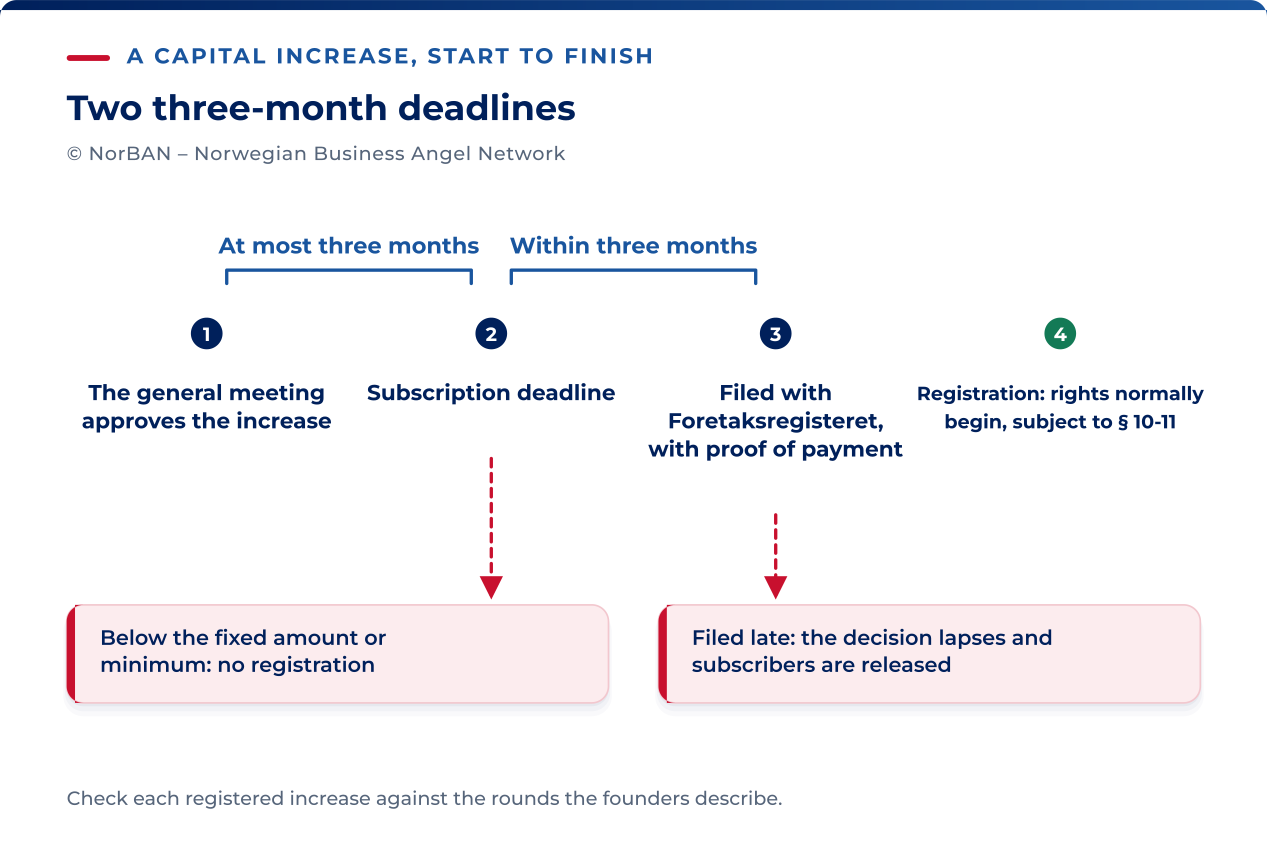
Set the registered capital increases against the rounds the founders describe. Each increase needs a general-meeting resolution, subscription, confirmed payment and a filing, and the timetable has two three-month periods.
| Step | The rule |
|---|---|
| Subscription deadline | At most three months from the general meeting’s decision, aksjeloven § 10-1 |
| Filing with Foretaksregisteret | Within three months of the subscription deadline, with the payment confirmation attached, aksjeloven § 10-9 |
| Under-subscription | Registration is barred where the amount bindingly subscribed is below the fixed increase or the stated minimum, aksjeloven § 10-10 |
| Effect | New shares confer rights from registration unless the resolution provides otherwise, and ordinary shareholder rights arise no later than registration, aksjeloven § 10-11 |
| Lapse | Filed late, the resolution lapses and the subscriptions cease to bind, aksjeloven § 10-9 |
For an unregistered round, check the filing deadline and whether a timely notification is pending. The shares do not yet exist, but subscribers are not automatically released. If the resolution has lapsed, reassess repayment and run a fresh issue; if a valid filing remains possible, complete it and reconcile the cap table.
Where the board issued shares under an authorisation, confirm the authorisation was registered before the board resolved on it. A convertible loan, a board authorisation and any subscription rights are registered facts too, so their absence from the register is itself a finding.
Allow time for register processing as well as the company’s own work. Brønnøysundregistrene publishes its processing status; an estimate is neither a guaranteed deadline nor a minimum repair period. Incomplete filings can take longer.
Board and general-meeting minutes
Every corporate act in the chain rests on a minute, so ask for three years of minutes and build the chain from them.
- A share issue rests on a general-meeting (generalforsamling) resolution, or a board resolution under a registered authorisation.
- An option grant rests on a board resolution and the authorisation behind it.
- A convertible loan rests on a general-meeting resolution, notified without delay once subscribed.
- A related-party agreement rests on board approval.
| Document | What it must show | The rule |
|---|---|---|
| General-meeting minutes | The decisions taken, signed by the chair of the meeting and at least one other person the meeting elects from those taking part. Where a sole shareholder resolves in simplified form, the chair of the board or a person the meeting appoints signs | aksjeloven § 5-16, § 5-7a |
| Notice of the meeting | Sent in writing at least one week before, stating the matters to be dealt with; a matter outside the agenda needs every shareholder’s consent | aksjeloven § 5-10 |
| Board minutes (styreprotokoll) | The board’s proceedings, signed under § 6-29, including its two-signatory exception for meetings of boards with five or more members and circulation for comments; kept for the company’s life | aksjeloven § 6-29 |
Investigate decisions taken in chat threads but never minuted, and minutes that nobody signed. Distinguish the legal effect of the defect from the practical steps available to address it.
Start with the rules for challenging a resolution. A general-meeting resolution may be challenged by suit under § 5-22, and under § 5-23 the suit must be brought within three months, after which the resolution stands.
The three-month deadline does not apply where the resolution could not be passed even unanimously, lacked consent required by law or the articles, or involved no notice or a material breach of notice rules. For a decision without a meeting, the ordinary period runs from circulation of the minutes.
Separately, a court may hear a claim brought within two years after the ordinary deadline expired if the claimant had a reasonable excuse and validity would produce a manifestly unreasonable result. Both conditions must hold. This is a late-challenge rule, not a fourth type of defect.
In practice, the response is to reconstruct the documentation and reconfirm the decision. Norwegian law has no general statute on approving a defective corporate act after the fact. Practitioners reconstruct the documentation and have a properly convened general meeting confirm the decision going forward, which works because most defects are procedural and a fresh resolution can validly re-make a decision.
A fresh, lawful resolution may achieve the intended result going forward. It does not automatically validate earlier acts, and missing consent may require a separate remedy. Have counsel identify the defect, the necessary approvals and the consequences for shares or payments already made.
Agreements that bind the company and the round
Two documents restrict a transfer or an issue, and they bind different people. The articles bind the company as a corporate body. A shareholders’ agreement binds only its parties, however it is drafted, so a consent right, a pre-emption right or a class right meant to bind the company must be in the articles.
Read the articles for transfer restrictions first. By statutory default an acquisition needs the board’s consent, deemed given two months after notice, and the other shareholders hold a pre-emption right on a change of ownership. Both can be varied in the articles in either direction, and they bite on your exit and on any secondary you buy alongside the round.
Then read every shareholders’ agreement and side letter for consent rights over a new issue, pre-emption on new shares, and price protection an earlier round negotiated. Each is a waiver to collect before closing, from every holder who has it.
Public filings provide evidence for the review of related-party agreements.
Under aksjeloven § 3-8 an agreement between the company and a shareholder, a shareholder’s parent company, a board member or the managing director, or anyone closely related to them, must be approved by the board where the company’s performance exceeds two and a half per cent of the balance-sheet total in its last approved accounts.
Agreements below NOK 100,000 and ordinary-course agreements on ordinary terms are among the exceptions the section lists.
The board must draw up a statement on the agreement and a declaration that it is in the company’s interest, that the values correspond reasonably and that equity and liquidity remain sound, and send both to all shareholders and to Foretaksregisteret.
A missing filing for an agreement within § 3-8 is a finding to investigate. Request the board minutes, statement and declaration for a founder consultancy, licence or shareholder lease. Approval and filing are separate requirements: an absent filing does not by itself prove that the board never approved the agreement.
The consequence is narrower than “void”. Under § 3-8 the agreement does not bind the company where the company proves the counterparty understood, or ought to have understood, that the board had not approved it, and what was performed is then reversed.
Have counsel establish whether approval, filing or another remedy is needed, and record the required evidence and deadline before closing.
Read the customer, supplier and lease agreements for change-of-control clauses last. A round that takes a founder below half, or a syndicate above a threshold the clause names, can hand the counterparty a termination right you did not price.
Security, encumbrances and shareholder loans
Security over the company’s assets is public. Pledges over operating assets, inventory, receivables and vehicles, and leasing agreements, are in the Register of Mortgaged Movable Property (Løsøreregisteret), searchable on the organisation number.
Security over the shares is not. A pledge over shares (pant i aksjer) is permitted unless the articles exclude it, and it is protected against third parties when the company receives notice of it, under aksjeloven § 4-8 and panteloven § 4-2a. Competing pledges rank by the time the company heard of them.
Where the articles carry a consent or pre-emption clause, an enforcing pledgee is bound by it, so a lender holding founder shares as security does not escape the transfer rules by enforcing. The rule differs for a company whose articles register its shares in a securities depository under § 4-4; protection then follows registration there.
Guarantees the company has given, and personal guarantees founders have given for its debt, are found only in the loan documents and the minutes. If a founder wants the round to release a personal guarantee over the overdraft, address that request in the terms.
Loans and security from the company to a shareholder or their close associates are restricted. Under aksjeloven § 8-7 they are permitted only within the funds the company could distribute as dividend, and only against adequate security for repayment, with exceptions for ordinary-course credit, group companies and an employee shareholder holding five per cent or less.
A loan outside those limits is void, repayable immediately, and a liability for whoever approved it. Separately, a loan to a personal shareholder is taxed as a dividend in the shareholder’s hands, so “I borrowed it from my own company” is a finding on two counts.
Disputes, authorisations and compliance
Request these four items at the outset. They can be checked independently of the rest of the legal work, and problems may be expensive to resolve after closing.
- Disputes. Live and threatened claims, three years back, with counsel’s written assessment and the provision in the accounts that matches it. A dispute described as resolved in principle is a dispute.
- Licences and authorisations. Whatever the business needs to trade, held in the operating company’s name and current.
- Data protection. Ask for the record of processing activities and necessary processor agreements. The exception below 250 employees is narrow and activity-specific: size alone does not remove the duty. Check the record against the product and operations.
- Beneficial owners. Every AS must register its beneficial owners, including a nil result, within 14 days of registration and of any change, and daily fines with no upper limit run until it is filed.
The beneficial-owner register is one you cannot search. Access is limited to reporting entities carrying out customer due diligence, public authorities, the media, civil-society organisations and higher-education institutions, so ask the company for its filing receipt and read it against the cap table.
A beneficial owner is a natural person holding more than a quarter of the shares or votes, able to appoint or remove more than half the board, or controlling the company in another way, including through a veto or a board-appointment right in a shareholders’ agreement.
An undisclosed shareholders’ agreement and a filing that shows nobody are a matched pair of findings. An investor crossing a quarter in the round puts a 14-day update on the closing checklist.
Defects that can be repaired, and defects that cannot
Most of what this workstream finds can be repaired before closing, on a timetable the statute sets. Sort the findings with this table, and put the repairs that must complete before money moves into the conditions to closing.
| Finding | Action | Timing |
|---|---|---|
| Increase decided, filing deadline open | File with contribution confirmation; effective on registration (§ 10-9). | Check registry processing. |
| Subscription-issue filing deadline missed | Resolution lapses; subscribers are released. Repeat the required steps from a fresh decision (§ 10-9). | Allow lawful notice, subscription, payment and registration. |
| Board mandate used before registration | Register it before a fresh issue decision (§ 10-16). | Two registration stages. |
| Reduction filing or completion deadline missed | Reassess and re-resolve after lapse. Initial filing: two months; completion: one year (§ 12-4, § 12-6). | Required creditor notice adds six weeks. |
| Defective meeting decision over three months old | Check exceptions and conditional late challenge under § 5-23. | Obtain advice before relying on it. |
| Chat decision or unsigned minutes within three months | Reconstruct evidence and consider fresh valid approval; missing statutory consents need separate resolution. | Depends on defect and notice rules. |
| Transfer missing from share register | Verify acquisition and entry conditions; enter without delay (§ 4-7). | Resolve outstanding rights first. |
| Unapproved related-party agreement | Check whether § 3-8 applies; obtain required approval, statement, declaration and filings, or assess termination. | Board, auditor and filing work. |
| Contractual consent or pre-emption | Obtain required consents or waivers from affected holders. | Depends on holders. |
| Beneficial owners unregistered | Register; coercive fines may be imposed under § 9. | Promptly through Altinn. |
| Invalid audit waiver | Convene a meeting to elect an auditor and register it (§ 7-6). | Notice plus filing. |
| Late annual accounts | File and address late fees under § 8-3; remission has separate conditions. | Promptly. |
| Undelivered option or share promise | Establish the obligation; arrange lawful delivery or an agreed release. | Before closing; unilateral withdrawal may breach the promise. |
The rows that stop the process are the ones that cannot be repaired and change what you would be buying: a lapsed round the founders still count, or a decision in a § 5-23 category a reconfirmation cannot reach. Respond by declining the investment or offering terms based on a rebuilt cap table.
Address the remaining findings through conditions to closing, warranties or the information used to negotiate price and terms. How much of the work you run yourself depends on your seat in the round.
- A follower obtains the share register and the company certificate, runs the share-count arithmetic against the registered capital, and reads counsel’s report with the repair table beside it.
- The lead engages counsel on a lead-sized position, holds the findings list, and decides which repairs are conditions to closing.
- An angel with a sector focus reads the customer and supplier agreements for change-of-control and exclusivity terms, whose commercial consequence is what they know.
- A syndicate agrees before the request goes out who instructs counsel and who owns the repair list, so each defect is fixed once and the closing checklist has one author.