
The findings list at the point of decision
Before negotiating, organise the diligence findings by their effect on the investment. Bring the findings from the four workstreams into the one tracker the checklist article sets up, and record the financial consequence of each finding and how certain the evidence is.
Then split the list in two. Some findings change what the company is worth, such as a pipeline that reconciles to half the model or a customer who is a third of revenue. Others change the risk of the transaction itself, such as a round never registered, an assignment never signed or arrears not provided for.
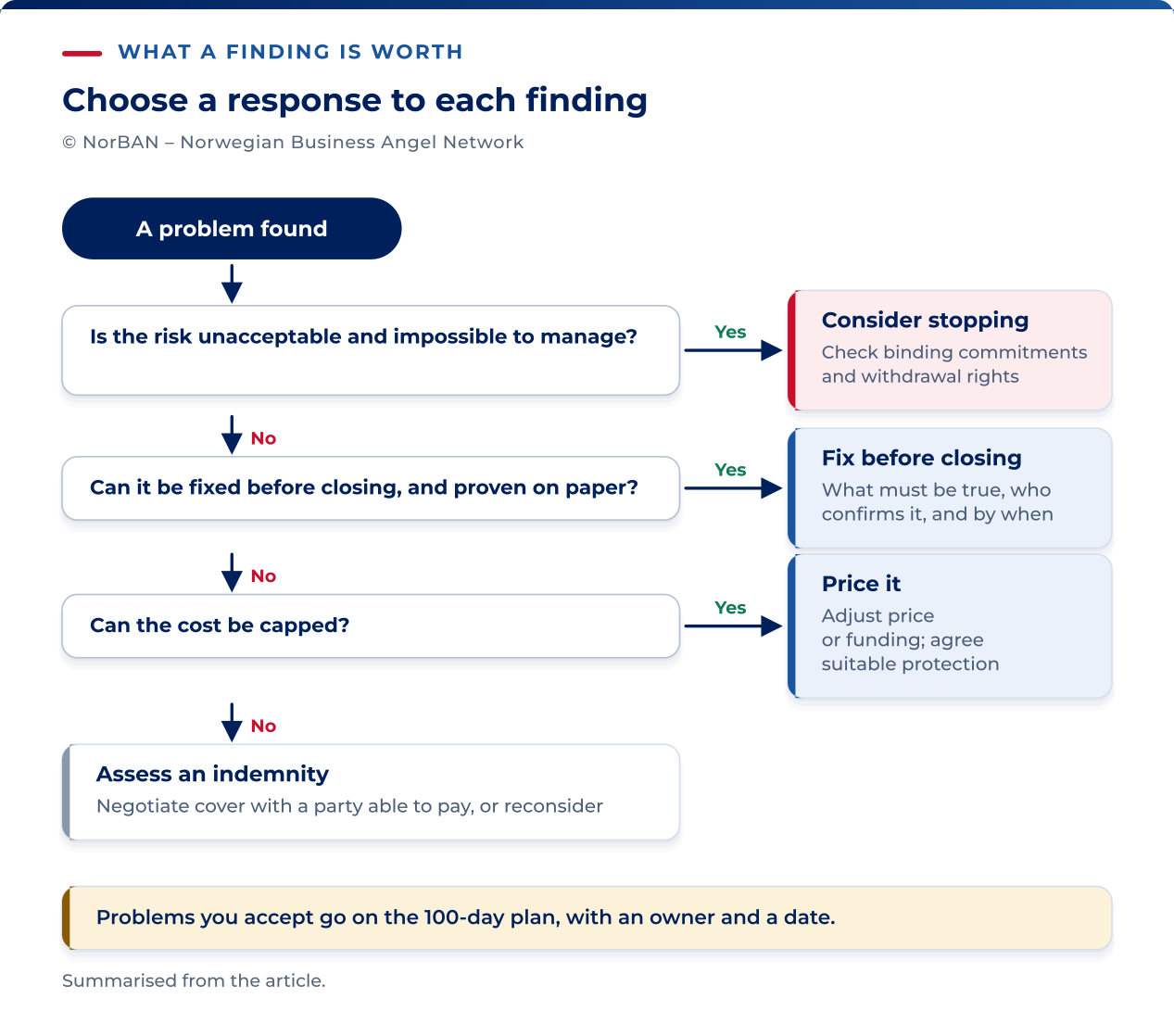
Price the first group. For the second, agree a repair before closing or an express allocation of the remaining risk. Record each finding as accepted, priced, a condition of closing or a reason to stop the transaction.
From finding to remedy
Sort the list with this table before you talk to the founders, so each item reaches them with a proposed outcome attached. Specify the evidence you will require before accepting that a remedy is complete.
| Finding | Usual remedy | What to insist on |
|---|---|---|
| A capital increase resolved and never registered, or a round still counted after its filing deadline ran | Condition of closing: registered before completion, or run again from a fresh resolution, since under aksjeloven § 10-9 the resolution lapses when the deadline passes. | An updated company certificate showing the registered capital you priced against. |
| An option or share promised in writing and never resolved | Condition of closing: granted and documented, or withdrawn in writing. | Every promise inside the fully diluted count you priced. |
| An assignment missing from the chain of title | Condition of closing: the contributor signs a confirmatory assignment and delivers the source code. | The signature from the person. A contributor who cannot be reached makes this a price question or a stop. |
| A customer that is a large share of revenue, or a contract with a change-of-control clause the round triggers | Priced, with a warranty that the contract is in force and every consent the clause requires has been given. | The consent in writing before closing. |
| Tax, VAT or payroll arrears | Condition of closing: settled, with a tax certificate dated close to completion and a warranty on the position at that date. | The certificate itself, in the closing pack. |
| Runway shorter than the milestone the round is meant to reach | Priced, through the round size or the pre-money. | A use-of-funds statement tied to the milestone, so the shortfall is visible in the agreement. |
| A registered pledge, a guarantee or a grant condition the round would breach | Condition of closing: released, waived or renegotiated. Otherwise a specific indemnity from the shareholders. | The release or waiver from the creditor or funder, in writing. |
| A dispute or claim the founders disclosed late | Priced if it can be bounded. A specific indemnity if it cannot. Fatal if it was withheld until you found it. | The full correspondence. |
Findings marked accepted go into the first hundred days with an owner and a date. No immediate adjustment is needed, but record them so the agreed work is not forgotten.
Repricing a finding
A finding is priced when it changes what the company is worth and leaves the transaction sound. Recalculate using the basis of the original pre-money valuation: if the price rested on a revenue figure, the reconciled figure goes in and the same method gives a new number; if it rested on a milestone, the milestone moves or the round grows.
A lower price does not repair an ownership defect. For a fixed investment, a lower pre-money valuation buys a larger percentage, but the company may still lack rights to its core asset. Make repair of that defect a closing condition.
The later you propose a new price, the more goodwill it costs, and some founders will walk away. Send the finding and the number together, in writing.
No price fixes an integrity finding. A founder whose account of the company the file contradicts is priced at zero, because every warranty you would then take is from the same person.
Conditions to closing
A condition to closing is workable when it names the state to be reached, who confirms it, the date, and what happens if the date passes. “Cap table cleaned up” cannot be confirmed by anyone. “The capital increase resolved on 3 June registered in Foretaksregisteret, evidenced by an updated company certificate” can.
In Norwegian transaction practice the agreement lapses if the conditions are not fulfilled or waived by closing. The party a condition protects may waive it or terminate without liability, unless the other side has broken an obligation, and both sides are taken to work loyally towards satisfying them.
The repairs that belong here can be completed between signing and completion, and each is confirmed by a document.
- Registering an old capital increase still inside its filing deadline under aksjeloven § 10-9.
- A properly convened meeting confirming a decision that was taken informally.
- Signing the missing employee, contractor and founder assignments, with source code delivered.
- Settling tax and VAT arrears and obtaining the certificate.
- Written waivers of consent and pre-emption rights from every existing shareholder the round touches.
- Releases of pledges and guarantees, and written consents under change-of-control clauses.
Check whether each repair can be completed in the available time. If a condition cannot be met, it only postpones the decision to decline.
A lapsed round must be run again from a general meeting, a university licence is renegotiated on the institution’s timetable, and a departed co-founder knows the round depends on the signature. Price the delay and set a long-stop date.
Holding back part of the money
Escrow and holdbacks are constrained by how a share issue (emisjon) works. Under aksjeloven § 10-9 the increase cannot be registered until the whole contribution has been received and confirmed, and the resolution under § 10-1 states the payment deadline. An unpaid tranche is never registered.
So a holdback inside a subscription is either a separate, later capital increase or a contractual arrangement outside the share capital. On a purchase of existing shares buyer and seller can escrow part of the price freely, because no corporate act depends on it.
For an angel investment, consider three ways to link funding to progress:
- A deferred tranche: the company approves a second capital increase when a milestone is met.
- A milestone release: the round closes in two parts on the same terms.
- A price adjustment: the price at the second closing changes against an agreed figure.
Each requires a second general meeting and filing.
Warranties, disclosure and indemnities
A warranty (garanti) is a statement of fact about the company, made by a named party. If it proves false, it gives you an agreed legal remedy. Negotiate the warranties in the subscription agreement (tegningsavtale), using the due-diligence findings to decide which facts need that protection.
In venture rounds Norwegian practitioners describe a catalogue that grows with the company’s maturity and stays generally less extensive than in United States practice. At angel stage the founder guarantees are six: ownership of the intellectual property, no third-party claims, taxes and VAT paid, valid contracts, no disputes, and full disclosure.
Disclosure affects cover according to the agreement. Check the definition of fair disclosure, the specified data-room record and any knowledge qualifications. A finding is not automatically excluded merely because the investor discovered it; equally, known matters may fall outside cover under the agreed terms or applicable purchase rules. Record how each material finding is treated.
A known problem may need a specific indemnity (skadesløsholdelse), a promise to make you whole for that named matter if it costs the company money, whatever was disclosed. The disputed claim, the arrears and the licence that may be in breach each get one, with the amount or the formula stated.
The limits on a warranty matter as much as the statement itself. Negotiate each in light of the round:
- Cap: the maximum total liability.
- De minimis threshold: excludes individual claims that are too small.
- Basket: the combined value claims must reach before anything can be claimed.
- Survival period: how long after completion a claim can be brought.
Pay particular attention to who gives the warranties. In Norwegian angel rounds the founders are commonly asked to warrant personally, while the UK’s model documents moved in February 2025 to the company as the sole warrantor.
A company warranty to a subscriber runs into the Companies Act. A transfer of value from the company to a shareholder in that capacity is a distribution, lawful only through the channels in aksjeloven § 3-6; a payout that fits none of them is unlawful and repayable under § 3-7.
A warranty is lawful for the company to give; the difficulty arises on breach, when the company must pay a shareholder. An indemnity, a bare promise to pay on defined events, is a more direct value transfer and harder to defend. A cap limits the exposure and does not change its legal character.
A compensation right given to the incoming investor alone can also breach the equal-treatment rule in § 4-1. And where the arrangement amounts to the company putting funds at the investor’s disposal in connection with the subscription, it is financial assistance under § 8-10, lawful only inside the distributable-equity frame of § 8-1 and on the § 8-10 procedure.
That procedure requires a credit assessment and a board report, the general meeting’s two-thirds approval before the assistance is given, and the filing with Foretaksregisteret ahead of it.
Two readings are open on when it applies. On one, a company warranty is an ordinary contractual statement, and the distribution rules bite only if it is breached and paid. On the other, a promise of value back to a subscriber is financial assistance from the outset.
The sources reviewed do not settle the concrete structure. Take it to company-law counsel before relying on it; a tax advance ruling does not decide company-law validity. In practice the compensation moves at shareholder level, keeping the value outside the company’s capital, and the founders are therefore the warrantors.
What a warranty is worth in practice
A warranty from founders is a claim against people who hold illiquid shares and draw a salary. Enforcing it means suing the people the company depends on, for assets that mostly consist of shares in that company. Whether a given guarantee can be enforced against a given person is a question for counsel with the facts.
Norwegian practice answers with compensation shares. On a breach, the company issues additional shares to you, restoring the ownership you would have held had the warranted facts been true. No founder cash moves, and the founders are diluted.
Norwegian practitioners report that in venture rounds compensation for a warranty breach is provided at shareholder level and typically structured this way, because existing shareholders are reluctant to pay cash. At angel stage it stands in for a personal claim.
The issue is an ordinary capital increase under chapter 10 of the Companies Act: a resolution under § 10-1 or a registered board authorisation, the pre-emptive right set aside by a two-thirds majority, payment or set-off, confirmation, and registration within the deadline.
Set-off requires a claim against the issuing company, the required resolution and auditor confirmation. A claim against a founder cannot simply be set off against a subscription owed to the company.
The contractual remedy therefore requires further corporate action. A clause saying you “shall receive additional shares” still needs a general meeting and a filing, which the founders you are claiming against may control. Pair it with an obligation on every shareholder to vote the issue through, and a standing board authorisation under § 10-14.
The statutory protection available alongside the contract depends on whether you bought existing shares or subscribed for new ones. On a purchase of existing shares under a share purchase agreement (aksjekjøpsavtale), the Sale of Goods Act (kjøpsloven) applies, and with it the buyer’s examination duty.
A defect you ought to have discovered cannot be claimed for afterwards, so a finding you saw and left out of the contract is yours. On a subscription there is no seller and no statutory remedy against the company. The contract is the whole of your protection.
Warranty and indemnity insurance is written for larger structured transactions. The minimum premium practitioners quote runs to several hundred thousand kroner, so price it against your ticket.
Walking away
End the process, whatever the price, for any of these findings:
- An integrity issue: the file contradicts the founders’ account or a problem was withheld until you found it.
- An irreparable chain of title, such as a core asset owned by a former employer or a contributor who will not sign.
- Liabilities larger than the round.
Syndicates that run a selection process keep two or three runner-up companies as back-up candidates in case diligence finds a blocker or the negotiation fails. A case that ends at diligence is a planned-for outcome.
How you withdraw depends on the documents and conduct, as the timing section explains. Before a binding investment commitment, communicate the decision and reasons in writing. Check separately when exclusivity, confidentiality and cost obligations end; declining the investment does not automatically terminate them.
Norwegian contract law has no general form requirement, so do not rely on the label “term sheet” alone.
Inside a signed agreement, you withdraw by the condition, which has to be tied to objectively described findings. A right tied to your own unreviewable satisfaction reads as an option, and the founders are entitled to read it that way.
Bad faith in a negotiation can ground liability even without a contract, so withdraw on the finding and say what it was.
Tell the founders the finding, in one paragraph, and what would have to change for the case to come back. Give the syndicate the same note plus the decision against each tracker item, so a member sent the company a year later starts from the record.
Recording the decision
Attach the outcome to every tracker item, accepted, priced, condition of closing or fatal, with the clause or the number it became, so that no item is left without one.
Record the closing state of the data room, since the warranties are given against it: what was disclosed, in which version, on which date. Keep the index and the question log with the closing pack.
Keep the file. The next round’s investor will ask the same questions, and a company that can hand over last year’s tracker with every item closed is easier to price. A compensation-share claim, if ever made, is proved from the same record.
Assign one owner to the tracker and agree each investor’s responsibilities according to their role in the round.
- A follower checks that every item they raised has an outcome and that each condition names a document.
- The lead holds the tracker, drafts the conditions, and sends findings, price and conditions to the founders in one document.
- An angel with a sector focus prices the commercial and technical findings, where the cost of a rebuild or a lost customer is known.
- A syndicate agrees who negotiates before the findings go out, so the founders hear one price and one set of conditions.