
What actually sets an early-stage price
A pre-revenue company has little operating history to support a valuation. Cash-flow forecasts and comparable transactions can still help, as can stage-based and qualitative methods, but their assumptions carry substantial uncertainty. No single method settles the negotiated price.
Discounted cash flow depends on a forecast that is itself uncertain, and small changes to the growth or discount rate can move the result by multiples. The price usually turns on the factors below, with competition for the round the one you can influence most.
- Stage and evidence. Explain what the team, prototype, pilots and paying customers establish, and what remains untested. A pilot can be useful evidence without proving repeatable sales.
- Competition for the round. Several credible prospective investors may strengthen your negotiating position, but interest is not a commitment.
- Capital required. Round size and the ownership offered imply a valuation. Check whether both are justified by the plan.
- Potential return. Investors consider whether the company can produce a return that compensates for the risk and losses elsewhere in their portfolio.
The stage ladder investors carry in their heads
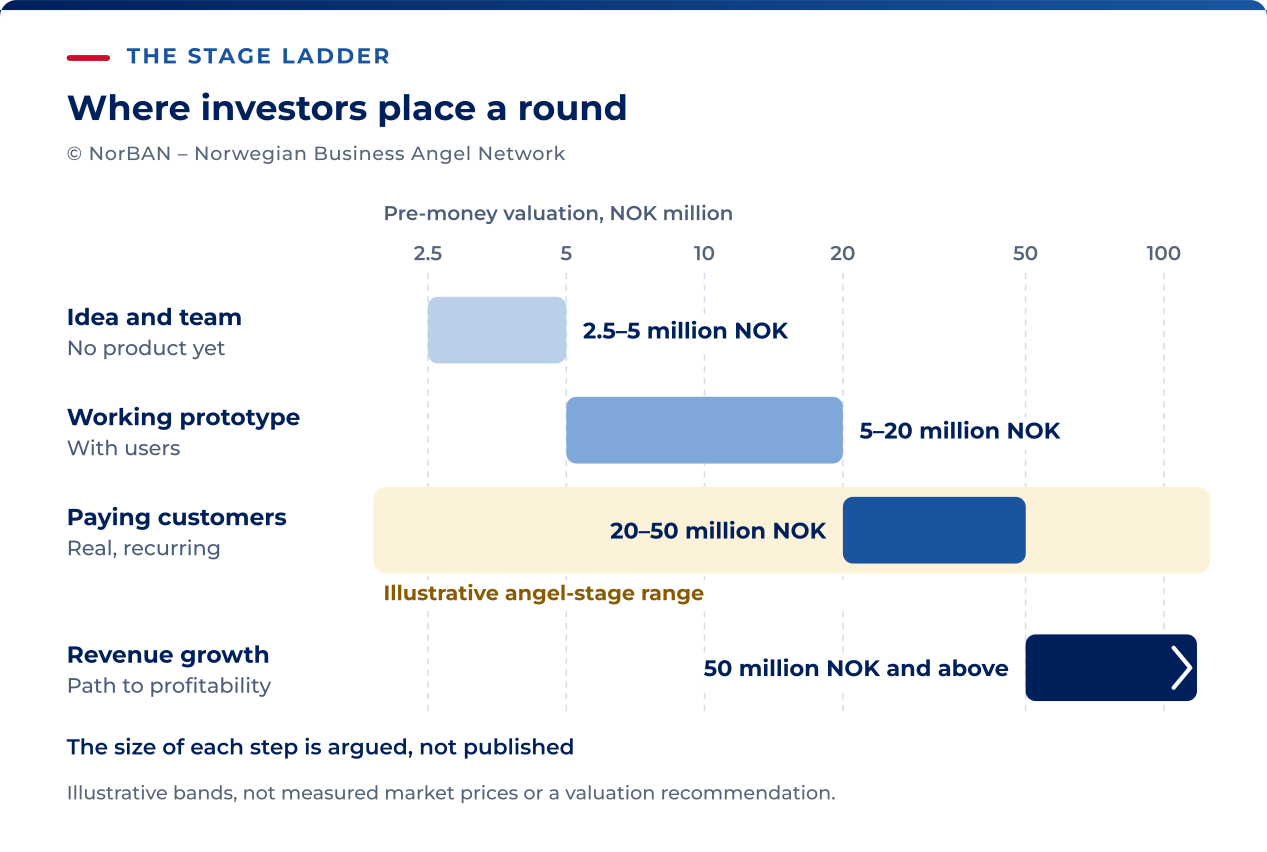
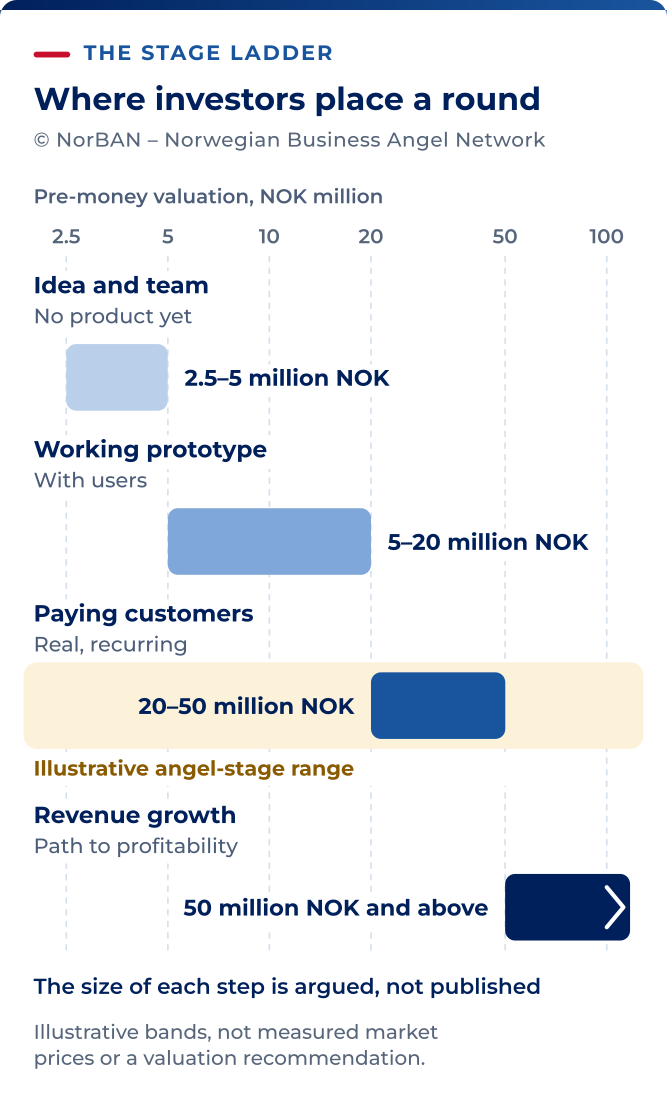
The illustrative ladder below shows how stronger evidence can support a higher valuation. The ranges are discussion examples, not surveyed Norwegian market prices or automatic entitlements at each stage. Compare with relevant transactions and explain differences in sector, team, terms and timing.
| Stage | Illustrative pre-money range |
|---|---|
| Idea and team, no product yet | NOK 2.5–5 million |
| Working prototype with users | NOK 5–20 million |
| Paying customers | NOK 20–50 million |
| Revenue growth with a path towards profitability | NOK 50 million and above |
These figures are discussion examples, not measured Norwegian transaction ranges. They do not establish where most angel rounds are priced.
When it comes to round sizes EBAN’s Statistics Compendium puts the average European angel investment per company at EUR 204,900 in 2024, and Norway’s visible market at EUR 25.23 million across 90 rounds, roughly EUR 280,000 each.
The multiple check: working backwards from an exit
Work backwards from a plausible exit to test your proposed valuation. Run the calculation before discussing the price with investors:
- Take a round of NOK 10 million at NOK 20 million pre-money. Post-money is NOK 30 million, and the investors hold 10 of 30, or 33.3 per cent.
- Say the addressable market is NOK 1.5 billion and the company can plausibly take a fifth of it, NOK 300 million of revenue. At twice sales, that is an exit at NOK 600 million, twenty times the post-money valuation.
- Assume two later rounds each cause dilution (utvanning) of exactly 20%. The original holders retain 80% × 80% = 64% of their initial stake, so one-third becomes 21⅓%.
- At a NOK 600 million equity exit, that stake returns NOK 128 million on NOK 10 million invested, or 12.8 times, before fees and taxes. This illustration excludes further pools, convertibles, debt adjustments and preference effects.
This calculation helps explain a lower offer and focuses the discussion on three assumptions you can support with evidence: the market, the share you can win and the multiple a buyer would pay.
Why a high valuation can hurt you
A higher valuation increases the value the company needs to create before the next round. Price the same round at NOK 40 million pre-money, twice the 20, and the investors take 20 per cent for their NOK 10 million, against 33.3 before.
After the same two 20% dilution rounds, the investors hold 12.8%. A NOK 600 million equity exit gives them NOK 76.8 million, or 7.68 times their investment. Matching the earlier NOK 128 million return requires a NOK 1 billion equity exit.
If the next round is priced lower, check any agreed anti-dilution protection. Its formula and delivery mechanism determine who receives extra shares or other adjustments, and who bears the resulting dilution. Model the effect on founders, employees and incoming investors before agreeing the new price.
Some examples: Klarna’s valuation fell 85 per cent, from USD 45.6 billion in June 2021 to USD 6.7 billion in its July 2022 raise.
Oda raised USD 151 million in December 2022 at about USD 353 million, down 61 per cent from roughly USD 900 million in April 2021, and cut 150 staff in the reset that followed.
Plan for a flat next round. A price with headroom survives a delayed sales cycle; a price with none turns an ordinary delay into a recapitalisation.
Valuation methods you will hear named
Valuation methods fall into several families. Understanding each helps you identify the inputs an investor needs and whether the method is useful before revenue.
- Cost. Historical or replacement cost describes resources used or needed. It is not a guaranteed floor: a business can be worth less than it cost to build.
- Income and expected exit proceeds. Discounted cash flow, scenario approaches such as First Chicago, and venture-capital return calculations use forecasts or an assumed exit. Failure risk must be reflected consistently; Damodaran discusses valuation under the uncertainty facing young companies.
- Market. Compare relevant transactions, with adjustments for stage, sector, rights and timing. A pre-revenue company has no current revenue for a revenue multiple, and private-deal information can be limited.
- Factors. Berkus assigns value to five characteristics, with a ceiling for each. Risk Factor Summation adjusts a regional starting valuation for twelve risks. Payne’s scorecard compares the company with a reference group using weighted factors. The latter two need a credible comparison base; Berkus does not use that same regional-average formula. All require judgment and suitable calibration.
- Stage. Use the illustrative ladder as a discussion aid, not a price list.
If an investor names a method, ask which inputs they are using. Discuss the assumptions behind the result before arguing about the figure.
Arriving at your number
Build a range from the stage you can evidence, the round you need and the exit case you can defend. Then do the ownership arithmetic.
New capital divided by post-money is the share you sell. A NOK 6 million round at NOK 24 million pre-money sells 20 per cent; the same round at NOK 14 million sells 30. Decide which you can live with, knowing you will raise again and be diluted again.
The subscription price (emisjonskurs, tegningskurs in the statute) is pre-money divided by the agreed pricing share count, and the general meeting resolution must state it when the capital increase is resolved (aksjeloven § 10-1). Specify how options, pool increases and conversion shares enter that count and the post-round total. The simple calculation above excludes them.
Judge an offer by the percentage it costs, the milestones the money funds before the next raise, and whether the price leaves the next investor a round worth doing. A price that leaves too little room for the next investor can make the next raise harder despite looking attractive today.
Setting the number, by situation
The tests are the same for every round. What you can argue from, and who sets the number, changes with where you are.
- First raise. Start with the evidence you have: team, prototype, pilots and customers. Calculate the capital needed for the next milestone and the ownership implied by the proposed terms.
- Later raise. Use the previous price and promised milestones as reference points. The earlier price is not a floor; the new round may be higher, flat or lower. Explain progress and changed conditions.
- With a committed lead. The lead often negotiates the main terms, but other investors still decide for themselves. Compare your assumptions about exit value and dilution with the lead’s.
- Without a lead. Speak to several relevant investors. Credible alternatives may help negotiations, but do not invent competing interest or assume that a particular sequence guarantees a higher price.