
What the shareholders’ agreement governs, and what the articles do
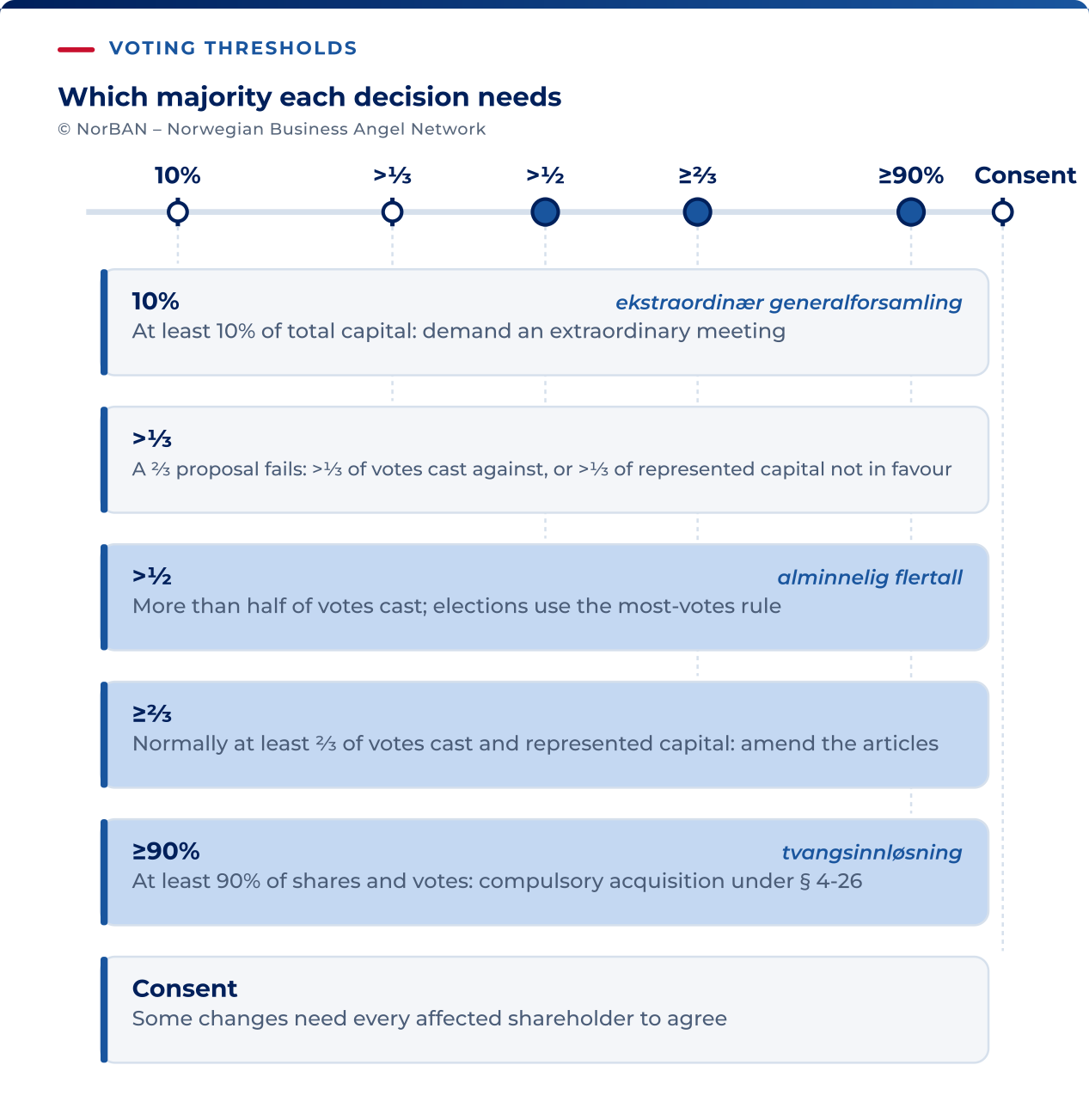
Read the draft against the statute. Every clause either replaces a default in the Companies Act (aksjeloven) or adds something the statute never provided, and the statute by itself decides very little. These are the thresholds the investors are contracting around.
- Ordinary decisions normally need more than half the votes cast. Elections and appointments normally go to the candidate(s) with the most votes; § 5-17 also regulates ties and permits different articles provisions.
- Amendments normally require at least two thirds of votes cast and represented capital under § 5-18. Failing either test blocks the proposal. Check stricter requirements, class rights and any board mandate for an issue.
- At least one tenth of share capital can require an extraordinary general meeting under § 5-6.
- Squeeze-out under § 4-26 requires at least 90% of both shares and votes. Minority holders can also demand purchase. Subsection 7 extends the rule to qualifying owners other than AS/ASA, including individuals; the rule is not confined to corporate parents.
Company law already provides minority protections, information rights and rules on equal treatment and abuse of power. It does not supply the tailored tag-along (medsalgsrett), drag-along (medsalgsplikt), founder vesting, board allocation or regular management reporting the parties may want. The agreement adds those arrangements; it does not create every shareholder protection from scratch.
Check whether a provision belongs in the shareholders’ agreement, the articles, or both. Its location determines what it can do, so settle that before negotiating wording.
- A shareholders’ agreement binds its parties. Ensure later owners join where the arrangement requires it, normally through an accession undertaking at transfer or subscription.
- Breach of the agreement does not by itself automatically invalidate a corporate decision. The same conduct may, however, also breach company law or the articles. Assess contractual remedies and corporate validity separately. Put corporate rights in the articles where required and legally possible.
- The company is contractually bound only if it is a party or otherwise validly bound. It cannot contract out of mandatory company law.
Standard and fair: sign without a fight
These clauses appear in almost every Norwegian shareholders’ agreement. Arguing against them costs you credibility and, in most cases, protection you will want yourself.
| Clause | What it does, and why you sign it |
|---|---|
| Board consent to transfers | The Companies Act already makes an acquisition conditional on the company’s consent unless the articles say otherwise. The board decides, and consent is deemed given if no refusal is notified within two months (§ 4-15, § 4-16). The agreement names the grounds and tightens the process, so you decide who joins the cap table. Watch the two-month silence rule: an unanswered request is a yes. |
| Pre-emption right (forkjøpsrett) | The statutory right lets the other shareholders take over shares that have already changed owner (§ 4-19), which protects against an unwanted co-owner after the transfer. Agreements convert it into an offer-first right: the seller must offer the shares internally before agreeing terms with an outsider. It keeps the shareholder group closed without needing anyone’s goodwill, and protects you as much as the investor. |
| Transfer restrictions and lock-up | A period in which nobody sells, and a definition of transfer that catches an indirect sale through a holding company. Investors buy the team, and a lock-up on the founders is the price of that. It should bind the investors too. |
| Accession requirement | Every new shareholder signs the agreement before receiving shares. Without it the agreement thins out with every round until it binds nobody who matters. |
| Information and reporting rights | Monthly or quarterly reporting, an annual budget, access to the accounts. Specify format, deadline and owner, because vague reporting promises become monthly friction. |
| Confidentiality | Both directions, with the usual carve-outs. It protects the company’s information in the hands of shareholders you did not choose. |
| Rights to work and technology | Document ownership or sufficient licences from founders, employees and contractors. Some rights pass by law, including qualifying employee software under Copyright Act § 71; employee inventions have separate rules. Check the actual chain of rights and remedy gaps |
Negotiable: where pushback is expected
Investors expect negotiation on these terms. Prepare a position on each and decide which two or three you are willing to trade to secure the others.
| Clause | What is at stake | What to ask for |
|---|---|---|
| Board composition | Who controls the company between general meetings. | A board that reflects ownership and stays workable: an investor seat where the holding justifies it, an observer seat where it does not, and a size that can meet at short notice. |
| Reserved matters | The list of decisions requiring investor consent. A long list stalls the company; a short one leaves the investor exposed at the moments they care about. | New issues, debt above a limit, related-party transactions, a sale of the company and changes to the business. Push operational items (hiring, salaries, ordinary purchasing) back to the board. |
| Decision thresholds | Whether consent means the lead investor, or a percentage of the investor group. | Percentages rather than named people, so the clause survives the investors selling to each other. A deemed-consent deadline, so silence cannot block a decision. |
| Drag-along | The threshold at which you can be forced into a sale. | A threshold that requires the founders’ bloc or a large majority, an equal-terms requirement, and a floor price or a board recommendation on early triggers. |
| Non-compete | Whether you can work at all if you leave. | The narrowest defensible field, and a duration measured in months. See the employment-law limits below. |
| Dividend policy | Whether profits are reinvested or paid out. | Nothing while the company reinvests, with a stated approach once it is cash generative. |
| Anti-dilution | What happens to your shareholding if a later round is priced below this one. | Broad-based weighted average at most, time-limited or limited to the next round. It is the market-standard formula where formula-based protection is given at all. Full ratchet is the aggressive outlier. |
| Liquidation preference (likvidasjonspreferanse) | Who is paid first, and how much, when the company is sold. | One times the investment, non-participating. Read it together with the drag-along: a drag that delivers a price inside the preference stack pays the founders nothing. |
A high headline price may make harsher anti-dilution terms tempting, but those terms can affect your holding for years. If the disagreement concerns valuation, negotiate that directly.
The terms remain the same throughout a raise. The process and the people you negotiate with depend on whether you have a lead and existing investors.
- First raise, no lead. Several angels each send comments and the draft drifts. Put your own draft on the table first, mark the positions from this table on it, and ask the group to name one person you negotiate with. Everyone else accedes to what that person agrees.
- First raise, with a lead. The lead’s counsel drafts. Negotiate the table above with the lead only, and settle the clauses about your own shares before the smaller investors see the document.
- Second raise. Read your existing agreement first, for the majority needed to amend it and for any right you hold that is tied to a threshold. The new investors will want the agreement amended, and what you negotiated last time only survives if the amendment clause lets it.
Read twice: the clauses about your own shares
Model each clause affecting your own shares at the value you expect the company to have in three years. Do this before signing, while you can still negotiate the personal consequences.
Work obligation. A commitment to work full time for a defined period, with consequences spelled out for leaving early. It is legitimate, because the round was priced on the assumption that the team stays. Check what counts as leaving, who decides, and whether illness or a board dismissal without cause lands you in the wrong category.
Vesting and departure. Reverse vesting of shares already owned by founders relies on contractual purchase rights. Specify vesting, events, buyers and price. Company buybacks must meet chapter 9; redemption through capital reduction follows chapter 12; transfers require their own consent and pre-emption assessment. The procedures are not identical.
Leaver price. Good-leaver and bad-leaver categories come from the agreement. Define how illness, retirement, resignation, agreed departure and dismissal affect both vested and unvested shares. Market value, cost and nominal value are different measures; do not assume that one automatically applies.
Model what that means for you. A founder holding 20 per cent bought at par for NOK 30,000, who leaves as a bad leaver when the company is worth NOK 20 million, surrenders shares worth NOK 4 million for NOK 30,000.
Distinguish a contractual leaver sale from statutory redemption. Under § 4-17, the statutory valuation point is the real value when the redemption claim is made; the provision also addresses articles-based price terms. § 4-23 refers to those rules for statutory pre-emption. Do not assume a shareholders’ agreement formula replaces every statutory rule for every affected person.
Contracts Act § 36 allows an agreement to be changed or set aside if enforcing it would be unreasonable or contrary to good business practice. The statute does not say “grossly unreasonable”. The assessment considers the terms, parties, formation, later events and other circumstances. Do not assume that a court will rescue an unfavourable bargain.
Settle these points before signing. Once you are leaving, you cannot rely on being able to reopen the definitions or valuation method.
- The leaver definitions themselves, and who decides which one applies.
- An objective method for market value, where market value is the good-leaver price.
- A cliff and schedule that credit the time you have already put in.
Non-compete, where you are also an employee. The Working Environment Act (arbeidsmiljøloven) limits post-termination non-competes between employer and employee: written form, a maximum of one year from termination, a genuine need for protection (§ 14 A-1), and compensation payable by the employer for the restricted period.
Compensation is 100% of employment remuneration up to 8 G and at least 70% above 8 G. The calculation uses remuneration earned in the twelve months before notice of termination or summary dismissal, not the last twelve months before the employment actually ends.
The employer may cap compensation at 12 G. Employment remuneration or earned income received or accrued during the restriction can be deducted, but the deduction cannot exceed half the compensation (§ 14 A-3). A separate chief-executive exception requires a written waiver against severance under § 14 A-5.
Whether those limits reach a non-compete placed in a shareholders’ agreement between the same people is a recognised grey zone. Chapter 14 A governs the employment relationship, and the rules cannot be evaded simply by moving the clause into another document between the same parties.
A genuine restriction connected with selling an ownership interest may be assessed differently from an employment restriction. For a founder who is both employee and shareholder, examine the parties, purpose, ownership and consideration. This is a fact-dependent classification, not a legal vacuum or a question answered by the document’s title.
Size any founder non-compete as if the employment-law limits applied, and have your own counsel look at it.
The clauses that should worry you
If any of these appear, stop and take advice before signing anything else. Each of them reaches past this round into your personal position.
| Clause | What it obliges | The problem |
|---|---|---|
| Personal guarantee | You, personally, stand behind a company obligation. | It converts a limited-liability shareholding into unlimited personal exposure, and it survives your leaving the company. |
| Duty to finance future rounds | Shareholders must participate in, or must not block, later capital raises. It appears in some Norwegian agreements; investors routinely negotiate an express statement that they carry no such obligation themselves. | An open-ended commitment to fund a company whose next crisis you cannot foresee, usually asymmetric: the duty lands on the people without the capital. |
| Full-ratchet anti-dilution | Earlier investors are repriced to the lowest price ever paid, without weighting for the size of the new round. | A small down round can transfer a large part of the founders’ shareholding. Broad-based weighted average is the market position. |
| Consent rights without limit | Every meaningful decision requires investor approval, with no deadline for answering. | A board that cannot act is worse than a board that acts imperfectly, and silence becomes a veto. |
| Redemption at par or nominal value, without limit | The company or the other shareholders can call your shares at a nominal price in circumstances that are not narrowly defined. | Combined with a broad bad-leaver definition, this is an option on your entire holding, held by people who can also trigger it. |
| Pre-agreed price with no method | An exit price fixed by a formula nobody can apply, or by the other party’s valuation. | Every future disagreement is decided by whoever chose the method. |
The mirror rights to insist on
Experienced investors pair drag-along with tag-along protection. Apply the same approach to your own position: check whether each right is one-sided and ask for reciprocal protection where it is.
- Tag-along against drag-along. If you can be forced to sell, you must also be able to join a sale. A drag without a matching tag lets a majority sell and leave you holding shares in a company with a new owner you did not choose.
- Equal terms when dragged. The same price per share, the same form of consideration, and the same warranty exposure. A dragged seller should not be asked to give warranties the majority does not.
- Information and confidentiality. The company supplies the agreed reports. Recipients take on confidentiality and use restrictions, with defined exceptions. That does not ordinarily require investors to supply reciprocal monthly accounts of their own affairs.
- Transfer restrictions that bind the investors. Pre-emption, consent and the indirect-transfer definition should apply to their shares as well as yours, so you are not one holding-company sale away from a co-owner you have never met.
- A right to follow your money. A right, not a duty, to take your pro rata share of the next issue is the cheapest protection you have against dilution.
How the agreement behaves later
Consider the next round and the exit when reading every clause. At those points you will have to rely on the wording agreed today.
At the next round. New investors may want different consent rights, board seats and preferences. Check how the agreement can be amended and which rights fall away if your holding is diluted. A board seat requiring a 20% holding may be lost in a later round.
At exit. Drag-along provisions and preferences affect who must sell and how proceeds are allocated. Leaver terms determine which shares former founders retain. Transfer rules may affect whether the buyer can acquire all the shares. Review how these provisions work together before a particular buyer appears.
Check the duration clause as well. The standard pattern binds each party for as long as they hold shares, and terminates for everyone on a trade sale or a listing. A right for any party to terminate on notice undoes the rest of the document. Take the draft to your own lawyer with your positions marked.