Where Norwegian risk capital sits
In SSB’s household statistics for 2024, primary and secondary homes together made up about 62% of gross wealth. The category shares and other securities accounted for about 14%, and 23.6% of households had assets in that category. Share savings accounts and investment funds were reported separately, so 23.6% does not measure ownership of any shares at all. About seven in ten households had a primary home. The figures exclude student households.
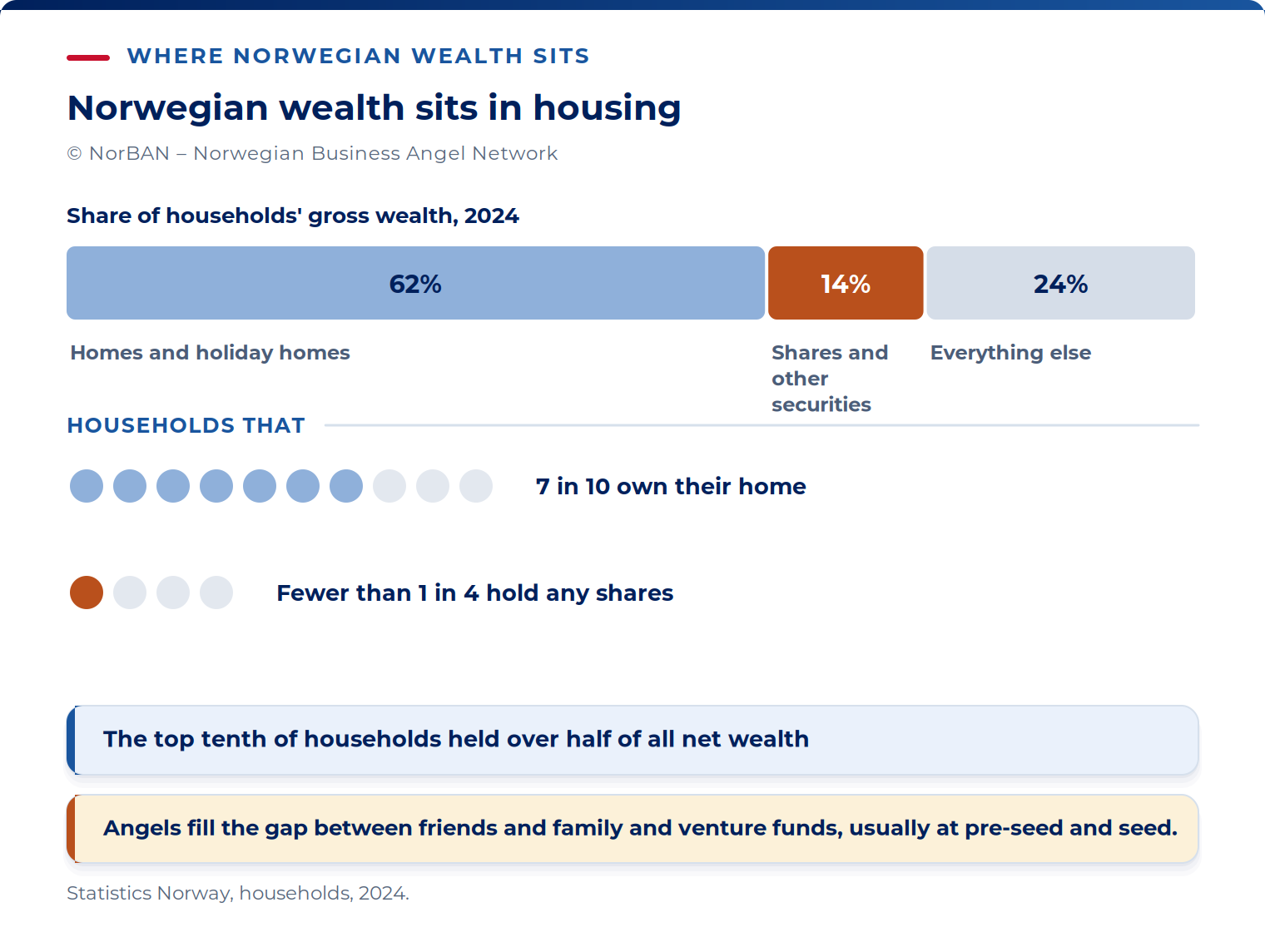
The wealthiest tenth of households held 51.9% of calculated net wealth. This shows concentration of wealth; it does not establish how much those households can or want to invest in startups.
That leaves a gap between the money a founder can raise from friends and family and the round a venture fund will price. Business angels (forretningsengler) occupy it, typically at the pre-seed and seed (såkorn) stage.
Public funding also depends on private capital: Innovation Norway’s start-up grants, for instance, are conditional on the company having matching capital of its own.
NorBAN and the national layer
NorBAN is the national interest organisation for business angels. We advise, connect, train and run events for member angels. We also help establish networks in countries where angels are active but have no network. NorBAN itself does not invest.
Our Code of Conduct bars anyone from giving investment advice or recommendations as part of the association’s operations, while leaving members free to share investment opportunities with each other. Investment decisions sit with members, individually or through consortiums and SPVs they set up themselves.
Our published page describes the angels reachable through NorBAN. Most are Micro Angels investing 30–500 kNOK to complete a round others have shaped. They are often passive investors, and many also work in operating roles.
Core Angels write 0.5–2 MNOK and can lead or anchor a pre-seed round; Super Angels write 2–5 MNOK or more and can carry a round substantially alone. Small round-filler tickets have a median of about 100 000 NOK, larger tickets about 1 million.
Roughly one in six angels can anchor or lead a round, and barely a handful can carry one alone, so a normal first or second round commonly includes four to six angels. Only about one in five require a board seat, and the requirement is unrelated to ticket size.
A majority have no sector preference; among those with one, B2B software dominates, and domain specialists cluster in construction and property, energy and climate, ocean and industry, and health. The page describes these as rough estimates from a decade of experience and self-reporting, not a formal study.
Regional networks and angel groups
Much of the syndication in Norway happens locally, among angels who already know each other. NorBAN publishes a list of the regional and domain-focused networks that have associated themselves with us. The level of association varies, and inclusion in the list is not an endorsement.
Regional groups take several forms. BAN Arctic is a registered regional organisation; Connect BAN Trøndelag and The Factory Fintech Angels are corporate angel groups. Others are informal groups or angel investment companies such as Nordic Ignite, where members pool capital in a jointly owned vehicle.
Much regional activity is organised informally or inside corporate groups, without a public membership list. Local membership brings opportunities from people you can meet in person and co-investors within driving distance of the company.
The Nordic and Baltic neighbourhood
Each of the neighbouring countries has a national angel network, and their members co-invest across borders as a matter of course. The region’s startup output is what makes that worth a Norwegian angel’s time: Dealroom’s Nordic profile counts the region’s billion-dollar companies by the dozen and its funded startups by the thousand, on a combined population of under thirty million.
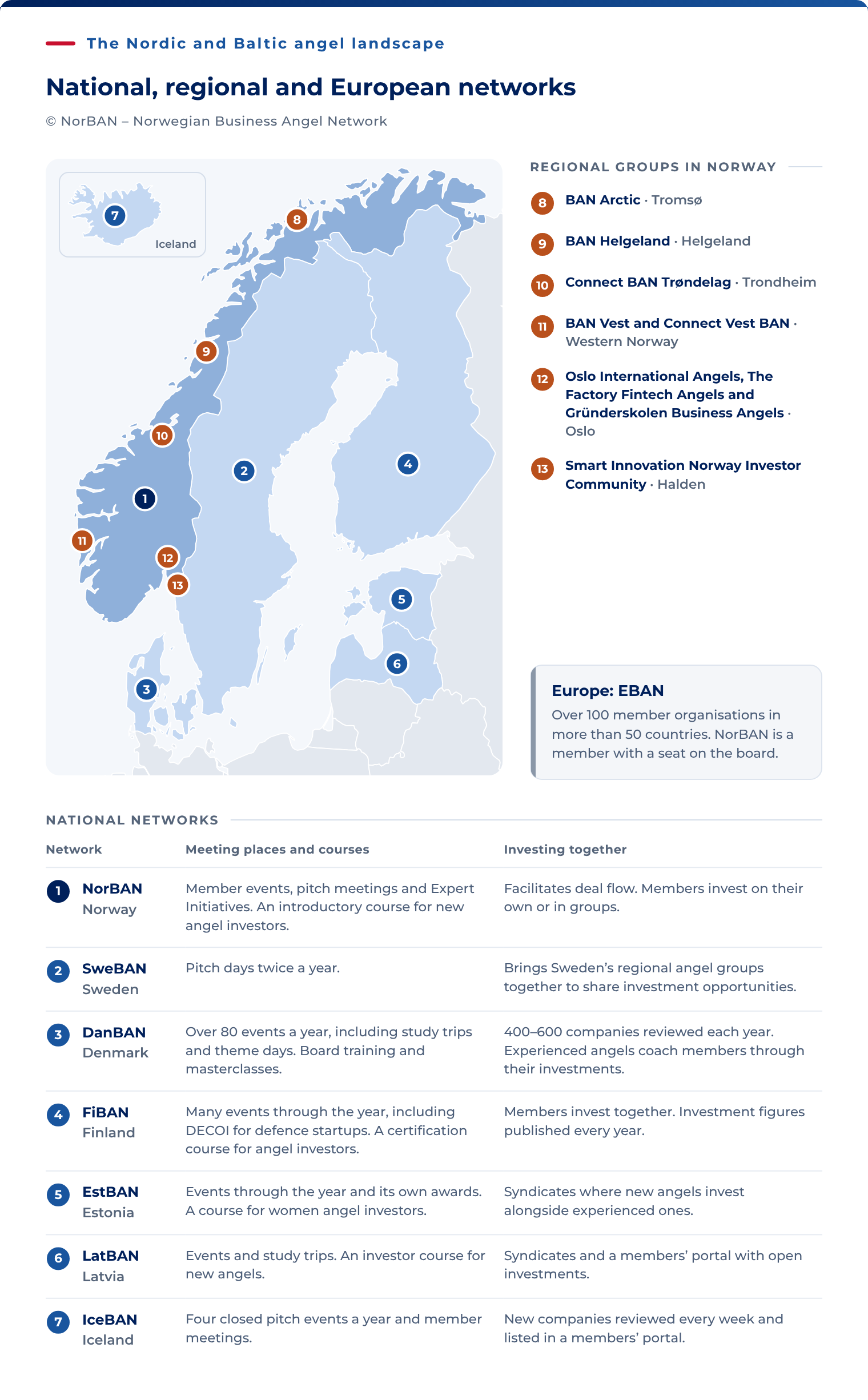
Use these networks to make contacts in neighbouring markets. The descriptions reflect how each network presents itself.
| Network | Country | What it is |
|---|---|---|
| SweBAN | Sweden | Swedish Business Angel Networks, launched in 2024 as a network of Sweden’s regional angel groups. Runs pitch days twice a year. |
| DanBAN | Denmark | A non-profit association and Denmark’s leading network of private investors. Runs over 80 events a year and sees several hundred startups through its deal flow annually. |
| FiBAN | Finland | Finnish Business Angels Network, over 600 angel investors. Publishes a median funding round of up to EUR 300,000 for startups applying to its network. |
| EstBAN | Estonia | Established in late 2012, a non-profit formed and led by its members, over 220 angel investors. Publishes its members’ annual investment totals and deal counts. |
| LatBAN | Latvia | Latvian Business Angels Network. Investor syndicates, a members’ portal, an investor course and an events programme. |
| IceBAN | Iceland | Iceland’s angel network, modelled on its European counterparts. Four pitch events a year, a code of conduct and published articles of association. |
Swedish angels meet in regional groups and at the Techarena and GoWest investor days. Since 2024 they have had a national network, SweBAN, set up with help from us and EBAN. In the North Atlantic, the Faroese startup conference TONIK and the North-Atlantic Business Angel Network, an international project associated with NorBAN, are the meeting points.
In EBAN’s compendium for 2024, the visible angel market was EUR 64 million in Sweden, EUR 54 million in Denmark, EUR 37 million in Finland and EUR 25 million in Norway. Visible means reported through networks, so the real markets are larger, and Norway’s is the smallest of the four.
EBAN and the European layer
EBAN is the pan-European representative for early-stage investors, gathering over 100 member organisations in more than 50 countries. It works in four areas: networks and communities, education, research and data, and policy towards the EU institutions and the OECD.
NorBAN is EBAN’s Norwegian member, and our members get affiliate membership of EBAN. It connects Norwegian angels with the wider European community. Members can access its annual Statistics Compendium, co-investment and fiscal-incentive compendia, and the guides and templates in its knowledge centre.
Membership also offers member terms at the annual congress and autumn summit, and cross-border contacts in every network on the map above.
NorBAN’s General Secretary sits on EBAN’s board representing Norway, and the lead of our Defence and Security Expert Initiative is a founding member of the Defence Angels European Network, which went operational in February 2026 with Norway among sixteen participating countries.
Plugging in
Your starting point depends on your experience and interests. Spend the first year meeting people who will share deals and invest alongside you, with a view to making investments in the second year.
- New to angel investing. Join NorBAN and a regional group where you live, so you see cases and meet the angels who lead them. Follow an experienced lead into your first one or two rounds, and attend one Norwegian investor day and one Nordic flagship in the first year.
- Investing already, widening the scope. Add the Nordic peers. Buy the investor ticket at Slush or TechBBQ, ask your network for an introduction to the peer network in the country you are interested in, and expect to be invited into a syndicate before you find one yourself.
- With a sector focus. Domain groups and sector conferences are more useful than flagship events when you have a specific sector focus. The corporate angel groups on the regional list exist for exactly this, and the sector event in your field is where the founders and the corporate acquirers both are.
- Building a syndicate. Meet your co-investors at the events, set up the vehicle yourselves with counsel, and take the group’s questions to EBAN’s congress, where every other network has already solved them. Platforms offer a further route to deal flow, and the routes into a deal are compared in their own article.