The map, stage by stage
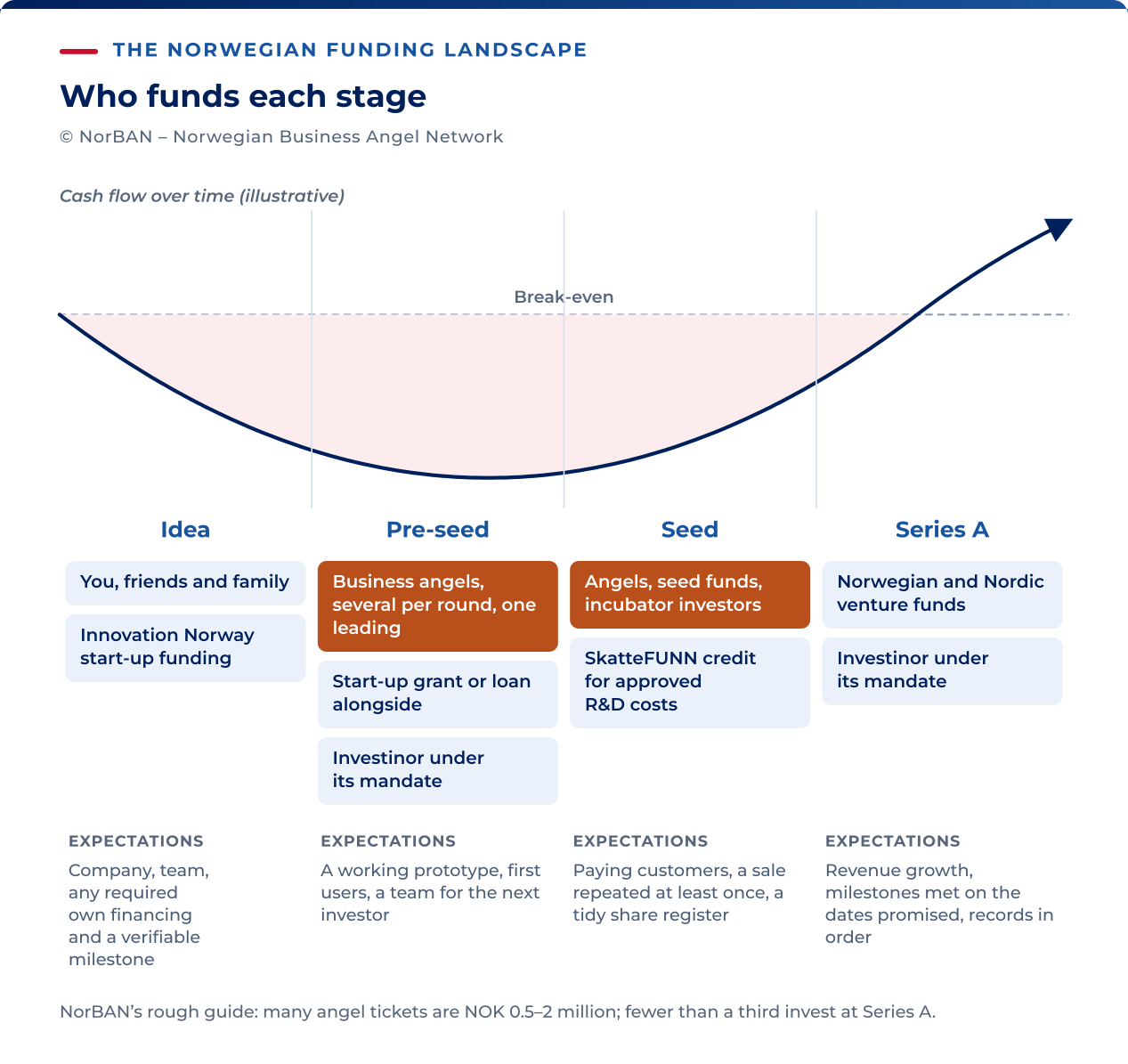
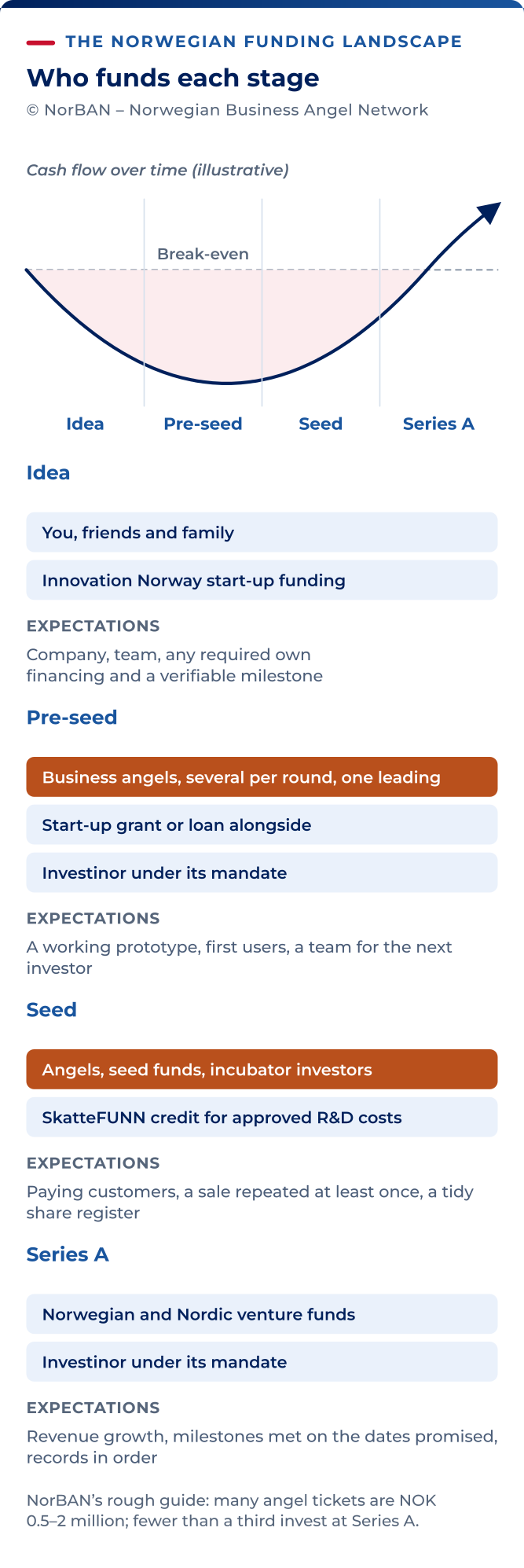
The four funding stages have different funders, each looking for different evidence. Identify your stage before building a pipeline to avoid spending months pitching funds that cannot invest yet.
| Stage | Who funds it, and what they need to see first |
|---|---|
| Idea | You, your friends and family, and the first phase of Innovation Norway’s start-up financing. They need a registered AS, a team, own capital wherever a grant (tilskudd) requires a match, and a plan with a milestone an outsider could verify. |
| Pre-seed | Business angels (forretningsengler), several to a round, with an anchor found first; a start-up grant or loan alongside; Investinor’s matching behind a new private lead. They need a working prototype, first users and a team that can carry the company to the next investor. Most angel tickets are between half a million and two million kroner. |
| Seed (såkorn) | Angels, seed funds and incubator-affiliated investors, with SkatteFUNN refunding part of the development cost. They need paying customers, a model that has repeated at least once, and a clean share register. Round sizes are a matter of practice, and larger than the round before. |
| Series A | Norwegian and Nordic venture funds, with Investinor able to invest alongside them on the same terms. They need revenue growth, milestones met on the dates promised, and board and shareholder records in order. Fewer than a third of angels will consider this stage. |
Idea stage: your money, and the first public kroner
The idea stage is funded by the founders, then by friends and family who are backing the people. Public money begins here too. Innovation Norway’s start-up financing is staged in phases, the first for the earliest work, and the current names, ceilings and conditions live on its financing pages.
Read the award terms before planning cash flow. Required co-financing must be documented, and some costs must be paid before reimbursement. Oppstartstilskudd 1 can cover all eligible external costs within its limit and allows up to half the grant at the start. Even then, the company needs cash for the remaining upfront expenses (payment and reporting).
“Too early for investors” means concretely that no user has touched the product and there is no milestone an outsider could verify. Even angels, who invest earlier than any fund, need something they can test.
Pre-seed and seed: where angels invest
Nearly all angels prefer to invest at pre-seed, and few invest later than a seed round. NorBAN’s published figures describe three kinds of angel, and a pre-seed round is assembled from several of them.
- Micro angels, with tickets from 30,000 to 500,000 kroner, are the majority. They complete a round others have shaped, and are often passive operators with a day job.
- Core angels, with tickets from half a million to two million kroner. You need at least one to lead or anchor a pre-seed round; they can be a sparring partner alongside the ticket and rarely take a board seat.
- Super angels, with tickets from two to five million kroner or more, are professional investors who can carry a round substantially alone and usually require regular follow-up and close collaboration.
The small round-filling tickets have a median of about 100,000 kroner and the larger ones about one million. A normal first or second round has four to six angels, roughly one in six can anchor or lead, and barely a handful can carry a round alone, so find the anchor first and then fill the round.
Networks, investment companies and syndicates can collectively invest materially more than their individual members, making them possible anchors. These figures are NorBAN’s estimates from experience.
NorBAN can introduce you to investors, who then decide whether to invest. Startups looking for investment can be published directly to investors in the NorBAN network through our digital channels, after an evaluation for relevance, and our investor matchmaking gives curated introductions and structured startup–investor sessions. Every investment decision is then the individual angel’s, alone or through a consortium the angels set up.
The public money that runs alongside: Innovation Norway and SkatteFUNN
Public support can complement equity financing, but the available amount depends on the programme and eligible costs. State-aid rules can limit combined support for the same costs. For a public loan, the relevant aid amount is not necessarily the whole loan principal.
A grant may extend the time your cash lasts between equity rounds without setting a new share price. Its timing is not fixed to those rounds: it follows the project and the award’s financing and payment conditions.
SkatteFUNN is a statutory tax deduction for eligible costs in an approved research and development project. Businesses in different legal forms can apply if they are registered in Brønnøysundregistrene, taxable in Norway and meet the scheme’s conditions. The Research Council approves the project and publishes the rate and cost limit. An auditor must certify the project costs for the tax claim.
The Tax Administration gives the support as a tax deduction or a payment where the deduction exceeds the tax payable, normally after the cost year. Other public support for the same eligible costs can reduce the SkatteFUNN deduction under the applicable aid limits.
Municipalities and counties run innovation grants of their own. The terms are set locally and change. Ask your municipality and county which schemes are open before including them in your funding plan.
Seed funds and early VC
Norwegian seed funds and early venture funds need evidence, particularly paying customers. Check each fund’s own pages for the stage at which it invests. Beside them sit programme investors, Antler for example, that publish a standard deal on their own pages, and incubators that also invest through a vehicle of their own, StartupLab among them.
Siva funds the incubators, business gardens and catapult centres themselves. What reaches a startup inside them is facilities, advice and network; the money in that chain stops at the incubator.
The state layer is Investinor, which manages the state’s interests in seed and pre-seed schemes through direct investments, investments in funds, co-investment alongside private investors and pre-seed matching.
Under the matching mandate, at least 30% of the investment must come from a new independent private investor or syndicate. Private investors must provide at least 51% overall and actively follow up the company. Investinor can hold at most 49% of the company and provide at most 49% of each round, on the same commercial terms as the private investors.
The round therefore needs an angel anchor before Investinor can provide matching funding. Its ticket bands are published on the same pages, and two regional seed vehicles, Såkorninvest Midt-Norge and Investinor Nord Norge, are named there too.
Series A: what changes
At Series A the funders are venture funds, Norwegian and Nordic, and the sums are multiples of a seed round. Investinor’s direct investments come in alongside private investors on the same commercial terms. Fewer than a third of angels will consider investing at this stage, and only about a third have capacity to follow on at all.
The money is international in both directions. NVCA’s activity survey for 2025 recorded Norwegian fund managers deploying NOK 2.4 billion in early stage while investment into Norwegian companies fell to its lowest level since 2018. A Norwegian fund compares you with companies abroad, and Nordic and European funds belong in your pipeline.
Funds assess the record you have built through the earlier stages. They look for milestones met on the dates promised, growing revenue, an understandable share register, and board and shareholder records kept from the first round.
Reading the map for your own raise
Before sending a deck, check the fund’s own pages or ask the investor whether they can invest at your stage. Remove those who cannot from your pipeline.
- First raise. Angels, with the anchor found first, and a start-up grant applied for in parallel so that the two land in the same year.
- Second raise. New core investors in place of a repeat of the first round, seed funds where the evidence supports it, SkatteFUNN on the development work, and Investinor’s matching once a new private lead is in.
- Beyond seed. Venture funds at home and in the Nordics, and Investinor alongside them, against a record the earlier rounds must already have produced.