
Size the pipeline before you build it
Start from the number of commitments the round needs. NorBAN’s published figures put a normal first or second round at four to six business angels (forretningsengel), depending on size, and the angels able to anchor or lead a round at roughly one in six.
The page calls its figures rough estimates from experience and self-reporting by angels, so read them as the shape of a round.
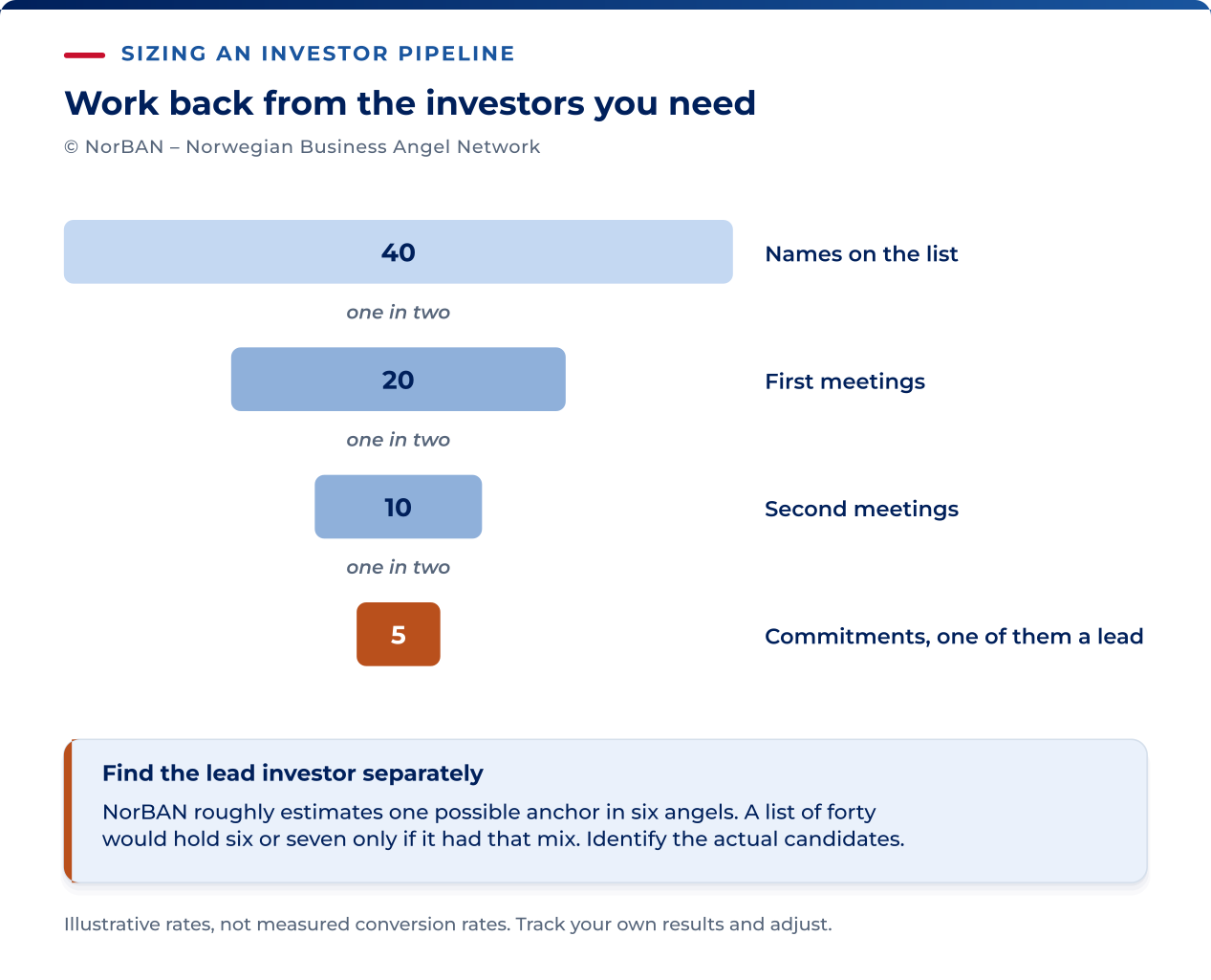
One possible structure is an anchor plus three to five other investors. An anchor commits a substantial part of the round; a lead investor also coordinates work such as diligence and terms. The same person may fill both roles. Prioritise suitable candidates while building the wider list.
Work backwards from the commitments you need, using your estimated conversion rates. Replace the example rates with your own to calculate the number of investors to approach.
| Step | Your assumed rate | Example |
|---|---|---|
| Commitments the round needs | From the round size and the investment bands below | 5, one of them an anchor |
| Second meetings that end in a commitment | Your rate | One in two, so 10 second meetings |
| First meetings that lead to a second | Your rate | One in two, so 20 first meetings |
| Contacts that take a first meeting | Your rate | One in two, so 40 names on the list |
The example requires forty names under its assumptions. Cold contacts or weaker investor fit may require a larger list. Begin updating your estimates after the first ten conversations, but treat that as a small sample and keep measuring.
Do not assume that forty selected contacts contain six or seven potential anchors. That follows from the one-in-six estimate only if your list has the same composition. Check willingness, available capital and experience directly, and track these candidates separately.
Targeting: who belongs on the list
Adding names will not help if those investors cannot fund your company. Filter every name against how much angels in Norway typically invest before anyone is approached; NorBAN’s figures give the calibration, with the same caveat that they are estimates from experience.
| Filter | NorBAN’s rough estimates | How to use them |
|---|---|---|
| Investment amount | Micro angels: NOK 30,000–500,000. Core angels: NOK 0.5–2 million. Super angels: NOK 2–5 million or more. The reported medians are about NOK 100,000 for round-completing investments and NOK 1 million for larger investments. | Record each investor’s actual range. At NOK 100,000 each, NOK 5 million needs fifty investors; at NOK 500,000 each, it needs ten. A larger anchor investment can reduce the number needed. |
| Stage | Strong pre-seed preference; fewer than one-third reportedly consider Series A. | Verify current stage preferences. One historical investment at a different stage is not enough to exclude someone. |
| Sector | Most report no sector preference. Among those with a stated focus, B2B SaaS and software lead, followed by property technology. | Use sector knowledge to prioritise, and check actual restrictions and competing investments. |
| Experience | Technology and product are most commonly reported, followed by founder/exit experience, commercial skills and then finance/fundraising. | Prioritise experience the team needs. |
| Follow-on capacity | Around one-third report capacity for later rounds. | Ask directly and plan alternatives; capacity is not a commitment. |
| Geography | Practical access can matter for meetings and active involvement. | Start where introductions are available, but include relevant investors elsewhere. |
Existing shareholders, advisers and angel networks can help identify contacts. Skatteetaten’s shareholder register also provides reported ownership at year-end, normally released the following May. Check the year and possible errors; it is not a live or complete map of indirect ownership. Use personal information in accordance with data-protection rules.
The tracker: one place, one owner
A spreadsheet is enough. One row per investor, one person who owns it, and a weekly update on a fixed day. Use the tracker to decide which conversations need attention and what to do next.
| Column | What to record | Purpose |
|---|---|---|
| Investor and investing entity | Contact person and actual subscriber, once confirmed | Avoid confusing the person in the meeting with the legal investor. Check whether several contacts share one decision process. |
| Likely amount | Confirmed range, or a clearly labelled estimate | Compare potential total with the funding target without counting estimates as commitments. |
| Possible anchor | Yes, no or not yet known | Follow relevant candidates separately. |
| Introduction route | Who introduced you and who handles follow-up | Coordinate contacts and avoid duplicate requests. |
| Status | The actual stage reached | See overall progress. |
| Latest contact and next step | Dates, task and responsible person | Make follow-up practical. |
| Questions and objections | What was asked and what remains unresolved | Repeated questions may show a gap in the material or a mismatch with the target investor. |
Use statuses that distinguish introductions, meetings, materials, indicated amounts, diligence, terms, binding commitments and payment. The actual order can vary. Record completed steps and outstanding conditions instead of forcing every investor through an identical sequence.
Review the counts before individual rows. Twenty identified names and two first meetings may indicate a contact problem, but also a recently created list. Eight second meetings without commitments may point to unanswered questions, price, timing or investor fit. Ask what is missing before deciding what to change.
Sequencing: who to approach first
Order the list before you send the first email, because the first meetings are also the rehearsal. NFX’s fundraising manual, written for American founders raising from venture firms, advises meeting a few less relevant investors first to train yourself, then the relevant but lower-tier ones, and only then the top targets.
For an angel round, consider beginning with relevant conversations where there is room to learn. You can also practise with advisers or founders. Approach strong anchor candidates once the pitch and answers are ready, without delaying genuine opportunities merely to follow a fixed order.
Do not leave anchor candidates until the very end. Paul Graham’s 2013 essay, written for US founders, argues that other investors’ interest can influence decisions. Treat that as practical advice, not a measured rule for Norwegian investors.
NFX recommends seeking a credible first term sheet to help other discussions progress. Consider both the investor and the terms: an unsuitable offer is not worth accepting merely to create momentum.
One workable sequence is three or four practice conversations, then a concentrated effort with anchor candidates while continuing suitable smaller-investor discussions. Adapt this to the actual opportunities. Some investors want an anchor in place; others can decide earlier.
One route per investor is the etiquette, and networks make it easy to break. When a case reaches many angels at once through a network’s channels, do not also ask three members to forward it individually.
Overlapping introductions can create confusion. Coordinate with the people helping you and record who has contacted whom. A second contact is not inherently harmful, but it should have a clear purpose.
Stage-parity and momentum
Graham recommends parallel discussions, prioritising the most promising investors. For an angel round, grouping first meetings over two or three weeks can be a useful starting plan. Adjust for availability and your ability to follow up; the timetable does not guarantee simultaneous decisions.
An early term sheet may leave you with fewer alternatives to compare, while several credible offers can improve negotiating choice. You can still question or reject the first offer. Review deadlines and any exclusivity obligation before continuing competing discussions.
Coordinate meeting dates to keep conversations at similar stages. Scheduling helps maintain momentum and gives you a better chance of comparing terms while investors are ready to move.
Investors will not wait for your batch if they are ready earlier. Tell them plainly that you are speaking to a group of investors, that second meetings are being held in a given fortnight, and that you will come back with the round’s shape after it.
An investor who wants to invest alongside others may welcome this coordination. Others may need a different timetable. Be clear about the proposed process and discuss any timing conflict directly.
Reading the pipeline
Review the number of investors at each stage and your conversion rates weekly. Compare both with the previous week to see where progress has slowed.
- First meetings booked. Compare activity with your plan and previous weeks. A low number is a prompt to investigate, not proof that introductions have dried up.
- Meetings that lead to another step. Ask why discussions stop. Revise the pitch, evidence or target list where the feedback supports it.
- Interest with an amount. Record it, but distinguish non-binding indications, conditional commitments, binding commitments and received funds. Only received funds are available cash.
- Conditions and timing. Ask what remains before a decision, who decides and when. Record the answer rather than assuming positive language is a commitment.
Repeated questions may reveal unclear material or unresolved business issues. Several responses of “too early” can suggest a stage mismatch or missing evidence. Ask what would change the answer before deciding whether to change the pitch, target list or business plan.
Silence after sending material can mean lower interest, lack of time or an internal delay. A brief follow-up can clarify whether a next step is realistic. Do not diagnose the cause from silence alone.
Use the weekly tracker review to notice when progress stalls. It gives you time to adjust the process before the raise loses further weeks.
The pipeline between rounds
The investors who said “too early” are the warm start of the next raise, and the tracker is where they are kept. Record what they said would change their answer, and the date by which you expect to have it.
NorBAN’s figures put the angels with capacity to follow on at about a third, and the page advises planning the next round on the assumption that most of your current angels will not be in it.
Plan to find new investors rather than relying entirely on follow-ons. Maintain relevant contacts, including those who said “too early”, and build new relationships between rounds. Some rounds can still be funded by existing owners.
Send the list a short update when you reach a milestone. This keeps the relationship active and gives you a reason to resume the conversation when you next raise.
Keep each name in the pipeline with the reason they remain a prospect. Use that record to make the next approach relevant to what they wanted to see.