
Keep existing investors informed before the next round
Plan the next round on the assumption that most of your current angels will not be in it. NorBAN’s published figures put follow-on capacity at about a third of angels, and describe their money as round-completing, so each round needs new core investors. The figures are estimates from experience across the network, and the page says so.
The third who can follow on, and the two thirds who cannot, matter to the next round in different ways. The first group can invest again.
Investors without follow-on capacity may still introduce others, provide references or help new investors understand the company’s progress. Keep them informed, while recognising that these contributions depend on their capacity and willingness.
Some angels reserve capital for follow-on investment. Whether they invest again depends on the company, valuation, available capital and their portfolio. A new round need not be priced near the previous one.
When deciding whether to invest again, an investor relies on what they have learned since the last round. The update provides much of that information.
The 2009 UK angel study reported a 1.2× aggregate multiple for exits involving follow-on investment, below the full sample’s result. This historical association does not show that follow-on investment caused lower returns or predict a particular investor’s choice. Expect each new investment to require its own case.
Investors often interpret silence after a round as a sign of trouble. Regular updates keep them informed and help you prepare for the next raise at little cost.
Cadence and length
Agree who reports, what is included and when it is due. Follow any binding provisions in the shareholder agreement or other relevant documents. If no schedule exists, establish one with the relevant parties.
As one published example, Visible’s December 2025 guidance suggests monthly updates at pre-seed and seed, quarterly reporting for more established companies, and greater frequency when runway falls below six months. This is practical guidance, not Norwegian law or evidence of a universal market standard.
Keep the update short enough to read easily and send it on schedule. Provide supporting detail separately when needed. Brevity improves accessibility but does not guarantee that every investor reads it.
Keep reporting even when little has changed. An on-time update after a flat month shows investors that you are still tracking the numbers; skipping it leaves them wondering why.
Use a recurring date, the same reporting inputs and a consistent order. Once the format and underlying records are established, preparation can become quicker. The time needed still depends on the business and the quality of its reporting.
The format that gets read
A consistent layout lets readers find figures, problems and requests quickly. Use the suggested structure below, or adapt it to the company and the reporting terms you have agreed.
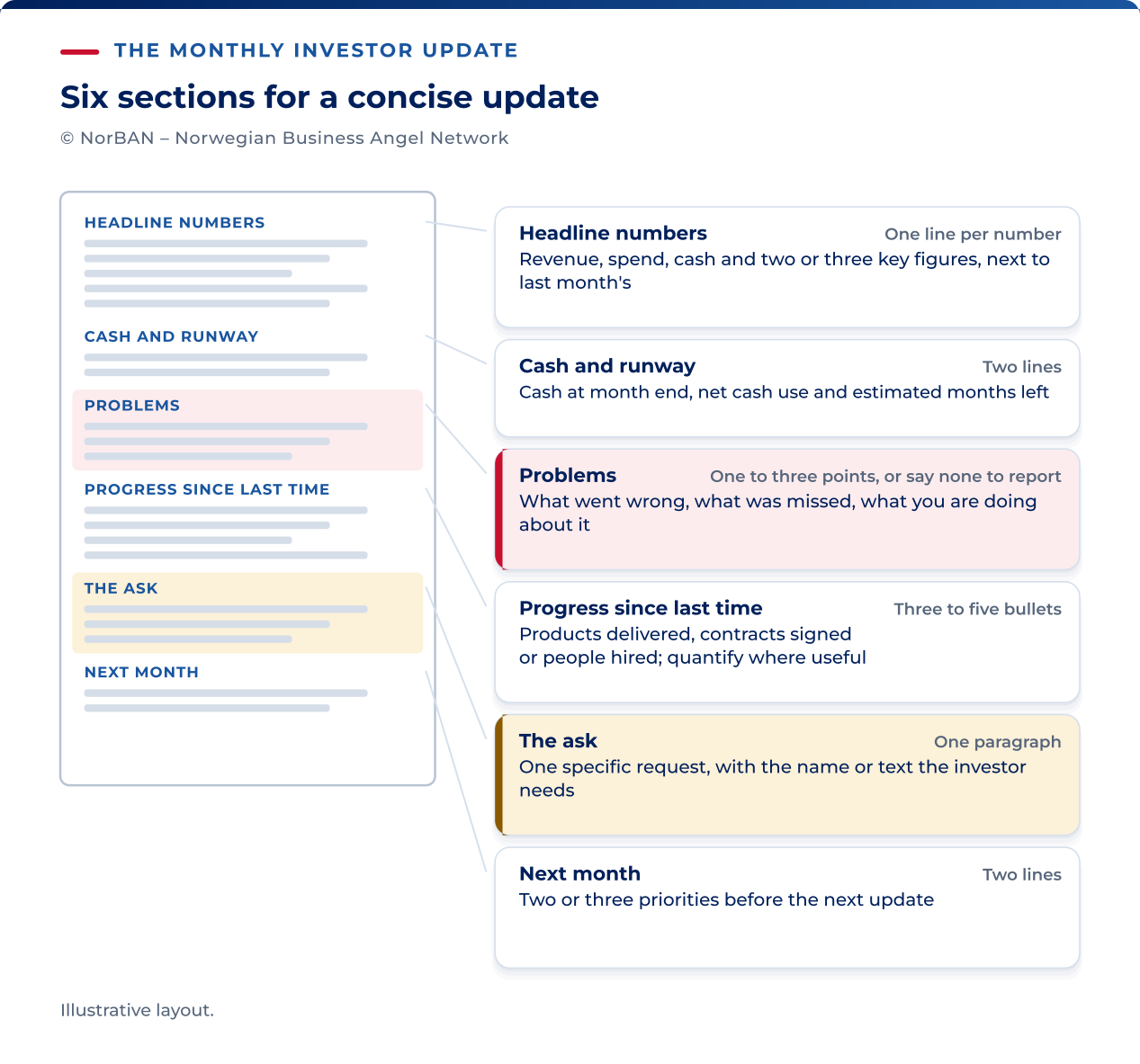
| Part | What to include | Suggested length |
|---|---|---|
| Key figures | Revenue and two or three relevant operating metrics, compared with the previous period | One line per figure |
| Cash and runway | Available cash, net cash use excluding financing, and forecast months until cash runs out; state assumptions and expected changes | A short paragraph |
| Problems and risks | Material setbacks or risks, their effects and your response. If there is no new material issue, say so | One to three points where relevant |
| Progress | Deliveries, contracts, launches or hires, with verifiable figures | Three to five points |
| Help needed | A specific request, with enough context to act | A short paragraph when needed |
| Next period | Two or three priorities and expected milestones | Two lines |
Base the update on your regular management reporting. Define metrics consistently and explain any change, including its effect on comparisons. A short summary should link to further detail where necessary; see the accounting and metrics articles.
Keep the growth figure honest at small numbers. Three customers becoming six is a doubling, and it is three customers. Report the count and the percentage together until the count is large enough for the percentage to mean something.
Sending the same ordinary shareholder update at the same time is a useful default. Section 6-28 prohibits unreasonable advantages at other shareholders’ or the company’s expense; it does not require every recipient always to receive identical information. Board duties, agreed information rights and a properly managed financing process can justify different access. Assess the purpose, confidentiality and interests involved.
Bad news goes first, and goes early
Place material problems close to the figures and explain the action being taken. Make reviewing risks a routine, but do not invent a setback to fill the section. If nothing material has changed, say that and identify any continuing risks worth monitoring.
Write the problem plainly. The published instruction is to state the missed target or the lost customer at the top of the section without defensive qualifiers, and it is the right instruction.
“We lost the pilot at Company X because the champion left; we have two replacement pilots in discussion” is a sentence an investor can act on. If you put a paragraph of context first, the investor has to search for the problem.
Early notice gives investors more time to help with introductions, recruitment, pricing or financing discussions. Six months usually gives more options than six weeks, but neither period guarantees a solution. Urgent financial concerns belong with the board immediately.
NorBAN lists technology and product, operating experience, commercial work, and finance and fundraising among the skills angels bring. Match the problem to the relevant person and involve them while there is time to act.
An unexpected disclosure can damage trust, especially if a material problem was known but not reported. Explain promptly what happened, when you learned it and what you are doing.
If investors first learn of a problem through an urgent funding request or another investor, they may question the reporting. Acknowledge any delay and establish a reliable update process. Trust may take time to rebuild; it is not necessarily lost permanently.
Increase reporting frequency when cash is tight or circumstances change quickly. Agree a useful interval with the relevant recipients and show a current cash forecast. More frequent reporting helps assessment; it neither commits investors to bridge funding nor replaces the board’s duties.
The ask
When you need help, choose a specific request that fits the investors’ experience or contacts. Explain the desired outcome rather than asking only for general support.
Provide what the investor needs: a short introduction they can forward, a role description or the name of a relevant contact. Reducing preparation work makes it easier to help, but leave room for them to decline.
Base requests on the skills your investors have offered. The four areas above suggest practical ways they can help.
- An introduction to a named customer or partner, with two sentences on why they should care that the investor can forward unchanged.
- A conversation with a candidate, where the investor has hired for the role before. Send the description and the candidate’s name.
- An hour on a product or technical decision, with the question written down and the options you are choosing between.
- An introduction to the next round’s investors, by name where you have them. This is the ask that matches the constraint NorBAN’s figures report, because most of your angels cannot follow on and many know who can.
- A reference, when a customer, a partner or a prospective investor wants to talk to someone who has backed you.
Discuss funding directly with investors who may have capacity, without relying on the network-wide estimate to predict an individual answer. The regular update can also invite other forms of help.
Report what happened after an introduction or other assistance. Thank the contributor, naming them where appropriate and agreed. This lets investors see the outcome of their help.
What you already owe
Your reporting obligations come from both the agreement you signed and the statutory rights of every Norwegian shareholder.
| What to check in your agreements | Examples of statutory shareholder rights |
|---|---|
| Norwegian venture guidance describes operational and financial information rights. Check the actual frequency, format, access and parties bound. | Annual accounts and any annual report and audit report must normally be sent at least one week before the ordinary general meeting under section 5-5. Website-document provisions under section 5-11a can affect delivery. Filed accounts are public under Accounting Act section 8-1. |
| Who prepares the update and its deadline. Amend unclear provisions by agreement. | For an ordinary meeting procedure, written notice must be sent at least one week before the meeting, unless a longer articles-based deadline applies; section 5-10 also governs agenda and participation information. Simplified procedures have separate rules. |
| Confidentiality and permitted use of information. | Under section 5-11, an agenda request with a proposed decision or reasons must reach the board no later than seven days before the notice deadline. If notice was already issued and time remains, a new notice must be sent. |
| Any board or observer nomination rights, with the required corporate decisions. | Section 5-15 gives a right to available information on specified matters at the meeting, subject to the statutory limits, including disproportionate harm. If information must be obtained, a written answer must be prepared within two weeks and sent to all shareholders with known addresses. |
| Any additional information rights in the articles or other arrangements. | Section 4-6 and its regulations provide public access to shareholder-register information. This is not access to every document in a fully diluted cap table. |
The table is not an exhaustive list of statutory rights. Regular investor updates are usually arranged by agreement, but obligations can also arise from the articles and other legal rules. Read the reporting provisions together, and amend contractual requirements with the parties whose consent is needed.
Assign someone to coordinate the company’s reporting. Check which obligations bind the company, founders or other parties. A common shareholder update is a practical starting point alongside any justified additional access.
Board reporting is a separate stream. A director receives the board papers as a director and owes the duty that comes with the seat to the company, and the article on working with an angel director covers what that means for you.
Give shareholders a useful picture of progress, finances and material risks in the regular update. That does not give every shareholder a right to all board material or require disclosure of information the company must protect.