
The month this conversation should happen
Six months of cash can leave more time to approach new investors, negotiate a priced round, reduce spending or arrange a sale or orderly closure. It does not guarantee that any option will succeed.
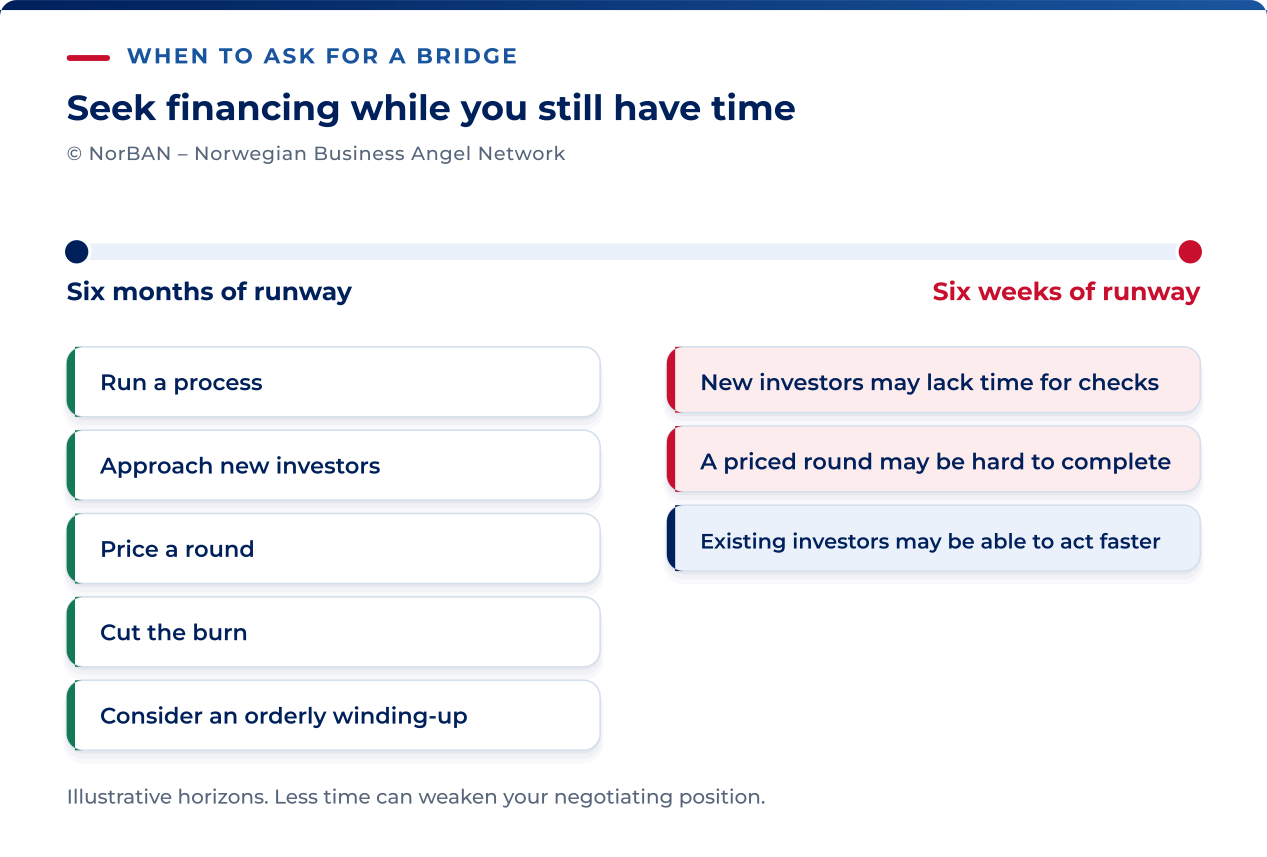
With six weeks left, a new investor may struggle to complete due diligence and a round in time. Existing investors may move faster because they know the company. Explore credible alternatives, but plan for the possibility that funding will not arrive.
Delay can weaken your negotiating position. Limited alternatives may make the terms less favourable, including the valuation cap on convertible finance. The result depends on the company, investors and available alternatives.
Regular reporting makes the conversation easier. Investors assess a bridge using what they have seen since their last investment, and a year of monthly updates gives them much of the information they need.
What the board must do as equity thins
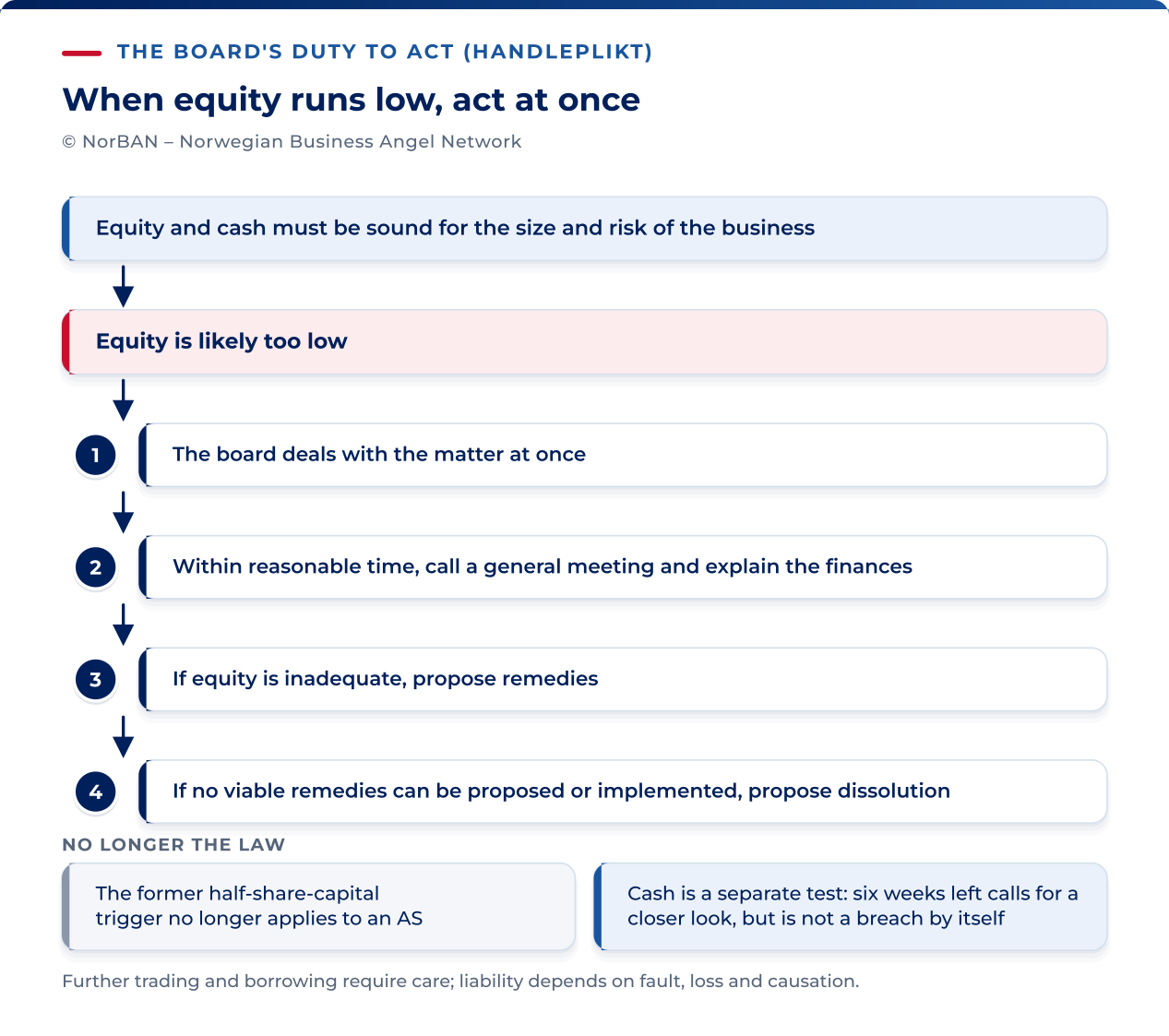
Under section 3-4, equity and liquidity must remain adequate for the business’s risk and scale. Assess both: a company may have positive accounting equity but be unable to pay bills on time.
If equity must be assumed inadequate, the board must consider the matter immediately under section 3-5. Within a reasonable time it must call a general meeting and explain the financial position. If equity remains inadequate, it must propose corrective measures. If there is no basis for measures, or they cannot be implemented, it must propose dissolution.
The provision names no deadline in days or months. The old trigger at half the share capital was repealed for an AS in 2017 and survives only for an ASA, in allmennaksjeloven § 3-5.
The board must also avoid decisions that make equity or liquidity inadequate. Poor results do not automatically establish personal liability: fault, loss and causation must be assessed in the particular case.
Insolvency needs more than a low bank balance. Under konkursloven § 61, inability to pay debts as they fall due must not be temporary. Insolvency is also absent if assets and income together are expected to cover the obligations fully, even if asset sales delay payment. Assess liquidity and coverage together, using realistic values and documented forecasts.
Liability under aksjeloven § 17-1 is fault-based and assessed director by director. In HR-2026-1181-A, decided 27 May 2026, a managing director and sole board member was asked by a supplier whether financing was in order.
He assured the supplier that financing was in place and there was no reason to worry. The Supreme Court found the misleading assurance at least negligent and decisive to the supplier continuing deliveries. He was personally liable. The judgment does not make actual knowledge of insolvency a general condition for liability.
The judgment draws on HR-2017-2375-A (Ulvesund), paragraphs 40–42. Management can have room for a realistic, active rescue attempt within a reasonable time. Whether liability follows depends on the information, conduct and prospects at the time, rather than simply whether the rescue failed.
Do not treat silence as a safe alternative. The company may have a duty to warn a counterparty about expected payment failure. Whether a director or manager is personally liable requires a separate assessment. Give accurate information and distinguish secured financing from hopes or ongoing negotiations.
If insolvency is possible, obtain advice promptly and document the board’s assessment. Penal Code section 407 concerns intentional or grossly negligent failure to seek the specified court process while insolvent, under its additional conditions concerning lost avoidance rights or clearly loss-making continued business without reasonable payment prospects. Its creditor-understanding exception requires a substantial share of creditors by both amount and number; informal support from one investor is not enough.
The paper you bring to the conversation
If reporting is current, much of the material may already exist. Allow enough time to check the figures, assumptions and proposed terms before the investor discussion.
| Material | Purpose | Source |
|---|---|---|
| Weekly cash forecast, for example for 13 weeks | Shows when cash is needed and what the funding could achieve | Bank balance, expected receipts, payments and tested assumptions |
| Revised operating plan | Explains what will change | Board’s assessment and proposed measures |
| What changed and when it became known | Explains the gap from earlier plans | Dated reports and new evidence |
| Milestone and funding requirement | Links the amount to an achievable objective and date | Revised plan and downside case |
| Proposed terms and minimum funding | Lets investors assess their commitments and any closing condition | A proposal developed with relevant investors and advisers |
| Plan if funding fails | Provides a realistic comparison | Cash forecast and assessed alternatives |
Asking the people already on your cap table
NorBAN’s published figures suggest that about a third of angels have follow-on capacity and about one in six can anchor a round. These network-level estimates do not describe every cap table. Ask your investors about capacity and willingness separately.
Coordinate investor discussions with the board’s work. The following groups may overlap; adapt the order without withholding material information from the board or bypassing shareholder rights.
- The board, including investor-appointed directors. Provide a sound decision basis and assess conflicts of interest before deliberation.
- Investors willing to develop a proposal. Agree who will coordinate the instrument, price or cap, minimum amount and timetable. This can be one investor or a group.
- The previous lead investor. Ask whether they can help assess the plan or organise further commitments.
- Investors able to participate. Send a clear written proposal, request a specific amount and explain any minimum-funding condition. Justify differences in treatment.
- Investors unable or unwilling to participate. Explain dilution and changes to rights. Their existing voting, information and pre-emption rights still matter.
- Public co-financiers. Read the actual award and loan terms before choosing the structure.
Ask separately about investment, timing and voting support. Give people the written basis before requesting a decision. Side agreements are not automatically prohibited, but assess their effects on other owners, conflicts, required approvals and disclosure; do not hide preferential terms from the decision-makers.
Structuring it when only some come in
Consider how each route affects shareholders who do not participate. Your next investor will also assess the resulting ownership and creditor rights.
| Method | Main approvals and checks | Effect on non-participants | What a later investor will examine |
|---|---|---|---|
| Proportionate cash offer to all owners | Capital-increase resolution or valid registered board authority; statutory pre-emption under section 10-4 | Dilution if they do not subscribe; new share rights may also matter | Price, participation and rights |
| Directed share issue | Valid capital-increase decision and waiver under sections 10-5 and 5-18; stricter articles or affected rights may require more | Dilution and possible changes in relative rights | Justification for price and unequal treatment |
| Convertible shareholder loan | Chapter 11 approval or valid authority where the lender can demand shares; assess debt terms and conflicts | Adds debt immediately; possible dilution on conversion | Maturity, interest, ranking and conversion terms |
| Ordinary shareholder loan | Board authority, conflicts and section 3-8 where applicable, including its exceptions | Adds a creditor claim even without security; repayment affects liquidity | Ranking, security, pricing and repayment obligations |
| Pay-to-play terms | Assess the precise rights change under company law, articles and agreements; enhanced majorities or individual consent may be required | Possible dilution or loss of rights, depending on valid terms | Enforceability and treatment of non-participants |
Two things are worth holding on to. The general meeting cannot resolve a greater deviation from pre-emption than the board’s own proposal states, unless the shareholders whose right is impaired consent, so the waiver is drafted in that proposal.
A formally adopted resolution can still breach the abuse-of-authority rules in section 5-21 or section 6-28. These provisions do not specify a universal price or dilution percentage. The ordinary deadline to challenge a general-meeting resolution is three months under section 5-23, with statutory exceptions.
The instrument terms belong to pricing the round. The dilution arithmetic belongs to your cap table three rounds out.
When the answer is no, or silence
A new investor may ask why an existing investor declined. Explain the reason if you know it, such as limited capacity, fund timing, investment policy or disagreement over the plan. If you do not know, say so rather than assigning a convenient motive.
Set a clear response deadline and follow up once. Distinguish an indicative funding response from formal subscription and voting deadlines. For statutory pre-emption, the subscription period cannot be shorter than two weeks from the required notification under section 10-4.
An offer made under financial pressure may still be worth accepting. Compare it with realistic alternatives: cost reductions, asset or business sales, restructuring, orderly dissolution or bankruptcy where required. Do not assume liquidation is always the only alternative.
Take the terms to counsel before you sign. If they are punitive, say what you will agree to and set your own deadline.
When a bridge is not the answer
The board should assess the realistic alternatives and record its reasoning. The following four categories are a practical checklist, not four statutory steps that must always be considered at a single meeting.
Reducing spending can help, but personnel savings take time. Before deciding on dismissal, discuss it with the employee as far as practicable under section 15-1. The ordinary statutory notice starts at one month, normally from the next month’s first day. Service, age, agreements and probation can change the period under section 15-3. Assess the lawful basis for dismissal as well.
Collective redundancies under section 15-2 generally mean at least ten dismissals in 30 days for reasons unrelated to the individuals; specified other terminations can count too. Consultation and notification rules apply, and dismissals take effect no earlier than 30 days after notification to NAV, with possible extension. Temporary layoff requires a temporary basis. Notice is normally 14 days, with exceptions, and the employer normally pays for 15 working days under NAV’s guidance.
Selling the company while it still has value is the second, and an orderly wind-down is the third. The fourth is the court-supervised route.
A debtor that has, or in the foreseeable future will have, serious financial difficulty may petition the tingrett, which is a lower threshold than insolvency (rekonstruksjonsloven § 2). A plan may defer payment, reduce claims, or convert debt into equity.
As checked on 9 October 2026, the temporary Reconstruction Act governs these proceedings. The Bankruptcy Act’s ordinary debt-negotiation rules remain displaced while the temporary regime applies.
The permanent reform was adopted on 19 June 2026 as Act 2026-06-19-48. Part I replaces the first part of the Bankruptcy Act when brought into force by the King. The amendment to the temporary Act in part V took effect immediately; that does not mean the permanent regime has started.
The commencement provision allows different starting dates and transitional regulations. The temporary Act is repealed when part I begins. Check both the commencement decision and transition rules for the actual case before relying on the comparison below.
Under temporary section 34, debt-to-equity conversion normally requires the affected creditor’s consent. A creditor who has not agreed is therefore not automatically included.
The court can override refusal where weighty reasons support conversion and the creditor manifestly lacks reasonable grounds to refuse. The adopted permanent rule in part I, section 33, instead normally permits conversion for affected creditors who do not object. This concerns claims covered by the proposed conversion, not every passive creditor.
The permanent rule retains the narrow court power to override an objection. It also protects affected creditors against receiving less than in bankruptcy or the other likely outcome if reconstruction fails, unless they consent to less. This is a creditor protection, not a general minimum payment guarantee for shareholders.
Temporary section 35 reduces the general-meeting majority for the specified debt-conversion and loss-covering capital-reduction decisions to at least half of votes cast and represented capital. It is not a general rule for every share issue. Check exactly which decision and other requirements apply.
Under the permanent reform, a confirmed plan can replace the corporate decisions covered by sections 33–34. When the plan contains such measures, shareholders form a separate voting class. Section 41 requires at least half of votes cast and participating capital to support it. A plan can in specified circumstances be confirmed despite that class voting against it, but cannot force shareholders to contribute new money.
The priority test in section 45 addresses creditor classes; shareholder treatment has its own framework. Owners may retain shares in some plans even where creditors are not paid in full. This is not an unrestricted right to keep value: all confirmation conditions and applicable company-law limits must be assessed.
For an owner, the practical steps are to participate, vote and obtain advice before the deadline. The permanent section 34 excludes the ordinary resolution-challenge rules in Companies Act sections 5-22–5-24, but not the abuse rule in section 5-21. The creditor-specific protection and objection ground do not automatically apply to someone solely as shareholder. The appeal rules identify who may appeal, including parties who voted against the plan.
Section 49 of the permanent reform gives a ten-day deadline to appeal confirmation. Seek insolvency-law advice promptly to establish standing, grounds and deadlines. Do not assume an ordinary challenge to the share-issue resolution will remain available after confirmation.
Under temporary section 41, specified claims lack voting rights, including related-party claims, conditions not yet triggered and certain subordinated claims. A shareholder is not automatically a related party: Recovery Act section 1-5 requires the relevant ownership or control connection. The plan’s binding effect follows section 54 and its exceptions, separately from voting rights.
For restructuring proceedings opened on or after 1 July 2026, the temporary suspension of tax priority no longer applies. Earlier proceedings remain covered by the transition rule in Regulation 2020-05-11-974. Priority under section 9-4 covers specified claims subject to time limits, not all tax arrears. A plan normally does not bind a creditor for the priority-covered portion unless the priority is waived as provided by law. Calculate the protected and unprotected amounts separately.
Public finance may constrain the transaction. Start with the company’s actual award letter, loan agreement and incorporated terms, rather than assuming one set of published conditions covers every scheme.
Grant repayment and lapse depend on the scheme and award conditions, which can cover incorrect information, ineligible use, overpayment, state-aid breaches and missed reporting deadlines. A three-year documentation deadline is programme-specific. Check the letter of offer (tilbudsbrev) and annexes for ownership conditions before the transaction.
Check specifically whether ownership changes, restructuring or a change in project scope require notice or consent. If the award documents do not give a clear answer, ask the scheme administrator in writing before committing to the transaction.
A consent requirement stated for an Innovation Norway borrower does not by itself establish the grant recipient’s obligations. Apply each actual agreement on its own terms. A portal option to request changed terms is not itself a contractual condition.
What you owe everyone once it is decided
Explain in writing how the completed round changes the holdings and rights of non-participating owners. Their rights do not disappear because they declined to invest. Share the final ownership calculation and the relevant decisions.
Tell employees about cuts yourself before they hear elsewhere. Explain the runway the round provides without making promises you may be unable to keep.
Record the decisions, evidence, alternatives and reasons, together with conflict assessments and who did not participate. Accurate minutes help establish what happened; they do not create immunity from liability.
For tax purposes, debt conversion generally is not debt forgiveness, even if the shares are worth less than the claim. Forgiveness within Tax Act section 14-6 reduces losses carried forward from the year of forgiveness and earlier years by the relevant forgiven amount. It does not reduce losses arising in later years. Check Skatte-ABC U-2-5.8 and the anti-avoidance rule in section 13-3 for the actual transaction.
Accounting has a separate answer. NRS 8, section 7.1.5 states that forgiveness caused by inability to pay is credited directly to equity rather than recognised as income. Other reasons, such as price adjustments, sales support or conversion for an ownership interest, are accounted for according to the arrangement’s actual substance.
Accounting treatment does not determine the tax result. Although small entities do not follow the specific equity-change note in section 7-25, section 7-1 still requires necessary information about position and results and additional information needed for a true and fair view. Do not assume a material forgiveness can be omitted from the notes.
Give the bookkeeper, and the auditor where applicable, the agreement and explain whether debt was converted or forgiven and why. Confirm the accounting, tax and disclosure treatment before closing.