
Forecasts, honest mistakes and deliberate false statements
A missed forecast, an honest mistake and a deliberate false statement need different checks. A forecast that turns out badly does not by itself establish a breach. Ask whether it misrepresented existing facts, lacked a reasonable basis or was promised as a contractual result. An honest but careless statement can still create liability.
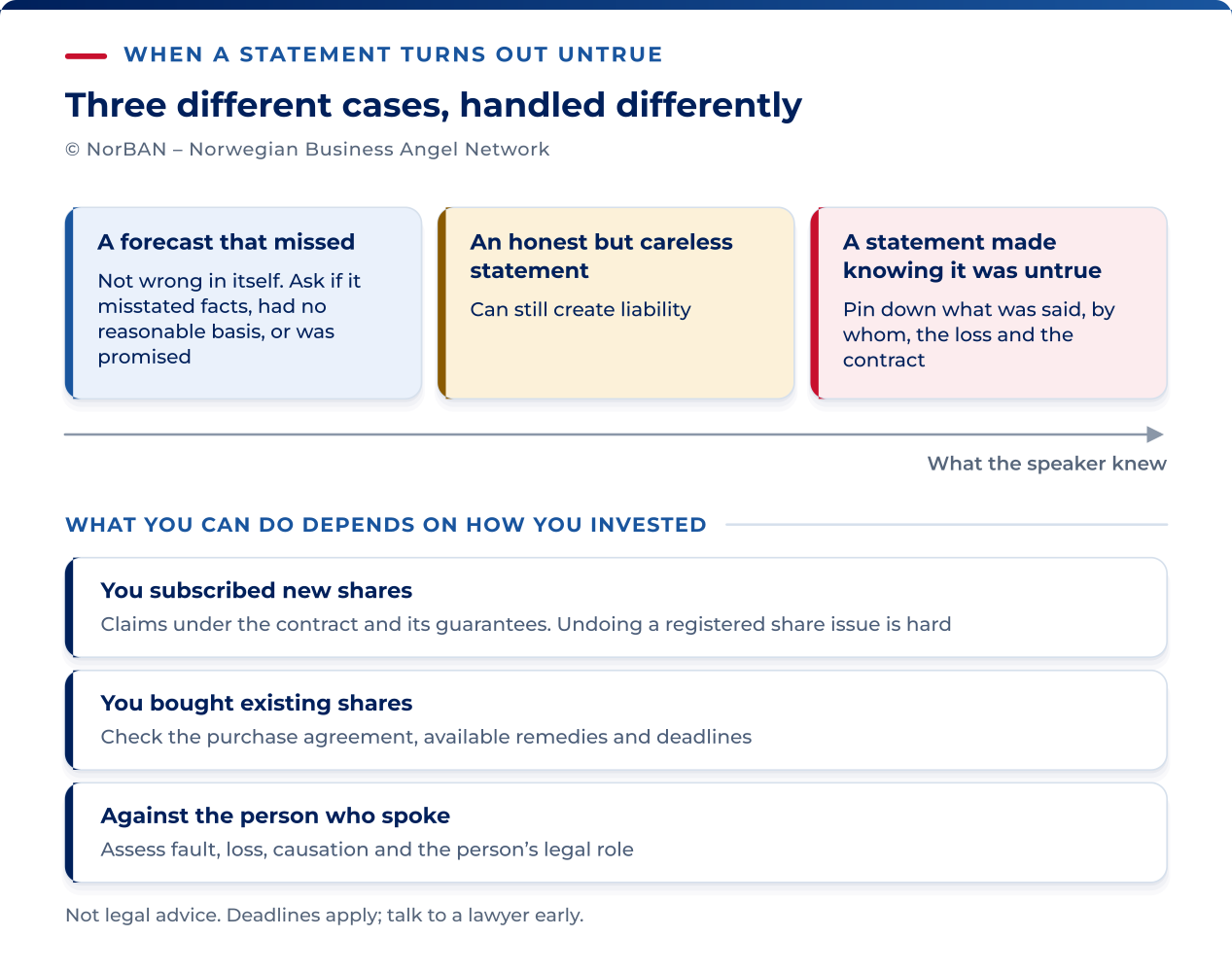
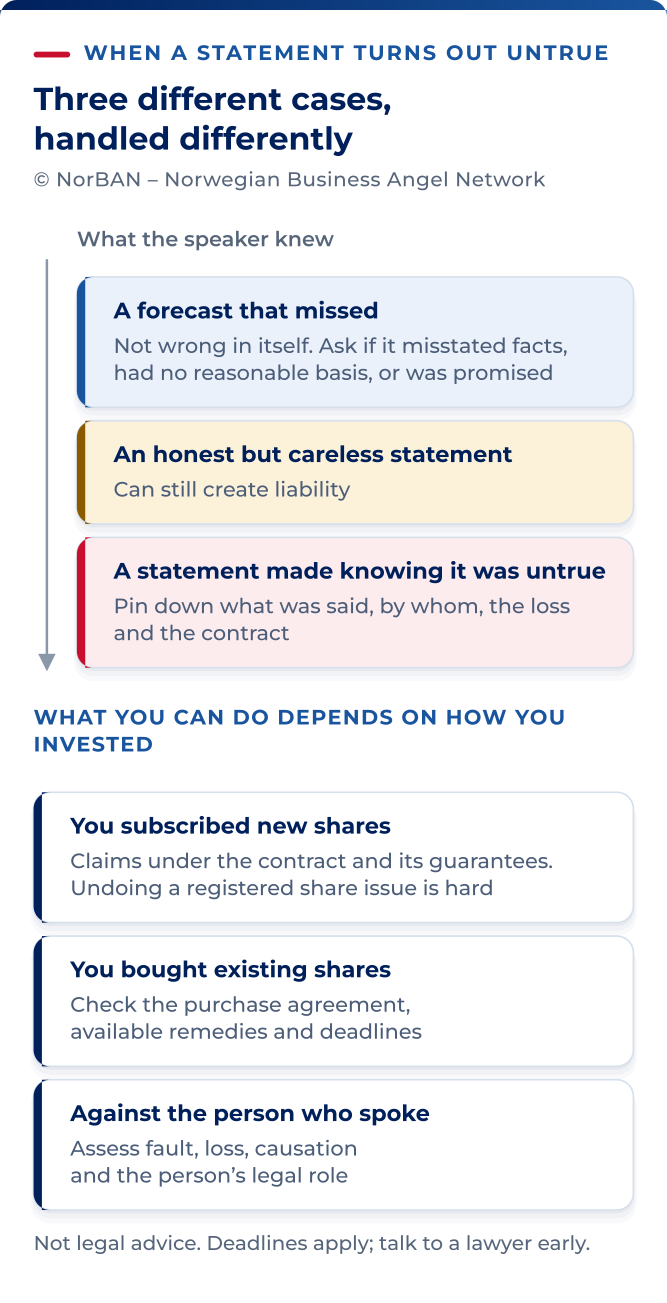
If a statement was knowingly false, record exactly what was said, who said it, the loss and the relevant agreement. A warranty can make someone responsible without proof of fault, depending on its wording and limits. A personal damages claim usually needs a separate legal basis, such as negligence by someone acting in a company role.
The director’s liability to a supplier in HR-2026-1181-A, discussed below, is not a rule that every contractual claim requires blame.
Common warning signs
Test these claims independently, using documents, specialist assessment and third-party responses as needed.
| Pattern | Evidence presented | Check |
|---|---|---|
| “Contracted” revenue | Pilot or letter of intent behind revenue. | Obtain each customer’s signed contract, term, notice period and price. |
| Conversation-based customer list | Logos and names without orders. | Call two customers using independently sourced numbers. |
| Missing share promise | Balanced cap table omitting an adviser or leaver commitment. | Reconcile with the share register (aksjeeierbok), registered capital and issue minutes. Ask in writing about unissued promises. |
| Undocumented convertible | Loan, perhaps unrecorded, with emailed conversion terms. | Obtain agreement and decisions. Distinguish chapter 11 conversion rights from loans needing a later issue. Check required filings and board authority; not every loan is registered. |
| Grant/deposit as revenue | Grant, advance or refundable deposit in revenue. | Read recognition policy; obtain bank evidence for the three largest lines. |
| IP outside the company | Claimed patent/trademark registered to another party. | Check Patentstyret and evidence of ownership or sufficient licences, including necessary assignments. |
| Departed founder still owns shares | Three team names, four registered holders. | Reconcile team and register; obtain departure agreement. |
| Inconsistent numbers | Deck, data room and co-investor figures differ. | Compare all three; ask a named person for written reconciliation. |
| Screenshot bank balance | Screenshot or unheaded export. | Request bank confirmation via the company. |
| Uncommitted adviser, customer or lead | Names presented as committed, despite ongoing conversations. | Call: what was signed, for how much, and when? |
Check against a register or a third party
These sources let you check claims without the company’s cooperation. Each has limits, so use it only for what it can establish.
| Source | What it proves | What it cannot prove |
|---|---|---|
| Foretaksregisteret (Brønnøysundregistrene) | That the company exists, who may bind it, what the articles say, what capital is registered, and any required filed reports or decisions, such as for specified related-party transactions, chapter 11 loans or board authorities. Filing requirements depend on the transaction. | Who owns the shares, or the commercial content of anything registered. |
| Regnskapsregisteret (Brønnøysundregistrene) | The filed accounts, whether they were filed on time, and whether they are audited. | That unaudited figures are right. Below the audit thresholds, unaudited is the normal state. |
| Løsøreregisteret (Brønnøysundregistrene) | Registered security over operating assets, inventory, receivables, vehicles and leasing agreements, on an organisation number. | For shares in an AS that are not registered in a securities depository, a contractual pledge is perfected by notice to the company and entered in the share register under § 4-8. Check the actual registration system and underlying documents. |
| Konkursregisteret (Brønnøysundregistrene) | Bankruptcy and role history for the chair, the general manager and the auditor. | Anything about a solvent company’s finances. |
| Skatteetaten’s shareholder register | Shareholders, share class and number of shares at the end of the income year, released in May of the following year. | Today’s cap table. The data can be seventeen months old when you read it, and it is no title register. |
| Patentstyret’s search service | That an application or registration exists for a trademark, patent or design, with owner, status and dates. | Ownership as between the company and its founders. A right appearing not to be in force may be under appeal. |
| The company’s own share register | Who is registered as a shareholder, with dated entries. Anyone may demand a copy under aksjeloven § 4-6. | Priority, an unnotified competing transfer, or a creditor’s position against the shares. |
Registers establish the facts they record, within the limits set out above. They cannot verify every company claim. The absence of a statutory audit also does not prove that nobody has reviewed the accounts.
Most of the patterns above are caught before money moves by reconciling the cap table against the share register and the registered capital.
You can also check directly with people. Contact a customer yourself to test the founder’s account, and obtain a bank confirmation addressed to you to verify the balance.
Before the money moves: what the documents give you
Your options depend on whether you bought existing shares or subscribed for new ones. For existing shares, kjøpsloven provides default remedies against the seller for defects, including rescission (heving): undoing the purchase. The agreement can change or exclude those rules.
Kjøpsloven § 20 first paragraph limits claims for matters you knew or must have known at purchase.
The second paragraph covers what an examination should have revealed, including one you declined without reasonable cause after an invitation. The exception for the seller’s gross negligence or conduct contrary to honesty and good faith applies to this second rule.
New shares are created under aksjeloven chapter 10. There is no seller, so kjøpsloven’s buyer remedies are unavailable against the company. After registration, capital-protection rules restrict your ability to undo the subscription.
Founder warranties provide negotiated protection, but are not the subscriber’s only possible remedy. Contractual damages, invalidity and personal liability must be considered separately.
Under aksjeloven §§ 10-7 and 2-10, registration generally makes an otherwise invalid subscription binding, subject to prior notification to the register and narrow exceptions for false or forged subscriptions, gross duress and breaches of guardianship rules. Damages may remain available.
A transfer of value to someone in their capacity as shareholder must follow a lawful distribution route under aksjeloven § 3-6. The capital limits and procedure depend on the route, such as a dividend, capital reduction or liquidation. A genuine damages claim is not automatically a shareholder distribution merely because the claimant also owns shares; assess its basis separately.
On discovery: the first week
Work through the steps in order. Preserve the evidence before approaching the company.
- Pause new commitments and check payments already owed. Get legal advice before withholding an agreed payment, especially a due subscription or tranche. Check conditions, default provisions and deadlines; suspicion alone does not suspend the obligation. Withholding without a valid basis can cause interest, damages or loss of rights.
- Preserve the record. Keep the deck, the data-room index, the e-mails and the version of each document you were sent, with dates. Do not ask the company to correct anything yet; a corrected file replaces the evidence.
- Establish what was said, in writing, and by whom. Set out each statement you relied on, where it appeared, who made it and on what date.
- Take counsel before you accuse anyone. An accusation you cannot support has consequences of its own. Start by showing your lawyer the evidence, then discuss what to do.
- Identify the claim and its conditions. Record what you relied on and what you would have done with accurate information. Counsel should distinguish negligence, contractual warranties, statutory purchase remedies and invalidity. Fault and reliance are not identical requirements across those routes.
- Choose a proportionate investigation process. For allegations against individuals, agree an independent investigator, written mandate, notice, an opportunity to respond and representation. The Norwegian Bar Association’s private-investigation guidelines set professional expectations; they are not a statute governing every diligence check.
Legal options to discuss with your lawyer
Claims after subscribing for new shares
A warranty claim depends on what was promised, who promised it and the agreed limits. General contract law also matters: deception or bad faith may engage avtaleloven §§ 30 and 33, and an unreasonable term or agreement may be reviewed under § 36. These routes do not remove the company-law limits on undoing a registered subscription.
Claims after buying existing shares
For a claim against the seller, check whether there is a defect under kjøpsloven § 17 and whether you gave notice within a reasonable time under § 32. Undoing the purchase requires a material defect under § 39.
In Rt-2002-1110, the Supreme Court allowed a purchase of all shares in an AS to be undone because of an undisclosed liability.
Late notice does not always end the claim. Kjøpsloven § 33 preserves it where the seller acted contrary to honesty and good faith.
A personal claim against the person who spoke
A managing director, board member or shareholder can be personally liable for a loss they caused intentionally or negligently while acting in that role. Liability under aksjeloven § 17-1 is assessed separately for each person.
If several people are liable for the same loss, they are jointly and severally liable under skadeserstatningsloven § 5-3 nr. 1. You can seek payment from any of them, but only for the loss covered by that person’s own liability.
The company’s claim, and the minority route
The general meeting can decide to pursue a company claim under § 17-3. After a decision granting discharge or rejecting a damages claim, holders of at least 10% of the capital may in specified circumstances sue in the company’s name under § 17-4. With 100 or more shareholders, at least 10% of their number is an alternative threshold. The action requires a common representative and normally must be filed within three months of the decision; a statutory investigation changes the starting point. This route is unavailable after a decision passed with the majority required for an articles amendment, or an agreed settlement.
The minority shareholders who bring the claim pay the legal costs themselves. They can recover those costs from the company only up to the amount the claim brings in.
Time limits for claims against an individual
For a damages claim under foreldelsesloven § 9 nr. 1, the time limit is three years from when you had, or should have obtained, the necessary knowledge of the loss and the person responsible.
For a damages claim outside a contract, the ordinary outer limit is twenty years from when the conduct ended (§ 9 nr. 2), subject to the provision’s exceptions. § 10 cannot extend that limit. The three-year period may expire much earlier, so do not treat twenty years as the time available to act.
Time limits for warranty claims against a seller
For a contractual breach, the ordinary three-year period generally starts when the breach occurs (foreldelsesloven §§ 2 and 3). A guarantee within § 3 no. 4 has a special starting rule: notice of the relevant matter, but no later than expiry of the guarantee. The wording and nature of the obligation determine whether that rule applies; the label warranty is not enough.
Where the creditor lacked necessary knowledge of the claim or debtor, § 10 no. 1 can postpone limitation until at least one year after the creditor obtained or should have obtained that knowledge. The section normally allows a maximum total extension of ten years. Check contractual notice deadlines separately; they do not necessarily start or end with statutory limitation.
HR-2026-1181-A, decided 27 May 2026, concerned a company buying goods on credit. A supplier asked its managing director, who was also its sole board member, whether financing was in place.
He replied by e-mail that it was and there was nothing to worry about, although he knew the company was insolvent. The Court unanimously held him personally liable and dismissed his appeal.
Det ligger i kjernen av lojalitetsplikten i kontraktsforhold å avstå fra å gi uriktige eller villedende opplysninger. Brytes plikten, og dette kan klandres den som forsettlig eller uaktsomt har avgitt utsagnet, vil veien til ansvar være kort.
Not giving a counterparty incorrect or misleading information is at the core of contractual loyalty, and where the duty is broken and its maker can be blamed, the road to liability is short. The room management has to try to save the company is no answer to it.
The decision also limits personal liability, drawing on HR-2017-2375-A (Ulvesund) avsnitt 40-42 rather than introducing a new framework.
Management is not automatically personally liable whenever the company breaches a contractual duty to warn. The Court identified a limit where management had relied on a defensible assessment of solvency, without deciding whether that consideration alone establishes liability.
Board liability (styreansvar) must still be assessed for each person, against what could reasonably be expected in the circumstances.
Consider the criminal-law question separately from your civil remedies. Fraud (bedrageri) is a criminal-law term, and Norwegian law imposes no general duty to report an offence already committed. A report to the police is open to anyone as a right, and that decision stands apart from any civil claim.
Straffeloven § 196 requires everyone to help prevent certain serious offences while they can still be prevented, regardless of confidentiality duties. It applies only to the offences listed in the provision. Ordinary fraud under § 371 is not on that list.
Banks, auditors, accountants and lawyers can have duties to report suspicious transactions under hvitvaskingsloven § 4. Holding an investment does not itself create those duties, although a separate regulated role can do so.
Telling the people who relied on you
Consider what your discovery means for co-investors who followed you into the deal. If you hold a board seat, you must also consider your duties there.
Concerns about member conduct have a reporting route. NorBAN’s Code of Conduct requires members to report concerns about misconduct or unethical behaviour to the board under its whistleblowing policy. Addressing the matter directly is encouraged only where possible and safe.
Make the report in writing, describing what happened and any relevant witnesses or earlier incidents. Anonymous reports are allowed. The policy provides for confidential handling, with identities shared only as needed to process the case.
Keep the conduct report distinct from decisions about the investment. Preserve the evidence and obtain separate advice on contractual claims, payments and any police or regulatory report that may be appropriate.
Check confidentiality, trade secrets, personal data and the risk of unsupported accusations before sharing material. Forretningshemmelighetsloven § 3 protects qualifying secrets without an NDA, but lawful reporting and other exceptions must also be considered. Share substantiated facts through an appropriate channel and limit disclosure to what the purpose requires.
The conduct standard and the confidentiality duty are set out in full elsewhere. You can say that you have paused new commitments and taken advice without sharing the company’s material. That gives co-investors a reason to make their own enquiries.
Warning duties depend on roles, statements and undertakings. Consider board duties, a lead’s mandate and information liability, especially if information you supplied is now known to be wrong. The sources do not establish a general duty for every passive investor. Seek advice on necessary communication and confidentiality.
If you hold a board seat
A board seat brings duties to act as well as questions about what you may share. The board must stay informed about the company’s finances and ensure adequate control of its activities, accounts and assets (aksjeloven §§ 6-12 and 6-13).
Every board member signs the annual accounts, and so does the managing director where there is one (regnskapsloven § 3-5). A director who suspects the reporting is untrue is being asked to put a name to it.
As a board member, you can require the board to consider a particular matter (aksjeloven § 6-20). You can also require a meeting to discuss it (§ 6-19) and ask for your own position to be recorded in the minutes (§ 6-29).
A shareholder can propose an investigation at the general meeting. If holders of at least one tenth of the represented capital support it, any shareholder may petition the court within one month under aksjeloven §§ 5-25 to 5-28; the court assesses whether there are reasonable grounds. Resigning does not remove responsibility for conduct during your time on the board.
If the company may be insolvent, obtain advice promptly on continued trading and a bankruptcy petition. Straffeloven § 407 does not criminalise every delay: it requires intent or gross negligence and specified circumstances involving creditor harm or clearly loss-making trading. See the distress guidance for the insolvency assessment and decision process.
When to stop
Decide whether to leave an uncompleted deal and whether to spend more time on an existing holding separately. For a live deal, explain your decision and check obligations already undertaken.
For an existing holding, decide how much more time and money to commit. Check the tax treatment of a loss separately; stopping support does not settle that question.
Look for unresolved discrepancies across customer evidence, different versions of the figures and ownership records. Record the explanation and supporting documents for each, then decide whether the remaining gap affects your investment decision.
Set a rule before a problem arises. Specify how many unexplained discrepancies will trigger action and how long you will wait for an answer.
For example, two unexplained differences in one area, or one still unexplained a week after a written question, can trigger formal follow-up. Write to the founder with the unresolved points and a response deadline.
On a first or second investment, start with the figures and the cap table, where checks are relatively straightforward and common problems can be found. Use the same approach to record and follow up unanswered questions in other areas.
With sector experience, you can make and assess customer calls yourself. If you lead or work through a syndicate, agree the follow-up process together so the person finding a problem need not assess it alone.
Assess any legal claim separately from the time you spend on the company.