
What financial diligence checks at this size
A seed-stage company has few numbers, a short history and often no auditor, so the financial workstream has two jobs of very different length. The first is a reconciliation chain from the model in the pitch to the monthly management accounts, and from those to the filed annual accounts (årsregnskap).
The second job is proving that the ownership in the spreadsheet is the ownership that legally exists. A share issue resolved and never registered, an option promised in an e-mail, or a convertible loan nobody entered means you are buying a different percentage from the one you priced, so ownership verification takes most of the time.
Expect monthly accounts, bank statements, a working budget, a loan schedule and an up-to-date share register (aksjeeierbok). Do not expect audited figures or a finance director. Record any document the company cannot produce as a finding.
The request-list items themselves are in the due-diligence checklist. Use the documents supplied to run the checks that follow.
The filed accounts and what they already tell you
Pull the filed accounts from Brønnøysundregistrene before the request goes out. They are public, and so is the filing history. Read the notes before the figures: related-party notes name the founders’ companies, and a going-concern note or an auditor’s qualification is a finding on its own.
Check when the accounts were filed. The general meeting must approve them within six months of the year end, and the complete accounts must reach the Register of Company Accounts within one month of adoption, with 31 July as the backstop for a calendar-year company under regnskapsloven § 8-2.
Late filing brings an escalating penalty under § 8-3. Board members become personally liable if the company has not paid within three weeks of the register’s demand.
Continued failure leads to compulsory dissolution by the district court. Ask the company to explain why it missed the filing deadline.
Check the audit status. The main rule under aksjeloven § 7-6 is that every AS is audited. A company below the revenue, balance-sheet and headcount thresholds in that section may opt out by a general-meeting resolution that takes effect only on registration, and Brønnøysundregistrene publishes the current thresholds and the mechanics.
Whether an auditor is registered is a registered fact on the company certificate. Unaudited accounts are still filed and still public.
Unaudited accounts are normal for a company of this size, but they provide no third-party assurance. Request the bank statements, ledger, VAT returns and tax certificate so you can check the figures against those records.
Burn, runway and what the round actually buys
Ask for the monthly management accounts for the current year and the twelve months before, and set them against the plan you were shown. Metric definitions are the ones in the business-model article; the two that matter here are burn and runway.
State the cash-flow convention before calculating runway. Andreessen Horowitz distinguishes gross and net burn; for this calculation, record net cash consumption as operating cash outflows minus operating cash inflows, with financing flows separate.
Divide available cash by positive average monthly consumption, using the bank balance and the last three months as a starting point. Where net consumption is zero or negative, use a cash forecast rather than interpreting the division as a negative runway. Check upcoming commitments and changes in trading.
Check whether the cash lasts until the next milestone. A round that funds fourteen months of cash and a next-round proof point in month sixteen has bought a second raise under pressure. Ask which milestone the round reaches, on what monthly burn.
Delayed payments can make the cash position look stronger than it is, so read the age of trade payables and any deferred salaries, rent or public charges against the bank balance on the same date.
Where the actuals and the plan disagree by more than a month of burn, ask for a reforecast before you price. A founder who can produce one in a week has a working model. One who cannot has a budget of hard-coded numbers.
Debt, guarantees, encumbrances and grant conditions
Debt in an early-stage company is rarely a bank loan. It arrives as leases, factoring, public loans, founder loans and guarantees, and each one has a claim on the cash your round puts in.
| Item | What to establish |
|---|---|
| Loans, overdrafts and public loans | Lender, balance, repayment profile and covenants; whether any repayment falls inside the runway |
| Leases and equipment finance | Term, remaining obligation and any lease-end liability |
| Factoring and receivables pledges | Which receivables are already assigned, and to whom |
| Founder loans to the company | Documented as debt, with terms and ranking. A founder loan shown as equity in the pitch is debt on the balance sheet |
| Guarantees | Guarantees the company has given, and personal guarantees founders have given for the company’s debt, which they will want released or priced |
| Grants and public loans | Every award letter with its conditions, read in full |
Security over the company’s assets is in a public register anyone can search. Pledges over operating assets, inventory, receivables and vehicles, and leasing agreements, are registered in the Register of Mortgaged Movable Property (Løsøreregisteret), searchable on the organisation number.
Registration is what protects the creditor against third parties, so a pledge that exists is one you can find in fifteen minutes.
Security over the company’s shares is different. A pledge over shares is permitted under aksjeloven § 4-8 unless the articles exclude it, and it obtains protection when the company receives notice of it. The company then enters it in the share register, so the register and the minutes are where you find it, and no public search will.
A funding round may help the company meet the conditions for public funding. Innovation Norway pays a grant only once the conditions in its offer letter are met. It also requires documented costs in project accounts checked by an auditor or authorised accountant (payment and reporting).
A grant shown on the balance sheet may therefore still be partly unpaid.
State-aid rules cap the public share of a project’s costs. Public money already in can therefore limit what the company can still receive.
SkatteFUNN is withdrawn where the approval, project accounts, auditor sign-off and reporting conditions are not met, and is reduced by other state aid. Read every award letter for a change-of-control or ownership condition, because the answer is in the document and nowhere else.
Tax, VAT and payroll obligations
Tax and VAT arrears are the liabilities most likely to crystallise after closing. None of it is public, so request the tax returns, the settlement notices and a fresh certificate.
The company orders RF-1507, tax and duty information, from Skatteetaten. It shows registered information including overdue unpaid taxes and duties. Request a fresh certificate during due diligence: an old one may no longer reflect the position. It does not establish that there are no other liabilities.
Deduct payroll withholding at each salary payment and ordinarily remit it directly to Skatteetaten by the first working day afterwards. The separate account requirement ended in 2026. Check payment records and any approved cross-border deadline exception; employer contributions have their own timetable. For earlier periods, check the rules then in force.
Where a deduction was not made, the company is financially liable for the amount, and a separate criminal track can reach the individuals responsible for the withholding function. Employer’s national insurance contributions (arbeidsgiveravgift) are the company’s own tax and show on the certificate as arrears.
Reporting runs through the monthly a-melding, so ask for the last twelve submissions and reconcile them to the payroll ledger. VAT registration should match the activity, and a company registered for VAT that has stopped filing has an arrear the certificate will show.
The cap table against the share register
Four documents hold a version of the ownership. The cap table is the company’s spreadsheet and has no legal status. The share register is the company’s own legal record.
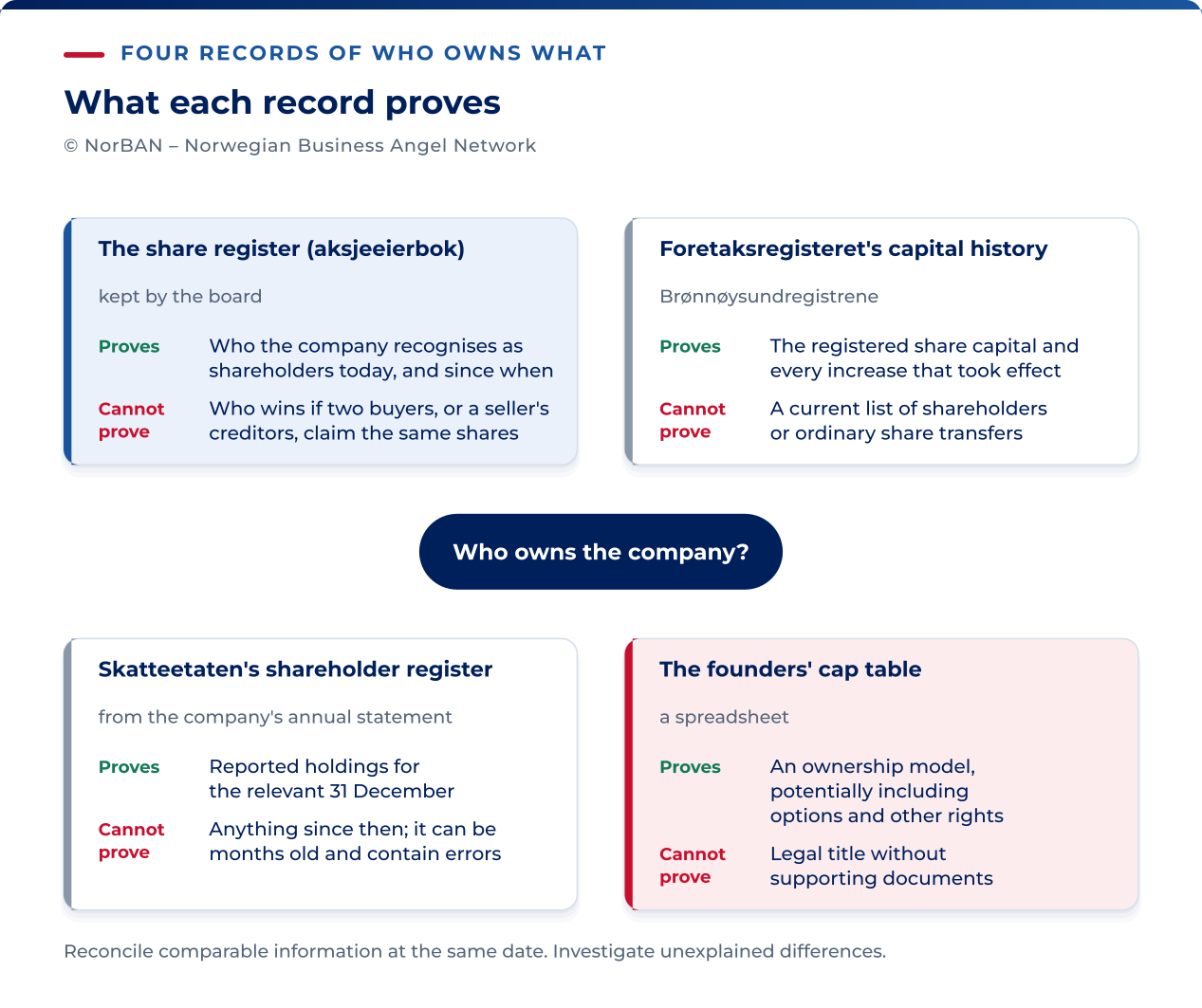
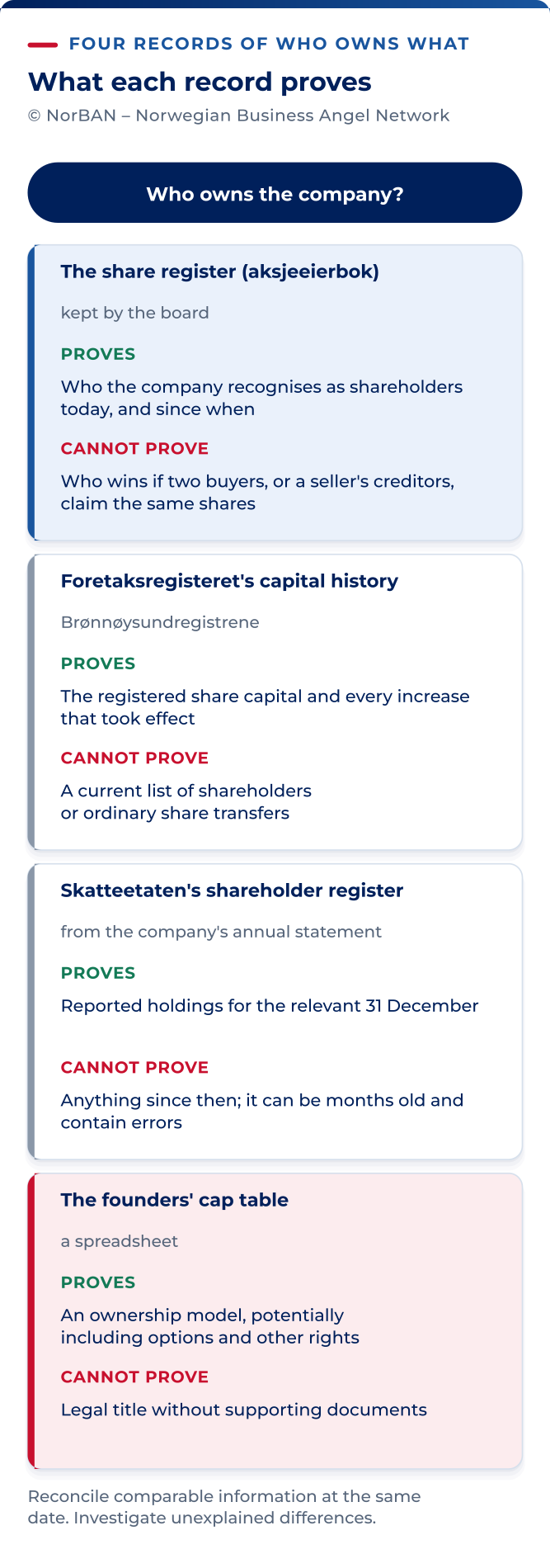
The Register of Business Enterprises (Foretaksregisteret) shows the registered share capital and every registered change. Skatteetaten’s shareholder register shows what the company reported at the last year end. Compare these with the other two ownership records, in this order.
- Pull the company certificate and the capital history from Brønnøysundregistrene. Note the registered share capital, the nominal value and every registered capital increase with its date.
- Demand the share register under aksjeloven § 4-6. Anyone may, and the regulation requires an electronic copy within three business days, free of charge. Ask for it dated, because entries must be.
- Multiply the shares in the register by the nominal value. The product must equal the registered share capital. A difference means a round exists in one place and not the other.
- Pull Skatteetaten’s shareholder register extract for the last year end, and compare holder by holder and class by class.
- Lay the founders’ cap table over the three, line by line, and list every difference with the founders’ explanation next to it.
| Source | What it proves | What it cannot prove |
|---|---|---|
| The company’s share register, kept by the board under aksjeloven § 4-5 | Who the company recognises as shareholders today, and since when. For existing shares, entry or a notified and documented acquisition not blocked by transfer restrictions generally permits exercise of rights, with exceptions for distributions and new-issue pre-emption under aksjeloven § 4-2 | Priority against a competing acquirer or a seller’s creditors, which turns on notice to the company under aksjeloven § 4-13. The historical ownership trail, which the access regulation withholds from outsiders |
| Foretaksregisteret’s capital history | The registered share capital and every capital increase that legally took effect. New shares confer rights from registration, unless the resolution provides otherwise, under aksjeloven § 10-11 | Who owns the shares. A transfer is never registered here and never appears on the company certificate |
| Skatteetaten’s shareholder register, built from the company’s own annual statement | Holders, share class and share count at the last 31 December, as the company reported them | Anything since the year end. The extract is opened the following May and can be many months stale, and Skatteetaten states that it may contain errors |
| The founders’ cap table | The founders’ understanding of the ownership, including promises made outside any document | Anything at all, until it agrees with the three above |
Reconcile discrepancies before drawing a conclusion. A holder missing from the share register may indicate a delayed entry, an unresolved transfer restriction or an error in the cap table. Under aksjeloven § 4-7, a notified and documented acquisition must be entered without delay unless consent or pre-emption prevents entry.
A capital increase in the cap table with no matching registration is a round that has not legally happened. A share class in the register or the Skatteetaten extract that the cap table does not show means the articles of association carry rights you have not read.
Some ownership risks appear only in the agreements. Ask for every shareholders’ agreement, side letter and loan document, and compare them with the register:
- Consent or pre-emption rights in an existing shareholders’ agreement can block your round until waived.
- An earlier round done at a lower price may carry price protection your price triggers.
- A convertible loan documented in an e-mail, or nowhere, is a claim on the equity that no register records.
The fully diluted position
The register tells you who owns the issued shares. The percentage you are pricing is the fully diluted one, after every instrument that can become shares has done so, and building that count is the last step of the reconciliation.
| Instrument | Where you find it | What the count needs |
|---|---|---|
| Options granted under a scheme | The scheme rules, each grant letter, the board minutes approving each grant | Number, strike, vesting and expiry per grant, and whether the exercise shares come from a registered board authorisation or a general-meeting resolution |
| Options promised outside a scheme | Employment contracts, offer letters, e-mails, the founders’ memory | A written list of every promise, signed by the founders, and a decision on whether each one is honoured, documented or withdrawn before closing |
| Warrants and subscription rights | The general-meeting resolution and the registration in Foretaksregisteret | Exercise price, number and expiry |
| Convertible loans (konvertibelt lån) | The loan agreement, the general-meeting resolution, the registration in Foretaksregisteret | Principal and accrued interest, discount, cap, the trigger for conversion, and what happens to it in your round |
| Advisor and consultant shares | Advisory agreements, board minutes | Whether they are issued, promised or vested, and what the advisor still owes |
| Side letters | Only from the company and the shareholders | Any right to shares, price protection or information that changes the count or your terms |
Some of these are registered facts. A convertible loan, a standing board authorisation to issue shares, and subscription rights are reported to Foretaksregisteret, and a convertible-loan resolution must be notified without delay once the amount is subscribed.
The register establishes the existence of these instruments. The discount, the cap, the strike and the holders sit in the agreements and the minutes you must request.
Delivery matters as much as the grant. An AS delivers shares on exercise or conversion through a capital increase, resolved by the general meeting or by the board under an authorisation that has been registered before the board uses it.
An option plan resting on an unregistered authorisation has no working delivery mechanism, and that is discovered at exercise unless you find it now.
Build the count in a table of your own: issued shares by holder, then each instrument converted at its own terms, then the shares your round adds. Dilution (utvanning) from an instrument that converts at a discount to your price falls on you as much as on the founders, so model it before you agree a pre-money.
Whether the resolutions behind each entry were validly taken, and what can be repaired, belongs to the legal workstream. This workstream establishes what the documents say exists.
Financial findings that move the price
Before negotiating, classify each finding by its effect on price, closing conditions or your assessment of the company. Include the classification when sending findings to the founders.
| Finding | Where it goes |
|---|---|
| A capital increase never registered, or an instrument that converts at a discount you did not model | The pre-money, or a condition that it is resolved before closing |
| An undocumented option or convertible promise | A condition to closing: honoured and documented, or withdrawn in writing, before money moves |
| A consent or pre-emption right in an existing shareholders’ agreement | A condition to closing: waived in writing by every holder |
| Runway shorter than the milestone the round is meant to reach | The round size, or the pre-money |
| A registered pledge, a guarantee or a grant condition the round triggers | A condition to closing, or a warranty with a specific indemnity |
| Tax, VAT or payroll arrears | A condition to closing that they are settled, and a warranty on the certificate’s date |
| Unaudited accounts, a founder loan properly documented, a stretched creditor | Information, priced into your view of the burn and the plan |
The first bin changes the price. The second stops the closing until fixed. The third is context for the terms and the first board meeting. How a written finding becomes a warranty, a condition or a price adjustment is the negotiation article’s subject.
Your role in the round determines how much work you do personally, but every investor should run the register checks.
- A follower pulls the company certificate, the capital history and the share register personally, runs the share-count arithmetic, and reads the lead’s fully diluted table against them. Those checks take an hour and depend on nobody.
- The lead holds the reconciliation, requests the agreements and the minutes, builds the fully diluted count and owns the findings list.
- An angel with a sector focus reads the burn against the plan knowing what the business should cost to run, and challenges the reforecast.
- A syndicate agrees before the request goes out who builds the fully diluted count, so one table exists and every member prices against it.