
Scoping the commercial workstream
The evaluation stage decided the commercial case was credible. The commercial workstream of due diligence (selskapsgjennomgang) tests that case against documents and the accounts of people who are not paid by anyone in the round. Start by writing down the three or four claims that made you want to invest, each as a statement that can be true or false.
“Customers renew because the product saves them a day a week” is testable. “Strong market pull” is too vague to test. A claim you cannot phrase as a testable statement is a claim you cannot verify, and it goes back to the founders as a question before the workstream opens.
Scale the hours to the investment. A round-filling ticket of 100,000 kroner justifies reading the lead’s findings, listening in on one or two customer calls, and checking the named customers in the public registers yourself. A lead-sized position carries the full set of calls, the pipeline reconciliation and the cohort data, and the lead owns the write-up.
In a syndicate, the member with sector experience owns this stream, because a customer will say things to someone who knows the trade that they will not say to a generalist. Agree the owner before the request list goes out, and keep one findings list.
Setting up customer reference calls
Reference calls can be the most useful hour in the process, but they are easy to mishandle. The common errors are asking for a testimonial, taking only the three names the founder chose, and reading a polite non-answer as approval.
Seraf’s published guidance on early-stage reference checking gives a usable structure. It distinguishes four types of check, two company-provided (personal and customer references) and two blind (personal references and potential customers reached through your own network), and recommends two or three calls of each type. Eight to twelve conversations of about thirty minutes is the sample Seraf describes. Treat it as their recommendation for a lead-sized position and scale it to your ticket.
Timing matters. Seraf’s advice is to leave customer calls until you are fairly sure you are going ahead, because intrusive investor questions can disturb a customer relationship the company depends on. Run them in the second half of diligence, after the documents have been read, with the founder’s knowledge.
Choose the people to call as carefully as the number of calls. The buyer who signed, the user who lives with the product and the budget holder who approves the renewal are three different people with three different views, and a founder’s list will contain the first and rarely the third. Ask for all three at the two largest accounts.
Get names beyond the founder’s list. Your own network, other NorBAN members in the sector, a LinkedIn search of the customer’s staff, and the customer’s procurement office all produce contacts the founder did not select. A blind call to a customer who declined to buy is worth two calls to a satisfied one.
Tell the customer plainly why you are calling. You are considering an investment, the founders know you are calling, the conversation is confidential, and it will take twenty minutes. Keep the explanation brief and respect the customer’s time.
Check the contractual limits on approaching customers, along with competition-law and data-protection requirements. Confidentiality clauses in the company’s own customer agreements bind the company, and they are why the founder controls the introduction.
Competition law can constrain information exchanges beyond a direct competitor call. Consider your portfolio, board roles and any route by which competitively sensitive information could reach another undertaking. Keep reference calls to the customer’s experience; do not seek confidential prices, capacity or future market plans. Konkurransetilsynet explains the risks of unlawful cooperation.
Calling a named contact is processing personal data. You need a lawful basis for the call under the Personal Data Act, as Datatilsynet sets out for any business, and the founder handing you the contact needs one for the disclosure.
What to ask a customer, and what the answers mean
Use the same script for every call so the deal team can compare notes. The purpose, in the phrase of Seraf’s customer-reference questionnaire, is to find out whether the company is selling “aspirin, oxygen or jewelry”, a critical need, an essential utility or a nice-to-have. The questions below are the customer-facing versions of what the founders were asked at evaluation.
| Question | A strong answer contains | A weak answer sounds like |
|---|---|---|
| How did you find the product, and who inside your company decided to buy? | A named channel, a named decision-maker, and a reason the decision was made when it was | “The founder knew someone here.” No decision-maker named. |
| What did you use before, and what did switching cost you? | A named alternative, including a spreadsheet or doing nothing, and a real switching cost that was worth paying | “Nothing really.” The product filled a gap nobody had felt. |
| What do you pay, and how was the price set? | A figure that matches the contract you have read, and a price the customer thinks is fair for the value | A discount, a free period, or a price the customer cannot remember. |
| What would make you stop using it? | A specific trigger, and a sense of what it would cost them to leave | “Nothing, we love it.” Enthusiasm without a reason. |
| Has the product changed how you work, and can you measure it? | A number: hours, errors, revenue, headcount | Adjectives. |
| Have you recommended it to anyone, and did they buy? | A name and an outcome | “I would if asked.” |
| What is the one thing you would change? | A concrete request, and evidence the company has been told | Silence, or a list long enough to suggest they are leaving. |
| Do you expect to renew, and who decides that? | A renewal date, a decision-maker, and a budget line | “Probably.” Renewal depends on someone the customer has not consulted. |
Hesitation or delayed calls leave a claim unresolved. Ask a specific follow-up and seek another source; the delay alone does not establish the customer’s intentions.
An unanswered reference call leaves an unresolved check. Ask about access constraints and seek another source before drawing a conclusion. Write up each completed call the same day, using the customer’s words where possible, and record what it establishes about the claim you tested.
Pipeline against signed agreements
The revenue in the model has to trace to paper. Take the model’s revenue lines for the current and next year and reconcile each to a signed agreement, an order, a delivered invoice or a paid invoice. Record unmatched amounts as pipeline: the founder’s forecast of purchases customers have yet to commit to.
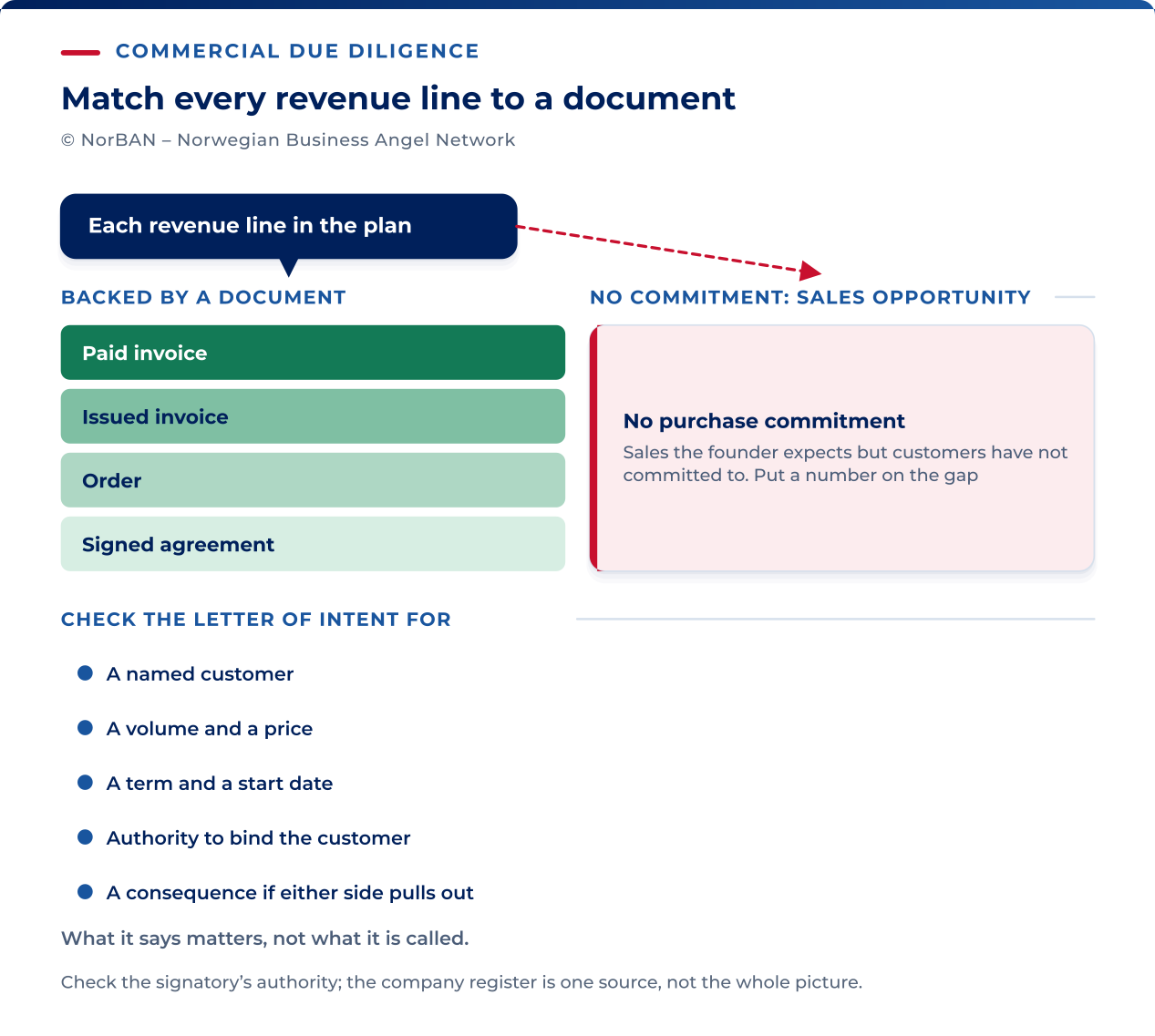
Framework agreements and letters of intent need particular care when a presentation treats them as revenue. Ordinary commercial contracts may bind without a formal signed document, but special form requirements can apply. A document’s title does not determine whether it is binding.
A letter of intent binds if its wording and context show an intention to be bound, and the label does not decide it. Read the Contracts Act as a backdrop and the document itself for the answer.
Read the terms to judge the document’s commercial value. Check the following points; a document missing most of them shows a willingness to discuss a purchase, with little evidence of commitment.
- A named counterparty, not a category of customer.
- A stated volume, a price or a pricing mechanism.
- A term and a start date.
- A signature from someone with authority to bind.
- A consequence for either side if it walks away.
Check the company certificate (firmaattest) and the signatory’s actual authority. Signature rights can bind the company broadly; prokura covers matters belonging to the operation of the business and is broader than the managing director’s ordinary day-to-day authority. It has statutory limits, including certain real-estate acts.
Registration under foretaksregisterloven § 3-4 is a starting point, not a substitute for checking the transaction and any joint-signature requirement.
| Reconciliation item | What to confirm |
|---|---|
| Revenue in the model, by customer | Each line matched to a signed agreement, order, or invoice, with the gap between model and paper stated as a number |
| Order backlog | Orders signed, dated, priced and not yet delivered, with the delivery dates inside the plan |
| Invoices issued and paid | Paid invoices for the last twelve months against the revenue claimed for the same period, and the debtor days |
| Framework agreements | Committed volume, if any, and the volume actually called off so far |
| Letters of intent | Named counterparty, volume or price, term, signatory authority, and any walk-away cost |
| Recent deals, last two quarters | The discount given against list price in each, and the direction of that discount over time |
| Contract terms | Term, notice period, termination for convenience, and any change-of-control clause your round would trigger |
The discount pattern in recent deals is an early margin signal. A company that closes each new customer at a deeper discount than the last is buying revenue, and the model’s gross margin has not noticed yet.
Retention, churn and concentration in the data
Ask for the cohort export, not the headline retention figure. A spreadsheet with one row per customer, the start date, the monthly revenue, and the end date if any, lets you compute retention yourself and see which cohort the headline was chosen from.
Agree the definitions before interpreting the figures. Agree with the founders what counts as a customer, what counts as lost, and whether churn (kundefrafall) is measured on customers or on revenue, and gross or net of expansion. Use the definitions from the business-model article, because a figure computed on different ones is not comparable to anything.
Check the renewal calendar against the runway. A company whose three largest contracts renew in the eight months your round is meant to fund has a different risk profile from one whose renewals fall after the next milestone, and the deck will not have said so.
Concentration is a finding on its own. The international accounting standard on segments requires disclosure once a single external customer reaches ten per cent of an entity’s revenue, and treats entities under common control as one customer.
That standard governs large reporting entities. Use it only as a reference point for where the accounting world starts to treat one customer as material.
A seed company that earns most of its revenue from one account depends heavily on that customer, however fast it is growing. Model the loss of the account before agreeing a price.
Testing the market case with third parties
Check the founders’ account of the market against independent people and records. Each source below answers a different part of it, and the register checks at the end are the cheapest and the least often done.
- Distributors and channel partners. Whether they carry the product, what share of their volume it is, and what the customer asks for that the product does not do.
- Industry buyers who did not buy. Why not, and what they bought instead. The best source is a procurement or category manager at a company on the founders’ target list.
- Former employees of competitors. What the competitor’s roadmap contains, and how long the window stays open before an incumbent adds the feature. Keep to what the person may lawfully tell you.
- Public procurement records. Doffin is the national database for Norwegian public procurement notices, so a claimed public-sector customer can be checked against contracts actually awarded.
- Register data on the customers themselves. Everything below is open to anyone and needs no request to the company.
| Register | What it tells you about a named customer |
|---|---|
| Foretaksregisteret and Enhetsregisteret | That the customer exists, its organisation number, address, board, and who holds signature and prokura |
| Regnskapsregisteret | The customer’s filed annual accounts, which size it against the founder’s description. Unaudited accounts are still filed |
| Konkursregisteret | Bankruptcy proceedings and disqualifications; commencements are announced publicly |
| Løsøreregisteret | Pledges over the customer’s operating assets and receivables, evidence of registered security, not proof of solvency or insolvency |
| Brønnøysundregistrene’s webshop | A confirmation that a business is not bankrupt, and a wider confirmation covering reconstruction and debt-settlement proceedings |
For a customer that accounts for a large share of revenue, check whether bankruptcy has been registered. That answers a narrow register question; assess current payment capacity separately using recent accounts, payment history and direct evidence.
A competitor’s roadmap tells you how long the window stays open. Ask the third parties which incumbent is closest, what it has announced, and how long a customer would wait for the incumbent’s version before switching. That answer sets how much of the plan the round has to fund before the advantage is tested.
Writing up the commercial findings
Turn the calls, the reconciliation and the register checks into one findings list the syndicate can act on. Each entry names the claim it tested, the evidence, and a verdict: confirmed, contradicted, or unresolved with what would settle it.
Identify the two or three findings that affect the price or terms, and specify the effect of each. A pipeline that reconciles to half the model’s revenue changes the pre-money. A renewal cluster inside the runway becomes a condition or a warranty.
An unanswered customer call leaves a gap: ask about access constraints and seek another source before drawing a conclusion.
Those marked items are what you carry into the negotiation of price, conditions and warranties. The rest is context for the first board meeting. How much of the work you do yourself depends on your role in the round.
- A follower reads the lead’s call notes and listens in on one or two calls, and runs the register checks on the top customers personally, because they take fifteen minutes and depend on nobody.
- The lead runs the full set of calls with one script, holds the reconciliation, and writes the findings list.
- An angel with a sector focus makes the blind calls through their own network, where the founder’s introduction is not needed and the answers are franker.
- A syndicate agrees before the request list goes out who owns the calls, so the customer is called once and the notes sit in one place.
Send the findings to the founders before the negotiation, with the unresolved items as questions. A founder who fixes the pipeline sheet within a day is telling you something; so is one who argues with the customer’s own account.